Building is quite doable, but the local conditions mean that exposed wood without nasty treatments is just generally doomed.
Dissertation on wood, plus stream of consciousness shit:
"Doomed" - well, that depends. What kills wood isn't the wet. It's the wet/dry cycle. Wood from the heyday of the US logging industry that has lain submerged in rivers for decades - well over a century - have been pulled up and found to be completely viable and are so valuable the wood brings a very high premium.
Also, the type of wood is very important. Some woods resist rot and insects better than others, and you have to do your due diligence. (Example: A popular alternative to standard fence posts around here are cedar logs - either they plant the trees in a line where they want the fence, let the trees grow up, top them at an angle and then tack wire to it - or they hammer cedar logs into the ground.)
Regardless of whatever you do, please try to stay away from "yellawood" - peanut butter soft yellow pine. It is utter shit and worse than useless. You use it thinking it will last (sort of) but you are rugpulling yourself/setting yourself up for failure. There were very durable, quality species of pines in the US (longleaf was one, as I recall) but they were over-harvested generations ago and are no longer used for home construction. There are efforts to bring them back though.
This might be TMI, but what lumber companies do is log out an area, sell off the best lumber to overseas sources like the Chinese (everyone else gets B and C grade stuff) then replant with fast(ish) growing yellow pines. Then they overwater and overfertilize them so they are forced to grow faster, resulting in the annular rings being very widely spaced and the strength/durability of the wood is compromised. When they are barely big enough for harvest, they are slab-sawn, kiln dried (but not normalized) and then banded.
But, because wood is a living thing, once it has a shape it always wants to return to that shape. That is all it wants to be. Banded, palletized wood looks straight but it wants to be something else. Once unbanded and the wood dries and normalizes, it will return to it's original shape - which is "not straight". This is compounded by the technique of slab sawing/live sawing. Wood that is the most dimensionally stable over time will be quarter sawn, where the annular rings run perpendicular to the width of the wood.
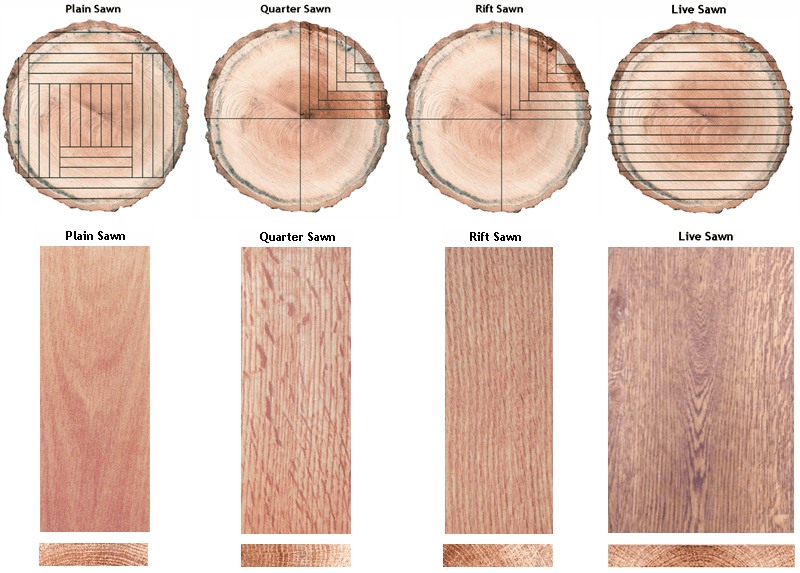
Quarter sawing lumber is "the right way" to do things, but it is not the most profitable, and lumber companies are all about profit.
Also, a 2x4 is not a 2x4. The sawblade they use is 1/8" thick, and they don't give anyone anything for free, so double that for two cuts for each dimension, and then subtract it. Which means your 2x4 is actually a 1 3/4" x 3 3/4" which has a direct impact on overall strength in tension, compression and shear.
If there is a lumber mill near you, and I hope there is, you can contract with them for your lumber and can be specific as to what species you want, the quality, the finish (you won't be needing S4S for framing a house), and the physical dimensions. Sometimes, lumber mills will be called up after big storms because the municipalities they are located in have a lot of old hardwood trees down. This is like finding gold in your backyard.
If you are in the US, you can go to any Big Box store and go to their Pro counter. If you have working drawings/blueprints, you can pay them for a materials list. For a fee, they will send off your working drawings and run it through their proprietary software which will estimate pretty closely what you will need for your building, including how many board feet of lumber you will be needing, hardware, etc. It will be a couple hundred dollars US for this.
Once you know what you need, you can upgrade the components. Hope some of this has helped you.


