Link/Archive
A pioneering operation will aim to drain fluid from the brain of a brown bear at a Kent wildlife park
Rhys Blakely, Science Correspondent
Saturday September 21 2024, 12.01am BST, The Times
In Borneo, Romain Pizzi became the first vet to remove an orangutan’s appendix using keyhole surgery. In Sierra Leone, he was first to use the same technique to fix a hernia for a chimpanzee.
And in the next few weeks Pizzi — who is based in Edinburgh and has been described by The Guardian as the “most versatile and inventive vet in the world” — will again break new ground by performing brain surgery on a brown bear.
Boki, two, was born at Port Lympne wildlife park in Kent after his parents were rescued from a circus in Spain. Rejected by the other bears at Port Lympne, he was moved to the Wildwood Trust near Canterbury. He was placed in an enclosure with two older males — Fluff and Scruff, who had been rescued from abysmal conditions in Bulgaria — and he had been doing well until six months ago, when he suffered a seizure and then had problems with his vision.
An MRI scan revealed a build-up of fluid inside his brain, known as hydrocephalus. The drugs that initially calmed his seizures have stopped working, so a decision has now been made to operate. This is in part because of the risk of the condition worsening when he enters a hibernation-like state of torpor over the winter.
The procedure to drain the fluid is expected to take several hours and is not without risk. “It’s the only viable option to make things better,” said Pizzi, who will operate free of charge.
Pizzi has a reputation for taking on cases that other vets will not. He was the first vet to perform keyhole gallbladder surgery on moon bears rescued from illegal bile farms in Vietnam. He has also devised a new way of amputating the injured legs of tarantulas, so they can regrow them when they next moult their skin, which happens every six to 18 months. Other patients have ranged from penguins and beavers, to giant tortoises, giraffes and a shark.
For Boki, the operation will involve making a small hole in the bear’s skull, near the top of his head. Using keyhole surgery — where instruments are inserted through very small incisions — a thin plastic tube will be inserted to drain the excess fluid. The tube will run under the skin, down to the abdomen, where the liquid should be absorbed harmlessly by the body.
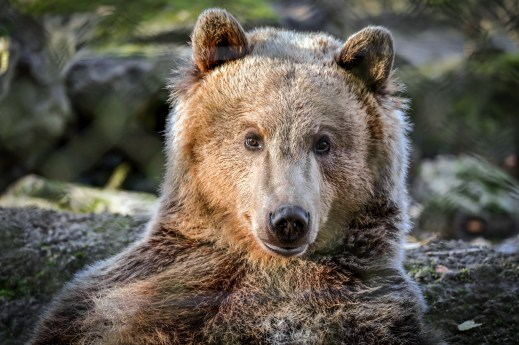
Boki has been described as an “extremely engaging bear”
THE WOODLAND TRUST
There is only one other record of the operation being performed on a bear — by Pizzi in 2012 in Lao, on a three-year-old Asiatic black bear called Champa who had gone blind. Champa’s brain had been badly damaged by the time of the operation but local laws would not allow her to be euthanised. The procedure was judged a success, restoring her sight and making her more comfortable.
Mark Habben, Wildwood’s director of zoo operations, said the decision to operate on Boki had been made because there was a good chance it would improve his quality of life.
“He’s an extremely engaging bear,” he added. “I don’t want to anthropomorphise too much, but I would say he’s been living an enriched and fulfilled life. He’s interested in everyone and everything. He likes people. He’s inquisitive, extremely intelligent and he’s very agile. For a 115kg bear, he scales trees at a phenomenal rate. And, of course, we want to see him back with Fluff and Scruff.”

A pioneering operation will aim to drain fluid from the brain of a brown bear at a Kent wildlife park
Rhys Blakely, Science Correspondent
Saturday September 21 2024, 12.01am BST, The Times
In Borneo, Romain Pizzi became the first vet to remove an orangutan’s appendix using keyhole surgery. In Sierra Leone, he was first to use the same technique to fix a hernia for a chimpanzee.
And in the next few weeks Pizzi — who is based in Edinburgh and has been described by The Guardian as the “most versatile and inventive vet in the world” — will again break new ground by performing brain surgery on a brown bear.
Boki, two, was born at Port Lympne wildlife park in Kent after his parents were rescued from a circus in Spain. Rejected by the other bears at Port Lympne, he was moved to the Wildwood Trust near Canterbury. He was placed in an enclosure with two older males — Fluff and Scruff, who had been rescued from abysmal conditions in Bulgaria — and he had been doing well until six months ago, when he suffered a seizure and then had problems with his vision.
An MRI scan revealed a build-up of fluid inside his brain, known as hydrocephalus. The drugs that initially calmed his seizures have stopped working, so a decision has now been made to operate. This is in part because of the risk of the condition worsening when he enters a hibernation-like state of torpor over the winter.
The procedure to drain the fluid is expected to take several hours and is not without risk. “It’s the only viable option to make things better,” said Pizzi, who will operate free of charge.
Pizzi has a reputation for taking on cases that other vets will not. He was the first vet to perform keyhole gallbladder surgery on moon bears rescued from illegal bile farms in Vietnam. He has also devised a new way of amputating the injured legs of tarantulas, so they can regrow them when they next moult their skin, which happens every six to 18 months. Other patients have ranged from penguins and beavers, to giant tortoises, giraffes and a shark.
For Boki, the operation will involve making a small hole in the bear’s skull, near the top of his head. Using keyhole surgery — where instruments are inserted through very small incisions — a thin plastic tube will be inserted to drain the excess fluid. The tube will run under the skin, down to the abdomen, where the liquid should be absorbed harmlessly by the body.
Boki has been described as an “extremely engaging bear”
THE WOODLAND TRUST
There is only one other record of the operation being performed on a bear — by Pizzi in 2012 in Lao, on a three-year-old Asiatic black bear called Champa who had gone blind. Champa’s brain had been badly damaged by the time of the operation but local laws would not allow her to be euthanised. The procedure was judged a success, restoring her sight and making her more comfortable.
Mark Habben, Wildwood’s director of zoo operations, said the decision to operate on Boki had been made because there was a good chance it would improve his quality of life.
“He’s an extremely engaging bear,” he added. “I don’t want to anthropomorphise too much, but I would say he’s been living an enriched and fulfilled life. He’s interested in everyone and everything. He likes people. He’s inquisitive, extremely intelligent and he’s very agile. For a 115kg bear, he scales trees at a phenomenal rate. And, of course, we want to see him back with Fluff and Scruff.”


