L | A
By Stephen Evans
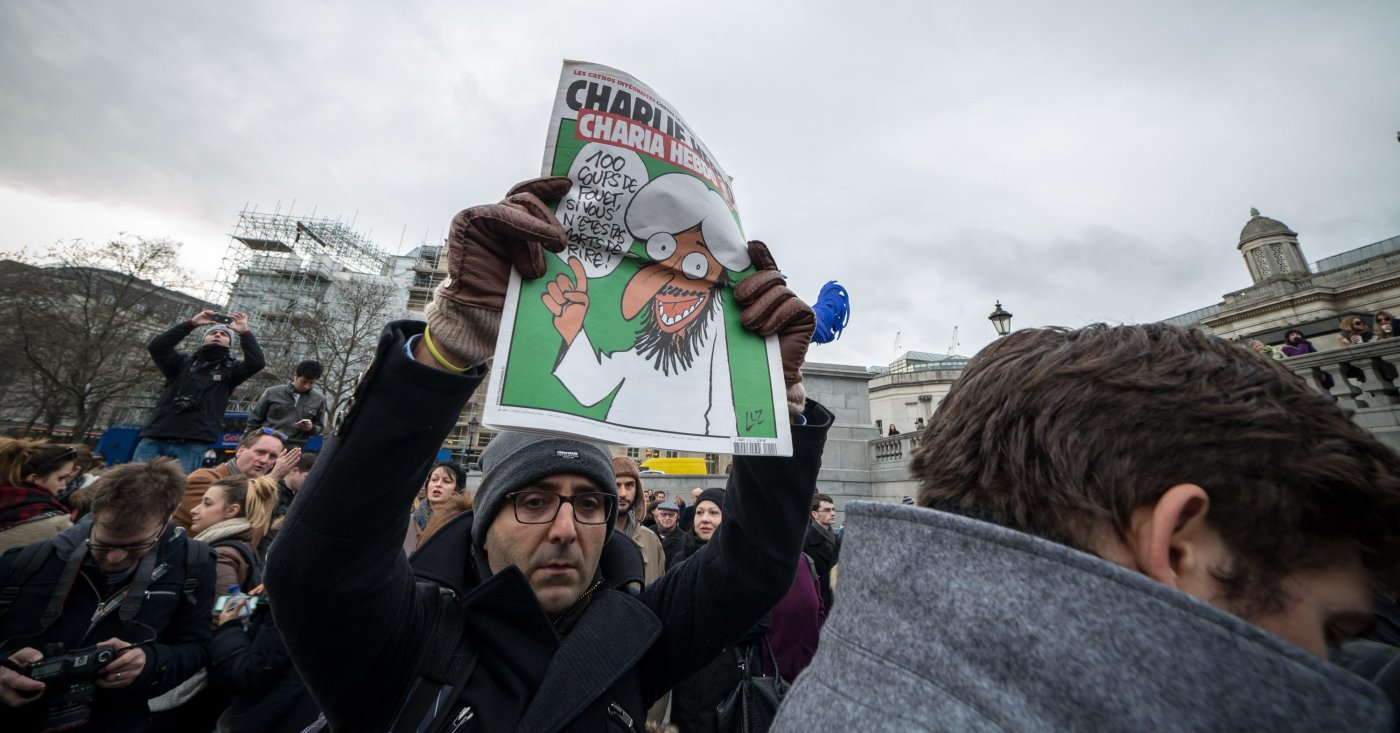
International Blasphemy Day, 30 September, was created "to remind the world that religion should never again be beyond open and honest discussion".
It was established after the publication in 2005 of 12 cartoons depicting Islam's prophet Muhammad by the Danish newspaper Jyllands-Posten led to worldwide riots. The founders wanted to "dismantle the wall which exists between religion and criticism".
The wall, however, remains very much intact.
Earlier this month, police in southern Pakistan shot dead Shah Nawaz, a doctor accused of insulting Muhammad and sharing blasphemous content on social media. The police officers involved were reportedly applauded and showered with rose petals by local residents.
Under Pakistan's blasphemy laws, anyone found guilty of insulting Islam or Islamic religious figures can be sentenced to death. But those accused are often subjected to mob lynching or extra-judicial killing before their cases get to trial.
Shah Nawaz was the second blasphemy suspect in Pakistan to be shot dead by police in the space of a week.
Pakistan is just one of around 70 countries that still have blasphemy laws. Penalties for violating them vary. But as with Pakistan, in Afghanistan, Iran, Nigeria, Saudi Arabia and Somalia, the maximum punishment for blasphemy is death.
The spread of Enlightenment values in Europe significantly diminished the concept of blasphemy, heralding greater freedoms to exercise critical thought, and subject religious dogmas to question and ridicule. Concerns about blasphemy were largely confined to fringe Christian groups.
But growing Muslim populations across the continent has sparked the resurgence of this concept, with debates around cultural sensitivity, social cohesion and the limits of freedom of expression challenging long-held secular liberal values.
Just last year Denmark banned the "inappropriate treatment" of religious texts - with a bill widely known in the country as the 'Quran law', following a series of burnings of Islam's holy book that led to uproar in Islamic countries.
The Rushdie affair reawakened the concept of blasphemy in the UK during the late eighties, and ever since we've struggled to assert the right to free expression around religion.
The common law offences of blasphemy and blasphemous libel (which protected only Christianity) were eventually abolished in England and Wales in 2008, and in Scotland in 2021. In both cases they were replaced by hate crime legislation, which for some, was intended to expand restrictions on speech to protect the feelings and beliefs of Muslims and other minority religions, too.
A coalition of secularists and other free speech defenders had to win a hard-fought campaign to secure a vital freedom of expression clause that ensured expressions of "antipathy, dislike, ridicule or insult towards" religion was explicitly protected.
But like in Pakistan, the wall which exists between religion and criticism is increasingly reinforced by threats, intimidation and violence.
According to a recent report from the UK Commission for Countering Extremism, "anti-blasphemy activism in the UK is gaining momentum and showing signs of becoming increasingly radicalised".
We saw evidence of this in 2016 when shopkeeper Asad Shah, an Ahmadi Muslim, was stabbed to death outside his store by an assailant who claimed he had "disrespected" Islam.
We saw it in Batley in 2021 when a teacher was forced into hiding in fear of his life after using a cartoon of Muhammad to teach about freedom of expression.
We saw it again that same year when Christian evangelist Hatun Tash was stabbed at Hyde Park's Speakers' Corner after preaching while wearing a Charlie Hebdo t-shirt.
We saw it again when nationwide screenings of "The Lady of Heaven" were cancelled amid concern for staff and customer safety after Muslim protestors outside cinemas branded it blasphemous.
And we saw it again in the pandering, panicked response to an incident at a Kettlethorpe School where a Quran was allegedly scuffed.
Blasphemy codes are remnants of medieval thought, designed to enforce conformity to religious dogmas and suppress dissent. They stand in stark contrast to the values of tolerance, pluralism, and critical thinking that modern Britain should be a standard bearer for.
Engaging in acts of blasphemy — whether through speech, art, or written word — serves as a powerful catalyst for questioning authoritarian doctrines, challenging the subjugation of women and securing individual freedoms. It is therefore incumbent on all of us to unapologetically assert these values.
That means resisting the temptation to appease those who use intimidation and threats to enforce their beliefs when blasphemy flashpoints occur, and instead defending and supporting the victims of fundamentalist bullies by being clear that free expression is fundamental to a free society.
It also means legislators in Northern Ireland abolishing the last remaining blasphemy laws on the books in the UK.
And it also means taking a principled stance against the de facto blasphemy code created by the concept of 'Islamophobia'.
Opposing the adoption of a contentious Islamophobia definition isn't to reject the idea that anti-Muslim hate doesn't need to be addressed. It does. But we need clear thinking and clear language that distinguishes between people and beliefs.
Islamophobia and other 'religion-phobia' language clearly fails to do so. It's perfectly possible to tackle discrimination and hatred against people based on their religion, while being very clear that everyone has the right to criticise and express contempt for any religion and the ideas, beliefs, and practices of those professing it.
Some people may find a lack of reverence towards what they hold sacred offensive. That's their right. But being offended from time to time is a price worth paying for living in a free society. Being offensive is not, in and of itself, a criminal offence. Being rude about religion isn't incitement to hatred and shouldn't be regarded as a justification for violence.
Blasphemous acts may seem trivial at times, yet they are profoundly significant, propelling societies forward. Giving succour to theocrats who want them punished again will only drag us backwards.
It's time blasphemy was more widely recognised as the vital driver of progress and personal autonomy that it is. So, this Blasphemy Day, let's celebrate and recognise blasphemy's role in winning the democratic rights and freedoms we enjoy, and support those living under regimes where those freedoms are so brutally repressed.
By Stephen Evans
International Blasphemy Day, 30 September, was created "to remind the world that religion should never again be beyond open and honest discussion".
It was established after the publication in 2005 of 12 cartoons depicting Islam's prophet Muhammad by the Danish newspaper Jyllands-Posten led to worldwide riots. The founders wanted to "dismantle the wall which exists between religion and criticism".
The wall, however, remains very much intact.
Earlier this month, police in southern Pakistan shot dead Shah Nawaz, a doctor accused of insulting Muhammad and sharing blasphemous content on social media. The police officers involved were reportedly applauded and showered with rose petals by local residents.
Under Pakistan's blasphemy laws, anyone found guilty of insulting Islam or Islamic religious figures can be sentenced to death. But those accused are often subjected to mob lynching or extra-judicial killing before their cases get to trial.
Shah Nawaz was the second blasphemy suspect in Pakistan to be shot dead by police in the space of a week.
Pakistan is just one of around 70 countries that still have blasphemy laws. Penalties for violating them vary. But as with Pakistan, in Afghanistan, Iran, Nigeria, Saudi Arabia and Somalia, the maximum punishment for blasphemy is death.
The spread of Enlightenment values in Europe significantly diminished the concept of blasphemy, heralding greater freedoms to exercise critical thought, and subject religious dogmas to question and ridicule. Concerns about blasphemy were largely confined to fringe Christian groups.
But growing Muslim populations across the continent has sparked the resurgence of this concept, with debates around cultural sensitivity, social cohesion and the limits of freedom of expression challenging long-held secular liberal values.
Just last year Denmark banned the "inappropriate treatment" of religious texts - with a bill widely known in the country as the 'Quran law', following a series of burnings of Islam's holy book that led to uproar in Islamic countries.
The Rushdie affair reawakened the concept of blasphemy in the UK during the late eighties, and ever since we've struggled to assert the right to free expression around religion.
The common law offences of blasphemy and blasphemous libel (which protected only Christianity) were eventually abolished in England and Wales in 2008, and in Scotland in 2021. In both cases they were replaced by hate crime legislation, which for some, was intended to expand restrictions on speech to protect the feelings and beliefs of Muslims and other minority religions, too.
A coalition of secularists and other free speech defenders had to win a hard-fought campaign to secure a vital freedom of expression clause that ensured expressions of "antipathy, dislike, ridicule or insult towards" religion was explicitly protected.
But like in Pakistan, the wall which exists between religion and criticism is increasingly reinforced by threats, intimidation and violence.
According to a recent report from the UK Commission for Countering Extremism, "anti-blasphemy activism in the UK is gaining momentum and showing signs of becoming increasingly radicalised".
We saw evidence of this in 2016 when shopkeeper Asad Shah, an Ahmadi Muslim, was stabbed to death outside his store by an assailant who claimed he had "disrespected" Islam.
We saw it in Batley in 2021 when a teacher was forced into hiding in fear of his life after using a cartoon of Muhammad to teach about freedom of expression.
We saw it again that same year when Christian evangelist Hatun Tash was stabbed at Hyde Park's Speakers' Corner after preaching while wearing a Charlie Hebdo t-shirt.
We saw it again when nationwide screenings of "The Lady of Heaven" were cancelled amid concern for staff and customer safety after Muslim protestors outside cinemas branded it blasphemous.
And we saw it again in the pandering, panicked response to an incident at a Kettlethorpe School where a Quran was allegedly scuffed.
Blasphemy codes are remnants of medieval thought, designed to enforce conformity to religious dogmas and suppress dissent. They stand in stark contrast to the values of tolerance, pluralism, and critical thinking that modern Britain should be a standard bearer for.
Engaging in acts of blasphemy — whether through speech, art, or written word — serves as a powerful catalyst for questioning authoritarian doctrines, challenging the subjugation of women and securing individual freedoms. It is therefore incumbent on all of us to unapologetically assert these values.
That means resisting the temptation to appease those who use intimidation and threats to enforce their beliefs when blasphemy flashpoints occur, and instead defending and supporting the victims of fundamentalist bullies by being clear that free expression is fundamental to a free society.
It also means legislators in Northern Ireland abolishing the last remaining blasphemy laws on the books in the UK.
And it also means taking a principled stance against the de facto blasphemy code created by the concept of 'Islamophobia'.
Opposing the adoption of a contentious Islamophobia definition isn't to reject the idea that anti-Muslim hate doesn't need to be addressed. It does. But we need clear thinking and clear language that distinguishes between people and beliefs.
Islamophobia and other 'religion-phobia' language clearly fails to do so. It's perfectly possible to tackle discrimination and hatred against people based on their religion, while being very clear that everyone has the right to criticise and express contempt for any religion and the ideas, beliefs, and practices of those professing it.
Some people may find a lack of reverence towards what they hold sacred offensive. That's their right. But being offended from time to time is a price worth paying for living in a free society. Being offensive is not, in and of itself, a criminal offence. Being rude about religion isn't incitement to hatred and shouldn't be regarded as a justification for violence.
Blasphemous acts may seem trivial at times, yet they are profoundly significant, propelling societies forward. Giving succour to theocrats who want them punished again will only drag us backwards.
It's time blasphemy was more widely recognised as the vital driver of progress and personal autonomy that it is. So, this Blasphemy Day, let's celebrate and recognise blasphemy's role in winning the democratic rights and freedoms we enjoy, and support those living under regimes where those freedoms are so brutally repressed.
