BY EDWARD ROBERT MCCLELLAND
ILLUSTRATION BY NICK LU
MARCH 22, 2023, 12:14 PM
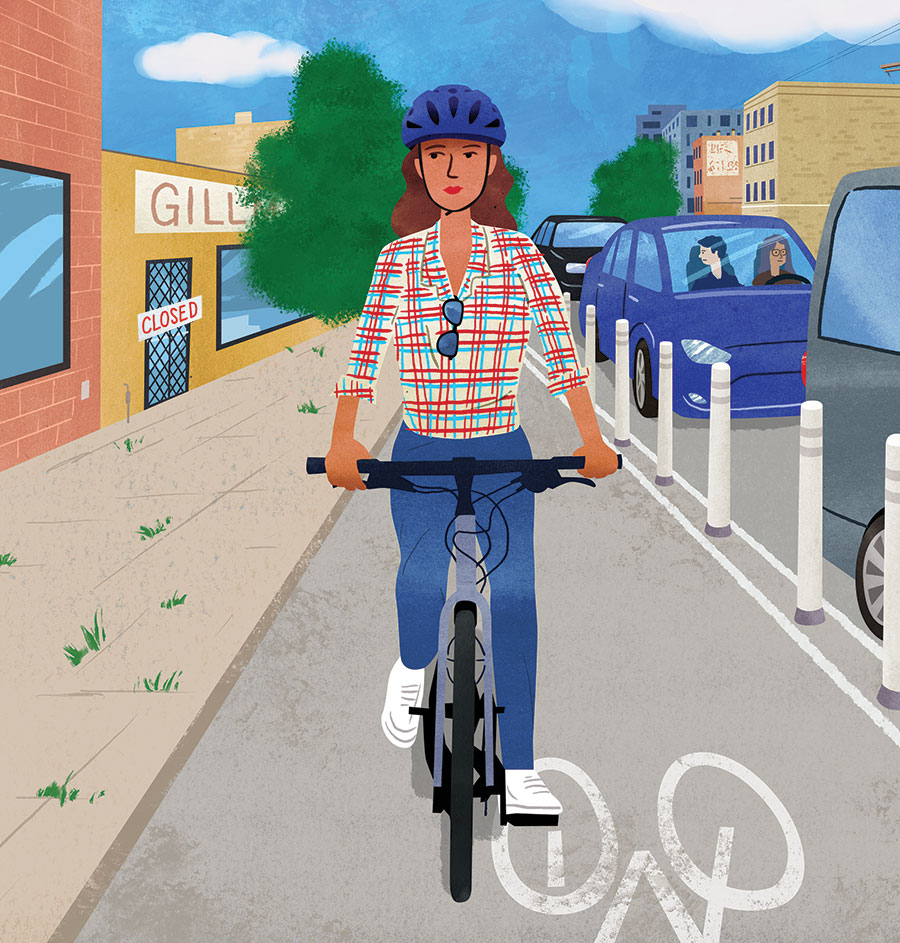
Gillman’s Ace Hardware, on Milwaukee Avenue in Logan Square, was a relic of an older Chicago. Opened in 1948, when the neighborhood was primarily Polish, Jewish, and German, Gillman’s sold hammers, nails, keys, and caulk for generations, thriving through the influx of Latinos, then “artists and tech people,” as owner Alan Gillman, whose father and uncle founded the business, puts it. A hand-lettered sign read “Asile #3: Light Fixtures, Fuses, Brakers, Screws.” Despite the misspellings, Gillman kept the sign up. It gave the store character.
Gillman’s plans to close by end of this month, unable, its owner says, to survive an innovation of a newer Chicago: protected bike lanes. In October 2020, the city installed plastic bollards in front of the shop, which is on a section of Milwaukee designated by the Chicago Department of Transportation as a “high-crash corridor,” with a disproportionate number of injury-causing collisions involving cars, bikes, or pedestrians. The bollards blocked off parking on Gillman’s side of the street. A year in, Gillman began noticing a decline in sales. “I had customers calling, saying, ‘Al, I’d like to patronize you, but there’s nowhere to park.’ ” They were driving to Menards, he says, rather than schlepping a 60-pound bucket of paint a few blocks.
Businesses have complained about protected bike lanes since they were first installed in 2011 by Mayor Rahm Emanuel, an avid cyclist who promised to make Chicago the nation’s “most bike-friendly city.” But the city has gotten more serious about the program, as cyclists demand safer streets in response to a series of fatal collisions, including one last June that killed 3-year-old Lily Grace Shambrook. By the end of this year, CDOT plans to install concrete barriers on the existing 41.8 miles of protected lanes and to add even more lanes.
In principle, no one is opposed to this practice — who can be against safer cycling? — but merchants complain the barriers are going in without their input and without plans to replace the parking spaces they eliminate.
Three months after George Bumbaris opened George’s Deep Dish on Clark Street in Edgewater in May 2021, protected lanes cut 12 spaces in front of his takeout pizzeria. “I have a lot of customers who stopped coming because they have nowhere to park,” he says. With the help of 48th Ward alderman Harry Osterman’s office, Bumbaris rented two 15-minute spaces around the corner on Thome Avenue, for $1,100 a year, but they’re often illegally occupied, he says. He estimates business is down 10 to 20 percent, and is considering moving.
Despite Bumbaris’s misgivings, Osterman thinks the protected lanes will boost business on that stretch of Clark Street. “I’m a big believer that when you add bike infrastructure, it makes streets more pedestrian friendly, which will lead to more commerce,” he says. (One Clark Street business that has benefited: Gary’s Cycle Shop, a block from Bumbaris’s pizzeria. “It’s been a bit of an advantage for us,” says owner Richard Kerwer.)
Backing Osterman’s contention: a Portland State University study of several cities that found adding bike infrastructure “either had positive or nonsignificant impacts on corridor employment and sales.” New York City says that after it replaced parking spaces with bike lanes on a street in Queens, area business sales increased 12 percent.
That’s because cyclists travel slowly enough to notice businesses and can easily stop to patronize them, say bicycle advocates. If small businesses are feeling a dip, Amazon is the more likely culprit, says Jim Merrell, managing director of advocacy for the Active Transportation Alliance: “I don’t think anyone would say Milwaukee Avenue is a dead zone.”
Andersonville may be the next battleground. With its walkable strip of bars and boutiques, Andersonville would seem a natural to benefit from protected bike lanes, yet businesses there have reservations. In January, the city held a virtual public meeting for Clark Street Crossroads, a proposal to improve the one-mile stretch of Clark between Montrose and Foster Avenues. The suggested changes include installing a protected lane and moving all parking to the street’s west side. During the meeting, Chicago Department of Planning and Development commissioner Maurice Cox noted that the lane is “at the top of the list” but the department will be “talking to businesses along this corridor and finding out what they need.”
The Andersonville Chamber of Commerce is leery, especially after hearing grousing farther north on Clark, where barriers have already gone in. “We get a lot of calls from the businesses there that it’s destroying their business,” says the chamber’s director of business services, David Oakes. “You have to look at the whole ecosystem before putting in bollards and concrete.”
Whatever their effect on business, protected bike lanes are making Chicago safer, and not just for cyclists. Since bollards and curb extensions were installed on Milwaukee, and the speed limit was reduced, collisions have decreased 56 percent, according to CDOT. Nonetheless, Logan Square businesses are playing a more assertive role in plans for future lanes, says Nilda Esparza, director of the Logan Square Chamber of Commerce. This winter, adding a protected lane on California Avenue between North and Diversey was the top vote-getter on the 1st Ward’s participatory budgeting ballot, which allows constituents to weigh in on how to spend $1.5 million earmarked for infrastructure. Chamber officials made regular visits to stores on California “to ensure we inform our operators of these installation plans early so they’re heard and can participate in this process,” Esparza says.
She adds: “While statistics show bike lanes do stir foot traffic, some of our small business operators don’t have the luxury of having this play out for them. Some businesses experienced a 30 percent dip in sales after protected bike lanes were installed near the hardware store.”
Even if protected bike lanes do bring in more customers, that doesn’t mean they’ll be good for every business. Whenever a city changes, there are winners and losers. A neighborhood hardware store, already an atavism, turned out to be a casualty of what a planning official called “a mode shift away from a reliance on private vehicles.”
Still, Gillman thinks it must be possible to accommodate both bikers and businesses. “To take someone’s food off their table,” he laments. “They could have narrowed the sidewalks. They could have had those bike lanes going down side streets. My dad always said, ‘No matter what, recession, depression, we’ll still be able to eat.’ Then came bike lanes.”
Source (Archive)
ILLUSTRATION BY NICK LU
MARCH 22, 2023, 12:14 PM
Gillman’s Ace Hardware, on Milwaukee Avenue in Logan Square, was a relic of an older Chicago. Opened in 1948, when the neighborhood was primarily Polish, Jewish, and German, Gillman’s sold hammers, nails, keys, and caulk for generations, thriving through the influx of Latinos, then “artists and tech people,” as owner Alan Gillman, whose father and uncle founded the business, puts it. A hand-lettered sign read “Asile #3: Light Fixtures, Fuses, Brakers, Screws.” Despite the misspellings, Gillman kept the sign up. It gave the store character.
Gillman’s plans to close by end of this month, unable, its owner says, to survive an innovation of a newer Chicago: protected bike lanes. In October 2020, the city installed plastic bollards in front of the shop, which is on a section of Milwaukee designated by the Chicago Department of Transportation as a “high-crash corridor,” with a disproportionate number of injury-causing collisions involving cars, bikes, or pedestrians. The bollards blocked off parking on Gillman’s side of the street. A year in, Gillman began noticing a decline in sales. “I had customers calling, saying, ‘Al, I’d like to patronize you, but there’s nowhere to park.’ ” They were driving to Menards, he says, rather than schlepping a 60-pound bucket of paint a few blocks.
Businesses have complained about protected bike lanes since they were first installed in 2011 by Mayor Rahm Emanuel, an avid cyclist who promised to make Chicago the nation’s “most bike-friendly city.” But the city has gotten more serious about the program, as cyclists demand safer streets in response to a series of fatal collisions, including one last June that killed 3-year-old Lily Grace Shambrook. By the end of this year, CDOT plans to install concrete barriers on the existing 41.8 miles of protected lanes and to add even more lanes.
In principle, no one is opposed to this practice — who can be against safer cycling? — but merchants complain the barriers are going in without their input and without plans to replace the parking spaces they eliminate.
Three months after George Bumbaris opened George’s Deep Dish on Clark Street in Edgewater in May 2021, protected lanes cut 12 spaces in front of his takeout pizzeria. “I have a lot of customers who stopped coming because they have nowhere to park,” he says. With the help of 48th Ward alderman Harry Osterman’s office, Bumbaris rented two 15-minute spaces around the corner on Thome Avenue, for $1,100 a year, but they’re often illegally occupied, he says. He estimates business is down 10 to 20 percent, and is considering moving.
Despite Bumbaris’s misgivings, Osterman thinks the protected lanes will boost business on that stretch of Clark Street. “I’m a big believer that when you add bike infrastructure, it makes streets more pedestrian friendly, which will lead to more commerce,” he says. (One Clark Street business that has benefited: Gary’s Cycle Shop, a block from Bumbaris’s pizzeria. “It’s been a bit of an advantage for us,” says owner Richard Kerwer.)
Backing Osterman’s contention: a Portland State University study of several cities that found adding bike infrastructure “either had positive or nonsignificant impacts on corridor employment and sales.” New York City says that after it replaced parking spaces with bike lanes on a street in Queens, area business sales increased 12 percent.
That’s because cyclists travel slowly enough to notice businesses and can easily stop to patronize them, say bicycle advocates. If small businesses are feeling a dip, Amazon is the more likely culprit, says Jim Merrell, managing director of advocacy for the Active Transportation Alliance: “I don’t think anyone would say Milwaukee Avenue is a dead zone.”
Andersonville may be the next battleground. With its walkable strip of bars and boutiques, Andersonville would seem a natural to benefit from protected bike lanes, yet businesses there have reservations. In January, the city held a virtual public meeting for Clark Street Crossroads, a proposal to improve the one-mile stretch of Clark between Montrose and Foster Avenues. The suggested changes include installing a protected lane and moving all parking to the street’s west side. During the meeting, Chicago Department of Planning and Development commissioner Maurice Cox noted that the lane is “at the top of the list” but the department will be “talking to businesses along this corridor and finding out what they need.”
The Andersonville Chamber of Commerce is leery, especially after hearing grousing farther north on Clark, where barriers have already gone in. “We get a lot of calls from the businesses there that it’s destroying their business,” says the chamber’s director of business services, David Oakes. “You have to look at the whole ecosystem before putting in bollards and concrete.”
Whatever their effect on business, protected bike lanes are making Chicago safer, and not just for cyclists. Since bollards and curb extensions were installed on Milwaukee, and the speed limit was reduced, collisions have decreased 56 percent, according to CDOT. Nonetheless, Logan Square businesses are playing a more assertive role in plans for future lanes, says Nilda Esparza, director of the Logan Square Chamber of Commerce. This winter, adding a protected lane on California Avenue between North and Diversey was the top vote-getter on the 1st Ward’s participatory budgeting ballot, which allows constituents to weigh in on how to spend $1.5 million earmarked for infrastructure. Chamber officials made regular visits to stores on California “to ensure we inform our operators of these installation plans early so they’re heard and can participate in this process,” Esparza says.
She adds: “While statistics show bike lanes do stir foot traffic, some of our small business operators don’t have the luxury of having this play out for them. Some businesses experienced a 30 percent dip in sales after protected bike lanes were installed near the hardware store.”
Even if protected bike lanes do bring in more customers, that doesn’t mean they’ll be good for every business. Whenever a city changes, there are winners and losers. A neighborhood hardware store, already an atavism, turned out to be a casualty of what a planning official called “a mode shift away from a reliance on private vehicles.”
Still, Gillman thinks it must be possible to accommodate both bikers and businesses. “To take someone’s food off their table,” he laments. “They could have narrowed the sidewalks. They could have had those bike lanes going down side streets. My dad always said, ‘No matter what, recession, depression, we’ll still be able to eat.’ Then came bike lanes.”
Source (Archive)


