https://www.newsweek.com/beef-prices-all-time-high-tariffs-2112771
https://archive.ph/7W8fX
Beef prices surged to an all-time high in July as the market grappled with consistently strong demand and long-term issues in domestic production.
According to the latest consumer price index, which the Bureau of Labor Statistics published on Tuesday, the beef and veal index rose by 2.5 percent in July, compared to 0.2 percent for the broader food category. This capped an 11.3 percent increase over the past 12 months.
Meanwhile, the price of ground beef and uncooked beef steaks has risen by 11.5 and 12.4 percent, respectively, both now at record levels.
These figures represent raw price changes rather than seasonally adjusted figures and have not been modified to remove predictable price patterns.
The unadjusted 11.3 percent increase seen for all beef and veal products compares to a 5.8 percent jump for the general meats category, 3.3 percent for chicken and 1.1 percent for pork.
The issue of rising beef prices in the U.S. has long been on the radar of policymakers and agricultural experts, who largely attribute this to declining cattle herds that are incapable of meeting demand, as well as a growing reliance on imports and periodic battles with adverse weather.
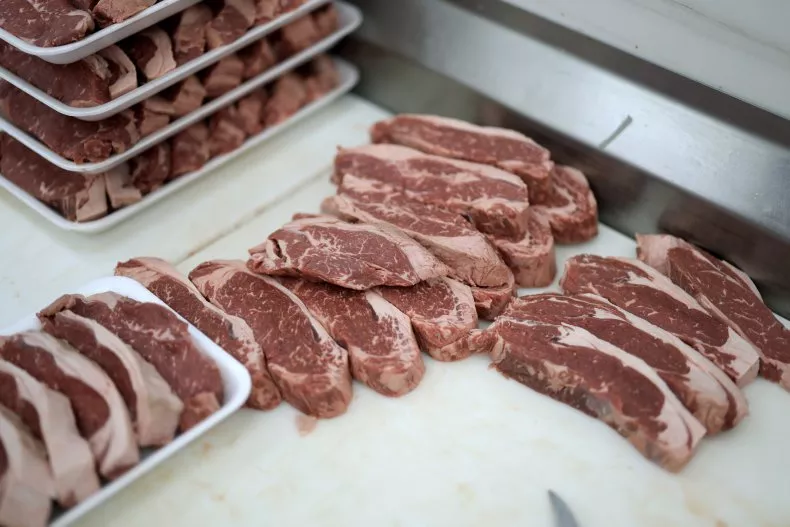
"Everybody likes a good hamburger and steak," agricultural economist David P. Anderson told Newsweek. "It's that demand growth coupled with tighter supplies that push prices higher."
According to the latest cattle inventory calculations from the U.S. Department of Agriculture (USDA), there were 94.2 million head of cattle and calves on U.S. farms as of July 1, of which 28.7 million were beef cattle. This compares to 94.4 million and 31.3 million in January 2020.
In a monthly report released on Tuesday, the USDA forecast that the total beef supply in the U.S. would drop to 31.1 billion pounds by August 2026, the lowest level since 2019.
Derrell Peel, a professor of agribusiness at Oklahoma State University, previously told Newsweek that since 2020, droughts in major beef-producing areas—alongside inflation, grain prices and rising interest rates—had driven up the cost of cattle farming and pushed many producers to trim their herds.
Years of price hikes have also made the U.S. a more attractive market for foreign producers and increased the country's overall reliance on beef imports. However, the recent imposition of tariffs on exporting nations threatens to impair the ability of foreign-sourced beef to soften the blow of rising prices.
The top sources of imported beef are Australia, Canada, Mexico, New Zealand and Brazil, according to the USDA. While beef originating from Canada and Mexico is currently exempt under the U.S.-Canada-Mexico Agreement, Brazil—which has accounted for about 15 percent of U.S. beef imports in 2025—has been slapped with a 50 percent tariff on all goods coming into the U.S.
According to a recent USDA report, total beef imports are expected to drop 6.1 percent to 4.95 billion pounds by August of next year. In its forecasts, the department said the decline reflected "reported trade data through the first half of the year, as well as reduced shipments due to higher tariff rates, particularly from Brazil."
Agricultural economist Derrell Peel previously told Newsweek: "It might be at least two to three years before we would see any significant change on the supply side that would ultimately lead to some moderation in beef prices."
Agricultural economist David P. Anderson told Newsweek: "In the big picture, there is not much relief in sight as long as supplies are tight and consumers keep buying. High prices are the cure for high prices because they are the signal for ranchers to try to expand their herds. If some herd expansion begins, it will still be a couple years before that increases beef production."
Colin Carter, a professor of agricultural and resource economics at UC Davis, told Newsweek in July: "Due to reduced domestic cattle numbers and record-high beef prices, the percentage of imported beef in the U.S. supply has risen significantly in the past few years. This is especially true for imports used for ground beef as U.S. cow slaughter numbers have declined."
He added: "The Trump administration has increased tariffs on imported beef, and this will serve to further raise the price of beef at the food store."
https://archive.ph/7W8fX
Beef prices surged to an all-time high in July as the market grappled with consistently strong demand and long-term issues in domestic production.
According to the latest consumer price index, which the Bureau of Labor Statistics published on Tuesday, the beef and veal index rose by 2.5 percent in July, compared to 0.2 percent for the broader food category. This capped an 11.3 percent increase over the past 12 months.
Meanwhile, the price of ground beef and uncooked beef steaks has risen by 11.5 and 12.4 percent, respectively, both now at record levels.
Why It Matters
The rising cost of staple agricultural goods such as beef and eggs has put additional strain on Americans' budgets this year. While the latter has moderatedafter breaking records in February, shrinking cattle herds continue to weigh heavily on the price of the former. Given the long-term remedies required to address inventory issues, and the prospect of new import taxes threatening to further trim the overall supply in the U.S., experts have told Newsweek that it could be years before prices return to more affordable levels for consumers.What To Know
Average ground beef prices rose to a record $6.34 per pound in July, while uncooked beef steaks also reached an all-time high of $11.88 per pound. In July 2024, those figures stood at $5.62 and $10.86, respectively.These figures represent raw price changes rather than seasonally adjusted figures and have not been modified to remove predictable price patterns.
The unadjusted 11.3 percent increase seen for all beef and veal products compares to a 5.8 percent jump for the general meats category, 3.3 percent for chicken and 1.1 percent for pork.
The issue of rising beef prices in the U.S. has long been on the radar of policymakers and agricultural experts, who largely attribute this to declining cattle herds that are incapable of meeting demand, as well as a growing reliance on imports and periodic battles with adverse weather.
"Everybody likes a good hamburger and steak," agricultural economist David P. Anderson told Newsweek. "It's that demand growth coupled with tighter supplies that push prices higher."
According to the latest cattle inventory calculations from the U.S. Department of Agriculture (USDA), there were 94.2 million head of cattle and calves on U.S. farms as of July 1, of which 28.7 million were beef cattle. This compares to 94.4 million and 31.3 million in January 2020.
In a monthly report released on Tuesday, the USDA forecast that the total beef supply in the U.S. would drop to 31.1 billion pounds by August 2026, the lowest level since 2019.
Derrell Peel, a professor of agribusiness at Oklahoma State University, previously told Newsweek that since 2020, droughts in major beef-producing areas—alongside inflation, grain prices and rising interest rates—had driven up the cost of cattle farming and pushed many producers to trim their herds.
Years of price hikes have also made the U.S. a more attractive market for foreign producers and increased the country's overall reliance on beef imports. However, the recent imposition of tariffs on exporting nations threatens to impair the ability of foreign-sourced beef to soften the blow of rising prices.
The top sources of imported beef are Australia, Canada, Mexico, New Zealand and Brazil, according to the USDA. While beef originating from Canada and Mexico is currently exempt under the U.S.-Canada-Mexico Agreement, Brazil—which has accounted for about 15 percent of U.S. beef imports in 2025—has been slapped with a 50 percent tariff on all goods coming into the U.S.
According to a recent USDA report, total beef imports are expected to drop 6.1 percent to 4.95 billion pounds by August of next year. In its forecasts, the department said the decline reflected "reported trade data through the first half of the year, as well as reduced shipments due to higher tariff rates, particularly from Brazil."
What People Are Saying
Sylvain Charlebois, a professor of food distribution and policy at Dalhousie University, Canada, told Newsweek: "Short term, there's no quick fix. It takes years to rebuild herds, and ranchers won't start expanding until they're confident feed prices and weather patterns stabilize. If we get a couple of good grazing years and feed costs come down, you could see prices plateau late next year or into 2027. A slowdown in consumer demand—maybe from a weaker economy—could also ease prices, but that's not something producers are rooting for."Agricultural economist Derrell Peel previously told Newsweek: "It might be at least two to three years before we would see any significant change on the supply side that would ultimately lead to some moderation in beef prices."
Agricultural economist David P. Anderson told Newsweek: "In the big picture, there is not much relief in sight as long as supplies are tight and consumers keep buying. High prices are the cure for high prices because they are the signal for ranchers to try to expand their herds. If some herd expansion begins, it will still be a couple years before that increases beef production."
Colin Carter, a professor of agricultural and resource economics at UC Davis, told Newsweek in July: "Due to reduced domestic cattle numbers and record-high beef prices, the percentage of imported beef in the U.S. supply has risen significantly in the past few years. This is especially true for imports used for ground beef as U.S. cow slaughter numbers have declined."
He added: "The Trump administration has increased tariffs on imported beef, and this will serve to further raise the price of beef at the food store."


