Article Link
Archive Link
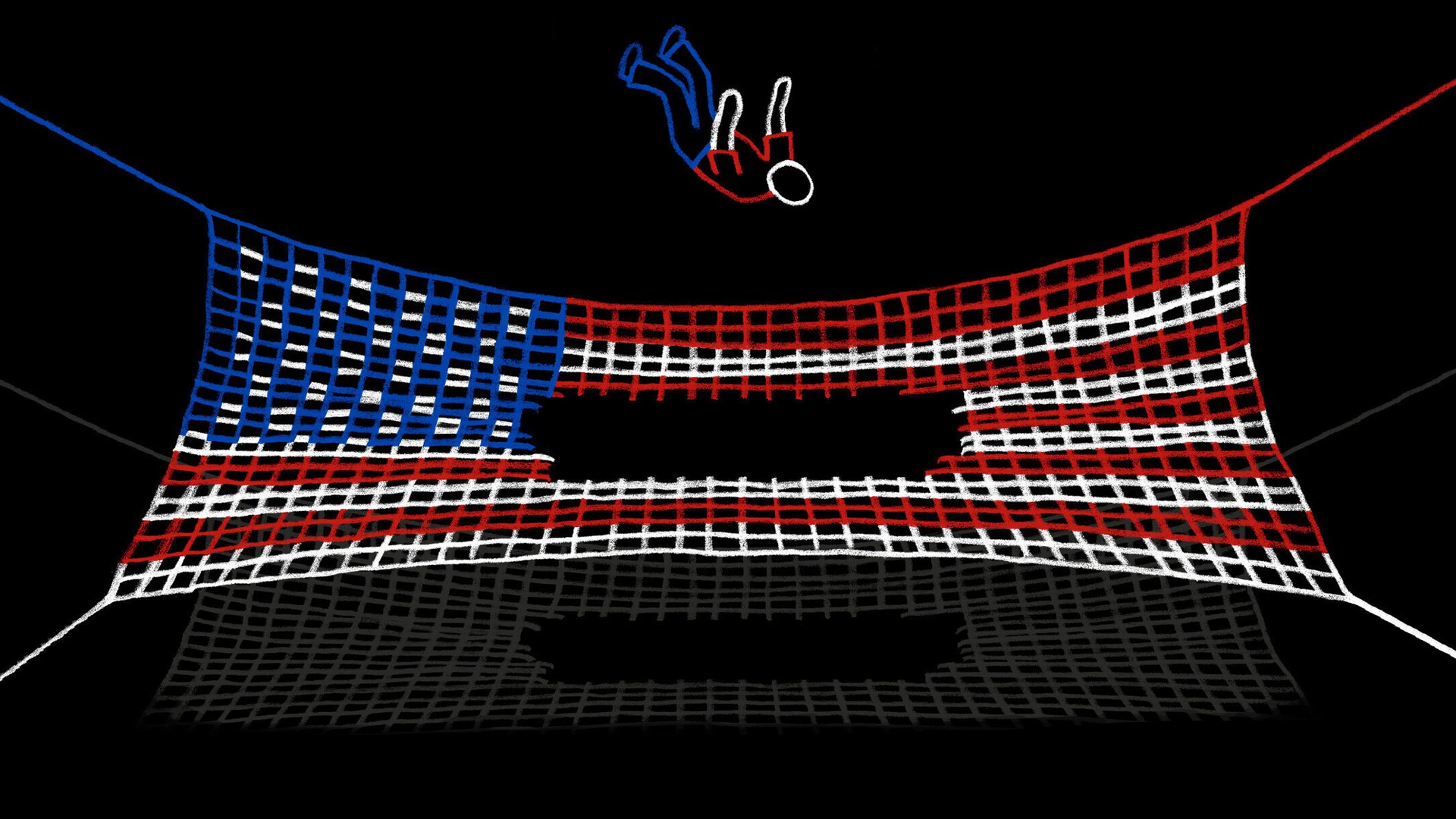
American history is driven by periodic moments of moral convulsion. The late Harvard political scientist Samuel P. Huntington noticed that these convulsions seem to hit the United States every 60 years or so: the Revolutionary period of the 1760s and ’70s; the Jacksonian uprising of the 1820s and ’30s; the Progressive Era, which began in the 1890s; and the social-protest movements of the 1960s and early ’70s.
These moments share certain features. People feel disgusted by the state of society. Trust in institutions plummets. Moral indignation is widespread. Contempt for established power is intense.
A highly moralistic generation appears on the scene. It uses new modes of communication to seize control of the national conversation. Groups formerly outside of power rise up and take over the system. These are moments of agitation and excitement, frenzy and accusation, mobilization and passion.
In 1981, Huntington predicted that the next moral convulsion would hit America around the second or third decade of the 21st century—that is, right about now. And, of course, he was correct. Our moment of moral convulsion began somewhere around the mid-2010s, with the rise of a range of outsider groups: the white nationalists who helped bring Donald Trump to power; the young socialists who upended the neoliberal consensus and brought us Bernie Sanders and Alexandria Ocasio-Cortez; activist students on campus; the Black Lives Matter movement, which rose to prominence after the killings of Eric Garner, Michael Brown, and Tamir Rice. Systems lost legitimacy. The earthquake had begun.
The events of 2020—the coronavirus pandemic; the killing of George Floyd; militias, social-media mobs, and urban unrest—were like hurricanes that hit in the middle of that earthquake. They did not cause the moral convulsion, but they accelerated every trend. They flooded the ravines that had opened up in American society and exposed every flaw.
Now, as we enter the final month of the election, this period of convulsion careens toward its climax. Donald Trump is in the process of shredding every norm of decent behavior and wrecking every institution he touches. Unable to behave responsibly, unable to protect himself from COVID-19, unable to even tell the country the truth about his own medical condition, he undermines the basic credibility of the government and arouses the suspicion that every word and act that surrounds him is a lie and a fraud. Finally, he threatens to undermine the legitimacy of our democracy in November and incite a vicious national conflagration that would leave us a charred and shattered nation. Trump is the final instrument of this crisis, but the conditions that brought him to power and make him so dangerous at this moment were decades in the making, and those conditions will not disappear if he is defeated.
From the July/August 2020 issue: History will judge the complicit
This essay is an account of the convulsion that brought us to this fateful moment. Its central focus is social trust. Social trust is a measure of the moral quality of a society—of whether the people and institutions in it are trustworthy, whether they keep their promises and work for the common good. When people in a church lose faith or trust in God, the church collapses. When people in a society lose faith or trust in their institutions and in each other, the nation collapses.
This is an account of how, over the past few decades, America became a more untrustworthy society. It is an account of how, under the stresses of 2020, American institutions and the American social order crumbled and were revealed as more untrustworthy still. We had a chance, in crisis, to pull together as a nation and build trust. We did not. That has left us a broken, alienated society caught in a distrust doom loop.
Read: Trust is collapsing in America
When moral convulsions recede, the national consciousness is transformed. New norms and beliefs, new values for what is admired and disdained, arise. Power within institutions gets renegotiated. Shifts in the collective consciousness are no merry ride; they come amid fury and chaos, when the social order turns liquid and nobody has any idea where things will end. Afterward, people sit blinking, battered, and shocked: What kind of nation have we become?
We can already glimpse pieces of the world after the current cataclysm. The most important changes are moral and cultural. The Baby Boomers grew up in the 1950s and ’60s, an era of family stability, widespread prosperity, and cultural cohesion. The mindset they embraced in the late ’60s and have embodied ever since was all about rebelling against authority, unshackling from institutions, and celebrating freedom, individualism, and liberation.
The emerging generations today enjoy none of that sense of security. They grew up in a world in which institutions failed, financial systems collapsed, and families were fragile. Children can now expect to have a lower quality of life than their parents, the pandemic rages, climate change looms, and social media is vicious. Their worldview is predicated on threat, not safety. Thus the values of the Millennial and Gen Z generations that will dominate in the years ahead are the opposite of Boomer values: not liberation, but security; not freedom, but equality; not individualism, but the safety of the collective; not sink-or-swim meritocracy, but promotion on the basis of social justice. Once a generation forms its general viewpoint during its young adulthood, it generally tends to carry that mentality with it to the grave 60 years later. A new culture is dawning. The Age of Precarity is here.
One question has haunted me while researching this essay: Are we living through a pivot or a decline? During past moral convulsions, Americans rose to the challenge. They built new cultures and institutions, initiated new reforms—and a renewed nation went on to its next stage of greatness. I’ve spent my career rebutting the idea that America is in decline, but the events of these past six years, and especially of 2020, have made clear that we live in a broken nation. The cancer of distrust has spread to every vital organ.
Renewal is hard to imagine. Destruction is everywhere, and construction difficult to see. The problem goes beyond Donald Trump. The stench of national decline is in the air. A political, social, and moral order is dissolving. America will only remain whole if we can build a new order in its place.
In that square, I met a 94-year-old woman who was passing out sandwiches to support the democratic protesters. Her name was Valentina Kosieva. She came to embody for me the 20th century, and all the suffering and savagery we were leaving behind as we marched—giddily, in those days—into the Information Age. She was born in 1898 in Samara. In 1905, she said, the Cossacks launched pogroms in her town and shot her uncle and her cousin. She was nearly killed after the Russian Revolution of 1917. She had innocently given shelter to some anti-Communist soldiers for “humanitarian reasons.” When the Reds came the next day, they decided to execute her. Only her mother’s pleadings saved her life.
In 1937, the Soviet secret police raided her apartment based on false suspicions, arrested her husband, and told her family they had 20 minutes to vacate. Her husband was sent to Siberia, where he died from either disease or execution—she never found out which. During World War II, she became a refugee, exchanging all her possessions for food. Her son was captured by the Nazis and beaten to death at the age of 17. After the Germans retreated, the Soviets ripped her people, the Kalmyks, from their homes and sent them into internal exile. For decades, she led a hidden life, trying to cover the fact that she was the widow of a supposed Enemy of the People.
Every trauma of Soviet history had happened to this woman. Amid the tumult of what we thought was the birth of a new, democratic Russia, she told me her story without bitterness or rancor. “If you get a letter completely free from self-pity,” Aleksandr Solzhenitsyn once wrote, it can only be from a victim of Soviet terror. “They are used to the worst the world can do, and nothing can depress them.” Kosieva had lived to see the death of this hated regime and the birth of a new world.
Those were the days of triumphant globalization. Communism was falling. Apartheid was ending. The Arab-Israeli dispute was calming down. Europe was unifying. China was prospering. In the United States, a moderate Republican president, George H. W. Bush, gave way to the first Baby Boomer president, a moderate Democrat, Bill Clinton. The American economy grew nicely. The racial wealth gap narrowed. All the great systems of society seemed to be working: capitalism, democracy, pluralism, diversity, globalization. It seemed, as Francis Fukuyama wrote in his famous “The End of History?” essay for The National Interest, “an unabashed victory for economic and political liberalism.”
We think of the 1960s as the classic Boomer decade, but the false summer of the 1990s was the high-water mark of that ethos. The first great theme of that era was convergence. Walls were coming down. Everybody was coming together. The second theme was the triumph of classical liberalism. Liberalism was not just a philosophy—it was a spirit and a zeitgeist, a faith that individual freedom would blossom in a loosely networked democratic capitalist world. Enterprise and creativity would be unleashed. America was the great embodiment and champion of this liberation. The third theme was individualism. Society flourished when individuals were liberated from the shackles of society and the state, when they had the freedom to be true to themselves.
For his 2001 book, Moral Freedom, the political scientist Alan Wolfe interviewed a wide array of Americans. The moral culture he described was no longer based on mainline Protestantism, as it had been for generations. Instead, Americans, from urban bobos to suburban evangelicals, were living in a state of what he called moral freedom: the belief that life is best when each individual finds his or her own morality—inevitable in a society that insists on individual freedom.
When you look back on it from the vantage of 2020, moral freedom, like the other dominant values of the time, contained within it a core assumption: If everybody does their own thing, then everything will work out for everybody. If everybody pursues their own economic self-interest, then the economy will thrive for all. If everybody chooses their own family style, then children will prosper. If each individual chooses his or her own moral code, then people will still feel solidarity with one another and be decent to one another. This was an ideology of maximum freedom and minimum sacrifice.
It all looks naive now. We were naive about what the globalized economy would do to the working class, naive to think the internet would bring us together, naive to think the global mixing of people would breed harmony, naive to think the privileged wouldn’t pull up the ladders of opportunity behind them. We didn’t predict that oligarchs would steal entire nations, or that demagogues from Turkey to the U.S. would ignite ethnic hatreds. We didn’t see that a hyper-competitive global meritocracy would effectively turn all of childhood into elite travel sports where a few privileged performers get to play and everyone else gets left behind.
Over the 20 years after I sat with Kosieva, it all began to unravel. The global financial crisis had hit, the Middle East was being ripped apart by fanatics. On May 15, 2011, street revolts broke out in Spain, led by the self-declared Indignados—“the outraged.” “They don’t represent us!” they railed as an insult to the Spanish establishment. It would turn out to be the cry of a decade.
We are living in the age of that disappointment. Millennials and members of Gen Z have grown up in the age of that disappointment, knowing nothing else. In the U.S. and elsewhere, this has produced a crisis of faith, across society but especially among the young. It has produced a crisis of trust.
High-trust societies have what Fukuyama calls spontaneous sociability. People are able to organize more quickly, initiate action, and sacrifice for the common good. When you look at research on social trust, you find all sorts of virtuous feedback loops. Trust produces good outcomes, which then produce more trust. In high-trust societies, corruption is lower and entrepreneurship is catalyzed. Higher-trust nations have lower economic inequality, because people feel connected to each other and are willing to support a more generous welfare state. People in high-trust societies are more civically engaged. Nations that score high in social trust—like the Netherlands, Sweden, China, and Australia—have rapidly growing or developed economies. Nations with low social trust—like Brazil, Morocco, and Zimbabwe—have struggling economies. As the ethicist Sissela Bok once put it, “Whatever matters to human beings, trust is the atmosphere in which it thrives.”
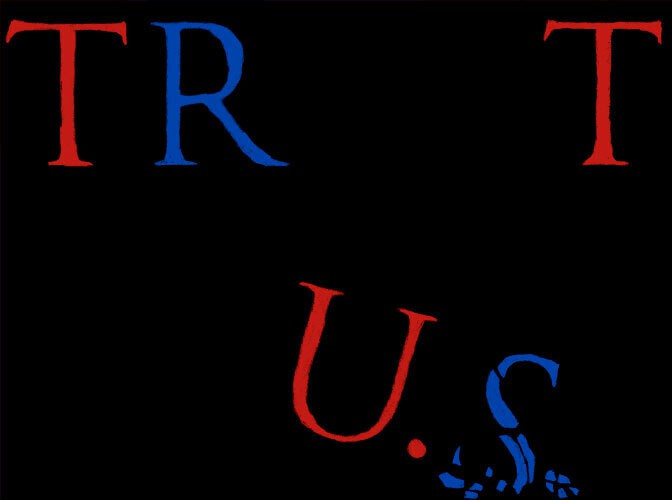
Linda Huang
During most of the 20th century, through depression and wars, Americans expressed high faith in their institutions. In 1964, for example, 77 percent of Americans said they trusted the federal government to do the right thing most or all of the time. Then came the last two moral convulsions. In the late 1960s and ’70s, amid Vietnam and Watergate, trust in institutions collapsed. By 1994, only one in five Americans said they trusted government to do the right thing. Then came the Iraq War and the financial crisis and the election of Donald Trump. Institutional trust levels remained pathetically low. What changed was the rise of a large group of people who were actively and poisonously alienated—who were not only distrustful but explosively distrustful. Explosive distrust is not just an absence of trust or a sense of detached alienation—it is an aggressive animosity and an urge to destroy. Explosive distrust is the belief that those who disagree with you are not just wrong but illegitimate. In 1997, 64 percent of Americans had a great or good deal of trust in the political competence of their fellow citizens; today only a third of Americans feel that way.
Falling trust in institutions is bad enough; it’s when people lose faith in each other that societies really begin to fall apart. In most societies, interpersonal trust is stable over the decades. But for some—like Denmark, where about 75 percent say the people around them are trustworthy, and the Netherlands, where two-thirds say so—the numbers have actually risen.
In America, interpersonal trust is in catastrophic decline. In 2014, according to the General Social Survey conducted by NORC at the University of Chicago, only 30.3 percent of Americans agreed that “most people can be trusted,” the lowest number the survey has recorded since it started asking the question in 1972. Today, a majority of Americans say they don’t trust other people when they first meet them.
Is mistrust based on distorted perception or is it a reflection of reality? Are people increasingly mistrustful because they are watching a lot of negative media and get a falsely dark view of the world? Or are they mistrustful because the world is less trustworthy, because people lie, cheat, and betray each other more than they used to?
There’s evidence to suggest that marital infidelity, academic cheating, and animal cruelty are all on the rise in America, but it’s hard to directly measure the overall moral condition of society—how honest people are, and how faithful. The evidence suggests that trust is an imprint left by experience, not a distorted perception. Trust is the ratio between the number of people who betray you and the number of people who remain faithful to you. It’s not clear that there is more betrayal in America than there used to be—but there are certainly fewer faithful supports around people than there used to be. Hundreds of books and studies on declining social capital and collapsing family structure demonstrate this. In the age of disappointment, people are less likely to be surrounded by faithful networks of people they can trust.
Thus the Harvard political scientist Robert Putnam argues that it’s a great mistake to separate the attitude (trust) from the behavior (morally right action). People become trusting when the world around them is trustworthy. When they are surrounded by people who live up to their commitments. When they experience their country as a fair place. As Vallier puts it, trust levels are a reflection of the moral condition of a nation at any given time. I’d add that high national trust is a collective moral achievement. High national distrust is a sign that people have earned the right to be suspicious. Trust isn’t a virtue—it’s a measure of other people’s virtue.
Unsurprisingly, the groups with the lowest social trust in America are among the most marginalized. Trust, like much else, is unequally distributed across American society, and the inequality is getting worse. Each of these marginalized groups has seen an additional and catastrophic decline in trust over the past few years.
Black Americans have been one of the most ill-treated groups in American history; their distrust is earned distrust. In 2018, 37.3 percent of white Americans felt that most people can be trusted, according to the General Social Survey, but only 15.3 percent of Black Americans felt the same. This is not general misanthropy. Black Americans have high trust in other Black Americans; it’s the wider society they don’t trust, for good and obvious reasons. And Black perceptions of America’s fairness have tumbled further in the age of disappointment. In 2002, 43 percent of Black Americans were very or somewhat satisfied with the way Black people are treated in the U.S. By 2018, only 18 percent felt that way, according to Gallup.
The second disenfranchised low-trust group includes the lower-middle class and the working poor. According to Tim Dixon, an economist and the co-author of a 2018 study that examined polarization in America, this group makes up about 40 percent of the country. “They are driven by the insecurity of their place in society and in the economy,” he says. They are distrustful of technology and are much more likely to buy into conspiracy theories. “They’re often convinced by stories that someone is trying to trick them, that the world is against them,” he says. Distrust motivated many in this group to vote for Donald Trump, to stick a thumb in the eye of the elites who had betrayed them.
This brings us to the third marginalized group that scores extremely high on social distrust: young adults. These are people who grew up in the age of disappointment. It’s the only world they know.
In 2012, 40 percent of Baby Boomers believed that most people can be trusted, as did 31 percent of members of Generation X. In contrast, only 19 percent of Millennials said most people can be trusted. Seventy-three percent of adults under 30 believe that “most of the time, people just look out for themselves,” according to a Pew survey from 2018. Seventy-one percent of those young adults say that most people “would try to take advantage of you if they got a chance.”
Many young people look out at a world they believe is screwed up and untrustworthy in fundamental ways. A mere 10 percent of Gen Zers trust politicians to do the right thing. Millennials are twice as likely as their grandparents to say that families should be able to opt out of vaccines. Only 35 percent of young people, versus 67 percent of old people, believe that Americans respect the rights of people who are not like them. Fewer than a third of Millennials say America is the greatest country in the world, compared to 64 percent of members of the Silent Generation.
Human beings need a basic sense of security in order to thrive; as the political scientist Ronald F. Inglehart puts it, their “values and behavior are shaped by the degree to which survival is secure.” In the age of disappointment, our sense of safety went away. Some of this is physical insecurity: school shootings, terrorist attacks, police brutality, and overprotective parenting at home that leaves young people incapable of handling real-world stress. But the true insecurity is financial, social, and emotional.
First, financial insecurity: By the time the Baby Boomers hit a median age of 35, their generation owned 21 percent of the nation’s wealth. As of last year, Millennials—who will hit an average age of 35 in three years—owned just 3.2 percent of the nation’s wealth.
Next, emotional insecurity: Americans today experience more instability than at any period in recent memory—fewer children growing up in married two-parent households, more single-parent households, more depression, and higher suicide rates.
Then, identity insecurity. People today live in what the late sociologist Zygmunt Bauman called liquid modernity. All the traits that were once assigned to you by your community, you must now determine on your own: your identity, your morality, your gender, your vocation, your purpose, and the place of your belonging. Self-creation becomes a major anxiety-inducing act of young adulthood.
Finally, social insecurity. In the age of social media our “sociometers”—the antennae we use to measure how other people are seeing us—are up and on high alert all the time. Am I liked? Am I affirmed? Why do I feel invisible? We see ourselves in how we think others see us. Their snarkiness turns into my self-doubt, their criticism into my shame, their obliviousness into my humiliation. Danger is ever present. “For many people, it is impossible to think without simultaneously thinking about what other people would think about what you’re thinking,” the educator Fredrik deBoer has written. “This is exhausting and deeply unsatisfying. As long as your self-conception is tied up in your perception of other people’s conception of you, you will never be free to occupy a personality with confidence; you’re always at the mercy of the next person’s dim opinion of you and your whole deal.”
In this world, nothing seems safe; everything feels like chaos.
Distrustful people try to make themselves invulnerable, armor themselves up in a sour attempt to feel safe. Distrust and spiritual isolation lead people to flee intimacy and try to replace it with stimulation. Distrust, anxiety, and anomie are at the root of the 73 percent increase in depression among Americans aged 18 to 25 from 2007 to 2018, and of the shocking rise in suicide. “When we have no one to trust, our brains can self-destruct,” Ulrich Boser writes in his book on the science of trust, The Leap.
People plagued by distrust can start to see threats that aren’t there; they become risk averse. Americans take fewer risks and are much less entrepreneurial than they used to be. In 2014, the rate of business start-ups hit a nearly 40-year low. Since the early 1970s, the rate at which people move across state lines each year has dropped by 56 percent. People lose faith in experts. They lose faith in truth, in the flow of information that is the basis of modern society. “A world of truth is a world of trust, and vice versa,” Rabbi Jonathan Sacks writes in his book Morality.
In periods of distrust, you get surges of populism; populism is the ideology of those who feel betrayed. Contempt for “insiders” rises, as does suspicion toward anybody who holds authority. People are drawn to leaders who use the language of menace and threat, who tell group-versus-group power narratives. You also get a lot more political extremism. People seek closed, rigid ideological systems that give them a sense of security. As Hannah Arendt once observed, fanaticism is a response to existential anxiety. When people feel naked and alone, they revert to tribe. Their radius of trust shrinks, and they only trust their own kind. Donald Trump is the great emblem of an age of distrust—a man unable to love, unable to trust. When many Americans see Trump’s distrust, they see a man who looks at the world as they do.
By February 2020, America was a land mired in distrust. Then the plague arrived.
Archive Link
American history is driven by periodic moments of moral convulsion. The late Harvard political scientist Samuel P. Huntington noticed that these convulsions seem to hit the United States every 60 years or so: the Revolutionary period of the 1760s and ’70s; the Jacksonian uprising of the 1820s and ’30s; the Progressive Era, which began in the 1890s; and the social-protest movements of the 1960s and early ’70s.
These moments share certain features. People feel disgusted by the state of society. Trust in institutions plummets. Moral indignation is widespread. Contempt for established power is intense.
A highly moralistic generation appears on the scene. It uses new modes of communication to seize control of the national conversation. Groups formerly outside of power rise up and take over the system. These are moments of agitation and excitement, frenzy and accusation, mobilization and passion.
In 1981, Huntington predicted that the next moral convulsion would hit America around the second or third decade of the 21st century—that is, right about now. And, of course, he was correct. Our moment of moral convulsion began somewhere around the mid-2010s, with the rise of a range of outsider groups: the white nationalists who helped bring Donald Trump to power; the young socialists who upended the neoliberal consensus and brought us Bernie Sanders and Alexandria Ocasio-Cortez; activist students on campus; the Black Lives Matter movement, which rose to prominence after the killings of Eric Garner, Michael Brown, and Tamir Rice. Systems lost legitimacy. The earthquake had begun.
The events of 2020—the coronavirus pandemic; the killing of George Floyd; militias, social-media mobs, and urban unrest—were like hurricanes that hit in the middle of that earthquake. They did not cause the moral convulsion, but they accelerated every trend. They flooded the ravines that had opened up in American society and exposed every flaw.
Now, as we enter the final month of the election, this period of convulsion careens toward its climax. Donald Trump is in the process of shredding every norm of decent behavior and wrecking every institution he touches. Unable to behave responsibly, unable to protect himself from COVID-19, unable to even tell the country the truth about his own medical condition, he undermines the basic credibility of the government and arouses the suspicion that every word and act that surrounds him is a lie and a fraud. Finally, he threatens to undermine the legitimacy of our democracy in November and incite a vicious national conflagration that would leave us a charred and shattered nation. Trump is the final instrument of this crisis, but the conditions that brought him to power and make him so dangerous at this moment were decades in the making, and those conditions will not disappear if he is defeated.
From the July/August 2020 issue: History will judge the complicit
This essay is an account of the convulsion that brought us to this fateful moment. Its central focus is social trust. Social trust is a measure of the moral quality of a society—of whether the people and institutions in it are trustworthy, whether they keep their promises and work for the common good. When people in a church lose faith or trust in God, the church collapses. When people in a society lose faith or trust in their institutions and in each other, the nation collapses.
This is an account of how, over the past few decades, America became a more untrustworthy society. It is an account of how, under the stresses of 2020, American institutions and the American social order crumbled and were revealed as more untrustworthy still. We had a chance, in crisis, to pull together as a nation and build trust. We did not. That has left us a broken, alienated society caught in a distrust doom loop.
Read: Trust is collapsing in America
When moral convulsions recede, the national consciousness is transformed. New norms and beliefs, new values for what is admired and disdained, arise. Power within institutions gets renegotiated. Shifts in the collective consciousness are no merry ride; they come amid fury and chaos, when the social order turns liquid and nobody has any idea where things will end. Afterward, people sit blinking, battered, and shocked: What kind of nation have we become?
We can already glimpse pieces of the world after the current cataclysm. The most important changes are moral and cultural. The Baby Boomers grew up in the 1950s and ’60s, an era of family stability, widespread prosperity, and cultural cohesion. The mindset they embraced in the late ’60s and have embodied ever since was all about rebelling against authority, unshackling from institutions, and celebrating freedom, individualism, and liberation.
The emerging generations today enjoy none of that sense of security. They grew up in a world in which institutions failed, financial systems collapsed, and families were fragile. Children can now expect to have a lower quality of life than their parents, the pandemic rages, climate change looms, and social media is vicious. Their worldview is predicated on threat, not safety. Thus the values of the Millennial and Gen Z generations that will dominate in the years ahead are the opposite of Boomer values: not liberation, but security; not freedom, but equality; not individualism, but the safety of the collective; not sink-or-swim meritocracy, but promotion on the basis of social justice. Once a generation forms its general viewpoint during its young adulthood, it generally tends to carry that mentality with it to the grave 60 years later. A new culture is dawning. The Age of Precarity is here.
One question has haunted me while researching this essay: Are we living through a pivot or a decline? During past moral convulsions, Americans rose to the challenge. They built new cultures and institutions, initiated new reforms—and a renewed nation went on to its next stage of greatness. I’ve spent my career rebutting the idea that America is in decline, but the events of these past six years, and especially of 2020, have made clear that we live in a broken nation. The cancer of distrust has spread to every vital organ.
Renewal is hard to imagine. Destruction is everywhere, and construction difficult to see. The problem goes beyond Donald Trump. The stench of national decline is in the air. A political, social, and moral order is dissolving. America will only remain whole if we can build a new order in its place.
The Age of Disappointment
the story begins, at least for me, in August 1991, in Moscow, where I was reporting for The Wall Street Journal. In a last desperate bid to preserve their regime, a group of hard-liners attempted a coup against the president of the Soviet Union, Mikhail Gorbachev. As Soviet troops and tanks rolled into Moscow, democratic activists gathered outside the Russian parliament building to oppose them. Boris Yeltsin, the president of Russia, mounted a tank and stood the coup down.In that square, I met a 94-year-old woman who was passing out sandwiches to support the democratic protesters. Her name was Valentina Kosieva. She came to embody for me the 20th century, and all the suffering and savagery we were leaving behind as we marched—giddily, in those days—into the Information Age. She was born in 1898 in Samara. In 1905, she said, the Cossacks launched pogroms in her town and shot her uncle and her cousin. She was nearly killed after the Russian Revolution of 1917. She had innocently given shelter to some anti-Communist soldiers for “humanitarian reasons.” When the Reds came the next day, they decided to execute her. Only her mother’s pleadings saved her life.
In 1937, the Soviet secret police raided her apartment based on false suspicions, arrested her husband, and told her family they had 20 minutes to vacate. Her husband was sent to Siberia, where he died from either disease or execution—she never found out which. During World War II, she became a refugee, exchanging all her possessions for food. Her son was captured by the Nazis and beaten to death at the age of 17. After the Germans retreated, the Soviets ripped her people, the Kalmyks, from their homes and sent them into internal exile. For decades, she led a hidden life, trying to cover the fact that she was the widow of a supposed Enemy of the People.
Every trauma of Soviet history had happened to this woman. Amid the tumult of what we thought was the birth of a new, democratic Russia, she told me her story without bitterness or rancor. “If you get a letter completely free from self-pity,” Aleksandr Solzhenitsyn once wrote, it can only be from a victim of Soviet terror. “They are used to the worst the world can do, and nothing can depress them.” Kosieva had lived to see the death of this hated regime and the birth of a new world.
Those were the days of triumphant globalization. Communism was falling. Apartheid was ending. The Arab-Israeli dispute was calming down. Europe was unifying. China was prospering. In the United States, a moderate Republican president, George H. W. Bush, gave way to the first Baby Boomer president, a moderate Democrat, Bill Clinton. The American economy grew nicely. The racial wealth gap narrowed. All the great systems of society seemed to be working: capitalism, democracy, pluralism, diversity, globalization. It seemed, as Francis Fukuyama wrote in his famous “The End of History?” essay for The National Interest, “an unabashed victory for economic and political liberalism.”
We think of the 1960s as the classic Boomer decade, but the false summer of the 1990s was the high-water mark of that ethos. The first great theme of that era was convergence. Walls were coming down. Everybody was coming together. The second theme was the triumph of classical liberalism. Liberalism was not just a philosophy—it was a spirit and a zeitgeist, a faith that individual freedom would blossom in a loosely networked democratic capitalist world. Enterprise and creativity would be unleashed. America was the great embodiment and champion of this liberation. The third theme was individualism. Society flourished when individuals were liberated from the shackles of society and the state, when they had the freedom to be true to themselves.
For his 2001 book, Moral Freedom, the political scientist Alan Wolfe interviewed a wide array of Americans. The moral culture he described was no longer based on mainline Protestantism, as it had been for generations. Instead, Americans, from urban bobos to suburban evangelicals, were living in a state of what he called moral freedom: the belief that life is best when each individual finds his or her own morality—inevitable in a society that insists on individual freedom.
When you look back on it from the vantage of 2020, moral freedom, like the other dominant values of the time, contained within it a core assumption: If everybody does their own thing, then everything will work out for everybody. If everybody pursues their own economic self-interest, then the economy will thrive for all. If everybody chooses their own family style, then children will prosper. If each individual chooses his or her own moral code, then people will still feel solidarity with one another and be decent to one another. This was an ideology of maximum freedom and minimum sacrifice.
It all looks naive now. We were naive about what the globalized economy would do to the working class, naive to think the internet would bring us together, naive to think the global mixing of people would breed harmony, naive to think the privileged wouldn’t pull up the ladders of opportunity behind them. We didn’t predict that oligarchs would steal entire nations, or that demagogues from Turkey to the U.S. would ignite ethnic hatreds. We didn’t see that a hyper-competitive global meritocracy would effectively turn all of childhood into elite travel sports where a few privileged performers get to play and everyone else gets left behind.
Over the 20 years after I sat with Kosieva, it all began to unravel. The global financial crisis had hit, the Middle East was being ripped apart by fanatics. On May 15, 2011, street revolts broke out in Spain, led by the self-declared Indignados—“the outraged.” “They don’t represent us!” they railed as an insult to the Spanish establishment. It would turn out to be the cry of a decade.
We are living in the age of that disappointment. Millennials and members of Gen Z have grown up in the age of that disappointment, knowing nothing else. In the U.S. and elsewhere, this has produced a crisis of faith, across society but especially among the young. It has produced a crisis of trust.
The Trust Fall
social trust is the confidence that other people will do what they ought to do most of the time. In a restaurant I trust you to serve untainted fish and you trust me not to skip out on the bill. Social trust is a generalized faith in the people of your community. It consists of smaller faiths. It begins with the assumption that we are interdependent, our destinies linked. It continues with the assumption that we share the same moral values. We share a sense of what is the right thing to do in different situations. As Kevin Vallier of Bowling Green State University argues in his forthcoming book, Trust in a Polarized Age, social trust also depends on a sense that we share the same norms. If two lanes of traffic are merging into one, the drivers in each lane are supposed to take turns. If you butt in line, I’ll honk indignantly. I’ll be angry, and I’ll want to enforce the small fairness rules that make our society function smoothly.High-trust societies have what Fukuyama calls spontaneous sociability. People are able to organize more quickly, initiate action, and sacrifice for the common good. When you look at research on social trust, you find all sorts of virtuous feedback loops. Trust produces good outcomes, which then produce more trust. In high-trust societies, corruption is lower and entrepreneurship is catalyzed. Higher-trust nations have lower economic inequality, because people feel connected to each other and are willing to support a more generous welfare state. People in high-trust societies are more civically engaged. Nations that score high in social trust—like the Netherlands, Sweden, China, and Australia—have rapidly growing or developed economies. Nations with low social trust—like Brazil, Morocco, and Zimbabwe—have struggling economies. As the ethicist Sissela Bok once put it, “Whatever matters to human beings, trust is the atmosphere in which it thrives.”
Linda Huang
During most of the 20th century, through depression and wars, Americans expressed high faith in their institutions. In 1964, for example, 77 percent of Americans said they trusted the federal government to do the right thing most or all of the time. Then came the last two moral convulsions. In the late 1960s and ’70s, amid Vietnam and Watergate, trust in institutions collapsed. By 1994, only one in five Americans said they trusted government to do the right thing. Then came the Iraq War and the financial crisis and the election of Donald Trump. Institutional trust levels remained pathetically low. What changed was the rise of a large group of people who were actively and poisonously alienated—who were not only distrustful but explosively distrustful. Explosive distrust is not just an absence of trust or a sense of detached alienation—it is an aggressive animosity and an urge to destroy. Explosive distrust is the belief that those who disagree with you are not just wrong but illegitimate. In 1997, 64 percent of Americans had a great or good deal of trust in the political competence of their fellow citizens; today only a third of Americans feel that way.
Falling trust in institutions is bad enough; it’s when people lose faith in each other that societies really begin to fall apart. In most societies, interpersonal trust is stable over the decades. But for some—like Denmark, where about 75 percent say the people around them are trustworthy, and the Netherlands, where two-thirds say so—the numbers have actually risen.
In America, interpersonal trust is in catastrophic decline. In 2014, according to the General Social Survey conducted by NORC at the University of Chicago, only 30.3 percent of Americans agreed that “most people can be trusted,” the lowest number the survey has recorded since it started asking the question in 1972. Today, a majority of Americans say they don’t trust other people when they first meet them.
Is mistrust based on distorted perception or is it a reflection of reality? Are people increasingly mistrustful because they are watching a lot of negative media and get a falsely dark view of the world? Or are they mistrustful because the world is less trustworthy, because people lie, cheat, and betray each other more than they used to?
There’s evidence to suggest that marital infidelity, academic cheating, and animal cruelty are all on the rise in America, but it’s hard to directly measure the overall moral condition of society—how honest people are, and how faithful. The evidence suggests that trust is an imprint left by experience, not a distorted perception. Trust is the ratio between the number of people who betray you and the number of people who remain faithful to you. It’s not clear that there is more betrayal in America than there used to be—but there are certainly fewer faithful supports around people than there used to be. Hundreds of books and studies on declining social capital and collapsing family structure demonstrate this. In the age of disappointment, people are less likely to be surrounded by faithful networks of people they can trust.
Thus the Harvard political scientist Robert Putnam argues that it’s a great mistake to separate the attitude (trust) from the behavior (morally right action). People become trusting when the world around them is trustworthy. When they are surrounded by people who live up to their commitments. When they experience their country as a fair place. As Vallier puts it, trust levels are a reflection of the moral condition of a nation at any given time. I’d add that high national trust is a collective moral achievement. High national distrust is a sign that people have earned the right to be suspicious. Trust isn’t a virtue—it’s a measure of other people’s virtue.
Unsurprisingly, the groups with the lowest social trust in America are among the most marginalized. Trust, like much else, is unequally distributed across American society, and the inequality is getting worse. Each of these marginalized groups has seen an additional and catastrophic decline in trust over the past few years.
Black Americans have been one of the most ill-treated groups in American history; their distrust is earned distrust. In 2018, 37.3 percent of white Americans felt that most people can be trusted, according to the General Social Survey, but only 15.3 percent of Black Americans felt the same. This is not general misanthropy. Black Americans have high trust in other Black Americans; it’s the wider society they don’t trust, for good and obvious reasons. And Black perceptions of America’s fairness have tumbled further in the age of disappointment. In 2002, 43 percent of Black Americans were very or somewhat satisfied with the way Black people are treated in the U.S. By 2018, only 18 percent felt that way, according to Gallup.
The second disenfranchised low-trust group includes the lower-middle class and the working poor. According to Tim Dixon, an economist and the co-author of a 2018 study that examined polarization in America, this group makes up about 40 percent of the country. “They are driven by the insecurity of their place in society and in the economy,” he says. They are distrustful of technology and are much more likely to buy into conspiracy theories. “They’re often convinced by stories that someone is trying to trick them, that the world is against them,” he says. Distrust motivated many in this group to vote for Donald Trump, to stick a thumb in the eye of the elites who had betrayed them.
This brings us to the third marginalized group that scores extremely high on social distrust: young adults. These are people who grew up in the age of disappointment. It’s the only world they know.
In 2012, 40 percent of Baby Boomers believed that most people can be trusted, as did 31 percent of members of Generation X. In contrast, only 19 percent of Millennials said most people can be trusted. Seventy-three percent of adults under 30 believe that “most of the time, people just look out for themselves,” according to a Pew survey from 2018. Seventy-one percent of those young adults say that most people “would try to take advantage of you if they got a chance.”
Many young people look out at a world they believe is screwed up and untrustworthy in fundamental ways. A mere 10 percent of Gen Zers trust politicians to do the right thing. Millennials are twice as likely as their grandparents to say that families should be able to opt out of vaccines. Only 35 percent of young people, versus 67 percent of old people, believe that Americans respect the rights of people who are not like them. Fewer than a third of Millennials say America is the greatest country in the world, compared to 64 percent of members of the Silent Generation.
Human beings need a basic sense of security in order to thrive; as the political scientist Ronald F. Inglehart puts it, their “values and behavior are shaped by the degree to which survival is secure.” In the age of disappointment, our sense of safety went away. Some of this is physical insecurity: school shootings, terrorist attacks, police brutality, and overprotective parenting at home that leaves young people incapable of handling real-world stress. But the true insecurity is financial, social, and emotional.
First, financial insecurity: By the time the Baby Boomers hit a median age of 35, their generation owned 21 percent of the nation’s wealth. As of last year, Millennials—who will hit an average age of 35 in three years—owned just 3.2 percent of the nation’s wealth.
Next, emotional insecurity: Americans today experience more instability than at any period in recent memory—fewer children growing up in married two-parent households, more single-parent households, more depression, and higher suicide rates.
Then, identity insecurity. People today live in what the late sociologist Zygmunt Bauman called liquid modernity. All the traits that were once assigned to you by your community, you must now determine on your own: your identity, your morality, your gender, your vocation, your purpose, and the place of your belonging. Self-creation becomes a major anxiety-inducing act of young adulthood.
Finally, social insecurity. In the age of social media our “sociometers”—the antennae we use to measure how other people are seeing us—are up and on high alert all the time. Am I liked? Am I affirmed? Why do I feel invisible? We see ourselves in how we think others see us. Their snarkiness turns into my self-doubt, their criticism into my shame, their obliviousness into my humiliation. Danger is ever present. “For many people, it is impossible to think without simultaneously thinking about what other people would think about what you’re thinking,” the educator Fredrik deBoer has written. “This is exhausting and deeply unsatisfying. As long as your self-conception is tied up in your perception of other people’s conception of you, you will never be free to occupy a personality with confidence; you’re always at the mercy of the next person’s dim opinion of you and your whole deal.”
In this world, nothing seems safe; everything feels like chaos.
The Distrust Mindset
distrust sows distrust. It produces the spiritual state that Emile Durkheim called anomie, a feeling of being disconnected from society, a feeling that the whole game is illegitimate, that you are invisible and not valued, a feeling that the only person you can really trust is yourself.Distrustful people try to make themselves invulnerable, armor themselves up in a sour attempt to feel safe. Distrust and spiritual isolation lead people to flee intimacy and try to replace it with stimulation. Distrust, anxiety, and anomie are at the root of the 73 percent increase in depression among Americans aged 18 to 25 from 2007 to 2018, and of the shocking rise in suicide. “When we have no one to trust, our brains can self-destruct,” Ulrich Boser writes in his book on the science of trust, The Leap.
People plagued by distrust can start to see threats that aren’t there; they become risk averse. Americans take fewer risks and are much less entrepreneurial than they used to be. In 2014, the rate of business start-ups hit a nearly 40-year low. Since the early 1970s, the rate at which people move across state lines each year has dropped by 56 percent. People lose faith in experts. They lose faith in truth, in the flow of information that is the basis of modern society. “A world of truth is a world of trust, and vice versa,” Rabbi Jonathan Sacks writes in his book Morality.
In periods of distrust, you get surges of populism; populism is the ideology of those who feel betrayed. Contempt for “insiders” rises, as does suspicion toward anybody who holds authority. People are drawn to leaders who use the language of menace and threat, who tell group-versus-group power narratives. You also get a lot more political extremism. People seek closed, rigid ideological systems that give them a sense of security. As Hannah Arendt once observed, fanaticism is a response to existential anxiety. When people feel naked and alone, they revert to tribe. Their radius of trust shrinks, and they only trust their own kind. Donald Trump is the great emblem of an age of distrust—a man unable to love, unable to trust. When many Americans see Trump’s distrust, they see a man who looks at the world as they do.
By February 2020, America was a land mired in distrust. Then the plague arrived.


