
- Joined
- Jan 2, 2025
Neighborhood Racial Composition and Gun Homicides
Even when comparing neighborhoods of the same socioeconomic status (deprivation level), those with a higher proportion of Black residents have significantly higher rates of gun homicides.
Key findings to support this conclusion are:
- Race is an independent factor: The rate of gun homicides increases with the proportion of Black residents, regardless of whether the neighborhood is relatively wealthy, average, or impoverished.
- The effect is consistent: As shown in the table, at every level of deprivation measured (from the 10th percentile to the 99th), the gun homicide rate consistently rises as the percentage of Black residents increases.
- Poverty alone doesn't explain the disparity: While neighborhoods with more Black residents tend to be more deprived (Figure A), the study's main finding (Figure B and Table) shows that factors beyond poverty are at play.
- Implications for policy: The authors suggest that policies aimed at reducing gun violence disparities must go beyond simply alleviating poverty and should address issues related to residential segregation, such as historic underinvestment and lack of institutional resources in Black communities.


Recent Trends in Firearm-Related Mortality in Black Youth
Based on the provided supplementary appendix, here is a summary of the paper's findings on firearm-related mortality in Black youth from 1999-2022.
Overall Trends in Firearm-Related Mortality
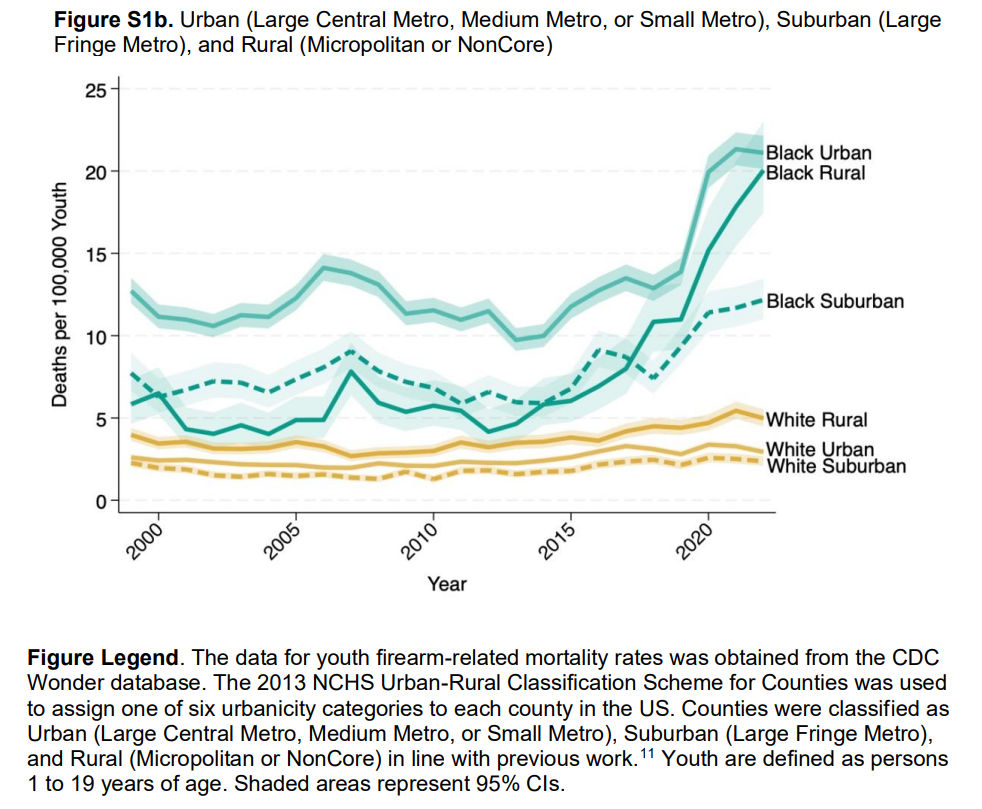
- Dramatic Increase for Black Youth: The firearm-related mortality rate for non-Hispanic Black youth (ages 1-19) more than doubled over the last decade. After hitting a low of 8.4 deaths per 100,000 in 2013, the rate rose by 50% to 12.5 by 2019, and then increased by another 50% to 18.6 per 100,000 in 2021, a rate that provisionally continued into 2022.
- Disproportionate Contribution to Overall Youth Mortality: Between 2019 and 2021, the all-cause mortality rate for US youth (ages 1-19) increased by 18%. Although non-Hispanic Black youth make up only 14% of this population, they accounted for 39% of this increase in deaths.
- Firearms as a Key Driver: Nearly 60% of the increase in deaths among Black youth from 2019-2021 was due to firearm-related injuries. These deaths (835 out of 3767) accounted for one-quarter of the total increase in deaths among all US youth during this period.
- Comparison with White Youth: In contrast, non-Hispanic White youth represented 20% of the additional deaths from 2019-2021, and only 22% of those were firearm-related.
Geographic and Rural/Urban Findings
- Shift from Urban Concentration: Historically, firearm-related mortality in Black youth was primarily an urban issue. The study finds this is no longer the case.
- Greatest Increase Among Rural Black Youth: Across various definitions of urban, suburban, and rural areas, rural Black youth experienced the greatest increases in firearm-related mortality over the past ten years. Their mortality rate has risen sharply, nearly converging with that of urban Black youth by 2022.
- Regional Differences:
- The increase in firearm mortality among rural Black youth is most pronounced in the South, where the rate climbed from approximately 10 per 100,000 in 1999-2013 to over 25 per 100,000 in 2020-2022.
- Among urban Black youth, the highest firearm mortality rates are found in the Midwest.
- The South has the largest absolute number of youth firearm deaths, driven by increases among both urban and rural Black youth and urban White youth.
Nature of Firearm Deaths
- Homicide vs. Non-Homicide:
- For Black youth (both rural and urban), the dramatic increase in firearm mortality is overwhelmingly driven by firearm homicide.
- For White youth, firearm deaths are driven primarily by non-homicide causes (such as suicide), which occur at a significantly higher rate than firearm homicides in this group.
- Contribution to All-Cause Mortality (Figure S2): By 2022, firearms accounted for a much larger proportion of all deaths for Black youth compared to White youth. The proportion of firearm-related deaths for rural and urban Black youth approaches 35-40% of all-cause mortality, whereas for White youth it is closer to 15-20%.
Methodological Notes
- The study uses data from the CDC WONDER database for youth aged 1-19 from 1999-2022.
- The authors adjusted 2021-2022 data for Black youth downwards by 15% to account for a change in how the CDC categorizes race in population estimates, making their findings for these years "likely conservative."
- Firearm-related deaths include homicides, suicides, unintentional deaths, and deaths of undetermined intent involving firearms.


Last edited:


