L | A
By Joanne Palmer

Bruce and Ruth Pomerantz of Alpine had wanted to go to Cuba for a long time, but the barriers to that trip often have been formidable.
Cuba is close to the United States, so the actual travel isn’t an obstacle. There’s no flying across many time zones or changing flights or dealing with airplane meal after airplane meal as you gradually lose all feeling in your legs and come to bitterly resent the head of the stranger in front of you implanting in your lap.
Politics has been an issue with many periods when the animosity between the United States and Cuba has made tourism nearly impossible. But now is not one of those times. Americans can get to Cuba, although once they’re there, they are limited in how and where they can spend money.
Language isn’t an issue; Ms. Pomerantz is fluent in Spanish.
In 2003, the Pomerantz’s younger daughter, Lara, spent the summer in Cuba after her sophomore year at Duke University. It was a good summer. She was there on a fellowship, and through their friend Rabbi Noam Marans of Teaneck they were able to arrange for her to stay with a Jewish family. “We were nervous about her staying there alone, at 19” — and at a time when cellphone service was spotty — but it worked out very well.
“I tried to visit her there,” Mr. Pomerantz said. “But I’d been a journalist, and the State Department asked me more and more questions, and by the time they approved my trip she already was on her way home.”
Both Pomerantzes also have historic family connections to Cuba.
“My mother’s aunt went to Cuba with her mother, my great-grandmother,” Ms. Pomerantz said. “My great-grandmother left Poland with her younger daughter; her son was already in the United States, and her other daughter, my grandmother, was already married in Poland. Life was very difficult in Poland, because my great-grandfather had been killed in World War II.

Ruth and Bruce Pomerantz are outside Fusterlandia, a Havana wonderland created by artist Jose Fuster
“So my great-grandmother came to the United States alone with her daughter. She wanted her daughter to meet a Jewish guy. In America, she heard about a handsome man from a good family in Cuba, so they went there. And that’s why Tante Helen married Uncle Louie.
“Then they came to live in the United States.”
Mr. Pomerantz had a great-aunt Frieda, who had somehow escaped Auschwitz, he said, and so did her husband. “I don’t know how they did it, but they did. So they got to Cuba. After they spent some time in Cuba, they went to Montreal, and became dry cleaners there.”
In May, the Pomerantzes decided that it finally was time to go to Cuba. They spent eight days there. They didn’t go with a group, but on their own, arranging for tour guides to show them around.

This reminder of the hostages held in Gaza hangs in Beth Sholom
One of their goals was to see what the Jewish community in Cuba was like, they said.
This community dates back to the Spanish Inquisition, when some Jews fled to the island. Many more Jews joined that very small group in the early 20th century — they’d hoped to go from Cuba to the United States, but restrictive U.S. immigration laws kept them out. Cuba was home then to an estimated 2,400 Jews. Others escaped from the Nazis and to Cuba in the 1930s. But about 95 percent of the Jewish community left Cuba after the Communist revolution in 1959.
By now, “there are only about 1,000 Jews left in Cuba,” Mr. Pomerantz said. “They have been leaving. They go wherever they can — they can’t come to America now, but South America, Europe, anywhere they can get in.
“They don’t face much antisemitism, but the economy is terrible.”
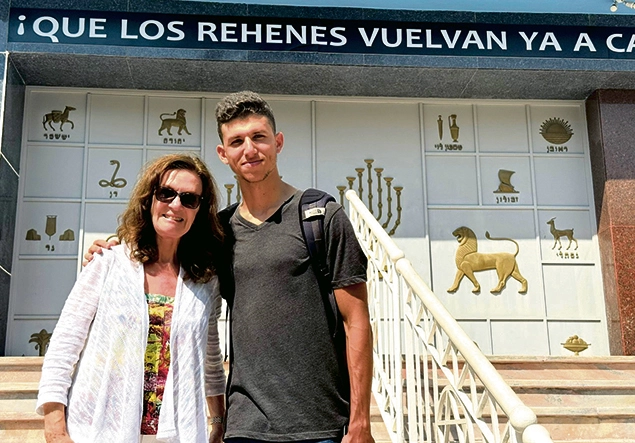
Ruth Pomerantz and Jewish tour guide Abel Hernandez Eskenazi at Beth Sholom; the sign asks for the release of the hostages
That’s true for the whole country, not just the Jewish community. “The average Cuban makes $30 a month,” Mr. Pomerantz said.
“They depend on tourism, and tourism is down worldwide,” Ms. Pomerantz said.
“It’s easy to get there,” Mr. Pomerantz said. “It’s not a big issue. The issue is that the American government has a lot of rules that make it much more complicated.” Americans can’t spend money at places that are even partially owned by the Cuban government, he explained, so “you can’t stay at a major hotel because the Cuban government owns half of all the major hotels. You are not allowed to eat in restaurants or go to museums that the government owns. That is the American law. We stayed at a B&B.”
“It was a very nice one,” Ms. Pomerantz added.
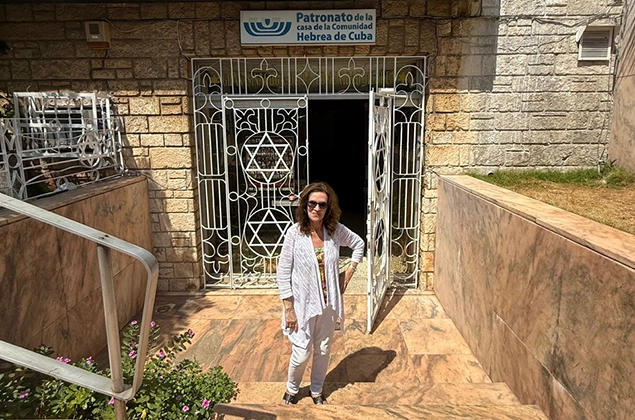
Ruth Pomerantz stands outside an entrance to the Jewish community house
“We hired a 24-year-old engineer to show us the Jewish community,” she continued. “He’s part of the community. We rented a fancy old car.”
Just about all of Cuba’s cars are old. Some of them are from the ’40s and ’50s. That’s because the United States embargoed cars from going into Cuba, and Fidel Castro forbade them from entering anyway. There apparently are some new cars now, but the island is famous for its fleet of old, ingeniously maintained and repaired vintage ones. “They refurbish them any way that they can,” Ms. Pomerantz said. “Most of the gas engines aren’t any good anymore, so they put diesel engines in,” her husband added. “It was a lot of fun.”
The tour guide, Abel Hernandez Eskenazi, “was so informative,” Ms. Pomerantz said. “We learned so much from him. He was actually the first Cuban Jew to win a medal in karate at the Maccabi Games.” That was in 2013, when he won a bronze, and he won another bronze in 2022. In 2017, he won a gold medal.
“He teaches at the university,” Mr. Pomerantz said. “Everyone who goes to the university goes for free, and has to pay the government back by working there. He makes $25 a month, and he can’t live on that, so he’s also a tour guide. His website is Havanajewishtour.com.
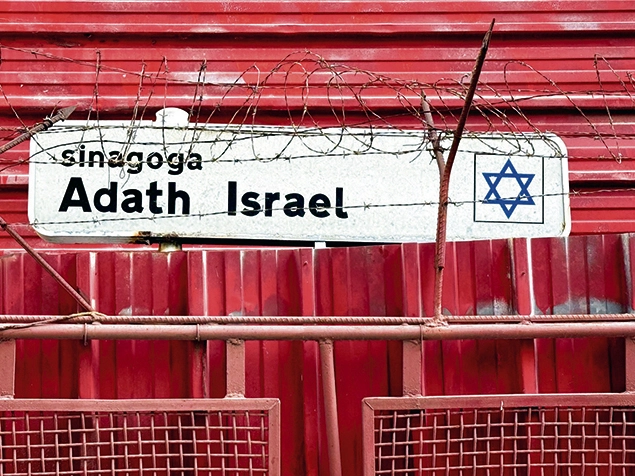
The Orthodox synagogue, Adath Israel, is surrounded by barbed wire
“Many people who are professionals become tour guides or go into the restaurant or tourism businesses. That’s what’s driving the economy.”
Mr. Hernandez Eskenazi doesn’t want to leave Cuba, but it’s complicated, Mr. Pomerantz said. “He feels very connected to it and involved with it. He tries to help wherever he can, especially with the elderly. This is just a fragment of the community, the remnant that is left.
“They also feel that there is no real future there. Abel said indirectly that he would like to leave, but it’s not simple.” The few young Jews who are left often date non-Jews; they have no choice. There are so few of them left.
There are three major synagogues in Havana, the Pomerantzes said; they described them as Orthodox, Sephardi, and Ashkenazi. The Sephardi and Ashkenazi shuls both are Conservative. A rabbi from Uruguay visits the community once a month, they added.
The Holocaust memorial in the Sephardi synagogue
“One of them is surrounded by barbed wire,” Mr. Pomerantz added.
Steven Spielberg funded a Holocaust exhibit inside the Sephardi shul, called Centro Sephardi. The exhibit is called “We Remember — The Holocaust and the Creation of a Living Community.”
The Pomerantzes saw the exhibit, and “it was small, it was intimate, and it was extraordinarily powerful,” Ms. Pomerantz said. “It was only photographs; it was beautifully curated and so emotional. It weaves our story together. No matter where we go in the world, we see these images, and we see ourselves in them.”
The Pomerantzes visited Beth Sholom, which is the Ashkenazi shul, although by now often the Sephardim join them there. “It’s very active, relatively speaking,” Ms. Pomerantz said. It’s the one that serves the community.” It’s a Conservative shul that’s also known as El Patronato.

One of the caretakers’ children
“It is beautiful,” she continued. “We went inside. It’s very tasteful and beautifully renovated. Abel took us into a back room to show us; it was full of boxes from Canada, all labeled, from the Canadian Joint.” That’s the Canadian branch of the American Jewish Joint Distribution Committee. “Every year at Pesach, the Joint sends a huge container of food. It’s all kinds of canned and packaged goods, and Beth Sholom distributes it to every Jew who wants to do Pesach. Abel spearheads the delivery, particularly to the elderly.”
There’s a lot of food left over after that, and it feeds the community throughout the year.
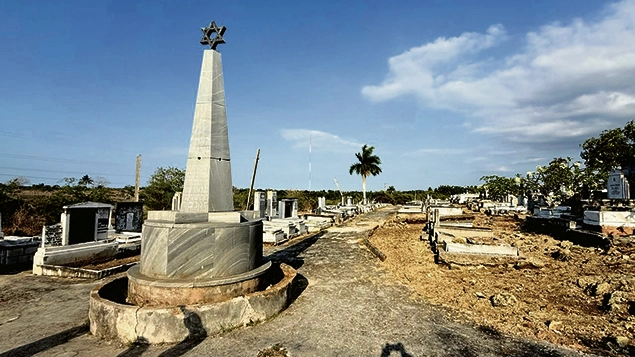
They also took a trip to the Jewish cemeteries. “There are two cemeteries near each other, both about a 45-minute drive from Havana,” Ms. Pomerantz said. “The larger one is Ashkenazi and the smaller one is Sephardi. The Sephardi cemetery is in disrepair, although now it’s getting money for renovation. It’s a slow process.” There’s a Holocaust memorial in that cemetery. “I think it’s pretty amazing to put a Holocaust memorial 45 minutes out of the city, in the middle of nowhere, in a cemetery,” she said.
They met the caretakers, a husband, wife, and two children who have taken care of the cemetery for about 25 years. They’re not Jewish, and the Pomerantzes were moved by their work, and the obvious care they put into it. “We gave the kids some gifts,” they said.

This photo collage hangs in Beth Sholom’s library
The signs of a terrible and sinking economy surrounded them.
They went to a rooftop jazz club one evening, they continued. “It was very small, maybe 25 or 30 people, and the best jazz pianist in Cuba,” Mr. Pomerantz said.
“We asked our waitress if she had a day job, and she said, ‘Yes, I am a radiologist.’ But she’s giving up her job as a doctor.” She can’t afford to keep it.
“The medical training is good, but when you walk to a pharmacy, you see that there is no medicine there. There is a black market for it, but nothing in the pharmacies.

This Torah scroll, donated by a community in Swampscott, Mass., sits in the ark at Centro Hebreo Sefaradi Synagogue
“We went to an artist’s house and gallery; the artist and his wife were both there,” Ms. Pomerantz said. “They were I think in their 60s. I said to his wife, ‘Are you also an artist?’ She said, ‘No I am a doctor. I have three degrees. But I had some medical issues and had to retire. I get a pension from the government. Five dollars a month.
As they looked back on their visit to Cuba, “we never felt unsafe,” the Pomerantzes both said. “The people were friendly. Everyone was friendly. People would want to take you to a restaurant because the restaurant would pay them a commission for that, but they were friendly. We never had a bad experience.
“It was enlightening to see that even with the poverty, how safe you can feel,” Mr. Pomerantz said.
“People’s dignity is so important,” Ms. Pomerantz said. “They are so creative. They find ways to be independent and support themselves. Everything has to do with people coming into the country. You can feel that.”
Now that the flow of tourism has slowed considerably — the whole world feels less safe than it did not all that long ago — “you can feel that too,” she said.
By Joanne Palmer
Bruce and Ruth Pomerantz of Alpine had wanted to go to Cuba for a long time, but the barriers to that trip often have been formidable.
Cuba is close to the United States, so the actual travel isn’t an obstacle. There’s no flying across many time zones or changing flights or dealing with airplane meal after airplane meal as you gradually lose all feeling in your legs and come to bitterly resent the head of the stranger in front of you implanting in your lap.
Politics has been an issue with many periods when the animosity between the United States and Cuba has made tourism nearly impossible. But now is not one of those times. Americans can get to Cuba, although once they’re there, they are limited in how and where they can spend money.
Language isn’t an issue; Ms. Pomerantz is fluent in Spanish.
In 2003, the Pomerantz’s younger daughter, Lara, spent the summer in Cuba after her sophomore year at Duke University. It was a good summer. She was there on a fellowship, and through their friend Rabbi Noam Marans of Teaneck they were able to arrange for her to stay with a Jewish family. “We were nervous about her staying there alone, at 19” — and at a time when cellphone service was spotty — but it worked out very well.
“I tried to visit her there,” Mr. Pomerantz said. “But I’d been a journalist, and the State Department asked me more and more questions, and by the time they approved my trip she already was on her way home.”
Both Pomerantzes also have historic family connections to Cuba.
“My mother’s aunt went to Cuba with her mother, my great-grandmother,” Ms. Pomerantz said. “My great-grandmother left Poland with her younger daughter; her son was already in the United States, and her other daughter, my grandmother, was already married in Poland. Life was very difficult in Poland, because my great-grandfather had been killed in World War II.
Ruth and Bruce Pomerantz are outside Fusterlandia, a Havana wonderland created by artist Jose Fuster
“So my great-grandmother came to the United States alone with her daughter. She wanted her daughter to meet a Jewish guy. In America, she heard about a handsome man from a good family in Cuba, so they went there. And that’s why Tante Helen married Uncle Louie.
“Then they came to live in the United States.”
Mr. Pomerantz had a great-aunt Frieda, who had somehow escaped Auschwitz, he said, and so did her husband. “I don’t know how they did it, but they did. So they got to Cuba. After they spent some time in Cuba, they went to Montreal, and became dry cleaners there.”
In May, the Pomerantzes decided that it finally was time to go to Cuba. They spent eight days there. They didn’t go with a group, but on their own, arranging for tour guides to show them around.
This reminder of the hostages held in Gaza hangs in Beth Sholom
One of their goals was to see what the Jewish community in Cuba was like, they said.
This community dates back to the Spanish Inquisition, when some Jews fled to the island. Many more Jews joined that very small group in the early 20th century — they’d hoped to go from Cuba to the United States, but restrictive U.S. immigration laws kept them out. Cuba was home then to an estimated 2,400 Jews. Others escaped from the Nazis and to Cuba in the 1930s. But about 95 percent of the Jewish community left Cuba after the Communist revolution in 1959.
By now, “there are only about 1,000 Jews left in Cuba,” Mr. Pomerantz said. “They have been leaving. They go wherever they can — they can’t come to America now, but South America, Europe, anywhere they can get in.
“They don’t face much antisemitism, but the economy is terrible.”
Ruth Pomerantz and Jewish tour guide Abel Hernandez Eskenazi at Beth Sholom; the sign asks for the release of the hostages
That’s true for the whole country, not just the Jewish community. “The average Cuban makes $30 a month,” Mr. Pomerantz said.
“They depend on tourism, and tourism is down worldwide,” Ms. Pomerantz said.
“It’s easy to get there,” Mr. Pomerantz said. “It’s not a big issue. The issue is that the American government has a lot of rules that make it much more complicated.” Americans can’t spend money at places that are even partially owned by the Cuban government, he explained, so “you can’t stay at a major hotel because the Cuban government owns half of all the major hotels. You are not allowed to eat in restaurants or go to museums that the government owns. That is the American law. We stayed at a B&B.”
“It was a very nice one,” Ms. Pomerantz added.
Ruth Pomerantz stands outside an entrance to the Jewish community house
“We hired a 24-year-old engineer to show us the Jewish community,” she continued. “He’s part of the community. We rented a fancy old car.”
Just about all of Cuba’s cars are old. Some of them are from the ’40s and ’50s. That’s because the United States embargoed cars from going into Cuba, and Fidel Castro forbade them from entering anyway. There apparently are some new cars now, but the island is famous for its fleet of old, ingeniously maintained and repaired vintage ones. “They refurbish them any way that they can,” Ms. Pomerantz said. “Most of the gas engines aren’t any good anymore, so they put diesel engines in,” her husband added. “It was a lot of fun.”
The tour guide, Abel Hernandez Eskenazi, “was so informative,” Ms. Pomerantz said. “We learned so much from him. He was actually the first Cuban Jew to win a medal in karate at the Maccabi Games.” That was in 2013, when he won a bronze, and he won another bronze in 2022. In 2017, he won a gold medal.
“He teaches at the university,” Mr. Pomerantz said. “Everyone who goes to the university goes for free, and has to pay the government back by working there. He makes $25 a month, and he can’t live on that, so he’s also a tour guide. His website is Havanajewishtour.com.
The Orthodox synagogue, Adath Israel, is surrounded by barbed wire
“Many people who are professionals become tour guides or go into the restaurant or tourism businesses. That’s what’s driving the economy.”
Mr. Hernandez Eskenazi doesn’t want to leave Cuba, but it’s complicated, Mr. Pomerantz said. “He feels very connected to it and involved with it. He tries to help wherever he can, especially with the elderly. This is just a fragment of the community, the remnant that is left.
“They also feel that there is no real future there. Abel said indirectly that he would like to leave, but it’s not simple.” The few young Jews who are left often date non-Jews; they have no choice. There are so few of them left.
There are three major synagogues in Havana, the Pomerantzes said; they described them as Orthodox, Sephardi, and Ashkenazi. The Sephardi and Ashkenazi shuls both are Conservative. A rabbi from Uruguay visits the community once a month, they added.
The Holocaust memorial in the Sephardi synagogue
“One of them is surrounded by barbed wire,” Mr. Pomerantz added.
Steven Spielberg funded a Holocaust exhibit inside the Sephardi shul, called Centro Sephardi. The exhibit is called “We Remember — The Holocaust and the Creation of a Living Community.”
The Pomerantzes saw the exhibit, and “it was small, it was intimate, and it was extraordinarily powerful,” Ms. Pomerantz said. “It was only photographs; it was beautifully curated and so emotional. It weaves our story together. No matter where we go in the world, we see these images, and we see ourselves in them.”
The Pomerantzes visited Beth Sholom, which is the Ashkenazi shul, although by now often the Sephardim join them there. “It’s very active, relatively speaking,” Ms. Pomerantz said. It’s the one that serves the community.” It’s a Conservative shul that’s also known as El Patronato.
One of the caretakers’ children
“It is beautiful,” she continued. “We went inside. It’s very tasteful and beautifully renovated. Abel took us into a back room to show us; it was full of boxes from Canada, all labeled, from the Canadian Joint.” That’s the Canadian branch of the American Jewish Joint Distribution Committee. “Every year at Pesach, the Joint sends a huge container of food. It’s all kinds of canned and packaged goods, and Beth Sholom distributes it to every Jew who wants to do Pesach. Abel spearheads the delivery, particularly to the elderly.”
There’s a lot of food left over after that, and it feeds the community throughout the year.
They also took a trip to the Jewish cemeteries. “There are two cemeteries near each other, both about a 45-minute drive from Havana,” Ms. Pomerantz said. “The larger one is Ashkenazi and the smaller one is Sephardi. The Sephardi cemetery is in disrepair, although now it’s getting money for renovation. It’s a slow process.” There’s a Holocaust memorial in that cemetery. “I think it’s pretty amazing to put a Holocaust memorial 45 minutes out of the city, in the middle of nowhere, in a cemetery,” she said.
They met the caretakers, a husband, wife, and two children who have taken care of the cemetery for about 25 years. They’re not Jewish, and the Pomerantzes were moved by their work, and the obvious care they put into it. “We gave the kids some gifts,” they said.
This photo collage hangs in Beth Sholom’s library
The signs of a terrible and sinking economy surrounded them.
They went to a rooftop jazz club one evening, they continued. “It was very small, maybe 25 or 30 people, and the best jazz pianist in Cuba,” Mr. Pomerantz said.
“We asked our waitress if she had a day job, and she said, ‘Yes, I am a radiologist.’ But she’s giving up her job as a doctor.” She can’t afford to keep it.
“The medical training is good, but when you walk to a pharmacy, you see that there is no medicine there. There is a black market for it, but nothing in the pharmacies.
This Torah scroll, donated by a community in Swampscott, Mass., sits in the ark at Centro Hebreo Sefaradi Synagogue
“We went to an artist’s house and gallery; the artist and his wife were both there,” Ms. Pomerantz said. “They were I think in their 60s. I said to his wife, ‘Are you also an artist?’ She said, ‘No I am a doctor. I have three degrees. But I had some medical issues and had to retire. I get a pension from the government. Five dollars a month.
As they looked back on their visit to Cuba, “we never felt unsafe,” the Pomerantzes both said. “The people were friendly. Everyone was friendly. People would want to take you to a restaurant because the restaurant would pay them a commission for that, but they were friendly. We never had a bad experience.
“It was enlightening to see that even with the poverty, how safe you can feel,” Mr. Pomerantz said.
“People’s dignity is so important,” Ms. Pomerantz said. “They are so creative. They find ways to be independent and support themselves. Everything has to do with people coming into the country. You can feel that.”
Now that the flow of tourism has slowed considerably — the whole world feels less safe than it did not all that long ago — “you can feel that too,” she said.