623-36-4798

  • Want to keep track of this thread?
    Accounts can bookmark posts, watch threads for updates, and jump back to where you stopped reading.
    Create account
MOONFLEET CONT

There was a moon three-quarters full, already in the sky, and on moonlight nights I was allowed no candle to show me to bed. But on that night I needed none, for I never took off my clothes, having resolved to wait till my aunt was asleep, and then, ghosts or no ghosts, to make my way back to the churchyard. I did not dare to put off that visit even till the morning, lest some chance passer-by should light upon the hole, and so forestall me with Blackbeard's treasure.

Thus I lay wide awake on my bed watching the shadow of the tester-post against the whitewashed wall, and noting how it had moved, by degrees, as the moon went farther round. At last, just as it touched the picture of the Good Shepherd which hung over the mantelpiece, I heard my aunt snoring in her room, and knew that I was free. Yet I waited a few minutes so that she might get well on with her first sleep, and then took off my boots, and in stockinged feet slipped past her room and down the stairs. How stair, handrail, and landing creaked that night, and how my feet and body struck noisily against things seen quite well but misjudged in the effort not to misjudge them! And yet there was the note of safety still sounding, for the snoring never ceased, and the sleeper woke not, though her waking then might have changed all my life. So I came safely to the kitchen, and there put in my pocket one of the best winter candles and the tinder-box, and as I crept out of the room heard suddenly how loud the old clock was ticking, and looking up saw the bright brass band marking half past ten on the dial.

Out in the street I kept in the shadow of the houses as far as I might, though all was silent as the grave; indeed, I think that when the moon is bright a great hush falls always upon Nature, as though she was taken up in wondering at her own beauty. Everyone was fast asleep in Moonfleet and there was no light in any window; only when I came opposite the Why Not? I saw from the red glow behind the curtains that the bottom room was lit up, so Elzevir was not yet gone to bed. It was strange, for the Why Not? had been shut up early for many a long night past, and I crossed over cautiously to see if I could make out what was going forward. But that was not to be done, for the panes were thickly steamed over; and this surprised me more as showing that there was a good company inside. Moreover, as I stood and listened I could hear a mutter of deep voices inside, not as of roisterers, but of sober men talking low.

Eagerness would not let me wait long, and I was off across the meadows towards the church, though not without sad misgivings as soon as the last house was left well behind me. At the churchyard wall my courage had waned somewhat: it seemed a shameless thing to come to rifle Blackbeard's treasure just in the very place and hour that Blackbeard loved; and as I passed the turnstile I half-expected that a tall figure, hairy and evil-eyed, would spring out from the shadow on the north side of the church. But nothing stirred, and the frosty grass sounded crisp under my feet as I made across the churchyard, stepping over the graves and keeping always out of the shadows, towards the black clump of yew-trees on the far side.

When I got round the yews, there was the tomb standing out white against them, and at the foot of the tomb was the hole like a patch of black velvet spread upon the ground, it was so dark. Then, for a moment, I thought that Blackbeard might be lying in wait in the bottom of the hole, and I stood uncertain whether to go on or back. I could catch the rustle of the water on the beach—not of any waves, for the bay was smooth as glass, but just a lipper at the fringe; and wishing to put off with any excuse the descent into the passage, though I had quite resolved to make it, I settled with myself that I would count the water wash twenty times, and at the twentieth would let myself down into the hole. Only seven wavelets had come in when I forgot to count, for there, right in the middle of the moon's path across the water, lay a lugger moored broadside to the beach. She was about half a mile out, but there was no mistake, for though her sails were lowered her masts and hull stood out black against the moonlight. Here was a fresh reason for delay, for surely one must consider what this craft could be, and what had brought her here. She was too small for a privateer, too large for a fishing-smack, and could not be a revenue boat by her low freeboard in the waist; and 'twas a strange thing for a boat to cast anchor in the midst of Moonfleet Bay even on a night so fine as this. Then while I watched I saw a blue flare in the bows, only for a moment, as if a man had lit a squib and flung it overboard, but I knew from it she was a contrabandier, and signalling either to the shore or to a mate in the offing. With that, courage came back, and I resolved to make this flare my signal for getting down into the hole, screwing my heart up with the thought that if Blackbeard was really waiting for me there, 'twould be little good to turn tail now, for he would be after me and could certainly run much faster than I. Then I took one last look round, and down into the hole forthwith, the same way as I had got down earlier in the day. So on that February night John Trenchard found himself standing in the heap of loose fallen mould at the bottom of the hole, with a mixture of courage and cowardice in his heart, but overruling all a great desire to get at Blackbeard's diamond.

Out came tinder-box and candle, and I was glad indeed when the light burned up bright enough to show that no one, at any rate, was standing by my side. But then there was the passage, and who could say what might be lurking there? Yet I did not falter, but set out on this adventurous journey, walking very slowly indeed—but that was from fear of pitfalls—and nerving myself with the thought of the great diamond which surely would be found at the end of the passage. What should I not be able to do with such wealth? I would buy a nag for Mr. Glennie, a new boat for Ratsey, and a silk gown for Aunt Jane, in spite of her being so hard with me as on this night. And thus I would make myself the greatest man in Moonfleet, richer even than Mr. Maskew, and build a stone house in the sea-meadows with a good prospect of the sea, and marry Grace Maskew and live happily, and fish. I walked on down the passage, reaching out the candle as far as might be in front of me, and whistling to keep myself company, yet saw neither Blackbeard nor anyone else. All the way there were footprints on the floor, and the roof was black as with smoke of torches, and this made me fear lest some of those who had been there before might have made away with the diamond. Now, though I have spoken of this journey down the passage as though it were a mile long, and though it verily seemed so to me that night, yet I afterwards found it was not more than twenty yards or thereabouts; and then I came upon a stone wall which had once blocked the road, but was now broken through so as to make a ragged doorway into a chamber beyond. There I stood on the rough sill of the door, holding my breath and reaching out my candle arm's-length into the darkness, to see what sort of a place this was before I put foot into it. And before the light had well time to fall on things, I knew that I was underneath the church, and that this chamber was none other than the Mohune Vault.

It was a large room, much larger, I think, than the schoolroom where Mr. Glennie taught us, but not near so high, being only some nine feet from floor to roof. I say floor, though in reality there was none, but only a bottom of soft wet sand; and when I stepped down on to it my heart beat very fiercely, for I remembered what manner of place I was entering, and the dreadful sounds which had issued from it that Sunday morning so short a time before. I satisfied myself that there was nothing evil lurking in the dark corners, or nothing visible at least, and then began to look round and note what was to be seen. Walls and roof were stone, and at one end was a staircase closed by a great flat stone at top—that same stone which I had often seen, with a ring in it, in the floor of the church above. All round the sides were stone shelves, with divisions between them like great bookcases, but instead of books there were the coffins of the Mohunes. Yet these lay only at the sides, and in the middle of the room was something very different, for here were stacked scores of casks, kegs, and runlets, from a storage butt that might hold thirty gallons down to a breaker that held only one. They were marked all of them in white paint on the end with figures and letters, that doubtless set forth the quality to those that understood. Here indeed was a discovery, and instead of picking up at the end of the passage a little brass or silver casket, which had only to be opened to show Blackbeard's diamond gleaming inside, I had stumbled on the Mohunes' vault, and found it to be nothing but a cellar of gentlemen of the contraband, for surely good liquor would never be stored in so shy a place if it ever had paid the excise.

As I walked round this stack of casks my foot struck sharply on the edge of a butt, which must have been near empty, and straightway came from it the same hollow, booming sound (only fainter) which had so frightened us in church that Sunday morning. So it was the casks, and not the coffins, that had been knocking one against another; and I was pleased with myself, remembering how I had reasoned that coffin-wood could never give that booming sound.

It was plain enough that the whole place had been under water: the floor was still muddy, and the green and sweating walls showed the flood-mark within two feet of the roof; there was a wisp or two of fine seaweed that had somehow got in, and a small crab was still alive and scuttled across the corner, yet the coffins were but little disturbed. They lay on the shelves in rows, one above the other, and numbered twenty-three in all: most were in lead, and so could never float, but of those in wood some were turned slantways in their niches, and one had floated right away and been left on the floor upside down in a corner when the waters went back.

First I fell to wondering as to whose cellar this was, and how so much liquor could have been brought in with secrecy; and how it was I had never seen anything of the contraband-men, though it was clear that they had made this flat tomb the entrance to their storehouse, as I had made it my seat. And then I remembered how Ratsey had tried to scare me with talk of Blackbeard; and how Elzevir, who had never been seen at church before, was there the Sunday of the noises; and how he had looked ill at ease whenever the noise came, though he was bold as a lion; and how I had tripped upon him and Ratsey in the churchyard; and how Master Ratsey lay with his ear to the wall: and putting all these things together and casting them up, I thought that Elzevir and Ratsey knew as much as any about this hiding-place. These reflections gave me more courage, for I considered that the tales of Blackbeard walking or digging among the graves had been set afloat to keep those that were not wanted from the place, and guessed now that when I saw the light moving in the churchyard that night I went to fetch Dr. Hawkins, it was no corpse-candle, but a lantern of smugglers running a cargo. Then, having settled these important matters, I began to turn over in my mind how to get at the treasure; and herein was much cast down, for in this place was neither casket nor diamond, but only coffins and double-Hollands. So it was that, having no better plan, I set to work to see whether I could learn anything from the coffins themselves; but with little success, for the lead coffins had no names upon them, and on such of the wooden coffins as bore plates I found the writing to be Latin, and so rusted over that I could make nothing of it.

Edit: oops posted the wrong part, sorry
 
MOONFLEET CONT

Soon I wished I had not come at all, considering that the diamond had vanished into air, and it was a sad thing to be cabined with so many dead men. It moved me, too, to see pieces of banners and funeral shields, and even shreds of wreaths that dear hearts had put there a century ago, now all ruined and rotten—some still clinging, water-sodden, to the coffins, and some trampled in the sand of the floor. I had spent some time in this bootless search, and was resolved to give up further inquiry and foot it home, when the clock in the tower struck midnight. Surely never was ghostly hour sounded in more ghostly place. Moonfleet peal was known over half the county, and the finest part of it was the clock bell. 'Twas said that in times past (when, perhaps, the chimes were rung more often than now) the voice of this bell had led safe home boats that were lost in the fog; and this night its clangour, mellow and profound, reached even to the vault. Bim-bom it went, bim-bom, twelve heavy thuds that shook the walls, twelve resonant echoes that followed, and then a purring and vibration of the air, so that the ear could not tell when it ended.

I was wrought up, perhaps, by the strangeness of the hour and place, and my hearing quicker than at other times, but before the tremor of the bell was quite passed away I knew there was some other sound in the air, and that the awful stillness of the vault was broken. At first I could not tell what this new sound was, nor whence it came, and now it seemed a little noise close by, and now a great noise in the distance. And then it grew nearer and more defined, and in a moment I knew it was the sound of voices talking. They must have been a long way off at first, and for a minute, that seemed as an age, they came no nearer. What a minute was that to me! Even now, so many years after, I can recall the anguish of it, and how I stood with ears pricked up, eyes starting, and a clammy sweat upon my face, waiting for those speakers to come. It was the anguish of the rabbit at the end of his burrow, with the ferret's eyes gleaming in the dark, and gun and lurcher waiting at the mouth of the hole. I was caught in a trap, and knew beside that contraband-men had a way of sealing prying eyes and stilling babbling tongues; and I remembered poor Cracky Jones found dead in the churchyard, and how men said he had met Blackbeard in the night.

These were but the thoughts of a second, but the voices were nearer, and I heard a dull thud far up the passage, and knew that a man had jumped down from the churchyard into the hole. So I took a last stare round, agonizing to see if there was any way of escape; but the stone walls and roof were solid enough to crush me, and the stack of casks too closely packed to hide more than a rat. There was a man speaking now from the bottom of the hole to others in the churchyard, and then my eyes were led as by a loadstone to a great wooden coffin that lay by itself on the top shelf, a full six feet from the ground. When I saw the coffin I knew that I was respited, for, as I judged, there was space between it and the wall behind enough to contain my little carcass; and in a second I had put out the candle, scrambled up the shelves, half-stunned my senses with dashing my head against the roof, and squeezed my body betwixt wall and coffin. There I lay on one side with a thin and rotten plank between the dead man and me, dazed with the blow to my head, and breathing hard; while the glow of torches as they came down the passage reddened and flickered on the roof above.
 
The Case of Charles Dexter Ward, cont'd.

V:5

Marinus Bicknell Willett has no hope that any part of his tale will be believed except by certain sympathetic friends, hence he has made no attempt to tell it beyond his most intimate circle. Only a few outsiders have ever heard it repeated, and of these the majority laugh and remark that the doctor surely is getting old. He has been advised to take a long vacation and to shun future cases dealing with mental disturbance. But Mr. Ward knows that the veteran physician speaks only a horrible truth. Did not he himself see the noisome aperture in the bungalow cellar? Did not Willett send him home overcome and ill at eleven o’clock that portentous morning? Did he not telephone the doctor in vain that evening, and again the next day, and had he not driven to the bungalow itself on that following noon, finding his friend unconscious but unharmed on one of the beds upstairs? Willett had been breathing stertorously, and opened his eyes slowly when Mr. Ward gave him some brandy fetched from the car. Then he shuddered and screamed, crying out, “That beard . . . those eyes. . . . God, who are you?” A very strange thing to say to a trim, blue-eyed, clean-shaven gentleman whom he had known from the latter’s boyhood.

In the bright noon sunlight the bungalow was unchanged since the previous morning. Willett’s clothing bore no disarrangement beyond certain smudges and worn places at the knees, and only a faint acrid odour reminded Mr. Ward of what he had smelt on his son that day he was taken to the hospital. The doctor’s flashlight was missing, but his valise was safely there, as empty as when he had brought it. Before indulging in any explanations, and obviously with great moral effort, Willett staggered dizzily down to the cellar and tried the fateful platform before the tubs. It was unyielding. Crossing to where he had left his yet unused tool satchel the day before, he obtained a chisel and began to pry up the stubborn planks one by one. Underneath the smooth concrete was still visible, but of any opening or perforation there was no longer a trace. Nothing yawned this time to sicken the mystified father who had followed the doctor downstairs; only the smooth concrete underneath the planks—no noisome well, no world of subterrene horrors, no secret library, no Curwen papers, no nightmare pits of stench and howling, no laboratory or shelves or chiselled formulae, no. . . . Dr. Willett turned pale, and clutched at the younger man. “Yesterday,” he asked softly, “did you see it here . . . and smell it?” And when Mr. Ward, himself transfixed with dread and wonder, found strength to nod an affirmative, the physician gave a sound half a sigh and half a gasp, and nodded in turn. “Then I will tell you,” he said.

So for an hour, in the sunniest room they could find upstairs, the physician whispered his frightful tale to the wondering father. There was nothing to relate beyond the looming up of that form when the greenish-black vapour from the kylix parted, and Willett was too tired to ask himself what had really occurred. There were futile, bewildered head-shakings from both men, and once Mr. Ward ventured a hushed suggestion, “Do you suppose it would be of any use to dig?” The doctor was silent, for it seemed hardly fitting for any human brain to answer when powers of unknown spheres had so vitally encroached on this side of the Great Abyss. Again Mr. Ward asked, “But where did it go? It brought you here, you know, and it sealed up the hole somehow.” And Willett again let silence answer for him.

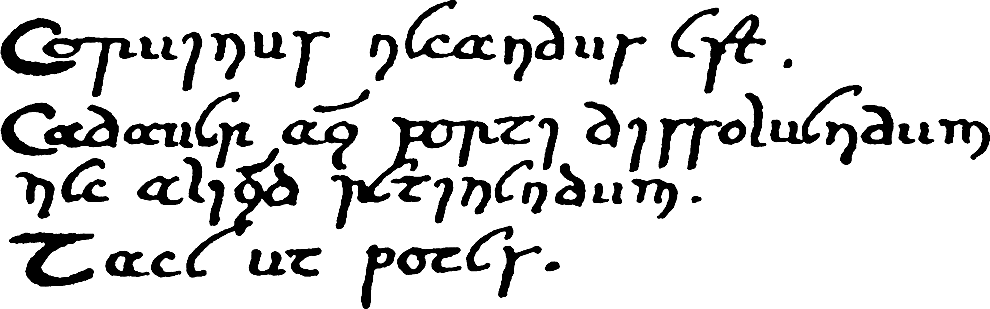
But after all, this was not the final phase of the matter. Reaching for his handkerchief before rising to leave, Dr. Willett’s fingers closed upon a piece of paper in his pocket which had not been there before, and which was companioned by the candles and matches he had seized in the vanished vault. It was a common sheet, torn obviously from the cheap pad in that fabulous room of horror somewhere underground, and the writing upon it was that of an ordinary lead pencil—doubtless the one which had lain beside the pad. It was folded very carelessly, and beyond the faint acrid scent of the cryptic chamber bore no print or mark of any world but this. But in the text itself it did indeed reek with wonder; for here was no script of any wholesome age, but the laboured strokes of mediaeval darkness, scarcely legible to the laymen who now strained over it, yet having combinations of symbols which seemed vaguely familiar. The briefly scrawled message was this, and its mystery lent purpose to the shaken pair, who forthwith walked steadily out to the Ward car and gave orders to be driven first to a quiet dining place and then to the John Hay Library on the hill.
1000023599.gif

At the library it was easy to find good manuals of palaeography, and over these the two men puzzled till the lights of evening shone out from the great chandelier. In the end they found what was needed. The letters were indeed no fantastic invention, but the normal script of a very dark period. They were the pointed Saxon minuscules of the eighth or ninth century A.D., and brought with them memories of an uncouth time when under a fresh Christian veneer ancient faiths and ancient rites stirred stealthily, and the pale moon of Britain looked sometimes on strange deeds in the Roman ruins of Caerleon and Hexham, and by the towers along Hadrian’s crumbling wall. The words were in such Latin as a barbarous age might remember—“Corvinus necandus est. Cadaver aq(ua) forti dissolvendum, nec aliq(ui)d retinendum. Tace ut potes.”—which may roughly be translated, “Curwen must be killed. The body must be dissolved in aqua fortis, nor must anything be retained. Keep silence as best you are able.”

Willett and Mr. Ward were mute and baffled. They had met the unknown, and found that they lacked emotions to respond to it as they vaguely believed they ought. With Willett, especially, the capacity for receiving fresh impressions of awe was well-nigh exhausted; and both men sat still and helpless till the closing of the library forced them to leave. Then they drove listlessly to the Ward mansion in Prospect Street, and talked to no purpose into the night. The doctor rested toward morning, but did not go home. And he was still there Sunday noon when a telephone message came from the detectives who had been assigned to look up Dr. Allen.

Mr. Ward, who was pacing nervously about in a dressing-gown, answered the call in person; and told the men to come up early the next day when he heard their report was almost ready. Both Willett and he were glad that this phase of the matter was taking form, for whatever the origin of the strange minuscule message, it seemed certain that the “Curwen” who must be destroyed could be no other than the bearded and spectacled stranger. Charles had feared this man, and had said in the frantic note that he must be killed and dissolved in acid. Allen, moreover, had been receiving letters from the strange wizards in Europe under the name of Curwen, and palpably regarded himself as an avatar of the bygone necromancer. And now from a fresh and unknown source had come a message saying that “Curwen” must be killed and dissolved in acid. The linkage was too unmistakable to be factitious; and besides, was not Allen planning to murder young Ward upon the advice of the creature called Hutchinson? Of course, the letter they had seen had never reached the bearded stranger; but from its text they could see that Allen had already formed plans for dealing with the youth if he grew too ‘squeamish’. Without doubt, Allen must be apprehended; and even if the most drastic directions were not carried out, he must be placed where he could inflict no harm upon Charles Ward.

That afternoon, hoping against hope to extract some gleam of information anent the inmost mysteries from the only available one capable of giving it, the father and the doctor went down the bay and called on young Charles at the hospital. Simply and gravely Willett told him all he had found, and noticed how pale he turned as each description made certain the truth of the discovery. The physician employed as much dramatic effect as he could, and watched for a wincing on Charles’s part when he approached the matter of the covered pits and the nameless hybrids within. But Ward did not wince. Willett paused, and his voice grew indignant as he spoke of how the things were starving. He taxed the youth with shocking inhumanity, and shivered when only a sardonic laugh came in reply. For Charles, having dropped as useless his pretence that the crypt did not exist, seemed to see some ghastly jest in this affair; and chuckled hoarsely at something which amused him. Then he whispered, in accents doubly terrible because of the cracked voice he used, “Damn ’em, they do eat, but they don’t need to! That’s the rare part! A month, you say, without food? Lud, Sir, you be modest! D’ye know, that was the joke on poor old Whipple with his virtuous bluster! Kill everything off, would he? Why, damme, he was half-deaf with the noise from Outside and never saw or heard aught from the wells! He never dreamed they were there at all! Devil take ye, those cursed things have been howling down there ever since Curwen was done for a hundred and fifty-seven years gone!

But no more than this could Willett get from the youth. Horrified, yet almost convinced against his will, he went on with his tale in the hope that some incident might startle his auditor out of the mad composure he maintained. Looking at the youth’s face, the doctor could not but feel a kind of terror at the changes which recent months had wrought. Truly, the boy had drawn down nameless horrors from the skies. When the room with the formulae and the greenish dust was mentioned, Charles shewed his first sign of animation. A quizzical look overspread his face as he heard what Willett had read on the pad, and he ventured the mild statement that those notes were old ones, of no possible significance to anyone not deeply initiated in the history of magic. “But,” he added, “had you but known the words to bring up that which I had out in the cup, you had not been here to tell me this. ’Twas Number 118, and I conceive you would have shook had you looked it up in my list in t’other room. ’Twas never raised by me, but I meant to have it up that day you came to invite me hither.”

Then Willett told of the formula he had spoken and of the greenish-black smoke which had arisen; and as he did so he saw true fear dawn for the first time on Charles Ward’s face. “It came, and you be here alive?” As Ward croaked the words his voice seemed almost to burst free of its trammels and sink to cavernous abysses of uncanny resonance. Willett, gifted with a flash of inspiration, believed he saw the situation, and wove into his reply a caution from a letter he remembered. “No. 118, you say? But don’t forget that stones are all changed now in nine grounds out of ten. You are never sure till you question!” And then, without warning, he drew forth the minuscule message and flashed it before the patient’s eyes. He could have wished no stronger result, for Charles Ward fainted forthwith.

All this conversation, of course, had been conducted with the greatest secrecy lest the resident alienists accuse the father and the physician of encouraging a madman in his delusions. Unaided, too, Dr. Willett and Mr. Ward picked up the stricken youth and placed him on the couch. In reviving, the patient mumbled many times of some word which he must get to Orne and Hutchinson at once; so when his consciousness seemed fully back the doctor told him that of those strange creatures at least one was his bitter enemy, and had given Dr. Allen advice for his assassination. This revelation produced no visible effect, and before it was made the visitors could see that their host had already the look of a hunted man. After that he would converse no more, so Willett and the father departed presently; leaving behind a caution against the bearded Allen, to which the youth only replied that this individual was very safely taken care of, and could do no one any harm even if he wished. This was said with an almost evil chuckle very painful to hear. They did not worry about any communications Charles might indite to that monstrous pair in Europe, since they knew that the hospital authorities seized all outgoing mail for censorship and would pass no wild or outré-looking missive.

There is, however, a curious sequel to the matter of Orne and Hutchinson, if such indeed the exiled wizards were. Moved by some vague presentiment amidst the horrors of that period, Willett arranged with an international press-cutting bureau for accounts of notable current crimes and accidents in Prague and in eastern Transylvania; and after six months believed that he had found two very significant things amongst the multifarious items he received and had translated. One was the total wrecking of a house by night in the oldest quarter of Prague, and the disappearance of the evil old man called Josef Nadek, who had dwelt in it alone ever since anyone could remember. The other was a titan explosion in the Transylvanian mountains east of Rakus, and the utter extirpation with all its inmates of the ill-regarded Castle Ferenczy, whose master was so badly spoken of by peasants and soldiery alike that he would shortly have been summoned to Bucharest for serious questioning had not this incident cut off a career already so long as to antedate all common memory. Willett maintains that the hand which wrote those minuscules was able to wield stronger weapons as well; and that while Curwen was left to him to dispose of, the writer felt able to find and deal with Orne and Hutchinson itself. Of what their fate may have been the doctor strives sedulously not to think.
 
MOONFLEET CONT

CHAPTER 4
IN THE VAULT
Let us hob and nob with Death—Tennyson

Though nothing of the vault except the roof was visible from where I lay, and so I could not see these visitors, yet I heard every word spoken, and soon made out one voice as being Master Ratsey's. This discovery gave me no surprise but much solace, for I thought that if the worst happened and I was discovered, I should find one friend with whom I could plead for life.

'It is well the earth gave way', the sexton was saying, 'on a night when we were here to find it. I was in the graveyard myself after midday, and all was snug and tight then. 'Twould have been awkward enough to have the hole stand open through the day, for any passer-by to light on.'

There were four or five men in the vault already, and I could hear more coming down the passage, and guessed from their heavy footsteps that they were carrying burdens. There was a sound, too, of dumping kegs down on the ground, with a swish of liquor inside them, and then the noise of casks being moved.

'I thought we should have a fall there ere long,' Ratsey went on, 'what with this drought parching the ground, and the trampling at the edge when we move out the side stone to get in, but there is no mischief done beyond what can be easily made good. A gravestone or two and a few spades of earth will make all sound again. Leave that to me.'

'Be careful what you do,' rejoined another man's voice that I did not know, 'lest someone see you digging, and scent us out.'

'Make your mind easy,' Ratsey said; 'I have dug too often in this graveyard for any to wonder if they see me with a spade.'

Then the conversation broke off, and there was little more talking, only a noise of men going backwards and forwards, and of putting down of kegs and the hollow gurgle of good liquor being poured from breakers into the casks. By and by fumes of brandy began to fill the air, and climb to where I lay, overcoming the mouldy smell of decayed wood and the dampness of the green walls. It may have been that these fumes mounted to my head, and gave me courage not my own, but so it was that I lost something of the stifling fear that had gripped me, and could listen with more ease to what was going forward. There was a pause in the carrying to and fro; they were talking again now, and someone said—

'I was in Dorchester three days ago, and heard men say it will go hard with the poor chaps who had the brush with the Elector last summer. Judge Barentyne comes on Assize next week, and that old fox Maskew has driven down to Taunton to get at him before and coach him back; making out to him that the Law's arm is weak in these parts against the contraband, and must be strengthened by some wholesome hangings.'

'They are a cruel pair,' another put in, 'and we shall have new gibbets on Ridgedown for leading lights. Once I get even with Maskew, the other may go hang, ay, and they may hang me too.'

'The Devil send him to meet me one dark night on the down alone,' said someone else, 'and I will give him a pistol's mouth to look down, and spoil his face for him.'

'No, thou wilt not,' said a deep voice, and then I knew that Elzevir was there too; 'none shall lay hand on Maskew but I. So mark that, lad, that when his day of reckoning comes, 'tis I will reckon with him.'

Then for a few minutes I did not pay much heed to what was said, being terribly straitened for room, and cramped with pain from lying so long in one place. The thick smoke from the pitch torches too came curling across the roof and down upon me, making me sick and giddy with its evil smell and taste; and though all was very dim, I could see my hands were black with oily smuts. At last I was able to wriggle myself over without making too much noise, and felt a great relief in changing sides, but gave such a start as made the coffin creak again at hearing my own name.

'There is a boy of Trenchard's,' said a voice that I thought was Parmiter's, who lived at the bottom of the village—'there is a boy of Trenchard's that I mistrust; he is for ever wandering in the graveyard, and I have seen him a score of times sitting on this tomb and looking out to sea. This very night, when the wind fell at sundown, and we were hung up with sails flapping, three miles out, and waited for the dark to get the sweeps, I took my glass to scan the coast-line, and lo, here on the tomb-top sits Master Trenchard. I could not see his face, but knew him by his cut, and fear the boy sits there to play the spy and then tells Maskew.'

'You're right,' said Greening of Ringstave, for I knew his slow drawl; 'and many a time when I have sat in The Wood, and watched the Manor to see Maskew safe at home before we ran a cargo, I have seen this boy too go round about the place with a hangdog look, scanning the house as if his life depended on't.'

'Twas very true what Greening said; for of a summer evening I would take the path that led up Weatherbeech Hill, behind the Manor; both because 'twas a walk that had a good prospect in itself, and also a sweet charm for me, namely, the hope of seeing Grace Maskew. And there I often sat upon the stile that ends the path and opens on the down, and watched the old half-ruined house below; and sometimes saw white-frocked Gracie walking on the terrace in the evening sun, and sometimes in returning passed her window near enough to wave a greeting. And once, when she had the fever, and Dr. Hawkins came twice a day to see her, I had no heart for school, but sat on that stile the livelong day, looking at the gabled house where she was lying ill. And Mr. Glennie never rated me for playing truant, nor told Aunt Jane, guessing, as I thought afterwards, the cause, and having once been young himself. 'Twas but boy's love, yet serious for me; and on the day she lay near death, I made so bold as to stop Dr. Hawkins on his horse and ask him how she did; and he bearing with me for the eagerness that he read in my face, bent down over his saddle and smiled, and said my playmate would come back to me again.

So it was quite true that I had watched the house, but not as a spy, and would not have borne tales to old Maskew for anything that could be offered. Then Ratsey spoke up for me and said—''Tis a false scent. The boy is well enough, and simple, and has told me many a time he seeks the churchyard because there is a fine view to be had there of the sea, and 'tis the sea he loves. A month ago, when the high tide set, and this vault was so full of water that we could not get in, I came with Elzevir to make out if the floods were going down inside, or what eddy 'twas that set the casks tapping one against another. So as I lay on the ground with my ear glued close against the wall, who should march round the church but John Trenchard, Esquire, not treading delicately like King Agag, or spying, but just come on a voyage of discovery for himself. For in the church on Sunday, when we heard the tapping in the vault below, my young gentleman was scared enough; but afterwards, being told by Parson Glennie—who should know better—that such noises were not made by ghosts, but by the Mohunes at sea in their coffins, he plucks up heart, and comes down on the Monday to see if they are still afloat. So there he caught me lying like a zany on the ground. You may guess I stood at attention soon enough, but told him I was looking at the founds to see if they wanted underpinning from the floods. And so I set his mind at ease, for 'tis a simple child, and packed him off to get my dubbing hammer. And I think the boy will not be here so often now to frighten honest Parmiter, for I have weaved him some pretty tales of Blackbeard, and he has a wholesome scare of meeting the Colonel. But after dark I pledge my life that neither he nor any other in the town would pass the churchyard wall, no, not for a thousand pounds.'

I heard him chuckling to himself, and the others laughed loudly too, when he was telling how he palmed me off; but 'he laughs loudest who laughs last', thought I, and should have chuckled too, were it not for making the coffin creak. And then, to my surprise, Elzevir spoke: 'The lad is a brave lad; I would he were my son. He is David's age, and will make a good sailor later on.'
 
Back
Top Bottom