Culture How the early internet created a place for trans youth to find one another and explore coming out - Trannies have been infesting the internet since the 1980s.

  • ⚙️ Performance issue identified and being addressed.
  • Want to keep track of this thread?
    Accounts can bookmark posts, watch threads for updates, and jump back to where you stopped reading.
    Create account


Follow coverage of trans issues, and you’ll hear some people say that teens who change their gender identity are participating in a fad, and that social media is the culprit.

As one proponent of legislation that would restrict access to care for trans teens claimed, social media platforms are where trans youths are falsely “convinced” that their feelings of identifying as a gender other than the one assigned to them at birth – known as gender dysphoria – are valid.

These fears of Instagram, Tumblr and TikTok as breeding grounds for instilling gender dysphoria in young people recall other moral panics over new media, from the Victorian-era paranoia that serialized stories called “penny dreadfuls” were going to incite a youth crime wave to 20th-century anxiety over children’s exposure to violence on television.

Moreover, it ignores the long-documented history of trans youth in North America, while assuming that trans youth using media to find social support and build community is somehow a new phenomenon.

As I’ve found in my research on early digital trans communities, trans youths have been online since the late 1980s. They weren’t seeking out information and community because their friends were all doing it. They were doing it of their own accord.

Trans adults hesitant to engage​

For a long time, adults within trans community organizations largely avoided contact with legal minors. Even though many had recognized their own cross-gender feelings from a young age, they feared backlash from parents or law enforcement if they interacted with youths who sought them out.

In 1996, physician Sheila Kirk, medical adviser to the International Foundation for Gender Education – at the time the largest transgender advocacy organization – said that the organization often had to cut off contact with teens who reached out to them, since the majority of them didn’t have parental consent to communicate with the organization.

In a 1996 column, transgender publisher Kymberleigh Richards wrote that adult members of regional trans support groups feared angry parents might charge them with “contributing to the delinquency of a minor.”

Even Richards, who’d done informal phone counseling with trans youths, felt uncomfortable regularly talking with teens without a referring doctor or nurse on the line.

Yet Richards was hopeful that the internet could be a safe space for these youths. Because many of these spaces were anonymous, trans youth could find support and resources by interacting with adults.

Dialing in and making connections​

Some of the first recorded examples of trans youth exploring trans communities online date back to 1988.

Unlike today’s always-on internet, the online landscape of the late 1980s and early 1990s varied widely. Some folks connected with others on bulletin board systems, or BBSes, which were independent computer servers often run out of the system operator’s home.

Instead of an IP or web address, users would dial in to a specific phone number using their modem. The cost of extended long-distance calls mostly limited users to those living within the bulletin board system’s area code. In many ways, these networks were some of the earliest forms of social media.

Others used national subscription services like America Online, CompuServe Information Service, Prodigy or GEnie. Most importantly, whether you used a bulletin board system or a subscription service, you received your own email address.

An installation floppy for CompuServe Information Manager
CompuServe was one of many subscription services where trans community groups flourished in the 1980s. jamescridland/flickr


On CompuServe’s trans-specific Genderline forum, chatrooms or CDForum, an early trans email list, trans youths were able to ask questions and learn how to safely explore their cross-gender feelings, find supportive therapists and grow their networks.

For example, 17-year-old Susie, a first-generation Chinese immigrant living in Canada, was a regular poster to CDForum throughout 1992. In her archived emails, available through Queer Digital History Project, she asked members for advice on managing her depression and kept them updated on major changes in her life.

Yet most of the members Susie and other trans youth communicated with were trans adults. Once the World Wide Web – and the homepage, in particular – took off, spaces by and for trans youth became far more common.

Becoming visible​

Though websites like GeoCities are now something of an internet joke, they were an important place where trans youths could come out and publicly identify as trans.

During the mid-to-late 1990s, ad-supported web hosting services allowed users to create their own websites, or homepages, that featured a variety of personalized content, from hobbies and fandoms to photo collections and journals.
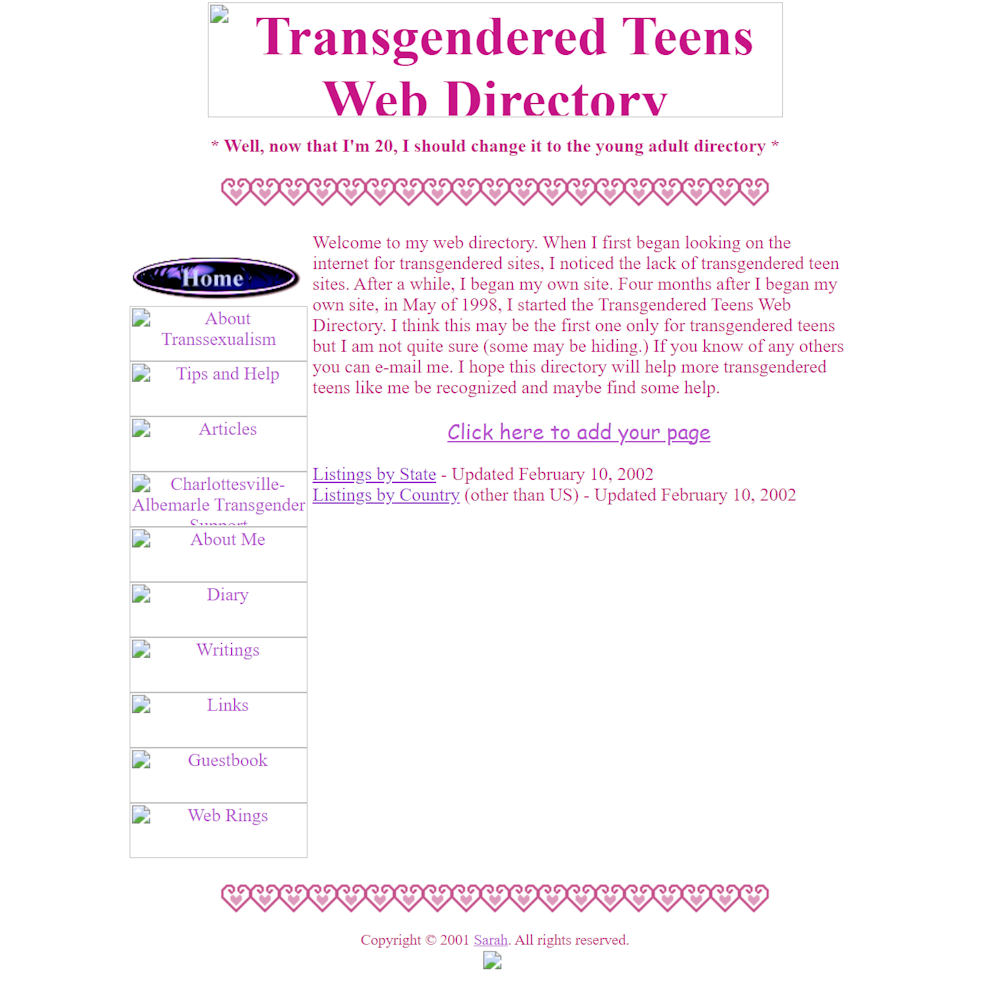
Screen shot from 2002 of the archived Transgendered Teens Web Directory
The Transgendered Teens Web Directory was a hub for trans youths to connect with one another. Internet Archive


Compared with text-heavy Bulletin Board Systems or email lists, homepages were vibrant: Most homepage creators decorated their spaces as you might your bedroom, using an array of colors, typefaces, embedded music files and animated GIFs.

The Transgendered Teens Web Directory, created in 1998 and last archived in 2002, included links, homepages and email addresses for youths from 32 different states. These homepages contained a variety of information, from advice on coming out and navigating being out in high school, to pursuing medical transition as a teen.

For example, the web diary of Transgendered Teens Web Directory founder Sarah, which has entries from 1997 to 2001, repeatedly references her email chats with other trans youths, who support her while she navigates her shifting identity, coming out to her parents, and making friends.
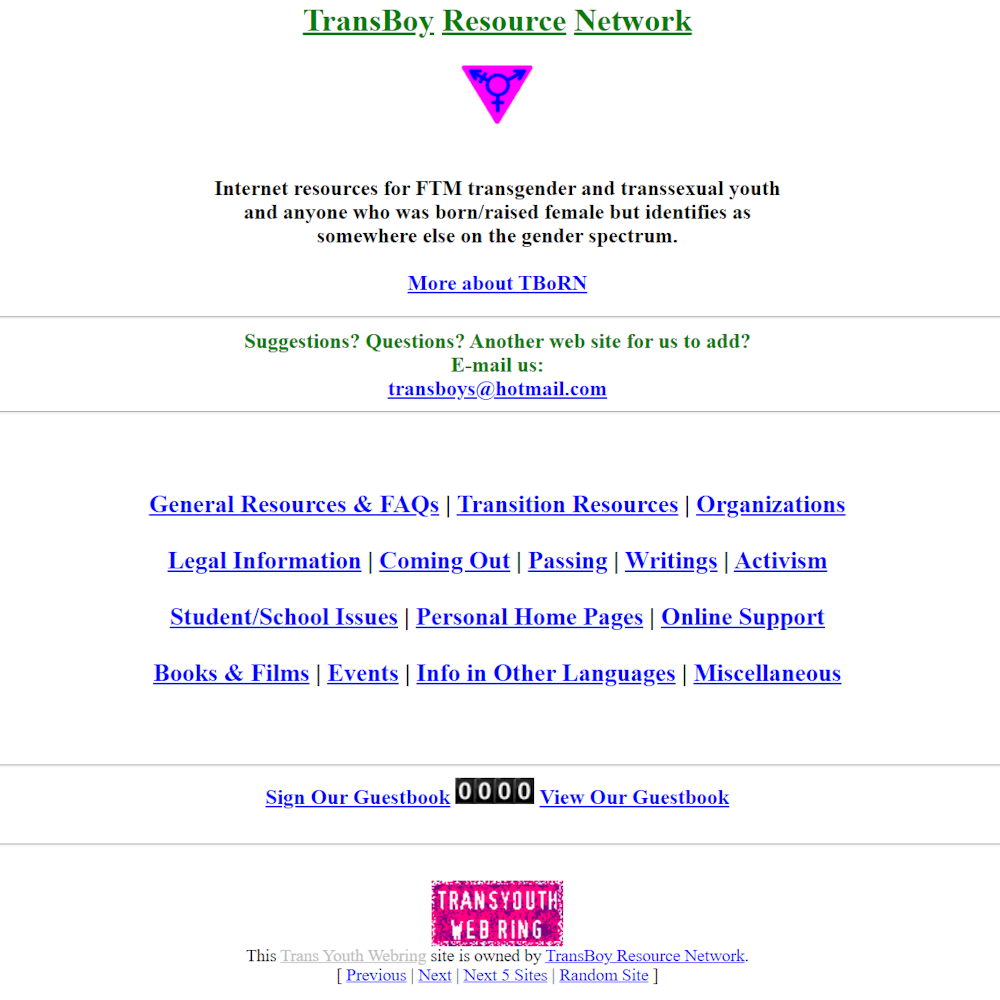
Screen shot of archived website TransBoy Resource Network from 1999
The TransBoy Resource Network offered information and support for questioning kids. Internet Archive


Trans youths also created resources that focused on what they thought other youths needed. On the TransBoy Resource Network’s “About” page, the creator describes being inspired by their own experience with “the potential the internet has for bringing trans people together and for the dissemination of information.”

Most importantly, for trans youths who couldn’t be themselves in real life, the homepage was a space for self-expression. On their pages, they could use gendered colors and graphics without fear of outing themselves, or post photos wearing the clothes they felt comfortable in without facing physical harassment. For trans creators who had supportive parents, their homepage could even become a place to share their transition progress, posting photos at each new personal milestone.

Much like today’s social media profiles, the homepage became a digital version of one’s ideal self. Over time, the growing number of pages meant that trans youths surfing the web were, as teenager Dylan Jared wrote on his own page, always able to “run across people like themselves.”

Trans teens grow their ranks​

Through these online spaces, what had once seemed rare – publicly identifying as trans before becoming an adult – was rapidly becoming a common experience for a large part of the trans community.

As trans youths became more visible, organizations felt empowered to actively advocate on their behalf. Issues facing trans youth were a central theme of IFGE’s 2004 annual conference, though some attendees still worried about the “ethical issues” of having youths give presentations.

Throughout the 2000s, the number of people in North America coming out as trans earlier in life grew exponentially. Now, some trans-affirming clinics struggle to see all their prospective patients.

This shift wouldn’t have been possible without the reach of the internet, which showed that trans youth have always been here. Online communities gave them a place – and a space – to be themselves, without fear of being ostracized, undermined or harassed.

And it’s having the support of their peers, not a passing social media fad, that’s giving them the courage to come out, then and now.
 
And it's that same freedom the early internet afforded that they wish for the death of every time a normal human doesn't call them a xir.
 
Wow, with this same shit article i can say the same thing about autists, social inepts, nerds and everybody else.
Where's the final nail in the coffin? Oh yeah, the classical "this is important because they're special" kind of line.
 
Bulimics and other mentally ill people who desperately need psychological help do the same thing. Turns out that by opening the internet to mentally ill people that instead of using the vast resources to help themselves they found communities of other mentally ill jackasses that reinforced their negative behaviors and told them it was okay (and techniques to trick other people).

None of this is new and has been documented for 20 years. The issue is that no one is willing to call the mentally ill trans community mentally ill.
 
Actually, this shit article is supposed to be a rebuttal to the fact that the internet is turning people trans.
You'd have to be incredibly dull to be gaslit by trannies into thinking this shit was always around and there were always this many kids wanting to become freaks of nature outside beyond the last decade.
 
Bulimics and other mentally ill people who desperately need psychological help do the same thing. Turns out that by opening the internet to mentally ill people that instead of using the vast resources to help themselves they found communities of other mentally ill jackasses that reinforced their negative behaviors and told them it was okay (and techniques to trick other people).
As the saying goes, "you can lead a horse to water, but you can't make him drink it," of course, nowadays hardly anyone will shoot the pink and blue elephant in the room.
 
Bulimics and other mentally ill people who desperately need psychological help do the same thing. Turns out that by opening the internet to mentally ill people that instead of using the vast resources to help themselves they found communities of other mentally ill jackasses that reinforced their negative behaviors and told them it was okay (and techniques to trick other people).

None of this is new and has been documented for 20 years. The issue is that no one is willing to call the mentally ill trans community mentally ill.
toasted.png
 
You mean to tell me that poor influences have always been a thing in any and all circles for kids? Color me fucking shocked. I met my first tranny in a ROM hacking community back in the mid to late 2000s, I was only in my early teens, and to the shock of precisely nobody I was groomed into erotically roleplaying with a good share of those types of individuals because I was lonely and craved affection around that age since I just wanted things that were deemed good and important that everyone else had.

I don't hold it against any of them today because really people didn't give as much of a shit back then and the internet was a different place back then. BlueSpike was a monster created by adults on the internet afterall, but nobody knew better at the time. It's best to just try and make sure these kind of things don't happen anymore.
 
Except back then you could tell them to go fuck themselves and stop trying to groom children without being shrieked at and hounded offline and canceled for hate speech.

The early internet created a place for everyone to tell the fucking trannies to go fuck themselves and their pride parades.
 
Is @Miss Tommie Jayne Wasserberg allowed to post here? I'd love to hear his thoughts on this fascinating article.
Thanks for asking. I can post here, but how long I will be able to is entirely up to the mods who respond to the Angry Autistic Adult Asshole Army insisting that I be "contained" in my own forum.

I'm a transfeminine intersex person assigned male at birth and I'll thank you not to refer to me as a "him", please. "Tommie" works best and I prefer "her", but would much rather people use "they" if they have a mental block against calling somebody with a penis "her". My documents all say "F". for gender. There really needs to be a box for sex too , because i have to be honest that it should be "M", but that's just my "sex toy" as Caroline Cossey describes it. She told me to think of it as an oversized clitoris. Some men are born with a vagina and some women are born with a penis. Get used to it. We have no choice in the matter. It's always been this way. There just seems to be so many more of us because it's so much safer to be open about it now.

The article was very informative and insightful, focused on trans youth. I honestly never encountered any minors in the early days of the internet and by the time I came out in 2010, the kids who appeared in the groups were accompanied by their parents.

I've been following the literature on transgender people since encountering Christine Jorgenson's biography in the mid 1960's. We had transsexual neighbors and I knew by the time I was 8 or 9, what was going on with me. My parents refused to listen to me when I was 4, so I just shut up about it and played along as best I could. This is a very common back story for trans boomers.

Two things happened in the 1990's that have resulted in this apparent explosion of gender non-conforming people. More important than the Internet for there being so many more trans youth visible today is that the doctors invoked the Hippocratic Oath on conversion therapy, resulting in the current affirmative protocols for pediatric gender related care. The results that are coming back from long term clinical studies have been astounding, clearly demonstrating that when transgender people are allowed to express themselves naturally in a supportive environment, they thrive. Needs for psychiatric intervention, most notably self harm and suicidal ideation, are significantly reduced in "gender creative" youth, who socially transition and in teens and adults who also medically transition. What's pathological is the stigmatization of homosexual and transgender people by self loathing bigots arguing with shitty scripture interpretations, debunked pseudoscience, obsolete biology and paranoid delusions.

Medical consensus today says that same sex attraction and transgender identities are genetically based , there's nothing pathological about them and most often, the behavioral health comorbidities that present themselves in transgender people are the result of rejection by family, bullying in the community and institutionalized discrimination against them in health care, housing , employment and hospitality venues. It is also very important to realize that not all transgender people are transsexual and many live their lives in the gender role opposite their sex without any hormones or surgery. There are transgender couples making babies today. Not all pregnant people are women. Trans men who make babies are called "Seahorse Dads".

The Internet provided us with access to each other. When I came online full time and started searching in April 1999, there were a number of "hub" type sites that were up and running. Lynn Conway's home page at U Michigan stands at the root of the community, with one of the most comprehensive libraries of biographies of transgender people anywhere. Andrea James' Transgender Roadmap and Susan's were started in the 90's. I'm pretty sure Mermaids in the UK was already there and there was a CD named Vicki Rene who ran a site called "Prettiest of the Pretty" that was pretty much a global directory for CD, TV, TG and TS classifieds that's been archived.


Between 2005 and 2010, numerous documentaries about trans kids and video transition diaries started to appear, with kids like Samantha, documenting their transitions publicly with the support of their parents. This brought a lot of closeted adults and post ops who had been living in stealth for decades out of the shadows to stand with the families through organizations like HRC and PFLAG in the struggle for queer equality. I met the Romero family when I first moved to Tucson and they showed up at my table at the gem show. I hadn't seen the video yet and it took me a moment to realize that Josie was trans (i couldn't find the documentary about Josie just now. This is a different one). Unfortunately, the external pressures were too much for the family and they divorced, with the mom taking Josie underground.

The ground shifted in 2013 with the Coy Mathis ruling, affirming a trans kindergartener's right to use the little girl's room, followed on in 2015 by the Obergefell vs Hodges ruling, killing the same sex marriage cash cow for the faux Christian anti-LGBT lobbying groups like the Heritage Foundation, Family Research Council and Alliance Defending Freedom, which resulted in their turning their sights on transgender kids. Caitlin Jenner's tabloid transition threw the media spot light on the whole shit show and here we are today.


Thanks for asking. I can post here, but how long I will be able to is entirely up to the mods who respond to the Angry Autistic Adult Asshole Army insisting that I be "contained" in my own forum.

I'm a transfeminine intersex person assigned male at birth and I'll thank you not to refer to me as a "him", please. "Tommie" works best and I prefer "her", but would much rather people use "they" if they have a mental block against calling somebody with a penis "her". My documents all say "F". for gender. There really needs to be a box for sex too , because i have to be honest that it should be "M", but that's just my "sex toy" as Caroline Cossey describes it. She told me to think of it as an oversized clitoris. Some men are born with a vagina and some women are born with a penis. Get used to it. We have no choice in the matter. It's always been this way. There just seems to be so many more of us because it's so much safer to be open about it now.

The article was very informative and insightful, focused on trans youth. I honestly never encountered any minors in the early days of the internet and by the time I came out in 2010, the kids who appeared in the groups were accompanied by their parents.

I've been following the literature on transgender people since encountering Christine Jorgenson's biography in the mid 1960's. We had transsexual neighbors and I knew by the time I was 8 or 9, what was going on with me. My parents refused to listen to me when I was 4, so I just shut up about it and played along as best I could. This is a very common back story for trans boomers.

Two things happened in the 1990's that have resulted in this apparent explosion of gender non-conforming people. More important than the Internet for there being so many more trans youth visible today is that the doctors invoked the Hippocratic Oath on conversion therapy, resulting in the current affirmative protocols for pediatric gender related care. The results that are coming back from long term clinical studies have been astounding, clearly demonstrating that when transgender people are allowed to express themselves naturally in a supportive environment, they thrive. Needs for psychiatric intervention, most notably self harm and suicidal ideation, are significantly reduced in "gender creative" youth, who socially transition and in teens and adults who also medically transition. What's pathological is the stigmatization of homosexual and transgender people by self loathing bigots arguing with shitty scripture interpretations, debunked pseudoscience, obsolete biology and paranoid delusions.

Medical consensus today says that same sex attraction and transgender identities are genetically based , there's nothing pathological about them and most often, the behavioral health comorbidities that present themselves in transgender people are the result of rejection by family, bullying in the community and institutionalized discrimination against them in health care, housing , employment and hospitality venues. It is also very important to realize that not all transgender people are transsexual and many live their lives in the gender role opposite their sex without any hormones or surgery. There are transgender couples making babies today. Not all pregnant people are women. Trans men who make babies are called "Seahorse Dads".

The Internet provided us with access to each other. When I came online full time and started searching in April 1999, there were a number of "hub" type sites that were up and running. Lynn Conway's home page at U Michigan stands at the root of the community, with one of the most comprehensive libraries of biographies of transgender people anywhere. Andrea James' Transgender Roadmap and Susan's were started in the 90's. I'm pretty sure Mermaids in the UK was already there and there was a CD named Vicki Rene who ran a site called "Prettiest of the Pretty" that was pretty much a global directory for CD, TV, TG and TS classifieds that's been archived.


Between 2005 and 2010, numerous documentaries about trans kids and video transition diaries started to appear, with kids like Samantha, documenting their transitions publicly with the support of their parents. This brought a lot of closeted adults and post ops who had been living in stealth for decades out of the shadows to stand with the families through organizations like HRC and PFLAG in the struggle for queer equality. I met the Romero family when I first moved to Tucson and they showed up at my table at the gem show. I hadn't seen the video yet and it took me a moment to realize that Josie was trans (i couldn't find the documentary about Josie just now. This is a different one). Unfortunately, the external pressures were too much for the family and they divorced, with the mom taking Josie underground.

The ground shifted in 2013 with the Coy Mathis ruling, affirming a trans kindergartener's right to use the little girl's room, followed on in 2015 by the Obergefell vs Hodges ruling, killing the same sex marriage cash cow for the faux Christian anti-LGBT lobbying groups like the Heritage Foundation, Family Research Council and Alliance Defending Freedom, which resulted in their turning their sights on transgender kids. Caitlin Jenner's tabloid transition threw the media spot light on the whole shit show and here we are today.


https://youtube.com/watch?v=fEps9uhc4cw
https://youtube.com/watch?v=69hjZ5y7dvg
https://youtube.com/watch?v=sFF6UfUN4vE
TL;DR and you're an ugly old tranny pedo
 
Back
Top Bottom