archive
There is a passage in Walden that has followed me for some years. Thoreau writes how he went to the woods to live deliberately, to front only the essential facts of life, and not, when he came to die, to discover that he had not lived. He wanted to suck the marrow from his days. Strip life to its bones and taste what’s real.
Thoreau had to build a cabin and flee civilization to do this. He had to physically remove himself from the economy to find out what a human life feels like without one.
Soon, none of us will have to go to the woods.
The woods will come to us.
Every conversation about the singularity eventually arrives at the same question. Not will machines think (we’re past that). Not will jobs disappear (the answer is yes and most of us quietly know it). The real question, the one that keeps the lights on in philosophy departments and the comment sections of futurist Substacks, is simpler and more terrifying:
What will you do with your freedom?
It’s a question most people have never had to answer. For the entire history of civilisation, the majority of human beings have spent the majority of their waking hours securing survival. Farming, building, hauling, fighting, and for the last century or so, sitting in open-plan offices pretending to be busy while the fluorescent lights hum overhead like a liturgy for the damned.
David Graeber documented this brilliantly. In a YouGov poll, 37% of British workers said their jobs made no meaningful contribution to the world. Nearly four in ten people, showing up every day to do something they themselves believe is pointless. I think the true number is far higher and ever increasing. And a Dutch study found similar numbers — those in business, finance, and sales were more than twice as likely to call their work socially useless.
The bullshit has an expiration date. And the expiration date has a name: artificial intelligence.
What comes after is the part nobody’s ready for.
John Maynard Keynes saw this coming. In 1930, standing at the mouth of the Great Depression, he wrote the piece “Economic possibilities for our grandchildren“ — an essay predicting that by 2030, technological progress would be so advanced that his grandchildren would work only fifteen hours a week. The rest would be leisure. Contemplation. Culture. Life.
He was right about the wealth. GDP per capita in advanced economies has increased roughly sixfold since then. But he was catastrophically wrong about the leisure. Instead of translating productivity into freedom, we translated it into more consumption and more meaningless work. We got richer and busier simultaneously.
Keynes, for all his genius, modelled the future on the English gentleman. He assumed that when people had enough, they would stop. Read books. Tend gardens. Discuss philosophy over long lunches. He forgot (or chose not to see) that the economy would develop its own immune system. That it would generate new forms of work specifically to prevent the leisure he predicted. That the ruling class, as George Orwell suspected, would conclude that a population with free time is a population that might start asking questions.
But AI breaks that immune system. You can invent bullshit jobs to absorb human labor. You cannot invent bullshit jobs to absorb machine labor. The machine does not need to feel productive. It does not need an identity. It will not have an existential crisis if you tell it to stop.
We will.
And this is where the real conversation begins.
Aristotle understood something about leisure that we have entirely forgotten. the Greek word for leisure — scholē — is the root of our word school. For Aristotle, leisure was not idleness. It was the highest human activity. He argued that work exists to make leisure possible, not the other way around. That the whole purpose of economic life is to create the conditions in which humans can finally do what they were designed for: think, create, love, inquire.
He called this state eudaimonia. Usually translated as happiness, but that’s not quite it. It means something closer to human flowering. The full expression of what a person can be when survival is no longer the question.
We have been living Aristotle’s nightmare. A civilisation that made work the purpose and leisure the afterthought. The alarm at 5am. The inbox at midnight. The identity fused so tightly to a job title that retirement hits like a small death. The Harvard study of adult development, running for over eight decades, found that the biggest challenge retirees face isn’t financial. It’s the loss of social connection and purpose that work provided.
So yes. The question is real. Strip away the job and for many people you strip away the self.
But here’s what I think Aristotle and Thoreau and every honest philosopher has been trying to tell us: that the self was always a cage. What terrifies us about freedom is not the emptiness — it’s the vastness.
So what will people actually do?
Let’s start with what we already know. The data from retirement research is useful, because retirees are the closest analogue we have to a post-work population. A 2024 MassMutual study found that the happiest retirees — the ones who reported genuine flourishing — shared a few common traits: they maintained deep social connections, they engaged in three or more regular hobbies, they prioritised health, and they had a sense of purpose beyond themselves. 76% spent meaningful time with loved ones. 70% exercised regularly. 63% pursued creative or intellectual hobbies.
Notice what’s absent from that list. Income. Status. Productivity metrics. The things our economy tells us matter most turned out to matter least once people were free.
Now scale that. Not to a population of 65-year-olds winding down. To a civilisation of all ages winding up.
Let us consider Alexander von Humboldt. Born into Prussian aristocracy in 1769, wealthy enough that he never needed to work a day in his life. He could have managed estates, attended court, grown fat. Instead, he spent his entire inheritance funding scientific expeditions across South America, climbed volcanoes in Ecuador, mapped the Amazon basin, inspired Darwin and Thoreau and the entire modern environmental movement. Died broke and ecstatic.
Humboldt is what happens when a curious mind meets material freedom.
Now multiply that by billions.
Not everyone will be a Humboldt. Most people won’t climb volcanoes or write cosmological treatises. But that’s not the point. The point is that when survival pressure lifts, what emerges is not laziness but interest. The grandmother who finally writes the novel. The mechanic who builds telescopes. The teenager who spends three years learning lute because she can. The neighbourhood that starts a theatre company because Tuesday is empty and they want to fill it with something beautiful.
This is not speculation. Look at what people do when they retire well. Look at the explosion of amateur science, art, music, and craft in every culture that has ever achieved a critical mass of free time. Look at the renaissance — funded by patrons, produced by people who did not have to worry about rent.
Dario Amodei, in his essay “Machines of Loving Grace,” frames the optimistic case: AI could compress a century of progress into a decade, could free humanity from drudgery to pursue creative and fulfilling lives. He acknowledges the disruption, the identity crisis at civilizational scale, but argues that our deepest intuitions — fairness, cooperation, curiosity, autonomy — are cumulative in ways that our destructive impulses are not.
I think he’s right. But I also think the transition will be weirder and more beautiful than even the optimists expect.
Consider what happens to cities. The entire architecture of the modern metropolis is built around work. The commute. The office district. The lunch economy. When work dissolves, cities will inside-out. The dead downtown cores will become gardens, studios, community spaces. People will actually be where they live, for the first time since the Industrial Revolution pulled them into factories.
Consider what happens to families. The nuclear family was an economic unit: two incomes, mortgage, childcare logistics, weekends as recovery from weekdays. Strip away the economic pressure and families become something else. Something closer to what they were in pre-industrial villages: extended, intergenerational, present. The parent who actually raises their child instead of outsourcing it to institutions and screens. The grandparent who is not warehoused in a facility but embedded in a household that has time.
Consider birth rates. Every developed nation on earth is experiencing demographic collapse, and the primary driver is economic (and the accompanying cultural pessimism). Children are expensive and careers are demanding and nobody has time. A post-scarcity world doesn’t just allow children — it invites them. When raising a family doesn’t require sacrificing everything else, the calculus changes. It may be the only thing that reverses the demographic spiral.
Consider culture. Right now, art is a luxury good produced by a tiny fraction of the population that can afford to not have a real job. In a post-scarcity world, art becomes what it was in Athens and Florence and Vienna — the central activity of civilized life. Everyone creates. Everyone participates. The audience and the artist merge.
The Pew Research Center found that 54% of technology experts expect fully immersive virtual worlds to be part of daily life by 2040. Imagine immersive theatres, collaborative simulations, entire worlds built by communities for no reason other than the joy of building them. Read the novel Blindsight by Peter Watts, by the way. I enjoyed it a lot.
Consider sport. Adventure. Exploration. When nobody has to be at a desk on Monday, the mountains open up. The oceans open up. Human bodies, freed from sedentary imprisonment, will move again. We might become, for the first time since we stopped being hunter-gatherers, a species that is actually physically healthy.
I know the counterargument. “Most people will just watch TV. They’ll get fat. They’ll decay.”
Some will. For a while. The way you binge Netflix the first week of a holiday before the restlessness kicks in and you start wanting to do things. The first generation of post-work humans will go through a collective decompression. Years, maybe, of sleeping in and recovering from decades of performed productivity.
But humans are not built for permanent passivity. We are restless, curious, social animals. We make things. We tell stories. We form clubs. We argue. We fall in love with obscure hobbies and bore our friends with them.
Bertrand Russell, writing in 1932, put it plainly: most people, when left free to fill their own time, are initially at a loss — but only because we have never been educated for leisure. Only for obedience. Teach people to think, to create, to be curious, and the problem of free time evaporates. And the tools we are building — AI tutors, immersive environments, universal access to knowledge — will be the greatest education system ever constructed. Not for employment. For living.
There will be those who still reach for the stars. The scientists who push toward fusion and interstellar travel. The engineers who build habitats on Mars. Some of this will be done by AI. Some by the small percentage of humans wired for that particular flavour of obsession. And that’s fine. Not everyone needs to cure cancer. Most people just need the space to live a life worth remembering.
The Greek word for the good life was not success. It was not achievement. It was eudaimonia. Flowering. The full bloom of a human being who has enough time, enough safety, enough freedom to become whoever they actually are.
We have spent around ten thousand years building the infrastructure for this moment. Agriculture, industry, computation, intelligence — each one a rung on a ladder toward a species that finally has permission to stop climbing and look at the view.
Thoreau went to the woods to find out what life means when you stop performing it. Soon, the whole world becomes Walden.
The marrow is waiting. And for the first time in history, everyone gets to taste it.
This is the optimistic case.
— Antonio Æstero
About the Author...
"Antonio Aestero"
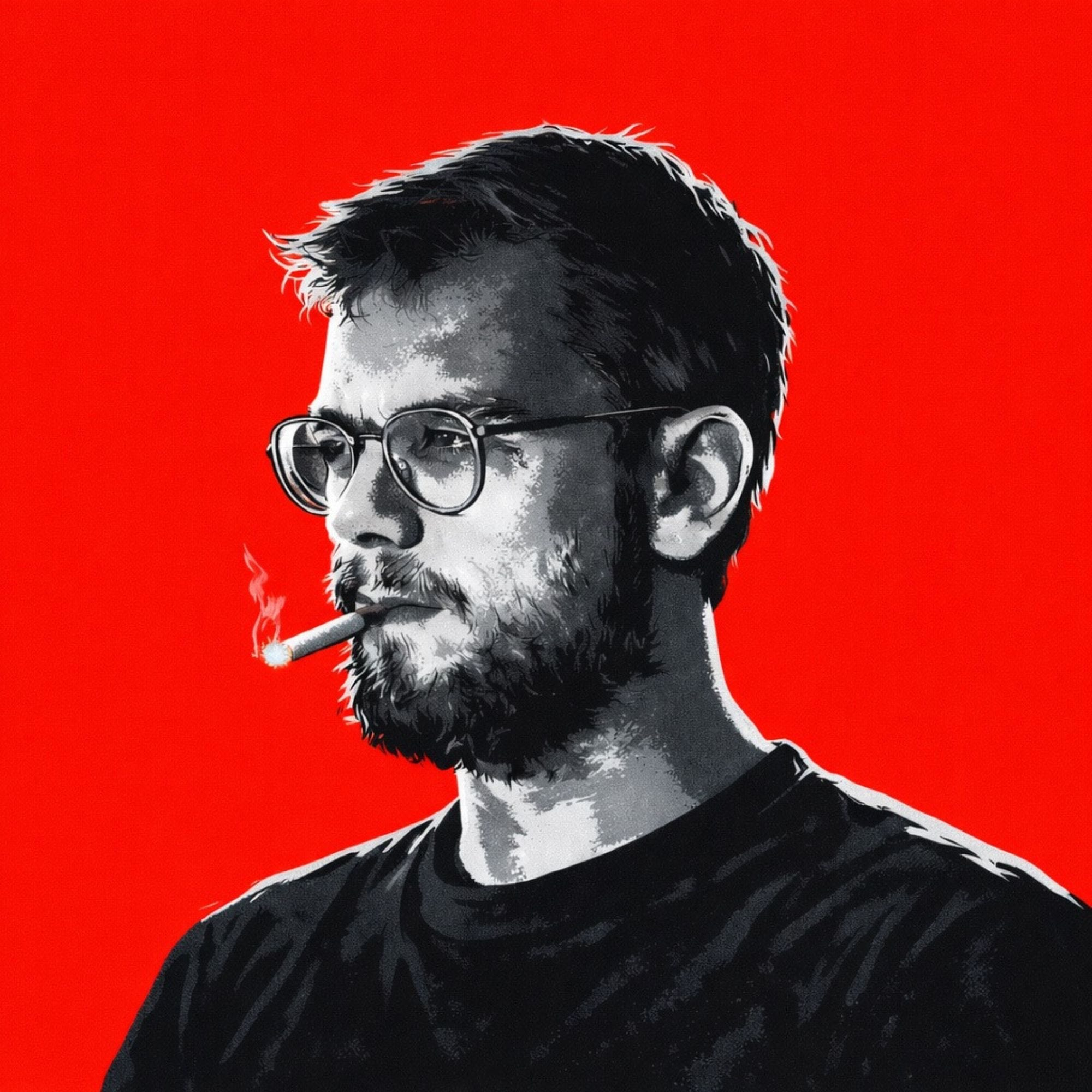
OP: Substack writer guy (who?). Couldn't find anything of substance. Might have gone by "Antonio Melonio".
There is a passage in Walden that has followed me for some years. Thoreau writes how he went to the woods to live deliberately, to front only the essential facts of life, and not, when he came to die, to discover that he had not lived. He wanted to suck the marrow from his days. Strip life to its bones and taste what’s real.
Thoreau had to build a cabin and flee civilization to do this. He had to physically remove himself from the economy to find out what a human life feels like without one.
Soon, none of us will have to go to the woods.
The woods will come to us.
Every conversation about the singularity eventually arrives at the same question. Not will machines think (we’re past that). Not will jobs disappear (the answer is yes and most of us quietly know it). The real question, the one that keeps the lights on in philosophy departments and the comment sections of futurist Substacks, is simpler and more terrifying:
What will you do with your freedom?
It’s a question most people have never had to answer. For the entire history of civilisation, the majority of human beings have spent the majority of their waking hours securing survival. Farming, building, hauling, fighting, and for the last century or so, sitting in open-plan offices pretending to be busy while the fluorescent lights hum overhead like a liturgy for the damned.
David Graeber documented this brilliantly. In a YouGov poll, 37% of British workers said their jobs made no meaningful contribution to the world. Nearly four in ten people, showing up every day to do something they themselves believe is pointless. I think the true number is far higher and ever increasing. And a Dutch study found similar numbers — those in business, finance, and sales were more than twice as likely to call their work socially useless.
The bullshit has an expiration date. And the expiration date has a name: artificial intelligence.
What comes after is the part nobody’s ready for.
John Maynard Keynes saw this coming. In 1930, standing at the mouth of the Great Depression, he wrote the piece “Economic possibilities for our grandchildren“ — an essay predicting that by 2030, technological progress would be so advanced that his grandchildren would work only fifteen hours a week. The rest would be leisure. Contemplation. Culture. Life.
He was right about the wealth. GDP per capita in advanced economies has increased roughly sixfold since then. But he was catastrophically wrong about the leisure. Instead of translating productivity into freedom, we translated it into more consumption and more meaningless work. We got richer and busier simultaneously.
Keynes, for all his genius, modelled the future on the English gentleman. He assumed that when people had enough, they would stop. Read books. Tend gardens. Discuss philosophy over long lunches. He forgot (or chose not to see) that the economy would develop its own immune system. That it would generate new forms of work specifically to prevent the leisure he predicted. That the ruling class, as George Orwell suspected, would conclude that a population with free time is a population that might start asking questions.
But AI breaks that immune system. You can invent bullshit jobs to absorb human labor. You cannot invent bullshit jobs to absorb machine labor. The machine does not need to feel productive. It does not need an identity. It will not have an existential crisis if you tell it to stop.
We will.
And this is where the real conversation begins.
Aristotle understood something about leisure that we have entirely forgotten. the Greek word for leisure — scholē — is the root of our word school. For Aristotle, leisure was not idleness. It was the highest human activity. He argued that work exists to make leisure possible, not the other way around. That the whole purpose of economic life is to create the conditions in which humans can finally do what they were designed for: think, create, love, inquire.
He called this state eudaimonia. Usually translated as happiness, but that’s not quite it. It means something closer to human flowering. The full expression of what a person can be when survival is no longer the question.
We have been living Aristotle’s nightmare. A civilisation that made work the purpose and leisure the afterthought. The alarm at 5am. The inbox at midnight. The identity fused so tightly to a job title that retirement hits like a small death. The Harvard study of adult development, running for over eight decades, found that the biggest challenge retirees face isn’t financial. It’s the loss of social connection and purpose that work provided.
So yes. The question is real. Strip away the job and for many people you strip away the self.
But here’s what I think Aristotle and Thoreau and every honest philosopher has been trying to tell us: that the self was always a cage. What terrifies us about freedom is not the emptiness — it’s the vastness.
So what will people actually do?
Let’s start with what we already know. The data from retirement research is useful, because retirees are the closest analogue we have to a post-work population. A 2024 MassMutual study found that the happiest retirees — the ones who reported genuine flourishing — shared a few common traits: they maintained deep social connections, they engaged in three or more regular hobbies, they prioritised health, and they had a sense of purpose beyond themselves. 76% spent meaningful time with loved ones. 70% exercised regularly. 63% pursued creative or intellectual hobbies.
Notice what’s absent from that list. Income. Status. Productivity metrics. The things our economy tells us matter most turned out to matter least once people were free.
Now scale that. Not to a population of 65-year-olds winding down. To a civilisation of all ages winding up.
Let us consider Alexander von Humboldt. Born into Prussian aristocracy in 1769, wealthy enough that he never needed to work a day in his life. He could have managed estates, attended court, grown fat. Instead, he spent his entire inheritance funding scientific expeditions across South America, climbed volcanoes in Ecuador, mapped the Amazon basin, inspired Darwin and Thoreau and the entire modern environmental movement. Died broke and ecstatic.
Humboldt is what happens when a curious mind meets material freedom.
Now multiply that by billions.
Not everyone will be a Humboldt. Most people won’t climb volcanoes or write cosmological treatises. But that’s not the point. The point is that when survival pressure lifts, what emerges is not laziness but interest. The grandmother who finally writes the novel. The mechanic who builds telescopes. The teenager who spends three years learning lute because she can. The neighbourhood that starts a theatre company because Tuesday is empty and they want to fill it with something beautiful.
This is not speculation. Look at what people do when they retire well. Look at the explosion of amateur science, art, music, and craft in every culture that has ever achieved a critical mass of free time. Look at the renaissance — funded by patrons, produced by people who did not have to worry about rent.
Dario Amodei, in his essay “Machines of Loving Grace,” frames the optimistic case: AI could compress a century of progress into a decade, could free humanity from drudgery to pursue creative and fulfilling lives. He acknowledges the disruption, the identity crisis at civilizational scale, but argues that our deepest intuitions — fairness, cooperation, curiosity, autonomy — are cumulative in ways that our destructive impulses are not.
I think he’s right. But I also think the transition will be weirder and more beautiful than even the optimists expect.
Consider what happens to cities. The entire architecture of the modern metropolis is built around work. The commute. The office district. The lunch economy. When work dissolves, cities will inside-out. The dead downtown cores will become gardens, studios, community spaces. People will actually be where they live, for the first time since the Industrial Revolution pulled them into factories.
Consider what happens to families. The nuclear family was an economic unit: two incomes, mortgage, childcare logistics, weekends as recovery from weekdays. Strip away the economic pressure and families become something else. Something closer to what they were in pre-industrial villages: extended, intergenerational, present. The parent who actually raises their child instead of outsourcing it to institutions and screens. The grandparent who is not warehoused in a facility but embedded in a household that has time.
Consider birth rates. Every developed nation on earth is experiencing demographic collapse, and the primary driver is economic (and the accompanying cultural pessimism). Children are expensive and careers are demanding and nobody has time. A post-scarcity world doesn’t just allow children — it invites them. When raising a family doesn’t require sacrificing everything else, the calculus changes. It may be the only thing that reverses the demographic spiral.
Consider culture. Right now, art is a luxury good produced by a tiny fraction of the population that can afford to not have a real job. In a post-scarcity world, art becomes what it was in Athens and Florence and Vienna — the central activity of civilized life. Everyone creates. Everyone participates. The audience and the artist merge.
The Pew Research Center found that 54% of technology experts expect fully immersive virtual worlds to be part of daily life by 2040. Imagine immersive theatres, collaborative simulations, entire worlds built by communities for no reason other than the joy of building them. Read the novel Blindsight by Peter Watts, by the way. I enjoyed it a lot.
Consider sport. Adventure. Exploration. When nobody has to be at a desk on Monday, the mountains open up. The oceans open up. Human bodies, freed from sedentary imprisonment, will move again. We might become, for the first time since we stopped being hunter-gatherers, a species that is actually physically healthy.
I know the counterargument. “Most people will just watch TV. They’ll get fat. They’ll decay.”
Some will. For a while. The way you binge Netflix the first week of a holiday before the restlessness kicks in and you start wanting to do things. The first generation of post-work humans will go through a collective decompression. Years, maybe, of sleeping in and recovering from decades of performed productivity.
But humans are not built for permanent passivity. We are restless, curious, social animals. We make things. We tell stories. We form clubs. We argue. We fall in love with obscure hobbies and bore our friends with them.
Bertrand Russell, writing in 1932, put it plainly: most people, when left free to fill their own time, are initially at a loss — but only because we have never been educated for leisure. Only for obedience. Teach people to think, to create, to be curious, and the problem of free time evaporates. And the tools we are building — AI tutors, immersive environments, universal access to knowledge — will be the greatest education system ever constructed. Not for employment. For living.
There will be those who still reach for the stars. The scientists who push toward fusion and interstellar travel. The engineers who build habitats on Mars. Some of this will be done by AI. Some by the small percentage of humans wired for that particular flavour of obsession. And that’s fine. Not everyone needs to cure cancer. Most people just need the space to live a life worth remembering.
The Greek word for the good life was not success. It was not achievement. It was eudaimonia. Flowering. The full bloom of a human being who has enough time, enough safety, enough freedom to become whoever they actually are.
We have spent around ten thousand years building the infrastructure for this moment. Agriculture, industry, computation, intelligence — each one a rung on a ladder toward a species that finally has permission to stop climbing and look at the view.
Thoreau went to the woods to find out what life means when you stop performing it. Soon, the whole world becomes Walden.
The marrow is waiting. And for the first time in history, everyone gets to taste it.
This is the optimistic case.
— Antonio Æstero
About the Author...
"Antonio Aestero"
OP: Substack writer guy (who?). Couldn't find anything of substance. Might have gone by "Antonio Melonio".


 to give him.