Link/Archive
David Spiegelhalter’s Sex by Numbers is memetic candy for nerds.

Think of every prurient factoid, supposition, and wild conjecture you’ve ever heard about sex at the societal level - the average sex act only lasts 15 minutes (the truth is under 10 minutes), people have sex once a week (nope, less), the average person has 3-6 partners in a lifetime, and more.

David Spiegelhalter is exactly who you’d want to evaluate and put these questions on a solid factual basis. A statistician, a chair at Cambridge for many years, an “ISI highly cited researcher,” President of the Royal Statistical Society, and a literal Knight of the Realm for his “services to statistics.”
Naturally, he’s very careful about talking about the data sources, grading those sources by quality and sample size and representativeness, and triangulating from multiple sources whenever he can.
It is, in a word, the “as good as it gets, epistemically” bible for sexual facts and sound bites. In a field that’s intrinsically hard to study and get straight answers about, this is the best we can do, and bless him for doing it! He was actually knighted while in the process of finishing the book, so let’s consider that karma.
If you have a live-in partner, it gets a little better, and you get up to a 6 per month median.
Maybe this is skewed by older couples? It does cover ages 16-74.
But if you select it down to only 16-34 year olds, you still get roughly 5-6 per month. People who’ve been in a relationship for <=2 years have it 7 times a month, and those >=5 years have it 4 times a month.
The overall trend is down, too - back to the “3 a month” median. 10 years before that, it was 4, and 20 years before, it was 5. We are all collectively increasingly fat and lazy and happier to stare at screens than to go to the trouble of actually having sex.
The median ‘intravaginal ejaculatory latency time’ is 9 minutes. Which, good god. How does any woman ever get off, anywhere, ever?
And to be clear, this is from a highest quality data source, measured by fitbits rather than memory / surveys, based on 900+ couples across 5 countries, and specifically excluding those suffering from premature ejaculation. This is the real average time!
The highest time in the entire study was 44 minutes, incidentally. Which also seems low? Particularly to be a 1/1k highest?? But, whatever.
Like, no wonder sex is down in frequency among Zennials. Why even bother at that point? It’s amazing our parents and grandparents bothered, if this was the norm back then!
And “sex and relationships” is impossibly prominent in people’s motivations and actions!! Like when you’re single, how much time do you have to just immolate on apps and dating per week? Way, way more than 10 hours a week, unless you pay for a dating or matchmaking service, and even then it’s at least 2-6 hours a week just on dates.
These people who have put in all that effort, who have “won” the relationship Red Queen’s Race, are literally spending 1/720th of their monthly time on something they’ve probably spent 10-30% of their cumulative lifetime mental time and optimization energy towards!
Does nobody else see a massive disconnect here?? Am I the crazy one?
The gender discrepancy is thought to be explained by some combination of prostitution, older men with less experience opting out of answering, and some women potentially refusing to count non-vaginal or unwanted sex in their partner count.

Generational mores have changed: 30% of women aged 25 to 34 reported more than 10 partners, versus 8% of women aged 65 to 74
Spiegelhalter alludes to a famous Caerphilly study:
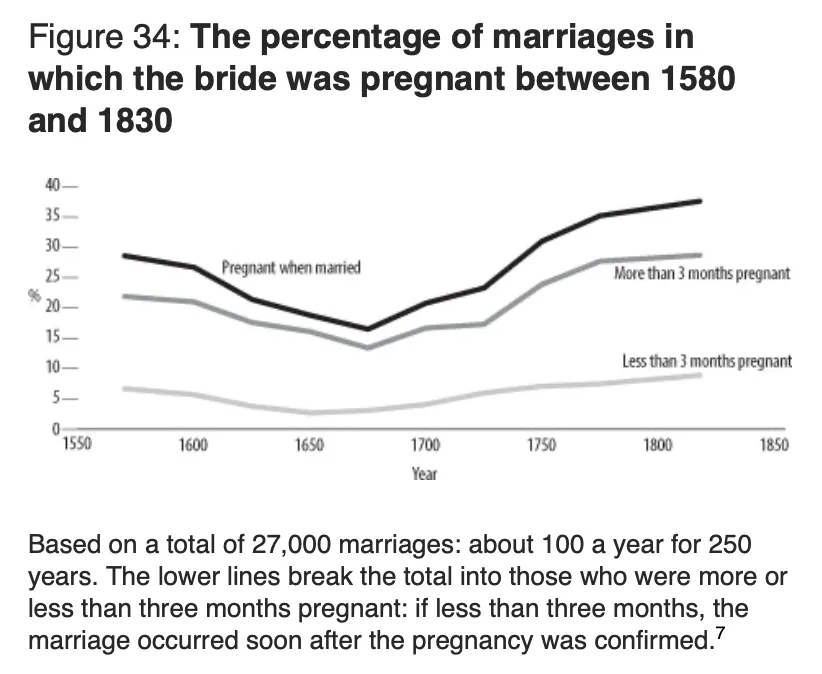
But what about deeper in our past? Surprisingly, if you look at historical UK “pregnant before marriage” rates, they were as high as 40% in the 1800’s! So it’s probably a decent bet that “~50% being virgins at marriage” is probably the historical peak, at least in the US and UK.
By 2010, this had dropped to 40% of men and 60% of women at age 25, and 90% of them were cohabitation rather than marriage.
They get VASTLY different numbers than the above, which I go over in my post here.
Spiegelhalter is using the European Study of Daily Fecundability for his numbers, which only looks at 782 couples, most of whom were recruited from “Natural Family Planning” centers and weren’t using contraception. They build a statistical model from the 487 resulting pregnancies, and get the numbers above.
What is the disconnect? The biggest ones I see are that they’re a selected population (Europeans age 18-40 who specifically eschew contraception and never use condoms, and attend “Natural Family Planning” centers. Additionally people who were known to be infertile were specifically excluded, as well as anyone with any illness that might affect fertility. 66% of them had had a past pregnancy before study enrollment - a reasonable estimate of the amount of women who’d had a pregnancy by the average age in this study (28-30) is more like 50%.
In other words, they were specifically selected to be a known and higher fertility sub-population, and it is from these that we are getting Spiegelhalter’s age by fertility numbers (and this same studied population has been the genesis of several post-2000 fertility estimates).
That said, we can at least go in with open eyes to some of the subsequent points here, which I found interesting.

In this particular case, I proved the “Chadopoly” is real, using Natsal 3 data:
But just for fun, can’t we make a “Chadopoly” argument using math, too?
If we can say “33% of guys are having 66% of the sex,” I think we could unfurl our “Mission Accomplished” banners. Let’s begin.
First, let us consider by number of total sexual partners. The largest slice of people have only 1 sexual partner in their lives, but there’s a long tail - it’s our old friend, a Pareto distribution!
This is from Natsal 3, generally regarded one of the highest quality data sources in the space:

As we can see, the graphs are heavily right skewed and demonstrate kurtosis, implying a Pareto distribution. It’s not quite 80/20 - if you break the data down and bin the buckets you can calculate the alpha and Gini inequality measures. The alpha is ~1.45, whereas you need an alpha of 1.16 to be a true 80/20 distribution. But do you know what an alpha of 1.45 means in this particular (capped) distribution? It means the top ~37% take 80%. I think we hit our 33/66!
Second, let’s consider by sexual incidence per unit time. The first one was akin to “lifetime wealth,” and this one is more akin to monthly flow, or income. This is sexual frequency over the last 4 weeks:

Shockingly, the modal frequency here is ZERO. People just plain aren’t having sex, or at least the bottom quintile isn’t.
So this graph actually has the long tail truncated here visually - the data itself goes out to one guy who said he’s having sex 100 times a month, in a 1500 guy (~2500 girl) sample.
We can bin the numbers again, and we find the cutoffs and alpha for this distribution too:

And we find that the top ~31% are getting 80% of all the sex by frequency! This handily beats our 33/66 threshold. In this case, the top 20% are probably having roughly 66% of the sex by frequency.
And actually, if you go back to the first “lifetime partners” graph - the top 20% are getting ~64.5% in that one! Close enough to 20/66 for me!
Granted, this is just swagging with some napkin math for fun, but it’s at least directionally reasonable.
David Spiegelhalter’s Sex by Numbers is memetic candy for nerds.
Think of every prurient factoid, supposition, and wild conjecture you’ve ever heard about sex at the societal level - the average sex act only lasts 15 minutes (the truth is under 10 minutes), people have sex once a week (nope, less), the average person has 3-6 partners in a lifetime, and more.
David Spiegelhalter is exactly who you’d want to evaluate and put these questions on a solid factual basis. A statistician, a chair at Cambridge for many years, an “ISI highly cited researcher,” President of the Royal Statistical Society, and a literal Knight of the Realm for his “services to statistics.”
Naturally, he’s very careful about talking about the data sources, grading those sources by quality and sample size and representativeness, and triangulating from multiple sources whenever he can.
It is, in a word, the “as good as it gets, epistemically” bible for sexual facts and sound bites. In a field that’s intrinsically hard to study and get straight answers about, this is the best we can do, and bless him for doing it! He was actually knighted while in the process of finishing the book, so let’s consider that karma.
But let’s get to the fun parts - the average live-in couple has sex <6 times a month, for only 9 minutes
Throughout the book, I was most struck by the combination of the impossible lifelong primacy sex has in most people’s minds and motivations, contrasted with the actual miniscule amounts of time dedicated to it. Truly, the “thought to action” ratio has to be comically immense, surely one of the largest “thought to action” ratios among any topic with appreciable mindshare.1How many times per month?
For instance, the median sexually active person, for both men and women, has sex just 3 times a month. And the quartile medians go down to 1 and up to 6, so it’s not like there’s a noticeable sub-population actually having a lot.If you have a live-in partner, it gets a little better, and you get up to a 6 per month median.
Maybe this is skewed by older couples? It does cover ages 16-74.
But if you select it down to only 16-34 year olds, you still get roughly 5-6 per month. People who’ve been in a relationship for <=2 years have it 7 times a month, and those >=5 years have it 4 times a month.
The overall trend is down, too - back to the “3 a month” median. 10 years before that, it was 4, and 20 years before, it was 5. We are all collectively increasingly fat and lazy and happier to stare at screens than to go to the trouble of actually having sex.
For how long?
Okay, well when you have it those 3-5 times a month, how long does it last?The median ‘intravaginal ejaculatory latency time’ is 9 minutes. Which, good god. How does any woman ever get off, anywhere, ever?
And to be clear, this is from a highest quality data source, measured by fitbits rather than memory / surveys, based on 900+ couples across 5 countries, and specifically excluding those suffering from premature ejaculation. This is the real average time!
The highest time in the entire study was 44 minutes, incidentally. Which also seems low? Particularly to be a 1/1k highest?? But, whatever.
This is a hilarious mismatch
It really makes me wonder, though: what is all the suffering and the effort and the endless drive to pair off even FOR? Under an hour of bad, 9 minute-at-a-time sex a handful of times per month??Like, no wonder sex is down in frequency among Zennials. Why even bother at that point? It’s amazing our parents and grandparents bothered, if this was the norm back then!
And “sex and relationships” is impossibly prominent in people’s motivations and actions!! Like when you’re single, how much time do you have to just immolate on apps and dating per week? Way, way more than 10 hours a week, unless you pay for a dating or matchmaking service, and even then it’s at least 2-6 hours a week just on dates.
These people who have put in all that effort, who have “won” the relationship Red Queen’s Race, are literally spending 1/720th of their monthly time on something they’ve probably spent 10-30% of their cumulative lifetime mental time and optimization energy towards!
Does nobody else see a massive disconnect here?? Am I the crazy one?
Female lack of interest
So given the above 9 minute standard, is it surprising at all that women are less interested in sex than men?- “34%: the proportion of women interviewed in Natsal-3 reporting a lack of interest in sex lasting at least 3 months in the preceding year”
- “This pattern extends to around 1 in 12 women feeling no excitement or arousal during sex.”
- “One of the less advertised findings from Natsal-2 is that 0.6% (1 in 160) of women reported that they ‘never felt sexually attracted to anyone at all”
Number of partners
Considering 35-44 year olds,2 about 1/6 say “1,” with the median 8 for men and 5 for women.The gender discrepancy is thought to be explained by some combination of prostitution, older men with less experience opting out of answering, and some women potentially refusing to count non-vaginal or unwanted sex in their partner count.
Generational mores have changed: 30% of women aged 25 to 34 reported more than 10 partners, versus 8% of women aged 65 to 74
- “Having more than 10 partners in your lifetime is associated with higher social class and educational status.” Which is obvious for men, but interesting for women, and seems to run counter to the usual stereotypes.
Rounding up and down
One other source of potential partner discrepancies? Both genders lie, in different directions. Men always lie UP - they lie about their dick size, number of partners, and how long they last in bed. Women lie DOWN - they always minimize the number of partners over whatever timeframe.- “30%: the increase in the number of sexual partners reported by US female students who thought they were attached to a lie-detector”
- General vice triangulation: “In 2008, people over 16 admitted to drinking an average of 12 units of alcohol a week in Britain, although alcohol sales over the same period showed they on average were actually drinking over 20 units a week.”
- “The results were what you might expect: women who thought they might be ‘exposed’ claimed an average of 2.6 sexual partners, the ‘anonymous’ group said 3.4, while those attached to the lie-detector said 4.4, at which point they roughly matched the male claim of 4.0”
Sex effectiveness vs exercise and calorie burn
Obviously, if sex is only going on for 9 minutes at a time a handful of times a month, it’s not doing anything for you, exercise and calorie wise. But might it be good for your health?Spiegelhalter alludes to a famous Caerphilly study:
But this study was “918 men aged 45-59 at time of recruitment between 1979 and 1983,” and I’d personally bet on the causation being backwards - ie, healthier and more robust men are able to have those 100 orgasms a year (roughly twice the average!).“But will sex help you to live longer? A much-cited study of men in Caerphilly, from a respectable team, estimated that an extra 100 orgasms a year was associated with a one third reduction in the risk of dying each year – this would translate to about 3 years’ extra life.”
Does sex burn calories if you last 3x longer than 9 minutes?
On fitbit-measured young couples:Yeah, 100 calories over 25 minutes is basically nothing. We burn about 100 calories per mile run, and even if you’re slow, you should have run 2 miles in 25 minutes. So compared against actual exercise, it doesn’t really move the needle much and is half strength. But in terms of enjoyment and adherence, I’m sure it’s many times better - the big problem is people apparently have sex every third blue moon or something, so in terms of contributing to incremental daily or weekly activity, it’s basically nothing.“The sex sessions lasted an average of 25 minutes, and the average energy use was 101 Kcal for men and 69 Kcal for women, but the range was 13 to 306 for men, and 12 to 164 for women, showing a range from extreme mellowness to athletic exuberance among the participants.”
“The average intensity of sexual activity was around 6 METS (1 MET is about the intensity of watching television), which is the borderline of moderate/vigorous, roughly between cycling and jogging. But some went up to 9 METS – higher than doing push-ups. Overall, as a source of exercise, sex came in at about half as effective as 30 minutes on a treadmill.”
Does sex cause heart attacks?
It also materially increases heart attack risk for older people, but honestly it’s hard to disagree with the common sentiment “if you have to go, it’s gotta be one of the best ways!”“A review of fourteen studies concluded that the risk of a heart attack did go up by nearly three times in the hours after sex for older people, but it was still only the same as any other form of similar exercise, such as shovelling snow, and the risk depended on fitness. A plausible estimate is that if 1,000 middle-aged people had sex for an hour a week for ten years, then there would be around one sudden death and two to three extra heart attacks. This may seem a risk worth taking, and it is interesting to note that the majority of the case reports of sudden death in the past have been men engaged in ‘extramarital sexual activity, in most cases with a younger partner in an unfamiliar setting and/or after excessive food and alcohol consumption’. I think we get the picture.”
Premarital sex changes over time
Kinsey in the US estimated that ~50% of women were virgins at marriage in the 1940’s. Of the half that were not, most of them had been with their fiance. For British women in the 1950’s, 35% had sex with their husband before marriage, and by the 1970’s, this had gone up to 74%. Today virginity at marriage is around 1-5%.But what about deeper in our past? Surprisingly, if you look at historical UK “pregnant before marriage” rates, they were as high as 40% in the 1800’s! So it’s probably a decent bet that “~50% being virgins at marriage” is probably the historical peak, at least in the US and UK.
By 1938, pregnancy at marriage was down to 18%, and by 2006, only 10% (thanks to contraception).“Figure 34 shows the long but changing tradition of brides being pregnant on their wedding day: the rate was nearly 30% when the ‘virgin’ Queen Elizabeth ruled and Shakespeare was writing plays of teenage love, then declined to around 18% during Oliver Cromwell’s rule in the 1650s, as the Puritans, who took a decidedly dim view of fornication, came to power. The rate then increased steadily through the decidedly non-Puritanical 1700s until reaching nearly 40% when Victoria was crowned.”
Marriage and cohabitation changes over time
In the eighties, 60% of men and 80% of women had formed some sort of live-in partnership by the time they were 25 (with the gap filled by women dating older men). 90% of those were marriages, with about 15 months of cohabitation before marriage.By 2010, this had dropped to 40% of men and 60% of women at age 25, and 90% of them were cohabitation rather than marriage.
- An average woman born in the late 1930s first had sex at 20 (generally with her fiance), got married at 21, and had her first child at 23-24.
- In the 1980s, the average woman first had sex at 17, started a partnership at 23 to 24, and had her first birth at 27.
- Nowadays, this is still around 17, women have a first birth at 29.5, and a first marriage at 32. (UK figures)
Unplanned / planned pregnancies
Including this because I had a reference point in my head of “roughly a third of pregnancies are unplanned.” It turns out that that’s a decent heuristic, but it can go up to 50%, and it’s actually more like a third of births are unplanned.“Statistics about ‘unintended’ pregnancies abound: figures around 50% are often quoted for both the UK and the USA. But what does ‘unintended’ mean? It’s not a black or white issue – there may be a degree of ambivalence, such as thinking that a baby would be nice to have some time, but perhaps not right now. For example, for births (rather than pregnancies) in the USA, the National Survey of Family Growth estimated that 23% of births were actively ‘unwanted’, and 14% were ‘just’ mistimed.”
Fertility variability
He has several “fertility by age” statistics, which more or less follow the consensus on points like:- 92% of 19 - 26yo couples will conceive in one year of trying, and 98% by two years
- Those numbers fall to 80% / 92% for couples who are 35-39
- A single sexual “throw” has a 6% chance of pregnancy for a 19 - 26yo woman
- An enthusiastic young couple trying for every day of a cycle has an 88% chance of pregnancy
They get VASTLY different numbers than the above, which I go over in my post here.
Spiegelhalter is using the European Study of Daily Fecundability for his numbers, which only looks at 782 couples, most of whom were recruited from “Natural Family Planning” centers and weren’t using contraception. They build a statistical model from the 487 resulting pregnancies, and get the numbers above.
What is the disconnect? The biggest ones I see are that they’re a selected population (Europeans age 18-40 who specifically eschew contraception and never use condoms, and attend “Natural Family Planning” centers. Additionally people who were known to be infertile were specifically excluded, as well as anyone with any illness that might affect fertility. 66% of them had had a past pregnancy before study enrollment - a reasonable estimate of the amount of women who’d had a pregnancy by the average age in this study (28-30) is more like 50%.
In other words, they were specifically selected to be a known and higher fertility sub-population, and it is from these that we are getting Spiegelhalter’s age by fertility numbers (and this same studied population has been the genesis of several post-2000 fertility estimates).
That said, we can at least go in with open eyes to some of the subsequent points here, which I found interesting.
- There’s a lot of variability in fertility - for a given 27 - 29yo woman, about 5% have a <5% chance of conception, and the upper 5% have a >83% chance.
- Having sex only once a week drops a 19 - 26yo couple from 92% to 82% chances, but increasing to 3x a week doesn’t bring you above 92%.
- “The effect of a man being 40 rather than 35 is about the same as dropping sex rates from twice to once a week.”
- Given the variability in fertility, he recommends couples keep trying even after a year - a 35yo woman with a 40 year old man who didn’t conceive in a given year will have a 43% chance of conceiving after 2 years.
Fun fertility anecdote:
The fact that anyone thinks having sex twice a day for years might be some implausibly unattainable threshold is just mind blowing to me. Particularly for somebody at the absolute top of their society and status heirarchy, with 500+ concubines and the Coolidge Effect in fullest flower.“Known as ‘the bloodthirsty’, owing to his habit of mass beheadings, Sultan Moulay Ismaïl Ibn Sharif of Morocco ruled from 1672 to 1727 and is reputed to have had the most number of children of any man in history. A French diplomat, Dominique Busnot, reported that by 1704 he had 600 sons by 4 wives and 500 concubines, which works out at around 1,200 children over his 32 years in power.”
“The maximum age of the concubines was 30, and we previously estimated an average probability of a conception of 6% from a ‘random copulation’ with women that age. I therefore believe that the sultan would have needed to have had sex twice a day for 32 years to have had the reputed number of children: if you don’t think this is plausible, then you should conclude that Dominique Busnot was being spun a tall story in 1704.”
The Chadopoly is real
Just for fun, I’ll put a triangulation I did once while commenting on Nuance Pill’s substack, an always-informative and well-supported blog I wholeheartedly recommend who frequently talks about sex and dating.In this particular case, I proved the “Chadopoly” is real, using Natsal 3 data:
But just for fun, can’t we make a “Chadopoly” argument using math, too?
If we can say “33% of guys are having 66% of the sex,” I think we could unfurl our “Mission Accomplished” banners. Let’s begin.
First, let us consider by number of total sexual partners. The largest slice of people have only 1 sexual partner in their lives, but there’s a long tail - it’s our old friend, a Pareto distribution!
This is from Natsal 3, generally regarded one of the highest quality data sources in the space:
As we can see, the graphs are heavily right skewed and demonstrate kurtosis, implying a Pareto distribution. It’s not quite 80/20 - if you break the data down and bin the buckets you can calculate the alpha and Gini inequality measures. The alpha is ~1.45, whereas you need an alpha of 1.16 to be a true 80/20 distribution. But do you know what an alpha of 1.45 means in this particular (capped) distribution? It means the top ~37% take 80%. I think we hit our 33/66!
Second, let’s consider by sexual incidence per unit time. The first one was akin to “lifetime wealth,” and this one is more akin to monthly flow, or income. This is sexual frequency over the last 4 weeks:
Shockingly, the modal frequency here is ZERO. People just plain aren’t having sex, or at least the bottom quintile isn’t.
So this graph actually has the long tail truncated here visually - the data itself goes out to one guy who said he’s having sex 100 times a month, in a 1500 guy (~2500 girl) sample.
We can bin the numbers again, and we find the cutoffs and alpha for this distribution too:
And we find that the top ~31% are getting 80% of all the sex by frequency! This handily beats our 33/66 threshold. In this case, the top 20% are probably having roughly 66% of the sex by frequency.
And actually, if you go back to the first “lifetime partners” graph - the top 20% are getting ~64.5% in that one! Close enough to 20/66 for me!
And lo! The Chadopoly is born!
Either by lifetime partners (wealth) or by monthly sexual frequency (income), the top 20% of men are having ~2/3 of all the sex!Granted, this is just swagging with some napkin math for fun, but it’s at least directionally reasonable.
Final fun factoids from the book
- You can influence the gender of your baby via timing - babies conceived before ovulation are 53% male, on the day of or 1 day after, 50% male, and 2 days after ovulation, 65% are male.
- Average age gaps have roughly halved since 1950, where age gaps were 2-4 years on average, and are now 1-1.5 years. But the tails are coming apart - in 1963, 5% of UK relationships had an age gap of >=10 years. In 2003, this had increased, and 5% had an age gap of >=13 years!
- “Lay back and think of England” is reputed to be from Lady Hillingdon’s 1912 journal: ‘When I hear his steps outside my door I lie down on my bed, open my legs and think of England’
- Around 15% of men suffer from premature ejaculation, with another 13% having problems with erectile dysfunction (split by age, 8% for 20 year olds, 30%+ for 70+)
- 16% of UK women aged 25-34 reported having anal sex in the last year, and 40-50% of couples have “ever” tried it.
- According to a high quality Australian survey, about 2% of the population is into BDSM, with 2.2% of sexually active men and 1.3% of women reporting having BDSM sex in the previous year.
- The rate of “paternal discrepancy” is generally ~3-4%, although this is ~10x over-represented in testing labs, which find a 30% rate in the sample of people that have selected into having their paternity tested.
Last edited:


