Centre for American Progress: The Trump Administration Has the Power and Legal Obligation To Pay SNAP Benefits During the Shutdown (archive)
Authors: Lily Roberts, Kyle Ross, Bobby Kogan
Oct 23, 2025

U.S. Department of Agriculture (USDA) Secretary Brooke Rollins recently stated that the Supplemental Nutrition Assistance Program (SNAP) will run out of money by November due to the government shutdown, and the USDA has sent a letter to states directing them to pause November issuances until further notice. Multiple states have responded by announcing that November benefits will not be paid if the shutdown continues past October. However, by immediately drawing on emergency contingency funds the USDA is legally obligated to use and by taking actions similar to those the administration has already used to protect other nutrition programs, the Trump administration could pay for these benefits—on which nearly 42 million people rely to feed their families as the holiday season begins.
Agencies develop “lapse of funding” plans specifically with government shutdowns in mind. Despite the USDA’s lapse of funding plan indicating that contingency funds would be available to fund SNAP benefits to cover a lapse in appropriations, the agency has not yet provided states with guidance suggesting it would use this money to pay for benefits. Estimates place the current value of the contingency fund at about $5 to $6 billion, which would cover the majority of the roughly $8 billion it would cost to pay for benefits in November. The federal government is legally obligated to release these funds.
The federal government is legally obligated to release SNAP contingency funds.
Yet solely relying on these funds would force states to reduce household benefits, and some are already saying they cannot make SNAP households whole. To work on the remaining gap, the USDA could transfer some of the more than $30 billion of funds in the State Child Nutrition Programs accounts. In fact, this is what the USDA has already done for the Special Supplemental Nutrition Program for Women, Infants, and Children (WIC) to supplement that program’s contingency funds, with this plan set to continue “for the foreseeable future.” Doing the same for SNAP would help ensure that benefits are not interrupted.
SNAP is extremely popular with voters, and survey respondents across demographic groups and party affiliations note that they believe that benefits are too low and that they would feel less favorable toward lawmakers who cut SNAP. SNAP plays an outsize role in the budgets of rural families and rural communities, whose residents are 20 percent more likely to use SNAP than people in metropolitan areas.
TABLE 1
While SNAP is a lifeline for recipients, it is also crucial at the community level: Tens of thousands of grocery stores and other retailers are at risk of closure without SNAP dollars—most of them in rural areas. Hundreds of thousands of jobs in agriculture, packaging, and retail depend on the food-related spending enabled by SNAP.
CBPP: Trump Administration Is Legally Required to Provide SNAP in Shutdown, Contrary to Its Claims (archive)
Statement of Sharon Parrott, CBPP President and former Office of Management and Budget (OMB) official, on Agriculture Secretary Brooke Rollins’ false claim that the Trump Administration cannot provide November SNAP benefits during the shutdown
Media Contact: Jacob Kaufman-Waldron - Director for Media Relations
CBPP Statement: October 23, 2025 - For Immediate Release
Secretary Rollins’ claim that the Trump Administration is unable to deliver November SNAP benefits during a shutdown is unequivocally false. In fact, the Administration is legally required to use contingency reserves — billions of dollars that Congress provided for use when SNAP funding is inadequate that remain available during the shutdown — to fund November benefits for the 1 in 8 Americans who need SNAP to afford their grocery bill.
The Administration itself admits these reserves are available for use. It could have, and should have, taken steps weeks ago to be ready to use these funds. Instead, it may choose not to use them in an effort to gain political advantage.
Also, the Administration could use its legal transfer authority — the same authority it already used to provide additional funds to WIC — to supplement the contingency reserves, which by themselves are not enough to fund families’ full benefits.
Speaking as a former OMB official, I know from experience that the federal government has the authority and the tools it needs during a shutdown to get these SNAP funds to families. Even at this late date, the professionals at the Department of Agriculture and in states can make this happen. And, to state the obvious, benefits that are a couple of days delayed are far more help to families than going without any help at all.
It would be unconscionable for the Administration to go out of its way to threaten millions of children, seniors, veterans, people with disabilities, parents, and workers with hunger, rather than taking all legal steps available to provide food assistance to people who need it.
Authors: Lily Roberts, Kyle Ross, Bobby Kogan
Oct 23, 2025
U.S. Department of Agriculture (USDA) Secretary Brooke Rollins recently stated that the Supplemental Nutrition Assistance Program (SNAP) will run out of money by November due to the government shutdown, and the USDA has sent a letter to states directing them to pause November issuances until further notice. Multiple states have responded by announcing that November benefits will not be paid if the shutdown continues past October. However, by immediately drawing on emergency contingency funds the USDA is legally obligated to use and by taking actions similar to those the administration has already used to protect other nutrition programs, the Trump administration could pay for these benefits—on which nearly 42 million people rely to feed their families as the holiday season begins.
The USDA has funds available that it is required to use for SNAP
The Trump administration has spent the entire year endangering the food security of millions of Americans. From terminating funding used to purchase food for schools and food banks to passing the largest cuts in SNAP history, the administration has made it clear that its goal is to take food away from hungry families—and that sentiment is extending to the USDA’s approach to the shutdown.Agencies develop “lapse of funding” plans specifically with government shutdowns in mind. Despite the USDA’s lapse of funding plan indicating that contingency funds would be available to fund SNAP benefits to cover a lapse in appropriations, the agency has not yet provided states with guidance suggesting it would use this money to pay for benefits. Estimates place the current value of the contingency fund at about $5 to $6 billion, which would cover the majority of the roughly $8 billion it would cost to pay for benefits in November. The federal government is legally obligated to release these funds.
The federal government is legally obligated to release SNAP contingency funds.
Yet solely relying on these funds would force states to reduce household benefits, and some are already saying they cannot make SNAP households whole. To work on the remaining gap, the USDA could transfer some of the more than $30 billion of funds in the State Child Nutrition Programs accounts. In fact, this is what the USDA has already done for the Special Supplemental Nutrition Program for Women, Infants, and Children (WIC) to supplement that program’s contingency funds, with this plan set to continue “for the foreseeable future.” Doing the same for SNAP would help ensure that benefits are not interrupted.
SNAP is used by millions and is widely popular
SNAP supports families in every corner of the country, with roughly 42 million people—about 1 in 8 Americans—receiving SNAP every month. Nearly 60 percent of SNAP benefits go to families with children, and at least 7.8 million elderly individuals and about 4 million nonelderly disabled people benefit from the program. It would be particularly cruel to unnecessarily and unlawfully withhold benefits during a month when Americans celebrate food and family.SNAP is extremely popular with voters, and survey respondents across demographic groups and party affiliations note that they believe that benefits are too low and that they would feel less favorable toward lawmakers who cut SNAP. SNAP plays an outsize role in the budgets of rural families and rural communities, whose residents are 20 percent more likely to use SNAP than people in metropolitan areas.
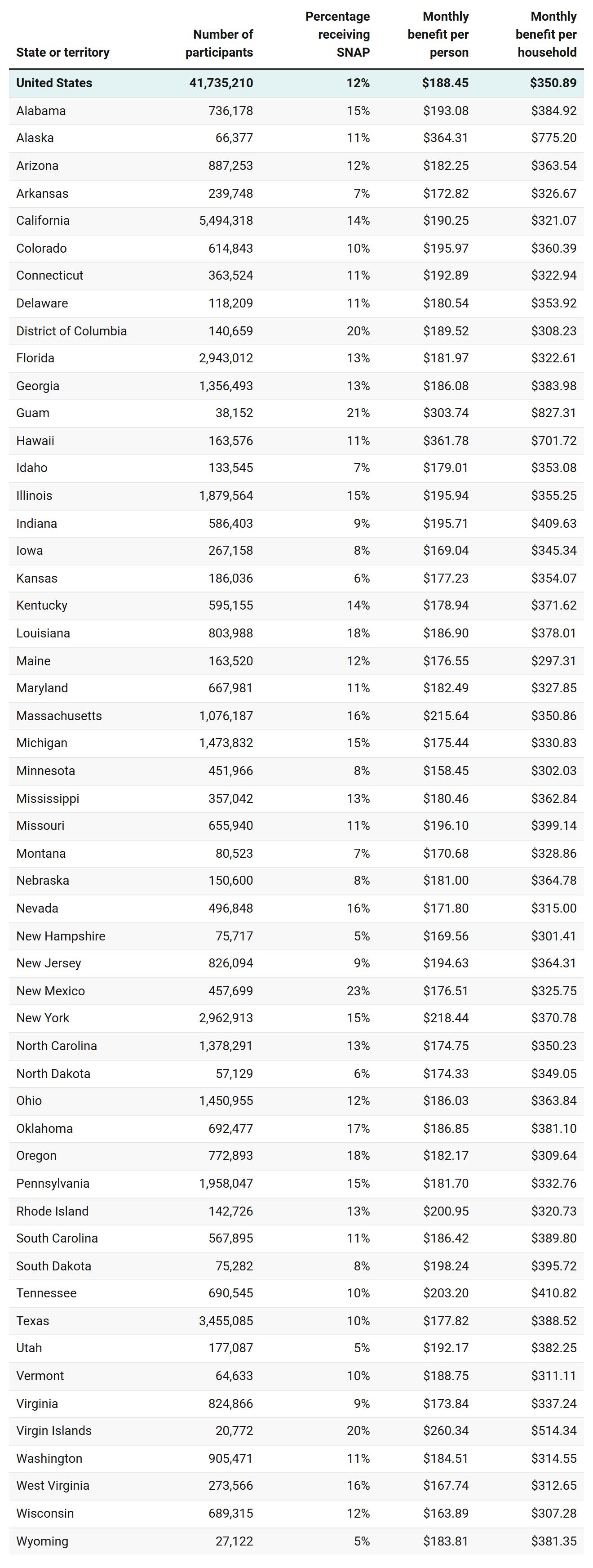
TABLE 1
USDA refusal to fund SNAP would harm roughly 42 million Americans
SNAP participation and benefits per person and household, by state
Note: Number of SNAP participants and SNAP benefits data come from preliminary May 2025 data, the latest month publicly available. The percentage of the population receiving SNAP is based on July 2024 data to align with census population estimates.
Source: USDA Food and Nutrition Service, “SNAP Data Tables” (last accessed October 2025); U.S. Census Bureau, “State Population Totals and Components of Change: 2020-2024” (last accessed October 2025); U.S. Census Bureau, “International Database (IDB)” (last accessed October 2025).
Table: Center for American Progress
While SNAP is a lifeline for recipients, it is also crucial at the community level: Tens of thousands of grocery stores and other retailers are at risk of closure without SNAP dollars—most of them in rural areas. Hundreds of thousands of jobs in agriculture, packaging, and retail depend on the food-related spending enabled by SNAP.
Conclusion
Not only does the Trump administration have the power to end the government shutdown; it also has the power—and both the financial ability and legal obligation—to make sure all SNAP recipients receive November benefits during the shutdown. Making the choice to withhold SNAP benefits would be cruel, unnecessary, and illegal.CBPP: Trump Administration Is Legally Required to Provide SNAP in Shutdown, Contrary to Its Claims (archive)
Statement of Sharon Parrott, CBPP President and former Office of Management and Budget (OMB) official, on Agriculture Secretary Brooke Rollins’ false claim that the Trump Administration cannot provide November SNAP benefits during the shutdown
Media Contact: Jacob Kaufman-Waldron - Director for Media Relations
CBPP Statement: October 23, 2025 - For Immediate Release
Secretary Rollins’ claim that the Trump Administration is unable to deliver November SNAP benefits during a shutdown is unequivocally false. In fact, the Administration is legally required to use contingency reserves — billions of dollars that Congress provided for use when SNAP funding is inadequate that remain available during the shutdown — to fund November benefits for the 1 in 8 Americans who need SNAP to afford their grocery bill.
The Administration itself admits these reserves are available for use. It could have, and should have, taken steps weeks ago to be ready to use these funds. Instead, it may choose not to use them in an effort to gain political advantage.
Also, the Administration could use its legal transfer authority — the same authority it already used to provide additional funds to WIC — to supplement the contingency reserves, which by themselves are not enough to fund families’ full benefits.
Speaking as a former OMB official, I know from experience that the federal government has the authority and the tools it needs during a shutdown to get these SNAP funds to families. Even at this late date, the professionals at the Department of Agriculture and in states can make this happen. And, to state the obvious, benefits that are a couple of days delayed are far more help to families than going without any help at all.
It would be unconscionable for the Administration to go out of its way to threaten millions of children, seniors, veterans, people with disabilities, parents, and workers with hunger, rather than taking all legal steps available to provide food assistance to people who need it.
Last edited:


