Navigation
Install the app
How to install the app on iOS
Follow along with the video below to see how to install our site as a web app on your home screen.
Note: This feature may not be available in some browsers.
More options
Style variation
You are using an out of date browser. It may not display this or other websites correctly.
You should upgrade or use an alternative browser.
You should upgrade or use an alternative browser.
r/fuckcars / Not Just Bikes / Urbanists / New Urbanism / Car-Free / Anti-Car - People and grifters who hate personal transport, freedom, cars, roads, suburbs, and are obsessed with city planning and urban design
- Thread starter Markass the Worst
- Start date
-
🏰 The Fediverse is up. If you know, you know.
-
Want to keep track of this thread?
Accounts can bookmark posts, watch threads for updates, and jump back to where you stopped reading.
Create account


- Joined
- Jul 1, 2015
Skyline's Free-to-ride weekend still fell short of Blangiardi's "25k daily ridership" target. / Archive
HONOLULU (HawaiiNewsNow) - Passengers enjoyed free rides on Skyline as part of the city’s fare-free weekend.
Free rides were also available on TheBus and TheHandi-Van.
The offer celebrated the opening of the rail’s second segment, which added five more miles of track and four new stations east of Halawa as of Thursday.
Passengers can now stop at Joint Base Pearl Harbor-Hickam, Daniel K. Inouye International Airport, and the Kalihi Transit Center at Middle Street.
Rider Carol Dang said she rode the rail from start to finish.
“We had a fabulous time today,” Dang said. “Our concern was not being able to use the restroom, but we got off at the airport.
“We also stopped at Middle Street and we got some information on purchasing HOLO cards, and also the fares, because I also plan to bring my kupuna group out here in a couple of weeks,” she added.
The city said 19,556 people rode Skyline Saturday, 10,471 on Friday, and 11,849 on Thursday.
Learn more about Skyline here.

- Joined
- Sep 29, 2022
Some cursory searching (according to Google AI, it says that Delhi only has 30k people square mile on average, which is about on par with the denser parts of Amsterdam (28k people) and far less than Manhattan (70k), which is less than the record-holder Manila in the Philippines (120k people). But that doesn't account for how much of Manhattan is housed vertically and in India that number isn't accurate.So Urbanists want the density of Indian cities but the infrastructure of western European cities
When it comes to raw numbers, most urbanists don't really think through what density actually means. Even when it comes to something like KWC the idea that it's a vertical slum and you aren't getting an apartment so much as a room, with no toilets, appliances, running water, or trash disposal.
The main issue with India is that it is completely overcrowded and would be significantly easier to live in with 1/2-1/3 of its population, which is why India’s official geopolitical strategy is to offload as much of its semi-educated-but-underemployed population onto the rest of the world to avoid unrest at home, and also gain remittances and political influence through this diaspora.
Almost all the third-world cities could fix themselves by getting the rapists and murderers off the street and ending corruption, and you can see remnants of civilization in places like Brazil with curbs, paved roads, signage (the yellow diamonds similar to North America), and streetlights (and that's still one of the better areas--from eyeballing São Paulo, they don't have the foot-traffic only favelas Rio de Janeiro has).
Assuming it could maintain itself and not fall apart South Africa-style, any third-world city, with sufficient funding could run bulldozers through the city to create new avenues, highways, and trains. In particular, Dubai's road network seems heavily influenced by the United States and details like stoplights suggests that they actually went to American cities and observed how they work.
An urbanist would go bald with horror if the third world got ahold of TxDOT (or whatever) schematics (they're not hard to find, on PDF!) and started to get ideas.
I believe it but the "trouble below, trouble above" is why big cities in America are problems. Broadly speaking, you got the Jewish/ultra-rich segment screwing things up upstream with uncivilized, lower-class non-whites creating problems downstream. To what extent depends on the city but I can absolutely see something like this going on overseas as well.I think due to the caste system still being socially there and Hindu faith it's impossible though Dalits are where most of the disgusting Jeet behavior is coming from while Brahmins where the skummy Jeet behavior in corporations is coming from. Though I have more faith in India getting better than Pakistan.

- Joined
- Apr 12, 2021
That's because half of municipal Delhi is farmland:Some cursory searching (according to Google AI, it says that Delhi only has 30k people square mile on average, which is about on par with the denser parts of Amsterdam (28k people) and far less than Manhattan (70k), which is less than the record-holder Manila in the Philippines (120k people). But that doesn't account for how much of Manhattan is housed vertically and in India that number isn't accurate.
The parts where people live are far, far, denser.
Anyone with eyes can tell you that this:
is far more dense than this:
(maps are at the same scale)
Even the densest parts of Manhattan look like ghost towns compared to India despite the massive residential skyscrapers because New York has actual open space, doesn't build on literally every square inch of land, and New Yorkers have personal space and don't live 10 to a bedroom:
In particular, Dubai's road network seems heavily influenced by the United States and details like stoplights suggests that they actually went to American cities and observed how they work.
Funny you should say that, because much of the Middle East's infrastructure was designed by Texans as part of their oil consulting. This is incredibly obvious when you look at their frontage road systems, which are rarely seen outside of Texas.An urbanist would go bald with horror if the third world got ahold of TxDOT (or whatever) schematics (they're not hard to find, on PDF!) and started to get ideas.
Riyadh, Saudi Arabia:
Dallas, Texas, USA:
Last edited:
- Joined
- Sep 29, 2022
The exits in Saudi Arabia aren't much of an exit but that and the "Texas turnaround" is definitely there. Meanwhile, in the UAE there's a bit of British roads and signage in there because of their legacy as part of the British empire...but there's more American/Texan/Florida influence at least in Dubai roads.Funny you should say that, because much of the Middle East's infrastructure was designed by Texans as part of their oil consulting. This is incredibly obvious when you look at their frontage road systems, which are rarely seen outside of Texas.

- Joined
- Jul 18, 2016
That is the strangest proposition to me, because I actually love driving. Hate traffic, love driving, figure that one out. But especially when I go over the mountain passes where I live, I get this wonderfully meditative experience of seeing the beauty of nature around me, and even without it, being in control of a powerful machine that lets me decide my own destiny is just a wonderful time.Well, if you've spent enough time in this thread, you know the playback, it's not that they just want trains, is that no one actually wants to drive, it's the eeeeeeeeeeeeevil car industry/oil industry that brainwashed the public and forced through road construction

- Joined
- Nov 26, 2018
I regularly do long car trips and I love driving through the states I drive through. Lots of beauty out there.That is the strangest proposition to me, because I actually love driving. Hate traffic, love driving, figure that one out. But especially when I go over the mountain passes where I live, I get this wonderfully meditative experience of seeing the beauty of nature around me, and even without it, being in control of a powerful machine that lets me decide my own destiny is just a wonderful time.
- Joined
- Jul 18, 2016
It's hard to find that beauty when you're stuck in the bug hive. I live in Washington State, and if you stay away from Seattle and Spokane you'll be awestruck by the natural beauty all around you. Seattle tries to have some of that beauty but fails miserably. Spokane does an alright job, has some good parks. But nothing compares to the experience of driving through a thick forest that Snoqualmie pass offers.I regularly do long car trips and I love driving through the states I drive through. Lots of beauty out there.
- Joined
- Sep 29, 2022
I realize I wrote "playback" when I should've done "playbook". But I also don't understand why they think people were "forced" to drive because polls suggest that while not everyone loves driving, an average of 78% like it a lot or at least a moderate amount. Those numbers don't favor the "we could get people off the roads if we poured $$$ into mass transit" and even the 22% of people who don't really like driving won't get "on board" because mass transit won't suit their needs. I knew a guy who drove out to construction sites from Salinas to the Bay Area (at least an hour). Didn't really like driving but mass transit wouldn't work either.That is the strangest proposition to me, because I actually love driving. Hate traffic, love driving, figure that one out. But especially when I go over the mountain passes where I live, I get this wonderfully meditative experience of seeing the beauty of nature around me, and even without it, being in control of a powerful machine that lets me decide my own destiny is just a wonderful time.
And of course, a good chunk of that 20% isn't happy with the reputation of mass transit either, because of the sorts of people who ride on mass transit. Permabans from mass transit are rare and only given out to the people who should've been euthanized years ago.
- Joined
- Nov 26, 2018
That's indeed a beautiful drive. At least when it's not fogged up or snowing.But nothing compares to the experience of driving through a thick forest that Snoqualmie pass offers.
- Joined
- Apr 12, 2021
Urbanist twitter is currently glazing JP Morgan Chase's new $3 billion skyscraper in NYC, 270 Park Avenue:

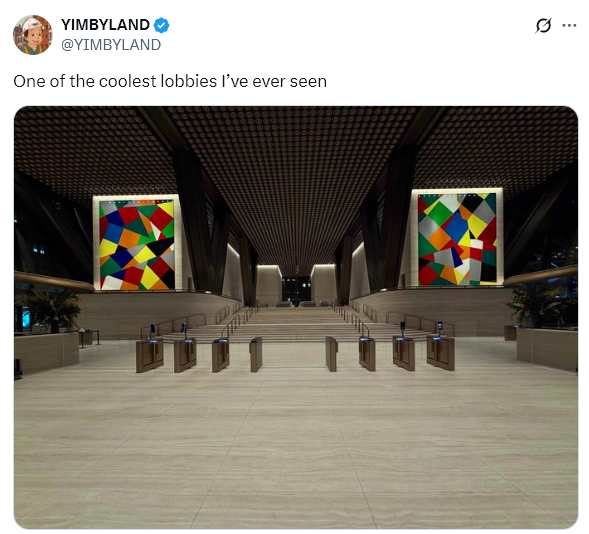
 Source (Archive)
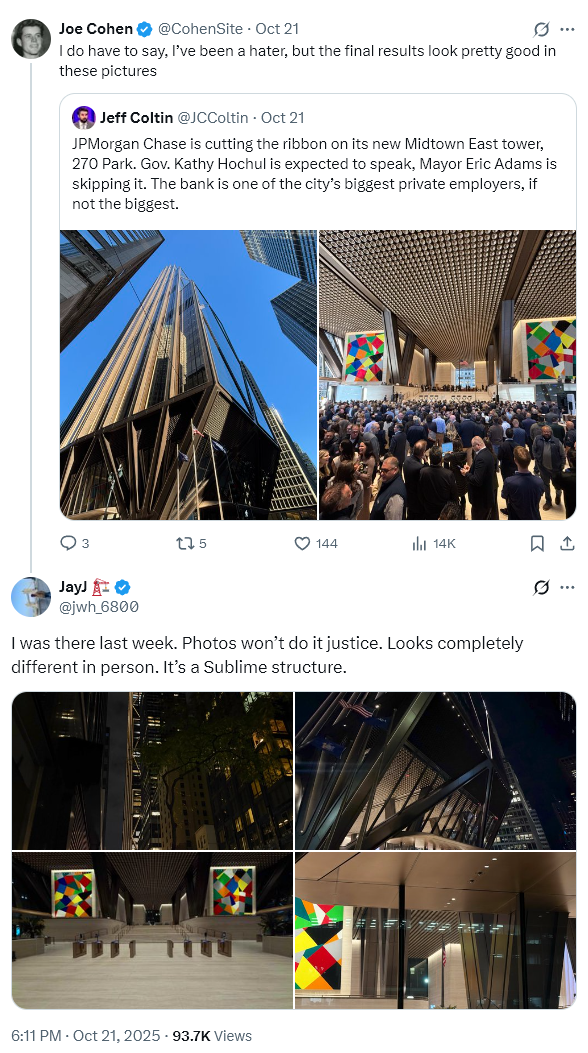


 Source (Archive)
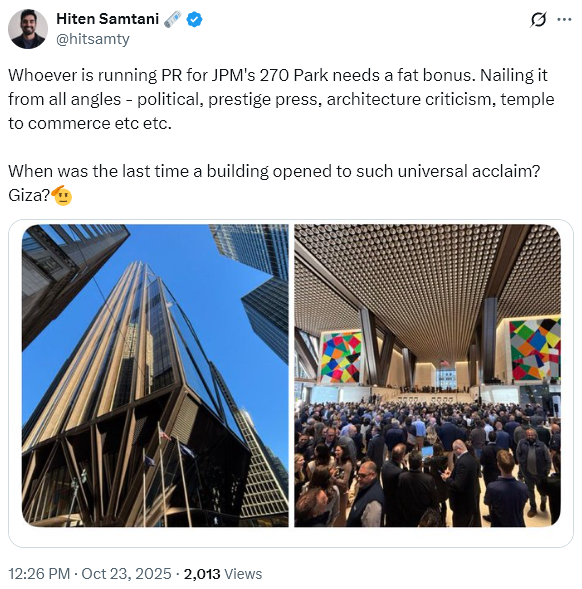
 Source (Archive)
What it looks like on the inside:

"Why does everyone want to work from home?" - CEO Jamie Dimon


What it looks like on the inside:
Source (Archive)Some investment bankers are finding that the building’s tall floors and large common areas mean their actual working spaces are more cramped than those at the old digs across the street at 383 Madison Avenue, people who work at the bank said.
"Why does everyone want to work from home?" - CEO Jamie Dimon

- Joined
- Jan 20, 2022
What a godless hellhole. The common areas look interesting, surely they do have money for something better than a big, empty floor space filled with desks. Those aren't even the universally hated cubicles (that give you some privacy and space, at least), it looks like a classroom (but worse)What it looks like on the inside:


- Joined
- Jun 18, 2019
Why would urbanists want a return to office? Surely shut ins would prefer working from home?Urbanist twitter is currently glazing JP Morgan Chase's new $3 billion skyscraper in NYC, 270 Park Avenue:
View attachment 8068979
View attachment 8068973
Source (Archive)
View attachment 8068952
Source (Archive)
View attachment 8068955
Source (Archive)
What it looks like on the inside:
View attachment 8068917
Source (Archive)
"Why does everyone want to work from home?" - CEO Jamie Dimon
I do like how the exterior of the building looks. At least it’s not a gray cube.

- Joined
- May 21, 2024
The exterior at least calls back somewhat to the greatness and grandeur of Art Deco. I don't hate it.I do like how the exterior of the building looks. At least it’s not a gray cube.
The interior is triggering my fight or flight response.
- Joined
- Apr 12, 2021
All their walkable businesses are dependent on suburban commuters or tourists to stay in business. City services are also dependent on taxes paid by nonresidents. WFH greatly enriched suburban cities and businesses at the expense of urban ones, and a major reason why big companies are pushing RTO (besides their sunk costs in real estate) is because core city governments are threatening them behind the scenes with losing their sweetheart tax breaks if they don't bring people back.Why would urbanists want a return to office? Surely shut ins would prefer working from home?
Urbanists may personally like working from home, but their ideology demands it be abolished because when given the choice of living anywhere, very few people choose to live in dense cities.
- Joined
- Sep 29, 2022
I don't mind going to the office. But if I'm being punished just for using my car in the city (congestion pricing—and why do I get the feeling that they won't get free parking) to work in a call center-like environment with zero personal space like an enslaved chimpanzee, then what's the point?"Why does everyone want to work from home?" - CEO Jamie Dimon
That's how things are supposed to look, you put the offices above and the retail/restaurants below, with maybe a few restaurants mid-building if it's impractical to send everyone down to the lobby for lunch hour. (The World Trade Center had a small food court in the middle of the building).As the sky-lobby filled with glossy retail and eateries, some executives worried it was beginning to look more like a mall than an office building. Dimon tapped Rick Caruso, the billionaire Los Angeles developer known for his shopping centers, for his advice on how to cultivate a more professional look.
Before COVID, Houston had a really robust network of underground tunnels that linked the various office buildings together. Don't like what your building has to offer? Just walk a few blocks to a different food court. It had a variety of chain places (Whataburger, Chick-fil-A, Which Wich) and some local places too, as well as a few retail tenants that made sense in a heavy office environment (iPhone accessories, Jos. A. Bank in case you needed a new shirt for whatever reason, drug store/newsstands, etc.). It was useful because it avoided the weather and crossing streets, and security kept problems out.
It was closed in the evenings and weekends but it was a workable ecosystem and the office crowds kept everyone in business.
Speaking of the World Trade Center, the original mall had a whole shopping network that featured more stores and restaurants than what the typical office building would have, including Warner Bros. Studio Store. (In earlier days, a good part of the concourse was taken up by Alexander's, an off-price department store). Because it was the World Trade Center it was also a huge tourist draw as well.
The current "Westfield World Trade Center" reflects both the boring mall mix places have these days and its office tower pedigree so you have Apple, a handful of clothing and gift stores, and three drugstores. It is also substantially vacant, though who knows what the REAL problem is (there could be anything--crime, lack of tourists, lack of residents, ridiculously high rent).
When it comes to retail, somehow the narrative switched from New York's higher-end retail, if it didn't have one-of-a-kind boutiques and flagship stores, it was in a bunch of smaller stores that you could find just about anything you needed. At some point (after COVID) it switched to the bodega cope. (The general lack of full-line, non-upscale grocery stores, was one of the things New Yorkers didn't like to talk about.)

- Joined
- Apr 30, 2023
In my career so far my favorite places to work were boring cookie cutter office parks. Low rise structures, lots of parking, a cubical or separated sometimes shared office, boring and basic. Everything else looks real cool for about 15 minutes but you're still an office drone, the things that matter more are how busy the bathroom is and how much privacy you have to pick your nose or browse twitter.Urbanist twitter is currently glazing JP Morgan Chase's new $3 billion skyscraper in NYC, 270 Park Avenue:
View attachment 8068979
View attachment 8068973
Source (Archive)
View attachment 8068952
Source (Archive)
View attachment 8068955
Source (Archive)
What it looks like on the inside:
View attachment 8068917
Source (Archive)
"Why does everyone want to work from home?" - CEO Jamie Dimon
If you're in a room with (guessing) 10x20 rows of seats, how annoying is it going to be when someone's talking on the phone nearby or leaves a stinker in the bathroom?
Even the restaurants in business parks tend to be better even if you have fewer options.
Edit: I rechecked that image and the rows are back to back. So at least 20x20.... 400 people per room.

- Joined
- Dec 15, 2022
The outside of the building looks really cool. Reminds me a bit of 1900s art deco, 5x better than anything else built this decade in NYC.Urbanist twitter is currently glazing JP Morgan Chase's new $3 billion skyscraper in NYC, 270 Park Avenue:
Lobby is 1x better than anything else this decade - ass.

- Joined
- Jun 12, 2020
Dunno, first thing I thought of seeing the building.Urbanist twitter is currently glazing JP Morgan Chase's new $3 billion skyscraper in NYC, 270 Park Avenue:
View attachment 8068979
View attachment 8068973
Source (Archive)
View attachment 8068952
Source (Archive)
View attachment 8068955
Source (Archive)
What it looks like on the inside:
View attachment 8068917
Source (Archive)
"Why does everyone want to work from home?" - CEO Jamie Dimon

- Joined
- Dec 23, 2023
I see this faggot has never lived. Learning how to not faceplant when cornering hard on a tricycle at speeds it should never go was practically a rite of passage. I'll bet he never accepted a dare to ride a tricycle downhill and over an improvised ramp in order to try to jump over a drainage ditch.Tricycles would fix this issue, dunno why urbanists obsess so much over the two wheelers instead.
edit: lmao what
View attachment 8042342