It was just another hot summer day on the remote Greek island of Samothrace in the northern Aegean. We hiked, my two small children and myself, along a breathtaking stream that still flowed coolly and abundantly even at the height of summer. Two hikers – a young couple, man and woman – got stuck behind us on the narrow trail, which is supposed to be an hour's hike; for us, it took almost an entire day.
I asked the children to let them pass, and they did. At a bend some distance away, just a second before he disappeared from sight, the man turned around toward us and his expression said: This is all I can do against you, murderer. He waved his fist at the blue sky and yelled: "Free Palestine!!" Out of pure shock, I mumbled a lame response: "Okay...." They were gone by then anyway.
When we ran into them again, a few minutes later, they were in a different stage: sprawled out on a hot boulder next to a frothy waterfall with a clear and cool pool at its bottom, naked as the day they were born. Their age, their expressions, her head shaven at the temples, his unruly mane, the earring in his nose – everything screamed "woke." Squinting and looking as if they were snarling, they surveyed their surroundings and conspicuously ignored us.
I didn't even try to exchange another word with them. What could I have said? That I protest every week against the government and its policies? That they should try to draw a map of the river, sea and the boundaries of the 1947 UN Partition Plan? Why, I thought, were they protesting here against me and not in front of the Israeli embassy in Athens? Maybe it's me who shouldn't be here, but in Israel, demonstrating?
Two weeks later, while we were still on the island, Israel's B'Tselem human rights organizations and Physicians for Human Rights defined the Israel Defense Forces operations in the Gaza Strip as genocide. "What are we doing here?" I asked my wife. "There is a genocide in Gaza and we're here, looking for the perfect taverna?"
Samothrace was supposed to be the main stop during our temporary escape from the mess in Israel: a two-month long journey from eastern Greece to western Italy via Albania. I was tired after two and a half years of rallies, marches, obsessive consumption of the news, and writing articles and opinion pieces that didn't change anything. I had hoped to blend in, to be swallowed up in the endless nature on the island, which has many more goats than people and more lush vegetation, streams and springs than your average Greek isle – not to mention a lot more in-your-face nudity than I'd ever seen in my life.
Because of a combination of historical and topographical factors, and the lack of supervision and enforcement, the small and charming Samothrace – with an area of only 178 square kilometers (about 69 square miles), smaller than the Mount Carmel ridge near Haifa – has become a pilgrimage site for hippies from all over the world. You see them on beaches and hiking trails, in chilly pools and hot springs, despising Western capitalism with an iPhone in their hand. One after another, they would gather, walk along the shoulders of the road that encircles the island, trying to catch a ride in the old style of hitchhiking, arms stretched out with thumbs up. When I stopped to pick them up and we began to talk, when said I was Israeli, silence prevailed.
The nudity on this island is a dominant and strange experience. Greece has a lot of nude beaches, the law even allows nudism in established resorts and beaches, but I have never been in a place where the phenomenon was so common. No one talks about it, it simply happens on hiking trails, at beaches and streams, although not everywhere. At first, it was strange to see men and women naked in front of you, ignoring you, reading a book and even walking on a trail wearing only a backpack and sandals. It takes time to understand how to control your gaze, how not to stare, how to explain it all to the children. But after a while it becomes, even if not exactly taken for granted, then at least somewhat reasonable. Clearly, it's more enjoyable to bathe in nature without clothes. All you have to do is to get used to the fact there are other people around, who also enjoy skinny dipping – the same as you.
Of course, you don't have to be naked. As people say in hippie circles, it's "optional." Simply do whatever you want. Even if you opt for a bathing suit, the small freedom of being able to change without hiding behind craggy rocks and thorny bushes is a joy. With this bacchanalia of private parts surrounding you, who cares if you're naked for 10 seconds? I made a new decision for myself every time, according to the circumstances. I usually avoided getting naked in the presence of my children, but when we hiked with another Israeli family who undressed completely (the dad sported only a Decathlon towel), it was weird to stay clothed all the time, so we became more flexible.
If a screenwriter had proposed making a movie about an Israeli family who travels at the height of the war in Gaza to an island of hippie nudists, the film fund people would have rejected it because of the too-obvious symbolism. We understand you, they would have told the screenwriter; the family wants to get rid of all their external trappings, encounter the world in its most primal state and return to their roots – but no matter how often they take off their clothes, they remain who they are – yes, yes, we got it, stop right away… But that really was the feeling and it was impossible to free yourself of it: Israeliness is an iron ball chained to your leg that no hacksaw can cut off. That was true whether we were encountering foreigners or other Israelis, who always seemed to have a sad look in their eyes.
You might get the impression that all this ruined everything for me, but you would be mistaken. The landscapes – both natural and human – were too powerful to ignore. Everything on this island got under your skin, or maybe crawled on top of it, as happened to me one pleasant afternoon when I was on my own and took advantage of the situation to take a dip in a stream in the nude. I floated on my back, enjoying the rustling sounds of nature, when suddenly I felt something wet and muscular move on my body, and not something small. In a fraction of a second, I realized it was a black water snake. The realization of all my nightmares. As a kid, I always had nightmares about snakes. I screamed incredibly loudly and ran out of the water. You wanted to touch nature without any barrier? I told myself, here you go. On the other hand, at least the snake was not repulsed by the fact that I'm Israeli. Thank God for small mercies.
Nude Mossad agents
About 3,000 Greeks live on Samothrace, many of them farmers. I got the impression the locals aren't particularly interested in the Israeli-Palestinian conflict. In addition, a few tens of thousands of visitors arrive every year, most of them attracted by the amazing natural sites and the anarchist and mystic aura of this mountainous island, which was mentioned back in "The Iliad" and boasts famous remains of an ancient temple. The tensions mostly surface when encountering tourists like these, especially the young people among them, energetic and angry Greek students for whom the face-to-face meeting with Israelis in the flesh arouses powerful emotions and a feeling of: Here's my chance.
The hippie nerve center of Samothrace is the huge, free campsite on the island's northern shore. For logistical reasons, we didn't erect our tent there. My wife needed to work remotely and the conditions were not convenient, but we did go there a number of times and were deeply impressed. It was a sort of small tent city, charming and filled with mosquitoes, in the shade of a large natural woodland. Narrow paths had been cleared, hammocks hung between trees and improvised kitchens had been set up on frayed plastic mats.
Some enterprising people had erected a few shacks from driftwood and dried-out bushes. The residents of the campsite spread out their portable solar panels between the huts in order to charge their phones; they glittered like square, brown gemstones between the gray pebbles. The seawater was so clear you could see the fish. On the sinks everyone used to wash their dishes, someone spray-painted in English one night: "Death to the IDF" and "Zionism = Fascism."
The Israelis, who gathered together in the "Israeli area" (of course there was such a place and of course it was the most crowded in the campsite), discovered these slogans one morning, along with: "Gaza is the new Auschwitz" and "A vacation from genocide – Not here." Dorel Mintzer, an Israeli filmmaker we met, called the incident Kristallnacht, with a bitter smile. Mintzer, his wife Agatha and their small daughters come to the island every year after making the long drive in a Subaru station wagon from their home in Lublin, Poland. Last year, when they were met with a similar vibe, they initiated a talking circle with the Greeks, which Mintzer described as very successful, even though – and maybe because – a lot of extreme viewpoints were aired there, including blunt antisemitism. It seemed as if the protest among the locals, at least back then, was not so much against the Israelis on the island as much as in favor of the Palestinians, said Mintzer. Greek leftists identify quite closely with the Palestinian narrative, since the days in which the PLO cooperated with them in the struggle against repressive pro-American regimes in Greece – Israel, on the one hand, and the Greek military dictatorship in the other.
This year, when the Greek woman who sells chocolate balls at the campsite accused Mintzer and his erstwhile compatriots of being Mossad agents ("Do you get that? She was talking about a handful of Israeli families, all of whom were naked all day long!" he said), he felt the situation no longer allowed dialogue. At the same time, he didn't want to pack up his tent and leave, the way other Israeli families did. The solution he and his wife found was to compose a written statement in English, three copies of which they posted in the area, asserting, "We do not support the genocide. We are deeply ashamed of our evil and Zionistic government. We didn't vote for them." Signed: "All of the Israelis at the camping."
Not all the Israelis identified with what you wrote.
Mintzer: "We chose to use their own language so the Greeks would understand, he said. "It's not my job to decide if it's genocide or not. The message was we are not the enemy they are protesting against."
Apparently, the letter did calm things down to a great extent.
Eva, a teacher at an anthroposophic preschool, from the Galilee (whose name has been changed to protect her privacy), had an even more unpleasant experience when she arrived in July for two weeks of camping on an isolated beach on Samothrace. While you can easily reach the Free Camp site in a car, the wild Vatos beach in the southern part of the island can only be reached in a boat or by hiking a long and steep trail. Anyone who comes there must bring food with them; water can be drawn from the well. The plane trees provide lots of shade, and the only sound heard at night is the cries of owls, echoing the star-filled skies.
"I'm a friendly person who travels alone a lot," Eva told me, adding that that's why she was surprised that for four full days she couldn't find any way to connect with the locals on Vatos. "Every time I tried to have a conversation, people turned away and left. I told myself: 'I just don't click with the Greek people.'" Only a week later, when a female couple who bothered her all the time told her explicitly: "You and all your Israeli friends aren't welcome here," did Eva fully understand why she was being ostracized. "As far as they're concerned, I'm the representative of Bibi and Smotrich. I'm the bad one," she said, referring to Israeli Prime Minister Benjamin Netanyahu and Finance Minister Bezalel Smotrich.
About 12 days after arriving in Vatos, Eva realized that being Israeli was also making it hard for her to leave the beach. The regular boatman who came every day, to bring people back and forth, had disappeared – and no one else would give her a ride, even when she offered to pay 200 euros, 20 times the regular rate. She and an Israeli friend who had joined her in the meantime were stuck in Vatos with nothing but lentils to eat. They had to stay around for another two days before they could board a boat sent for them by a friendly person from the local fire department.
Eva: "It took me a week to recover. I got sick. After that I stuck with Israelis. I met a few Israeli women who told me about difficult experiences. The Israeli men hid their identity pretty much because soldiers were especially not welcome there."
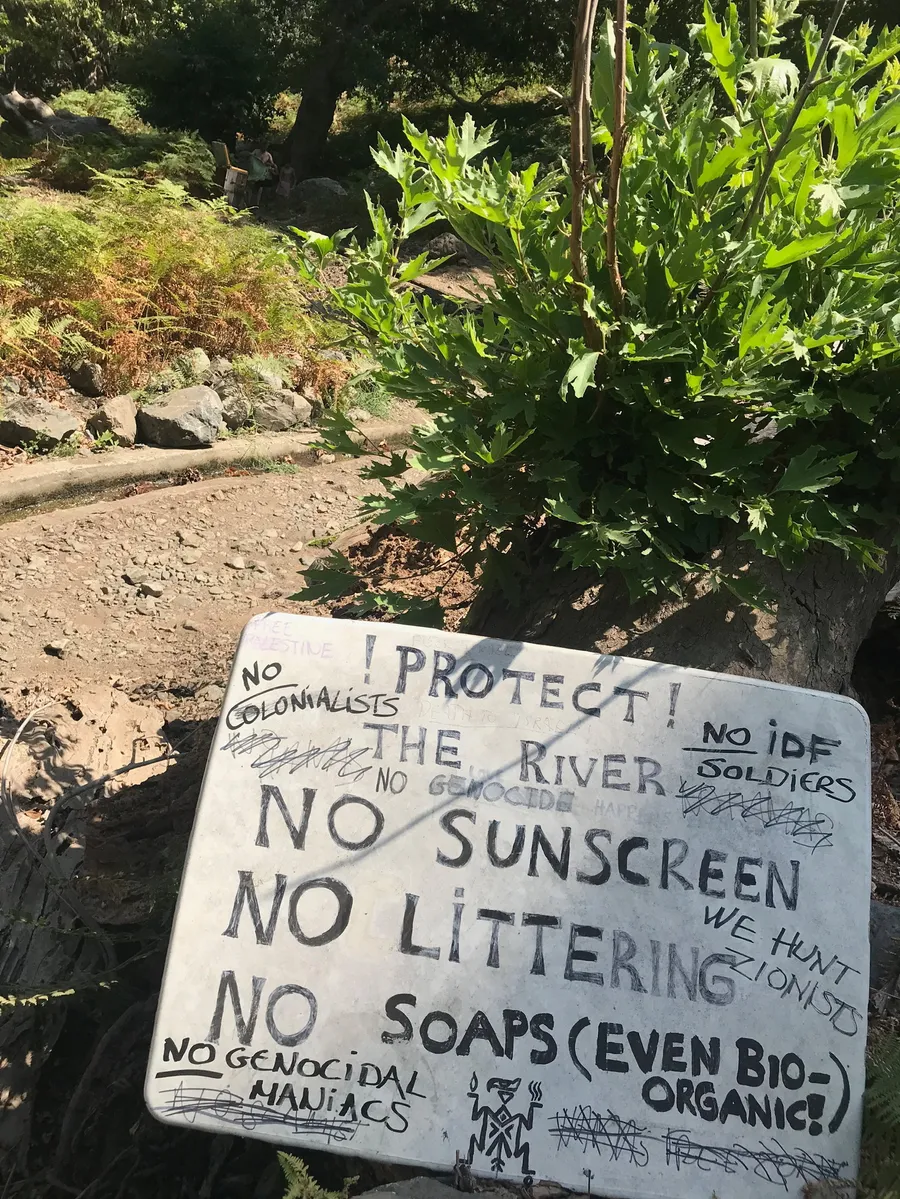
One of the posters that was hung on Samothrace said the only type of Israelis who would be welcome would be "teens burning their draft orders."

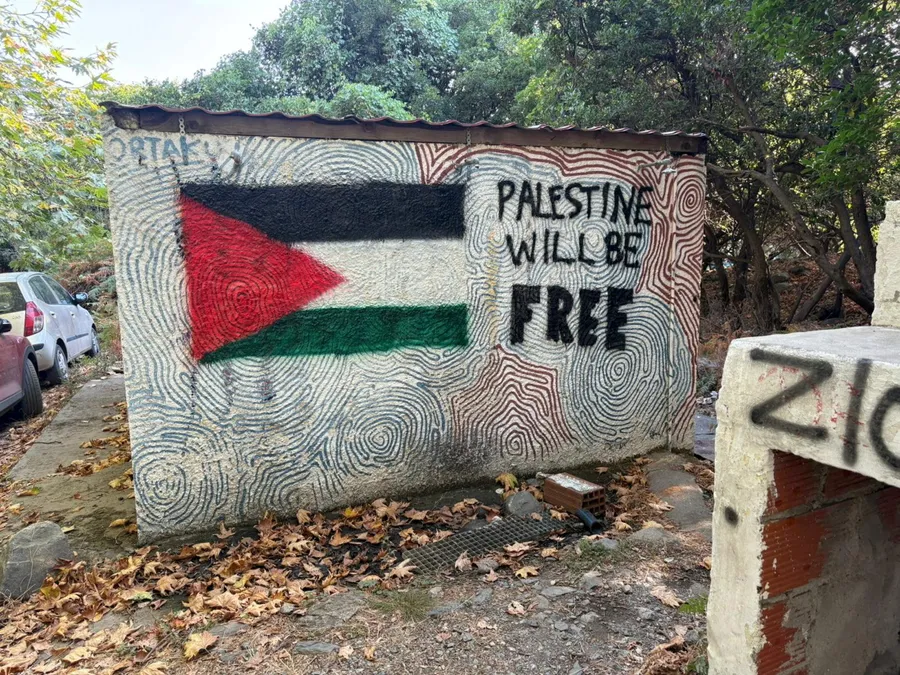
Anti-Israel graffiti on the island. On this trip, for the first time in my life, I even felt a bit like I wanted to go back to Israel already, where they hate me because I'm a leftist – not because I'm Israeli.
'Boom, boom'
This trip marked a watershed for me. It was the first time I felt so unwanted outside of Israel. Once, 20 years ago, on a mountain in Nepal, a Belgian backpacker said to me: "That's so Jewish of you," when I told him about my negotiating habits. But No. 1: I'm not especially proud in retrospect of what I told him, and No. 2: It was an instance of just plain antisemitism, the good old, garden-variety antisemitism I had never run into before – and not since, either. This past summer everything was different. Among certain segments of the local and foreign populations we encountered – whether hikers, diving instructors, students, almost every educated person and/or English speaker – it was no longer possible to say "I'm from Israel" any more without those words getting stuck in your throat, or without precipitating a heavy silence that invited explanations, clarifications or apologies.
In Italy, someone told my wife: "You're Israeli – but certainly not Zionist, right?" A salesman in a bicycle store in Naples, who I approached with my young son to ask about renting a bike with a child seat, first muttered something about the store being closed, and then summoned up his courage: "We don't sell to Israelis – boycott," he reproached us, walking away. As opposed to other incidents that occurred in Europe, at least we never experienced violence. But it's enough that people reject you openly once; it ruins your mood for an entire day. On this trip, for the first time in my life, I even felt a bit like I wanted to go back to Israel already, where they hate me because I'm a leftist – oh, old well-known shit – and not because I'm Israeli.
In an article that summed up the hostile reception Israelis have received from the world this last summer, The New York Times mentioned a list of similar incidents – from Uber drivers refusing to take passengers with Israeli names to a waiter in a pizzeria who threw out three classical musicians who had come for a bite to eat before a concert in Vienna. Cellist Amit Peled, who was one of them, told The Times: "The people around us were clearly startled, some offered sympathetic glances, and then, quietly, they went back to their dinners, their conversations, their wine — as though nothing had happened." What was even more a galling "was that two of them came to the concert after their meal."
I felt, too, that the social rejection was harder than the refusal to sell something to you. The feeling of being rebuffed came from those you hoped to connect with, to hike alongside on the same trail or to exchange views about oat milk and reusable diapers.
At one point, I told myself: So they don't like you in one place or another, but that's just a small minority. The sad truth is different: Surveys show about a virtual meltdown in public opinion in the West concerning Israel over the past few months. According to a Pew Research Center poll published in June, the majority in almost every country surveyed had negative views on Israel – from Japan, 79 percent, in the east; to Canada, 60 percent, in the West; including Greece, 72 percent, and Italy, 66 percent. Out of 24 countries, only in three were the percentages of positive views higher than negative ones: in India, Kenya and Nigeria.
A YouGov survey that compared data this spring from that of previous periods found that support for Israel in six key European countries (the United Kingdom, France, Germany, Denmark, Spain and Italy) was at its lowest in years. A vast majority of respondents from those places said Israel had made a mistake by sending soldiers into Gaza from the very outset, or justified the outbreak of the war but said Israel had "gone too far and caused too many civilian casualties." Only 6 percent to 16 percent of those surveyed said the Israeli attacks on Gaza have been "proportional." In a survey conducted this summer by the Israel Democracy Institute, 59 percent of Jewish Israelis said that in light of the harassment they feared, they planned on cancelling their next trip overseas, or would at least change the destination.
One person we met who was revealed as a warm pro-Israeli was an Albanian man in the prime of life, whom we met next to a lukewarm spring, reeking of sulphur, in southern Albanian on the border with Greece. He didn't speak a word of English, but when he heard the word "Israel," he became so enamored of us that he gave us half a melon as a gift. Somehow, even those who told me they "actually like us," made me a bit depressed. "Israel? Boom, boom," the guy said with an expression – actually, of respect – imitating a soldier shooting a rifle. That's us now, boom, boom. Two hours later I threw up the melon.
A vanishing dream
The journey to Samothrace is long. The island does not have an airport and to reach it you must take a two-hour ferry ride from the city of Alexandroupolis, about a three-hour drive east of Thessaloniki. The dusty port city of Kamariotissa, where the ferry docks on Samothrace, looks like every port city on every Greek island: a row of cafes that serve shitty ice coffee and local beer, a children's play area that opens every day only at 7 P.M. because of the heat, and a few businesses for renting cars and beaten-up mopeds.
On our first night on the island I didn't understand why we had made such an effort to go there specifically. After all, there are so many charming Greek isles, all of them with tavernas and souvlaki; all have insanely beautiful beaches, villages with winding alleys, cute lambs and flourishing fig trees. Everything looks the same at first on this island, until you begin to walk about. Suddenly, you discover another stream, and another waterfall, more incredible pools with a naked person lounging on the bank who set up a tent there. In one of the streams, we even found to our amazement, a sort of netting that a few Serbs had woven at a height of six meters, on some trees, which they slept on for a few nights.
People camp everywhere there. That is against Greek law, but enforcement seems lax although Samothrace is environmentally vulnerable. Camping at the free site, however, is less harmful and totally legit, but I don't see myself going back. It's sad. After so many years of trips I had found the perfect destination for a vacation: abundant nature, little commercialization, proximity to Israel and free camping. But the dream has vanished. I've been banished from the Garden of Eden. Maybe someday it will be possible to once again join the hippie community without having to pray that no one asks where I'm from.
Mintzer saw things a bit differently. After the conversation with the chocolate-ball seller, he realized that his feeling of helplessness in coping with the horrors happening in Gaza made him shut himself off from people; the protests and posters, in his eyes, were not just "anti" and offensive, but also an emotional wake-up call.
"Genocide or not, what is happening is real," he said. "People are dying and it's painful. I realized it needed to come out somewhere, so I wrote two nice songs – one about what we [Israelis] have done in Gaza, the other about the peace that could be. These are the songs of a teenager, of someone who experienced the feelings, like these Greeks in their 20s did, who go to demonstrate in the squares of Athens and Thessaloniki, and also on their vacation on Samothrace.
He added: "If you manage to see past the aggressive manner of expression, you'll understand the intention in their hearts is pure."
His words touched me, and suddenly I understood how preoccupied I had been with the question of whether they "like us," or at least "don't hate us," or if they "understand the complexity." I would mutter to myself "Oy, oy, oy," every time I saw more graffiti of a Palestinian flag spray-painted in yet another corner of the island.
I paid very little attention to the essence of this whole campaign, to the feelings of terror and sorrow of those who try to fight against Israel and in so doing fight against me too. Maybe that's simply what we wanted when we traveled abroad, an emotional disconnect. The bottom line: Anyone who wants emotional detachment would be better off not travelling to Europe now – or to the West at all. India, Kenya and Nigeria. That's what's left.
(L/A)
I asked the children to let them pass, and they did. At a bend some distance away, just a second before he disappeared from sight, the man turned around toward us and his expression said: This is all I can do against you, murderer. He waved his fist at the blue sky and yelled: "Free Palestine!!" Out of pure shock, I mumbled a lame response: "Okay...." They were gone by then anyway.
When we ran into them again, a few minutes later, they were in a different stage: sprawled out on a hot boulder next to a frothy waterfall with a clear and cool pool at its bottom, naked as the day they were born. Their age, their expressions, her head shaven at the temples, his unruly mane, the earring in his nose – everything screamed "woke." Squinting and looking as if they were snarling, they surveyed their surroundings and conspicuously ignored us.
I didn't even try to exchange another word with them. What could I have said? That I protest every week against the government and its policies? That they should try to draw a map of the river, sea and the boundaries of the 1947 UN Partition Plan? Why, I thought, were they protesting here against me and not in front of the Israeli embassy in Athens? Maybe it's me who shouldn't be here, but in Israel, demonstrating?
Two weeks later, while we were still on the island, Israel's B'Tselem human rights organizations and Physicians for Human Rights defined the Israel Defense Forces operations in the Gaza Strip as genocide. "What are we doing here?" I asked my wife. "There is a genocide in Gaza and we're here, looking for the perfect taverna?"
Samothrace was supposed to be the main stop during our temporary escape from the mess in Israel: a two-month long journey from eastern Greece to western Italy via Albania. I was tired after two and a half years of rallies, marches, obsessive consumption of the news, and writing articles and opinion pieces that didn't change anything. I had hoped to blend in, to be swallowed up in the endless nature on the island, which has many more goats than people and more lush vegetation, streams and springs than your average Greek isle – not to mention a lot more in-your-face nudity than I'd ever seen in my life.
Because of a combination of historical and topographical factors, and the lack of supervision and enforcement, the small and charming Samothrace – with an area of only 178 square kilometers (about 69 square miles), smaller than the Mount Carmel ridge near Haifa – has become a pilgrimage site for hippies from all over the world. You see them on beaches and hiking trails, in chilly pools and hot springs, despising Western capitalism with an iPhone in their hand. One after another, they would gather, walk along the shoulders of the road that encircles the island, trying to catch a ride in the old style of hitchhiking, arms stretched out with thumbs up. When I stopped to pick them up and we began to talk, when said I was Israeli, silence prevailed.
The nudity on this island is a dominant and strange experience. Greece has a lot of nude beaches, the law even allows nudism in established resorts and beaches, but I have never been in a place where the phenomenon was so common. No one talks about it, it simply happens on hiking trails, at beaches and streams, although not everywhere. At first, it was strange to see men and women naked in front of you, ignoring you, reading a book and even walking on a trail wearing only a backpack and sandals. It takes time to understand how to control your gaze, how not to stare, how to explain it all to the children. But after a while it becomes, even if not exactly taken for granted, then at least somewhat reasonable. Clearly, it's more enjoyable to bathe in nature without clothes. All you have to do is to get used to the fact there are other people around, who also enjoy skinny dipping – the same as you.
Of course, you don't have to be naked. As people say in hippie circles, it's "optional." Simply do whatever you want. Even if you opt for a bathing suit, the small freedom of being able to change without hiding behind craggy rocks and thorny bushes is a joy. With this bacchanalia of private parts surrounding you, who cares if you're naked for 10 seconds? I made a new decision for myself every time, according to the circumstances. I usually avoided getting naked in the presence of my children, but when we hiked with another Israeli family who undressed completely (the dad sported only a Decathlon towel), it was weird to stay clothed all the time, so we became more flexible.
If a screenwriter had proposed making a movie about an Israeli family who travels at the height of the war in Gaza to an island of hippie nudists, the film fund people would have rejected it because of the too-obvious symbolism. We understand you, they would have told the screenwriter; the family wants to get rid of all their external trappings, encounter the world in its most primal state and return to their roots – but no matter how often they take off their clothes, they remain who they are – yes, yes, we got it, stop right away… But that really was the feeling and it was impossible to free yourself of it: Israeliness is an iron ball chained to your leg that no hacksaw can cut off. That was true whether we were encountering foreigners or other Israelis, who always seemed to have a sad look in their eyes.
You might get the impression that all this ruined everything for me, but you would be mistaken. The landscapes – both natural and human – were too powerful to ignore. Everything on this island got under your skin, or maybe crawled on top of it, as happened to me one pleasant afternoon when I was on my own and took advantage of the situation to take a dip in a stream in the nude. I floated on my back, enjoying the rustling sounds of nature, when suddenly I felt something wet and muscular move on my body, and not something small. In a fraction of a second, I realized it was a black water snake. The realization of all my nightmares. As a kid, I always had nightmares about snakes. I screamed incredibly loudly and ran out of the water. You wanted to touch nature without any barrier? I told myself, here you go. On the other hand, at least the snake was not repulsed by the fact that I'm Israeli. Thank God for small mercies.
Nude Mossad agents
About 3,000 Greeks live on Samothrace, many of them farmers. I got the impression the locals aren't particularly interested in the Israeli-Palestinian conflict. In addition, a few tens of thousands of visitors arrive every year, most of them attracted by the amazing natural sites and the anarchist and mystic aura of this mountainous island, which was mentioned back in "The Iliad" and boasts famous remains of an ancient temple. The tensions mostly surface when encountering tourists like these, especially the young people among them, energetic and angry Greek students for whom the face-to-face meeting with Israelis in the flesh arouses powerful emotions and a feeling of: Here's my chance.
The hippie nerve center of Samothrace is the huge, free campsite on the island's northern shore. For logistical reasons, we didn't erect our tent there. My wife needed to work remotely and the conditions were not convenient, but we did go there a number of times and were deeply impressed. It was a sort of small tent city, charming and filled with mosquitoes, in the shade of a large natural woodland. Narrow paths had been cleared, hammocks hung between trees and improvised kitchens had been set up on frayed plastic mats.
Some enterprising people had erected a few shacks from driftwood and dried-out bushes. The residents of the campsite spread out their portable solar panels between the huts in order to charge their phones; they glittered like square, brown gemstones between the gray pebbles. The seawater was so clear you could see the fish. On the sinks everyone used to wash their dishes, someone spray-painted in English one night: "Death to the IDF" and "Zionism = Fascism."
The Israelis, who gathered together in the "Israeli area" (of course there was such a place and of course it was the most crowded in the campsite), discovered these slogans one morning, along with: "Gaza is the new Auschwitz" and "A vacation from genocide – Not here." Dorel Mintzer, an Israeli filmmaker we met, called the incident Kristallnacht, with a bitter smile. Mintzer, his wife Agatha and their small daughters come to the island every year after making the long drive in a Subaru station wagon from their home in Lublin, Poland. Last year, when they were met with a similar vibe, they initiated a talking circle with the Greeks, which Mintzer described as very successful, even though – and maybe because – a lot of extreme viewpoints were aired there, including blunt antisemitism. It seemed as if the protest among the locals, at least back then, was not so much against the Israelis on the island as much as in favor of the Palestinians, said Mintzer. Greek leftists identify quite closely with the Palestinian narrative, since the days in which the PLO cooperated with them in the struggle against repressive pro-American regimes in Greece – Israel, on the one hand, and the Greek military dictatorship in the other.
This year, when the Greek woman who sells chocolate balls at the campsite accused Mintzer and his erstwhile compatriots of being Mossad agents ("Do you get that? She was talking about a handful of Israeli families, all of whom were naked all day long!" he said), he felt the situation no longer allowed dialogue. At the same time, he didn't want to pack up his tent and leave, the way other Israeli families did. The solution he and his wife found was to compose a written statement in English, three copies of which they posted in the area, asserting, "We do not support the genocide. We are deeply ashamed of our evil and Zionistic government. We didn't vote for them." Signed: "All of the Israelis at the camping."
Not all the Israelis identified with what you wrote.
Mintzer: "We chose to use their own language so the Greeks would understand, he said. "It's not my job to decide if it's genocide or not. The message was we are not the enemy they are protesting against."
Apparently, the letter did calm things down to a great extent.
Eva, a teacher at an anthroposophic preschool, from the Galilee (whose name has been changed to protect her privacy), had an even more unpleasant experience when she arrived in July for two weeks of camping on an isolated beach on Samothrace. While you can easily reach the Free Camp site in a car, the wild Vatos beach in the southern part of the island can only be reached in a boat or by hiking a long and steep trail. Anyone who comes there must bring food with them; water can be drawn from the well. The plane trees provide lots of shade, and the only sound heard at night is the cries of owls, echoing the star-filled skies.
"I'm a friendly person who travels alone a lot," Eva told me, adding that that's why she was surprised that for four full days she couldn't find any way to connect with the locals on Vatos. "Every time I tried to have a conversation, people turned away and left. I told myself: 'I just don't click with the Greek people.'" Only a week later, when a female couple who bothered her all the time told her explicitly: "You and all your Israeli friends aren't welcome here," did Eva fully understand why she was being ostracized. "As far as they're concerned, I'm the representative of Bibi and Smotrich. I'm the bad one," she said, referring to Israeli Prime Minister Benjamin Netanyahu and Finance Minister Bezalel Smotrich.
About 12 days after arriving in Vatos, Eva realized that being Israeli was also making it hard for her to leave the beach. The regular boatman who came every day, to bring people back and forth, had disappeared – and no one else would give her a ride, even when she offered to pay 200 euros, 20 times the regular rate. She and an Israeli friend who had joined her in the meantime were stuck in Vatos with nothing but lentils to eat. They had to stay around for another two days before they could board a boat sent for them by a friendly person from the local fire department.
Eva: "It took me a week to recover. I got sick. After that I stuck with Israelis. I met a few Israeli women who told me about difficult experiences. The Israeli men hid their identity pretty much because soldiers were especially not welcome there."
One of the posters that was hung on Samothrace said the only type of Israelis who would be welcome would be "teens burning their draft orders."
Anti-Israel graffiti on the island. On this trip, for the first time in my life, I even felt a bit like I wanted to go back to Israel already, where they hate me because I'm a leftist – not because I'm Israeli.
'Boom, boom'
This trip marked a watershed for me. It was the first time I felt so unwanted outside of Israel. Once, 20 years ago, on a mountain in Nepal, a Belgian backpacker said to me: "That's so Jewish of you," when I told him about my negotiating habits. But No. 1: I'm not especially proud in retrospect of what I told him, and No. 2: It was an instance of just plain antisemitism, the good old, garden-variety antisemitism I had never run into before – and not since, either. This past summer everything was different. Among certain segments of the local and foreign populations we encountered – whether hikers, diving instructors, students, almost every educated person and/or English speaker – it was no longer possible to say "I'm from Israel" any more without those words getting stuck in your throat, or without precipitating a heavy silence that invited explanations, clarifications or apologies.
In Italy, someone told my wife: "You're Israeli – but certainly not Zionist, right?" A salesman in a bicycle store in Naples, who I approached with my young son to ask about renting a bike with a child seat, first muttered something about the store being closed, and then summoned up his courage: "We don't sell to Israelis – boycott," he reproached us, walking away. As opposed to other incidents that occurred in Europe, at least we never experienced violence. But it's enough that people reject you openly once; it ruins your mood for an entire day. On this trip, for the first time in my life, I even felt a bit like I wanted to go back to Israel already, where they hate me because I'm a leftist – oh, old well-known shit – and not because I'm Israeli.
In an article that summed up the hostile reception Israelis have received from the world this last summer, The New York Times mentioned a list of similar incidents – from Uber drivers refusing to take passengers with Israeli names to a waiter in a pizzeria who threw out three classical musicians who had come for a bite to eat before a concert in Vienna. Cellist Amit Peled, who was one of them, told The Times: "The people around us were clearly startled, some offered sympathetic glances, and then, quietly, they went back to their dinners, their conversations, their wine — as though nothing had happened." What was even more a galling "was that two of them came to the concert after their meal."
I felt, too, that the social rejection was harder than the refusal to sell something to you. The feeling of being rebuffed came from those you hoped to connect with, to hike alongside on the same trail or to exchange views about oat milk and reusable diapers.
At one point, I told myself: So they don't like you in one place or another, but that's just a small minority. The sad truth is different: Surveys show about a virtual meltdown in public opinion in the West concerning Israel over the past few months. According to a Pew Research Center poll published in June, the majority in almost every country surveyed had negative views on Israel – from Japan, 79 percent, in the east; to Canada, 60 percent, in the West; including Greece, 72 percent, and Italy, 66 percent. Out of 24 countries, only in three were the percentages of positive views higher than negative ones: in India, Kenya and Nigeria.
A YouGov survey that compared data this spring from that of previous periods found that support for Israel in six key European countries (the United Kingdom, France, Germany, Denmark, Spain and Italy) was at its lowest in years. A vast majority of respondents from those places said Israel had made a mistake by sending soldiers into Gaza from the very outset, or justified the outbreak of the war but said Israel had "gone too far and caused too many civilian casualties." Only 6 percent to 16 percent of those surveyed said the Israeli attacks on Gaza have been "proportional." In a survey conducted this summer by the Israel Democracy Institute, 59 percent of Jewish Israelis said that in light of the harassment they feared, they planned on cancelling their next trip overseas, or would at least change the destination.
One person we met who was revealed as a warm pro-Israeli was an Albanian man in the prime of life, whom we met next to a lukewarm spring, reeking of sulphur, in southern Albanian on the border with Greece. He didn't speak a word of English, but when he heard the word "Israel," he became so enamored of us that he gave us half a melon as a gift. Somehow, even those who told me they "actually like us," made me a bit depressed. "Israel? Boom, boom," the guy said with an expression – actually, of respect – imitating a soldier shooting a rifle. That's us now, boom, boom. Two hours later I threw up the melon.
A vanishing dream
The journey to Samothrace is long. The island does not have an airport and to reach it you must take a two-hour ferry ride from the city of Alexandroupolis, about a three-hour drive east of Thessaloniki. The dusty port city of Kamariotissa, where the ferry docks on Samothrace, looks like every port city on every Greek island: a row of cafes that serve shitty ice coffee and local beer, a children's play area that opens every day only at 7 P.M. because of the heat, and a few businesses for renting cars and beaten-up mopeds.
On our first night on the island I didn't understand why we had made such an effort to go there specifically. After all, there are so many charming Greek isles, all of them with tavernas and souvlaki; all have insanely beautiful beaches, villages with winding alleys, cute lambs and flourishing fig trees. Everything looks the same at first on this island, until you begin to walk about. Suddenly, you discover another stream, and another waterfall, more incredible pools with a naked person lounging on the bank who set up a tent there. In one of the streams, we even found to our amazement, a sort of netting that a few Serbs had woven at a height of six meters, on some trees, which they slept on for a few nights.
People camp everywhere there. That is against Greek law, but enforcement seems lax although Samothrace is environmentally vulnerable. Camping at the free site, however, is less harmful and totally legit, but I don't see myself going back. It's sad. After so many years of trips I had found the perfect destination for a vacation: abundant nature, little commercialization, proximity to Israel and free camping. But the dream has vanished. I've been banished from the Garden of Eden. Maybe someday it will be possible to once again join the hippie community without having to pray that no one asks where I'm from.
Mintzer saw things a bit differently. After the conversation with the chocolate-ball seller, he realized that his feeling of helplessness in coping with the horrors happening in Gaza made him shut himself off from people; the protests and posters, in his eyes, were not just "anti" and offensive, but also an emotional wake-up call.
"Genocide or not, what is happening is real," he said. "People are dying and it's painful. I realized it needed to come out somewhere, so I wrote two nice songs – one about what we [Israelis] have done in Gaza, the other about the peace that could be. These are the songs of a teenager, of someone who experienced the feelings, like these Greeks in their 20s did, who go to demonstrate in the squares of Athens and Thessaloniki, and also on their vacation on Samothrace.
He added: "If you manage to see past the aggressive manner of expression, you'll understand the intention in their hearts is pure."
His words touched me, and suddenly I understood how preoccupied I had been with the question of whether they "like us," or at least "don't hate us," or if they "understand the complexity." I would mutter to myself "Oy, oy, oy," every time I saw more graffiti of a Palestinian flag spray-painted in yet another corner of the island.
I paid very little attention to the essence of this whole campaign, to the feelings of terror and sorrow of those who try to fight against Israel and in so doing fight against me too. Maybe that's simply what we wanted when we traveled abroad, an emotional disconnect. The bottom line: Anyone who wants emotional detachment would be better off not travelling to Europe now – or to the West at all. India, Kenya and Nigeria. That's what's left.
(L/A)


