Their Water Taps Ran Dry When Meta Built Next Door
In the race to develop artificial intelligence, tech giants are building data centers that guzzle up water. That has led to problems for people who live nearby.
After
Meta broke ground on a $750 million data center on the edge of Newton County, Ga., the water taps in Beverly and Jeff Morris’s home went dry.
The couple’s house, which uses well water, is 1,000 feet from Meta’s new data center. Months after construction began in 2018, the Morrises’ dishwasher, ice maker, washing machine and toilet all stopped working, said Beverly Morris, now 71. Within a year, the water pressure had slowed to a trickle. Soon, nothing came out of the bathroom and kitchen taps.
Jeff Morris, 67, eventually traced the issues to the buildup of sediment in the water. He said he suspected the cause was Meta’s construction, which could have added sediment to the groundwater and affected their well. The couple replaced most of their appliances in 2019, and then again in 2021 and 2024. Residue now gathers at the bottom of their backyard pool. The taps in one of their two bathrooms still do not work.
144137_1_10visualUploader-89718_wg_1080p.mp4
Jeff and Beverly Morris.
“It feels like we’re fighting an unwinnable battle that we didn’t sign up for,” said Ms. Morris, a retired payroll specialist, adding that she and her husband have spent $5,000 on their water problems and cannot afford the $25,000 to replace the well. “I’m scared to drink our own water.”
The Morrises’ experience is one of a growing number of water-related issues around Newton County, which is a one-and-a-half-hour drive east of Atlanta and has a population of about 120,000 people. As tech giants like Meta build data centers in the area, local wells have been damaged, the cost of municipal water has soared and the county’s water commission may face a shortage of the vital resource.
The situation has become so dire that Newton County is on track to be in a water deficit by 2030, according to a report last year. If the local water authority cannot upgrade its facilities, residents could be forced to ration water. In the next two years, water rates are set to increase 33 percent, more than the typical 2 percent annual increases, said Blair Northen, the mayor of Mansfield, a town in Newton County.
“Absolutely terrible,” he said.

Mr. Morris traced the home’s water issues to a buildup of sediment after Meta moved in.
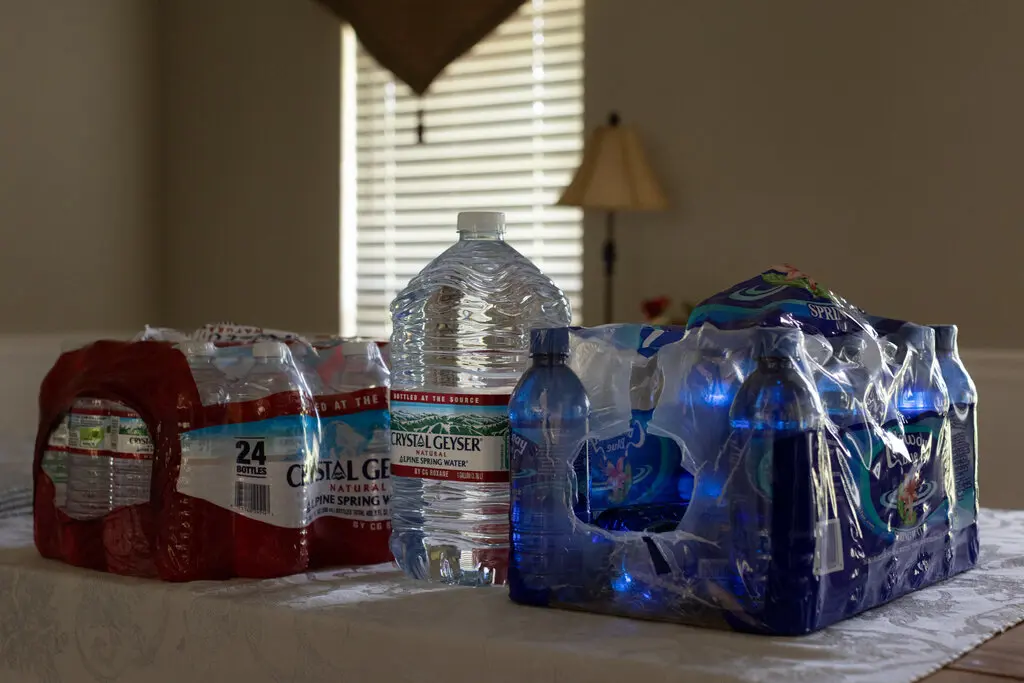
A collection of bottled water on the dining room table in the Morrises’ home.
In the
age of artificial intelligence, water has become as critical to data centers — which power the development of the cutting-edge technology — as electricity. The facilities pump enormous amounts of cold water into pipes that run throughout the buildings to cool the computers inside so that they can perform calculations and keep internet services like social networking humming.
A data center like Meta’s, which was completed last year, typically guzzles around 500,000 gallons of water a day.
New data centers built to train more powerful A.I. are set to be even thirstier, requiring millions of gallons of water a day, according to water permit applications reviewed by The New York Times.
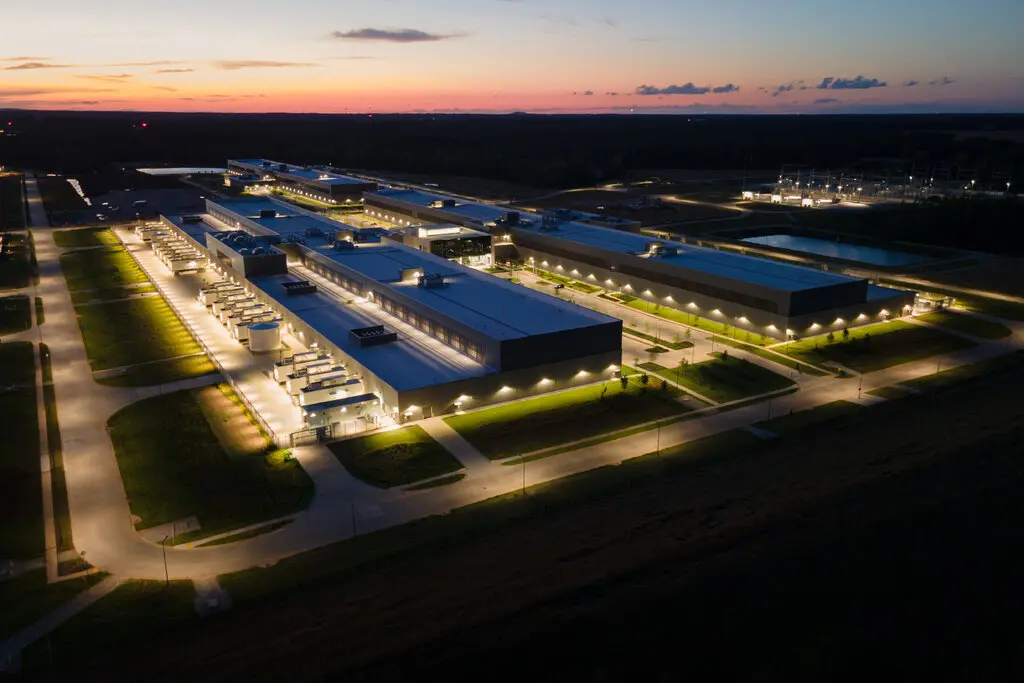
Meta broke ground on the data center in Newton County in 2018. It was completed last year.
Data center companies often demand as much water as they can get, using the tax revenue they pay as leverage, said Newsha Ajami, a hydrologist and director of urban water policy at Stanford. Some projects are so large that they require the land to first be “dewatered,” which is when groundwater is pumped out of the surrounding area in preparation for construction.
Yet water is a particularly difficult resource to manage. If a municipality needs to add energy capacity to its grid, it can build new solar farms, wind turbines or reopen coal and nuclear power plants. But the water used by Newton County comes from a nearby reservoir that can be replenished with only rainwater.
Because
electricity is more costly for data centers than water, companies often prioritize building their facilities in places with cheap power, even if the area is drought stricken. That has exacerbated water shortages across the world, Ms. Ajami said.
“Water is an afterthought” for tech companies, she said. “The thinking is, ‘Someone will figure that out later.’”
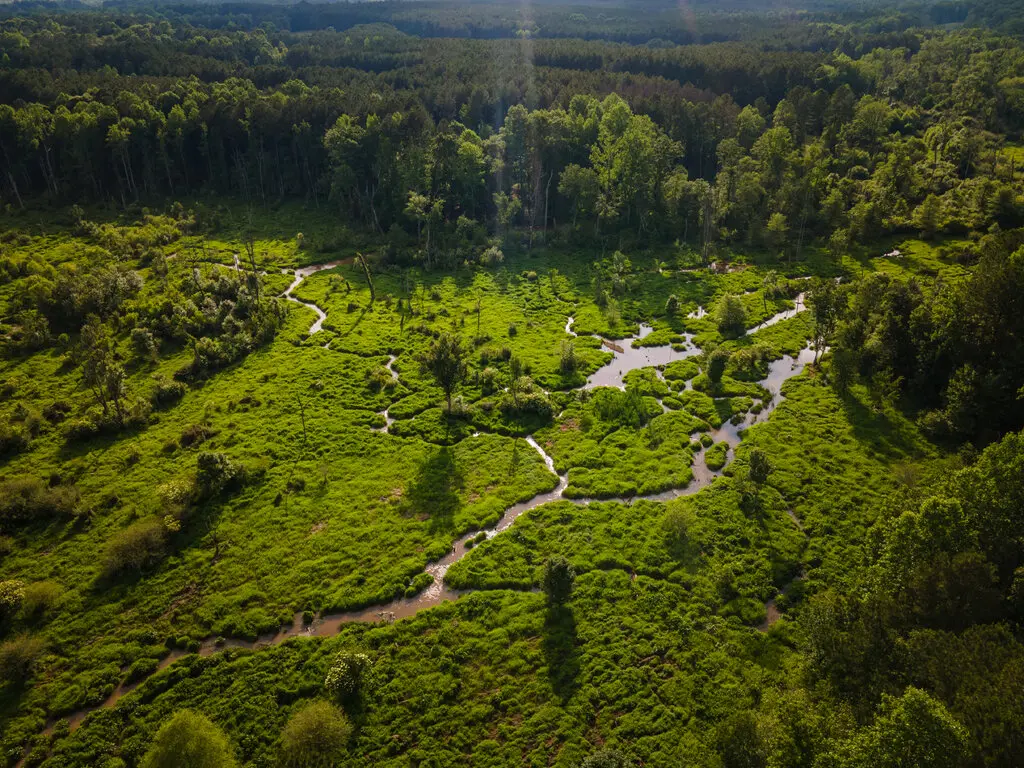
A flood plain connects to a river near the Morris home.
Water troubles similar to Newton County’s are also playing out in other data center hot spots, including Texas, Arizona, Louisiana and the United Arab Emirates. Around Phoenix, some homebuilders have paused construction because of droughts exacerbated by data centers. In Colorado, water use by data centers has become a focal point of renegotiating the Colorado River’s water treaty.
A Meta spokeswoman said the company had recently commissioned a well study on the Morrises’ property and said it was “unlikely” that its data center affected the supply of groundwater in the area.
Meta’s data center uses about 10 percent of the county’s total water use daily, said Mike Hopkins, the executive director of the Newton County Water and Sewerage Authority, which is the county’s water authority. The water authority has a good relationship with Meta, he said, but new data center companies are asking for more resources than close to what’s available.
“What the data centers don’t understand is that they’re taking up the community wealth,” he said. “We just don’t have the water.”
For years, Newton County was a growing residential exurb of Atlanta, until that future was put on hold by the 2008 financial crisis. Instead, local officials sought out large industrial projects to fill the void. In the late 2010s, data centers, which can generate millions of dollars in tax revenue, filled that bill.
Meta’s project was the first major data center to arrive in Georgia in 2018. At the time, Gov. Brian Kemp, a Republican, celebrated with
Facebook-branded shovels at the State Capitol. New tax incentives and cheap industrial power soon made Georgia one of the
top picks in the nation for new data centers.
In recent months, Mr. Hopkins said, nine companies had applied to build data centers in Newton County, some asking for as much as six million gallons of water a day — more than the county’s entire daily use. Some applicants are tech companies as large as Amazon, according to the water permits, while other companies used aliases to hide their identities.
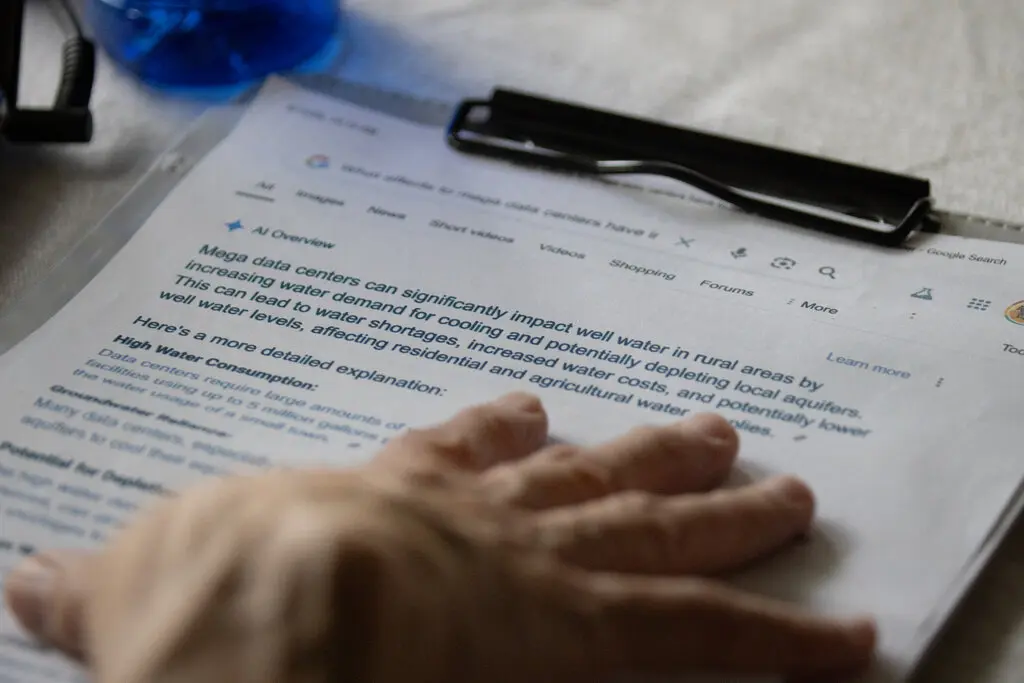
Ms. Morris has researched the effects of data centers on ground water.
The county’s water authority is wrestling with how to accommodate the projects — and the tax revenue they bring — while saving enough water for residents. Its solution is to upgrade its recycling facilities, which Mr. Hopkins said was a “race against the clock” that would cost more than $250 million.
Data center companies rarely disclose how much water they use, which has left some policymakers in the dark when it comes to regulation, said Chris Manganiello, the water policy director of Chattahoochee Riverkeeper, an environmental nonprofit in Georgia.
Last year, Mr. Manganiello figured out a way to get access to some data: If a site was so large it needed to rezone land, the company had to submit its water use as part of a mandatory regional development study.
The first time he saw the data, Mr. Manganiello said, his “eyes popped.” One data center company was asking for nine million gallons of water a day, equal to 30,000 households. “It is a tremendous amount,” he said.
The strain on Georgia’s water has been so severe that some legislators tried to slow down new developments with a bill to repeal tax incentives. Those efforts were vetoed by Mr. Kemp, who said in a statement that the bill would hurt economic development.
When Beverly and Jeff Morris bought their house in 2016, it was even quieter than their last home in Madison, Ga., a speck of a town with one stoplight. They paid $265,000 for the house and its six-acre lot, charmed by the dirt roads and forest of oak trees that Ms. Morris could ride her horses by.
“It was supposed to be our forever home,” she said.

Jon Barnett, the son of Beverly Morris from a previous marriage, opened presents for his 48th birthday. Mr. Barnett has Down syndrome.
Meta bulldozed the oak forest in 2019, and the well water problems began soon after. The couple have taken out thousands of dollars in loans to grapple with the water issues. Mr. Morris has also delayed his retirement as a machine operator at a nearby wood yard.
Three of their neighbors have also had issues with their well water since the data center was built. Chris Wilson, who lives three doors down, said his house had experienced water pressure issues within months of the construction. To keep the taps from going dry, he replaces the water filters every month instead of every year.
Sometimes the water is “so brown, you’d think it came from a creek,” Mr. Wilson, 40, said.
Ben Sheidler, a spokesman for the Joint Development Authority, which manages the industrial park that Meta’s facilities occupy, said the cause of the water issues was unknown. The Joint Development Authority did not do a well water study before construction to determine any potential effects, but the timing of the problems could be a coincidence, he said.
“I wouldn’t want to speculate that even the construction had something to do with it,” he said. “One thousand feet away is a pretty significant distance.”
The hardest part, Ms. Morris said, is that the house now has just one usable bathroom, which they have to share with her adult son Jon, 48, who has Down syndrome. They tried selling the house, with no luck.
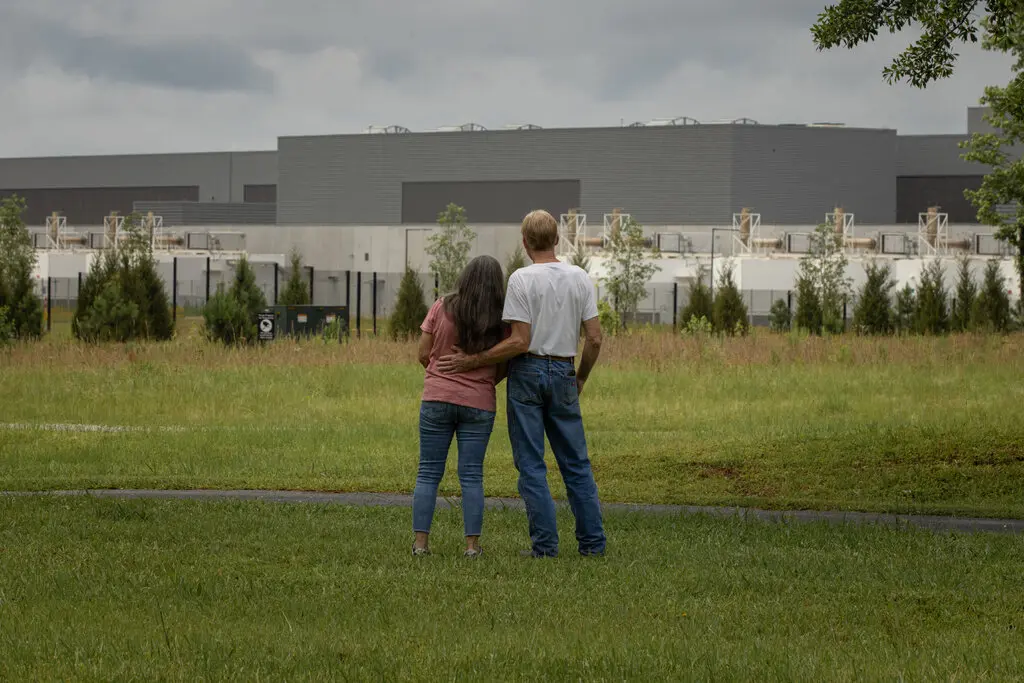
The Morrises looking at the Meta data center from their front yard.
“Our realtor told us, ‘There’s only one party that would ever be interested in buying this land — and that’s Facebook,’” she said.
The walls of her home are decorated with phrases about faith and family, and she has spent countless nights questioning how the data center fits into God’s plan for her. Above the kitchen sink, one sign reads: “The Lord giveth and the Lord taketh.”
In May, after an activist media outlet, More Perfect Union, made a
video about some of the issues, Meta sent a community relations manager to visit. The company offered to do the well study and fixed some nighttime lighting to reduce glare, but it took no responsibility for the water issues.
When Ms. Morris said she was afraid to cook with the tap water because of the sediment, the Meta employee suggested that she try boiling the water before using it. The company has denied that its employee said that.

They are genuinely using anti-AI ignorance to make money.


