L A

By Allie Kelly
Apr 19, 2025, 8:17 AM UTC
Brianna DeWitt didn't want to be a stay-at-home mom.
The 35-year-old loves her job: She spends mornings on the early shift as a physical therapist in Oahu, Hawaii. The rush she gets working in a hospital every day makes her years of intense medical training worth it.
So when her first baby was born in 2023, DeWitt did her best to make space for her career alongside her new role as a parent. Working part time seemed like the best of both worlds; she could still get the satisfaction that came from her job, and the scaled-back hours would allow her to spend time with her son and cut down on childcare bills. But then DeWitt realized that reducing her schedule below full time would disqualify her family from healthcare coverage and make her ineligible for an employer-matched 401(k).
"My husband was self-employed," she told me. "So I was trying to hold down the fort as far as our health insurance benefits went." He recently switched to a corporate job so the family could have stable coverage, and DeWitt could continue splitting her schedule between the hospital and their baby, "That was really important to us," she said.
DeWitt's dilemma is shared by parents and caregivers across America. Unlike other developed countries, the US offers few legal protections for part-time employees, meaning that people who typically work fewer than 30 to 34 hours a week are left at the mercy of their company's policies. At a time when many millennials are starting families, a shift to working part time could be a perfect solution for new parents to stay connected to their careers while attending to the needs of their children. While some companies like Starbucks and UPS offer benefits to part-time workers, for most people, stepping back from full-time work can mean losing out on healthcare coverage, paid leave, and fair wages.
"It could be the same position, the same qualifications, but you have one worker working full time and one worker working part time, and they are given different access to benefits, eligibility for promotions, or even paid differently based on hourly wages," Laura Narefsky, a senior attorney at the National Women's Law Center, told me.
At a time when the job market is cooling and businesses are keen to keep valuable employees around, conversations with economists, policy analysts, company leaders, parents, and caregivers made it clear that expanding workers' ability to adjust their hours is a winning idea. Companies that allow parents to work part time could retain experienced talent and save money on hiring. And letting more parents, especially mothers, stay connected to the workforce could be a path to economic growth as a whole: Nearly 3 million part-time workers are parents with children under 6 years old. America has a long way to go in terms of making the labor force flexible — but improving part-time opportunities is not only possible, it has overwhelmingly positive implications for the US job market.
Over 29 million people in the US work part time — roughly 18% of the total American labor force. Employees might choose a part-time schedule for a variety of reasons: They could be parents or caregivers who need to be home to look after a loved one; some are students trying to make ends meet while they finish a degree; others are retirees, people with disabilities, or people working multiple jobs. What all of these part-time workers have in common is a lack of federal protections.
Full-time employees in the US are guaranteed some basic rights, such as paid leave and access to company benefits. But once you dip below that roughly 30-hour-a-week threshold, employees don't have the same safeguards. Workers told me that can lead to unpredictable schedules and tight budgets. Part-time workers are about three times as likely as full-time workers to hold a low-paying job, and many live near the federal poverty line. In a 2020 report, the Economic Policy Institute found that part-time workers are paid nearly 20% less per hour than their full-time counterparts in the same industry and occupation. And that doesn't include the money part-time workers lose if they don't have access to benefits.
Julie Gagne, 63, cobbles together part-time and gig work to make ends meet while caring for her ex-husband, who is quadriplegic. She is a delivery driver near her home in Ann Arbor, Michigan, and often earns less than $20 an hour. It's enough to cover basic essentials, but she hasn't been able to build any savings and the job can be "physically exhausting," she said.
"Candidly, I have not had health insurance in a very, very long time," she said, adding, "I'm very healthy, but obviously if something catastrophic happened, I'd be screwed."
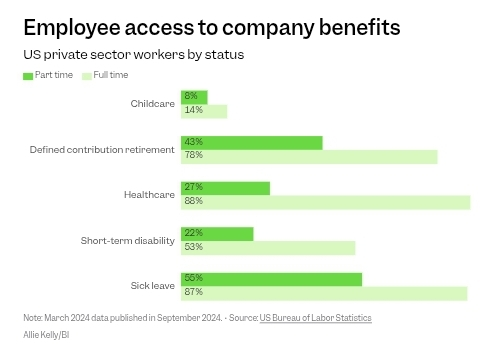
This level of economic uncertainty is particularly acute for parents. As the cost of childcare has skyrocketed in recent years, outpacing salaries in some cities, many have been left in a bind. The lack of options hits moms especially hard. Deborah Singer, the chief marketing officer at the advocacy and research organization Moms First, said that mothers and female caregivers are most likely to drop to part-time hours or leave the workforce altogether. About six in 10 part-time employees are women, and working fewer hours can have long-term consequences.
"That's not just a penalty that women are going to pay when their child is young," Singer said. "That's going to impact their entire career, their retirement savings, and our economy more broadly."
Having access to a flexible schedule — without having to make major financial sacrifices — would be a game changer for millennial parents, allowing more of them to stay on the career ladder when their kids are toddlers or in preschool. Right now, though, many have to choose between a steady paycheck and time with their family.
I became a mom, and as much as I wanted to be there for my family, I also didn't want to lose myself.
Jessica Cuevas, 35, lives in Chicago with her husband, their preschool-aged son, and toddler. After her first child was born, Cuevas knew she wanted to hang on to the successful career she'd built in academia. To save on childcare bills, she switched from a full-time role in college admissions and education policy to a part-time job as a college counselor for a nonprofit. The move helped her stay in the field she's passionate about, but she said she lost her access to employer healthcare and retirement plans. Her pay is unpredictable month-to-month, and she hopes to return to full-time work as soon as her youngest son goes to school.
"I became a mom, and as much as I wanted to be there for my family, I also didn't want to lose myself," she told me, adding, "I'm very frustrated with companies and employers for putting the load directly on mom: What if she also wants to grow? What if she also wants to scale up? What if she also wants to get paid more than her partner?"
The lack of protections for part-time workers makes the US an anomaly compared to many of its peer countries such as the Netherlands, Sweden, Australia, and Spain. In the Netherlands, for example, part-time workers are required by law to have the same access to benefits, time off, and pensions as full-time employees. Not extending these rights to part-time workers in the US isn't just a burden on the individuals, but it's also holding back the nation's economy as a whole. Kathryn Anne Edwards, an economist who studies the labor market and economic inequality, said providing more rights for part-time employees could boost the American labor force.
"Our labor market is much meaner and exclusive than people realize," Edwards told me. "Our labor market is very much like, 'If you can't hack it, you're out' at the expense of people's participation."
Take the Netherlands: As of 2023, the country's labor-force participation rate was 73%, with a slightly higher rate for men (76%) than women (68%), largely thanks to the prevalence of part-time work. At the end of 2023, the US labor-force participation rate was 62.5% with a sharper gap between men (68.2%) and women (57.3%). Historically, when more people are working, there are positive downstream effects like higher consumer spending and more movement in the labor market.
Our labor market is much meaner and exclusive than people realize.
"What the US labor market needs is a 'glow-up,'" Edwards said. But it's unlikely that laws protecting part-time employees will be passed at the federal level anytime soon. A Part-Time Worker Bill of Rights — which would ensure that all part-time employees have access to paid leave and other benefits — was introduced in the House in 2023, but the bill has gone nowhere.
Still, companies can take steps to protect part-time workers, even without government involvement. UPS offers pensions and some healthcare coverage for part-time employees, and Trader Joe's offers medical, dental, and vision benefits, along with access to a 401(k) for most part-time employees. The moves aren't just a moral imperative for these companies, they also have material benefits for their business.
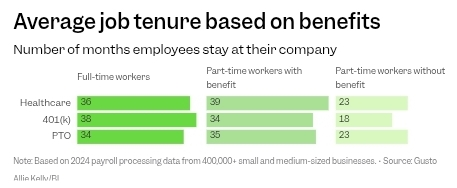
In a March report for BI using data from 400,000-plus small and midsize businesses, the business research firm Gusto found that the average job tenure for part-time workers with healthcare benefits is 39 months, compared to 36 months for full-time workers and 23 months for part-time workers without healthcare benefits. Employees who had access to paid vacation time and retirement plans were also more likely to stay at their companies than those who didn't. When experienced talent stays at a company, employers don't have to spend money to fill open roles.
In recent years, Starbucks has implemented similar part-time work benefits. It offers full tuition for full- and part-time employees pursuing a degree, parental leave for part-time employees working at least 20 hours a week, 401(k) matches, and healthcare coverage. A spokesperson for Starbucks told me that most of the company's barista employees are part time. The spokesperson said employee retention at the chain is at its highest level since the pandemic, and the company believes its benefit policies play a big role in that. The spokesperson said the company has seen a boost in traffic to its Careers webpage since its enhanced parental leave policy for full- and part-time workers began on March 1.
Jamie-Lee Kapana, 33, is a barista in Oahu and has a 13-year-old son. She's been working part time at Starbucks since he was a toddler. Kapana said that with past service-industry jobs, she struggled to find the flexibility she needed as a new mom while still paying the bills. Starbucks' health, 401(k), and other benefits have been a game changer for her family, she said.
"I decided to leave the restaurant job and commit to Starbucks because of the health benefits, job flexibility, and consistent hours," Kapana told me. "One of the biggest advantages was being able to work just 20 hours a week to receive these benefits, not just for myself, but also for my son."
More white-collar industries are leaning into part-time work as well. A June report from the hiring platform Indeed found that part-time job postings in sectors like beauty and wellness, marketing, and communications rose by up to 27% between 2022 and 2024. Still, higher-paying sectors like insurance, law, and finance remain heavily tilted toward full-time roles.
A more accessible workforce is a win-win for employees and employers. Companies can retain talent, and parents can achieve a healthy work-life balance. Plus, as Edwards told me, "more workers equals a bigger economy, full stop."
By Allie Kelly
Apr 19, 2025, 8:17 AM UTC
Brianna DeWitt didn't want to be a stay-at-home mom.
The 35-year-old loves her job: She spends mornings on the early shift as a physical therapist in Oahu, Hawaii. The rush she gets working in a hospital every day makes her years of intense medical training worth it.
So when her first baby was born in 2023, DeWitt did her best to make space for her career alongside her new role as a parent. Working part time seemed like the best of both worlds; she could still get the satisfaction that came from her job, and the scaled-back hours would allow her to spend time with her son and cut down on childcare bills. But then DeWitt realized that reducing her schedule below full time would disqualify her family from healthcare coverage and make her ineligible for an employer-matched 401(k).
"My husband was self-employed," she told me. "So I was trying to hold down the fort as far as our health insurance benefits went." He recently switched to a corporate job so the family could have stable coverage, and DeWitt could continue splitting her schedule between the hospital and their baby, "That was really important to us," she said.
DeWitt's dilemma is shared by parents and caregivers across America. Unlike other developed countries, the US offers few legal protections for part-time employees, meaning that people who typically work fewer than 30 to 34 hours a week are left at the mercy of their company's policies. At a time when many millennials are starting families, a shift to working part time could be a perfect solution for new parents to stay connected to their careers while attending to the needs of their children. While some companies like Starbucks and UPS offer benefits to part-time workers, for most people, stepping back from full-time work can mean losing out on healthcare coverage, paid leave, and fair wages.
"It could be the same position, the same qualifications, but you have one worker working full time and one worker working part time, and they are given different access to benefits, eligibility for promotions, or even paid differently based on hourly wages," Laura Narefsky, a senior attorney at the National Women's Law Center, told me.
At a time when the job market is cooling and businesses are keen to keep valuable employees around, conversations with economists, policy analysts, company leaders, parents, and caregivers made it clear that expanding workers' ability to adjust their hours is a winning idea. Companies that allow parents to work part time could retain experienced talent and save money on hiring. And letting more parents, especially mothers, stay connected to the workforce could be a path to economic growth as a whole: Nearly 3 million part-time workers are parents with children under 6 years old. America has a long way to go in terms of making the labor force flexible — but improving part-time opportunities is not only possible, it has overwhelmingly positive implications for the US job market.
Over 29 million people in the US work part time — roughly 18% of the total American labor force. Employees might choose a part-time schedule for a variety of reasons: They could be parents or caregivers who need to be home to look after a loved one; some are students trying to make ends meet while they finish a degree; others are retirees, people with disabilities, or people working multiple jobs. What all of these part-time workers have in common is a lack of federal protections.
Full-time employees in the US are guaranteed some basic rights, such as paid leave and access to company benefits. But once you dip below that roughly 30-hour-a-week threshold, employees don't have the same safeguards. Workers told me that can lead to unpredictable schedules and tight budgets. Part-time workers are about three times as likely as full-time workers to hold a low-paying job, and many live near the federal poverty line. In a 2020 report, the Economic Policy Institute found that part-time workers are paid nearly 20% less per hour than their full-time counterparts in the same industry and occupation. And that doesn't include the money part-time workers lose if they don't have access to benefits.
Julie Gagne, 63, cobbles together part-time and gig work to make ends meet while caring for her ex-husband, who is quadriplegic. She is a delivery driver near her home in Ann Arbor, Michigan, and often earns less than $20 an hour. It's enough to cover basic essentials, but she hasn't been able to build any savings and the job can be "physically exhausting," she said.
"Candidly, I have not had health insurance in a very, very long time," she said, adding, "I'm very healthy, but obviously if something catastrophic happened, I'd be screwed."
This level of economic uncertainty is particularly acute for parents. As the cost of childcare has skyrocketed in recent years, outpacing salaries in some cities, many have been left in a bind. The lack of options hits moms especially hard. Deborah Singer, the chief marketing officer at the advocacy and research organization Moms First, said that mothers and female caregivers are most likely to drop to part-time hours or leave the workforce altogether. About six in 10 part-time employees are women, and working fewer hours can have long-term consequences.
"That's not just a penalty that women are going to pay when their child is young," Singer said. "That's going to impact their entire career, their retirement savings, and our economy more broadly."
Having access to a flexible schedule — without having to make major financial sacrifices — would be a game changer for millennial parents, allowing more of them to stay on the career ladder when their kids are toddlers or in preschool. Right now, though, many have to choose between a steady paycheck and time with their family.
I became a mom, and as much as I wanted to be there for my family, I also didn't want to lose myself.
Jessica Cuevas, 35, lives in Chicago with her husband, their preschool-aged son, and toddler. After her first child was born, Cuevas knew she wanted to hang on to the successful career she'd built in academia. To save on childcare bills, she switched from a full-time role in college admissions and education policy to a part-time job as a college counselor for a nonprofit. The move helped her stay in the field she's passionate about, but she said she lost her access to employer healthcare and retirement plans. Her pay is unpredictable month-to-month, and she hopes to return to full-time work as soon as her youngest son goes to school.
"I became a mom, and as much as I wanted to be there for my family, I also didn't want to lose myself," she told me, adding, "I'm very frustrated with companies and employers for putting the load directly on mom: What if she also wants to grow? What if she also wants to scale up? What if she also wants to get paid more than her partner?"
The lack of protections for part-time workers makes the US an anomaly compared to many of its peer countries such as the Netherlands, Sweden, Australia, and Spain. In the Netherlands, for example, part-time workers are required by law to have the same access to benefits, time off, and pensions as full-time employees. Not extending these rights to part-time workers in the US isn't just a burden on the individuals, but it's also holding back the nation's economy as a whole. Kathryn Anne Edwards, an economist who studies the labor market and economic inequality, said providing more rights for part-time employees could boost the American labor force.
"Our labor market is much meaner and exclusive than people realize," Edwards told me. "Our labor market is very much like, 'If you can't hack it, you're out' at the expense of people's participation."
Take the Netherlands: As of 2023, the country's labor-force participation rate was 73%, with a slightly higher rate for men (76%) than women (68%), largely thanks to the prevalence of part-time work. At the end of 2023, the US labor-force participation rate was 62.5% with a sharper gap between men (68.2%) and women (57.3%). Historically, when more people are working, there are positive downstream effects like higher consumer spending and more movement in the labor market.
Our labor market is much meaner and exclusive than people realize.
"What the US labor market needs is a 'glow-up,'" Edwards said. But it's unlikely that laws protecting part-time employees will be passed at the federal level anytime soon. A Part-Time Worker Bill of Rights — which would ensure that all part-time employees have access to paid leave and other benefits — was introduced in the House in 2023, but the bill has gone nowhere.
Still, companies can take steps to protect part-time workers, even without government involvement. UPS offers pensions and some healthcare coverage for part-time employees, and Trader Joe's offers medical, dental, and vision benefits, along with access to a 401(k) for most part-time employees. The moves aren't just a moral imperative for these companies, they also have material benefits for their business.
In a March report for BI using data from 400,000-plus small and midsize businesses, the business research firm Gusto found that the average job tenure for part-time workers with healthcare benefits is 39 months, compared to 36 months for full-time workers and 23 months for part-time workers without healthcare benefits. Employees who had access to paid vacation time and retirement plans were also more likely to stay at their companies than those who didn't. When experienced talent stays at a company, employers don't have to spend money to fill open roles.
In recent years, Starbucks has implemented similar part-time work benefits. It offers full tuition for full- and part-time employees pursuing a degree, parental leave for part-time employees working at least 20 hours a week, 401(k) matches, and healthcare coverage. A spokesperson for Starbucks told me that most of the company's barista employees are part time. The spokesperson said employee retention at the chain is at its highest level since the pandemic, and the company believes its benefit policies play a big role in that. The spokesperson said the company has seen a boost in traffic to its Careers webpage since its enhanced parental leave policy for full- and part-time workers began on March 1.
Jamie-Lee Kapana, 33, is a barista in Oahu and has a 13-year-old son. She's been working part time at Starbucks since he was a toddler. Kapana said that with past service-industry jobs, she struggled to find the flexibility she needed as a new mom while still paying the bills. Starbucks' health, 401(k), and other benefits have been a game changer for her family, she said.
"I decided to leave the restaurant job and commit to Starbucks because of the health benefits, job flexibility, and consistent hours," Kapana told me. "One of the biggest advantages was being able to work just 20 hours a week to receive these benefits, not just for myself, but also for my son."
More white-collar industries are leaning into part-time work as well. A June report from the hiring platform Indeed found that part-time job postings in sectors like beauty and wellness, marketing, and communications rose by up to 27% between 2022 and 2024. Still, higher-paying sectors like insurance, law, and finance remain heavily tilted toward full-time roles.
A more accessible workforce is a win-win for employees and employers. Companies can retain talent, and parents can achieve a healthy work-life balance. Plus, as Edwards told me, "more workers equals a bigger economy, full stop."


