The PSP was actually the one between the PS1 and PS2 in terms of specs/graphic fidelity, rather than the DS itself, considering the handheld ports of PS1/PS2 games present on it (especially on the JP side) and what its exclusives were capable of.
They are both between those two generations spec wise, with DS being closer to the N64 side of things and the PSP being closer to PS2. DS has the same amount of RAM as a base Nintendo 64, but far exceeds it in terms of what can be done with regards to textures and storage leading to better graphics on games that were released on both like Mario Kart and Mario 64. They are similarly powered on paper, but the N64's texture cache is very low so it has these blurry, low res textures which led to an increased reliance on Gouraud Shading to fill out surfaces as opposed to texture maps. This is why the textures in Mario 64 DS look so much better than Mario 64 on the N64. Check out the the difference between the texture mapping on the path, the bridge, the grass and rocks and stuff. Even little things like the ruffles in Mario's shirt collar are textures that the N64 would have struggled with:
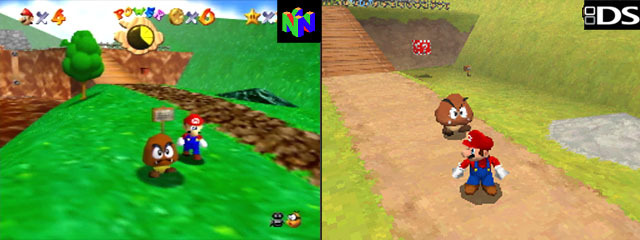
Even though the N64 itself outputs at a higher resolution, the textures are a higher resolution in the DS version thanks to the N64's texture cache bottleneck.
The blockier polygonal models on the N64 is less to do with horsepower and more to do with the fact it was the first N64 game.
DS would have been perfectly capable of running an acceptable port of any game the PS1 could have run if anyone had bothered to port them, albeit at a lower resolution due to the lower resolution of the screen.
Anyway, this is an interesting area of discussion, but it is all moot point because I don't think it particularly matters if the Switch is a handheld or not. In recent generations, games get ported back and fourth between handhelds and home consoles all the time to the point where the idea that there's a fundamental difference between what makes a handheld game and a home console game is nonsensical. It's just a label and the games are what's really important. I was just pointing out how much the Switch has in common with previous Nintendo portables versus their contemporaries because someone cited the difference between the home console and portable experience as a possible explanation why Nintendo's output has dropped so much.
*Edit*
Here, Rayman 2 is an interesting one to look at because it came out across so many platforms.
Note how the DS version has a higher framerate than the PS1 version. The N64 & Dreamcast use anti-aliasing to get rid of the jaggies, so it is a bit jarring to see the jaggies in the DS and 3DS versions, but they were made for lower resolution screens where the jaggies would not be noticeable. When they do the comparisons of all versions together and the image is about the size of an actual DS screen, the lack of anti-aliasing is not noticeable.
he Switch is just a tad below the base PS4 model (there are some areas where the Switch shines better than the PS4 and vice-versa).
PS4 has an 84% higher floating point performance and twice the ram as a Switch. Now that doesn't mean games can't be optimized better on the Switch than the PS4 and they up looking similar, or that a game can't be made with the capabilities of the Switch in mind and also released for PS4, but in terms of raw capability, it's not even close.
It's sort of like a PS2/Wii situation where Wii was much more powerful than the PS2, but it wasn't nearly as powerful as the 360 or PS3 and so straight ports were difficult. So because PS2 was the best selling system of all time and was supported for a long time,
many multiplatform Wii games were made with the limitations of the PS2 in mind so developers could reuse assets between the two to save on development costs.
It's more that we've reached a ceiling for graphic fidelity, which has often been a detriment to development time as @The Demon Pimp of Razgriz pointed out earlier (leading to fewer games in result).
I don't disagree with this in principal. That would be a good explanation for why it took so long to make TOTK despite using the same engine and map, for instance. I just find it hard to believe the difference in development is so great they can only release one Mario Kart or Animal Crossing or 2D Mario Bros every decade. We're not talking about games that are generally graphically intense here, even for the Switch.


