Link (Archive)
1. Was Christianity the original incel religion? I was struck by how sex-negative the movement was in its earliest days. Paul’s letters basically had the message that “sex is so awful, but fine, get married if it lets you avoid fornication.” The idea that celibacy is better than marriage, which is better than sex outside of marriage, seems to have been the common Christian view, and for Catholics and Orthodox believers might still be. This is covered in detail in the chapter titled “Virgins, Celibates, Ascetics (c. 100-c. 300).” Beginning in the second century, you find a lot of Christian texts discussing the merits of celibacy, and very few talking about marriage, which was usually addressed in a much more negative light.
In order to reinforce this view, thinkers cited Jesus’ parable about different sowers getting yields of thirty times, sixty times, or one hundred times. Without any good reason, this was interpreted by an early third-century North African writer as representing married people who renounced sex, virginal ascetics, and martyrs. It was the consensus up to the Middle Ages that this biblical classification system referred to the married, widows, and virgins, with of course the more sex you are currently having or have had in the past, particularly for women, the lower you are in the ranking.
Early Christians were so sex-negative that it was even a live debate whether castration was desirable.
 Protestantism was in part a rebellion against the extreme sex-negativity of Catholicism, which still hadn’t completely subsided a millennium and a half later.
2. This got me thinking of another ideology that is less sex-positive toward family formation than rival worldviews, yet nonetheless has grown rapidly through conversion: liberalism. You would think that through the process of cultural evolution, more pro-natal ideologies would win out. Yet we have approximately three centuries now of liberalism being less conducive to forming and creating families than alternatives, and yet its growth has been rapid, outcompeting rival faiths.
Rodney Stark argues that Christians had an advantage in not practicing infanticide, preserving the lives of girls, and caring for the sick. The evidence that this is based on appears to be quite flimsy. When trying to explain the weirdness of a religion hostile to sex winning over Rome, perhaps we can say that the concerns of Christian intellectuals did not reflect how laymen actually behaved, and somehow the message of the faith nonetheless ended up being relatively pro-natal and pro-survival compared to paganism. The alternative possibility is that Christians didn’t have an advantage in terms of reproduction or survival, but rather growth was largely or entirely due to conversion. If this is true, and I would lean in that direction, then this is a remarkable historical example of cultural evolution not depending on competition between groups selecting for traits that are necessarily the most adaptive at the individual or familial level. That is perhaps good news for the future of liberalism, though I think that evolution in the classic sense has to win in the long run. Maybe the transition comes with universal access to birth control, plus reaching the point of near zero infant mortality? If so, then we may predict that the next century will not be as good for liberalism as the last century has been. But the story of Christian sex-negativity has updated me in the direction of thinking that winning new converts, rather than creating more members of a group, trumps everything else in the struggle over culture and ideas.
3. Scholars like Joe Henrich stress the importance of the fact that Christianity mandated monogamy, but this was already a unique feature of Greco-Roman society. In fact, Jewish custom made monogamy potentially problematic.
4. The rise of Christianity was really slow. MacCulloch writes that “the earliest roughly dateable Christian building known, from Dura Europos in Syria, is a converted house no earlier than around 240 CE.” If I started a religion and two hundred years after my death there wasn’t a single building dedicated to it, you would probably think that this new faith wasn’t going anywhere. The triumph of Christianity is even more remarkable when put in this context.
MacCulloch cites an estimate of Christians being no more than 1-2% of the population of the Roman Empire at 300 CE. He continues that probably a few dozen to two hundred literate males in the century after Jesus’ death shaped the entirety of the faith. Rarely has such a small group had so much historical impact.
Rodney Stark has a much higher estimate of 8%-12%. Yet it appears to be based on speculative modeling, and MacCulloch says he doesn’t believe his estimates in Chapter 6, footnote 6. The main source that MacCulloch cites for his 1-2% estimate comes from Keith Hopkins’ “Christian Number and Its Implications.” The upshot of this article is that we don’t really have data we can trust, but that pagans and Jews did not consider Christians any more than a minor annoyance, often one that they either missed or thought not worth mentioning, into the third century. Considering that many if not most early Christians were converts from Judaism, the fact that rabbinic writings, which were copious, did not acknowledge their existence before the fourth century is striking. The high-end estimates of Christian penetration at the time of the conversion of Constantine seem to be a minority position among scholars, indicating that Christianity was a small faith before it achieved political power, well under 10% and perhaps below 5%.
5. The Church was uninvolved in marriage until surprisingly late: “even as Christianity became ever more dominant in the Roman Empire, and most of the population became at least nominally Christian, most people also went on marrying and having children as they had always done.” The Gregorian Revolution of the eleventh century, a term used to describe the reforms of Pope Gregory VII (1073-1085), created a framework of seven sacraments, beyond Baptism and Eucharist, which included marriage. This was the first time in the Western Church that all Christians were encouraged to get married in a religious ritual.
6. MacCulloch traces the beginning of the move away from traditional sexual morality to 1690s Amsterdam and London. Of course, this was about the exact same place and time that the Industrial Revolution began. While throughout the rest of the book, MacCulloch traces practices and beliefs to the ideas of influential priests and thinkers, he points out that this change had not been argued for or theorized about. Economic growth took off, and this led to revolutions in how people lived, including with regard to sex. Maybe capitalism and the commercial society can be seen more generally as the triumph of the practical over the theoretical, and the more advanced civilization gets, the less that intellectuals matter.
7. What we think of as traditional Catholicism today was to a large extent the creation of nineteenth century Catholicism, which emerged in response to greater economic growth and the challenge of the French Revolution. It was only in 1854 that the Immaculate Conception, the idea that Mary was conceived without sin, became dogma. Before reading this book, I had actually always assumed that the Immaculate Conception referred to the idea that Jesus was born of a virgin. I went through First Communion and did not know any better. This doctrine was so controversial that when a Catholic priest preached against it, he was suspended, and then in anger stabbed and killed the Archbishop of Paris in 1857. Pope Pius IX’s 1869 bull called Apostolicae sedis for the first time put forth an absolute ban on abortion, though it would come to allow for a few rare exceptions. I thought that one of the appeals of Catholicism was that it has been consistent throughout its history, but this consistency is only relative to most other faiths.
8. How did they get to the total ban on abortion? Funny story. The logic of the absolutist pro-life position has always been that souls enter the body at conception. This was a doctrine that was rejected by early Christians. According to them, sex was a sin, so how could the moment of sin be the moment of ensoulment? This was apparently good enough for Thomas Aquinas. There were even early Irish hagiographical texts in which priests prayed for spontaneous abortions for nuns! The idea that life starts at conception had actually been affirmed by Pope Sixtus V in 1588, but it was repealed less than three years later by his successor.
The nineteenth-century return to the doctrine was based on the Church accepting the Immaculate Conception. So when it had been declared that Mary was conceived without sin, a chain of logic unfolded. Her moment of ensoulment needed to be contrasted with the rest of humanity, who were all conceived with sin, as apparently this elevated Mary’s status, instead of making her conception the only one in which personhood began at the moment she was in the womb. If Mary had a soul at conception, so must everyone else. And so here we are.
9. MacCulloch is a serious historian, but clearly has a political agenda, which he doesn’t hide. Upon finishing the book, I learned that he is gay and was a deacon in the Church of England, but refused ordination based on the church’s views of homosexuality. So keep that in mind when, in the final chapter, he declares that “contrary to many assertions over the last two centuries, a sustained journey through Christian history reveals that there is no such thing as a Christian theology of sex. There are multiple Christian theologies of sex, many of which have over two millennia been downright contradictions of each other.” This seems to be going too far. Sure, maybe there isn’t a lot that is continuous over two thousand years. But to have doctrines surviving for several hundred years at a time is quite impressive! And on homosexuality, the topic dear to the author’s heart, he is clear sighted and honest enough to implicitly acknowledge throughout the book that it has never been accepted, even if at some points repression was well short of absolute.
Christianity made concessions to heterosexual marriage, otherwise it wouldn’t have survived, but never fornication or the Greco-Roman practice of pederasty. Similarly, one has to do some real stretching to find precursors to transgenderism. MacCulloch cheekily refers to castration as a kind of early “gender modification surgery,” but the concerns and logic behind such practices shared little in common with ideas about freedom of choice and being born in the wrong body that have become popular today.
Depending on what is emphasized, one can tell a story of finding continuity or constant change in the history of Christianity, but I think it’s difficult to argue that mainstream Catholicism, Orthodoxy, or Protestantism adopting modern left-wing positions on abortion, sexual freedom, or LGBT issues would not be a momentous break with the past.
10. You’ve probably heard the idea that Western colonialism brought homophobia to the non-white world. More likely, actually, you’ve probably heard rightists online complain about the idea. MacCulloch appears to endorse a version of this argument, but it unsurprisingly comes off as much more plausible than the right-wing caricature.
That was probably because there was no tendency to seek logical consistency between the doctrines of their faith and every aspect of human life. But the question for me is whether 1) the West caused them to get more conservative on sex because they were aping it; or 2) the West encouraged them to rationalize theological doctrine, law, and societal practice and bring them into harmony. Only 1 is consistent with the woke interpretation of history.
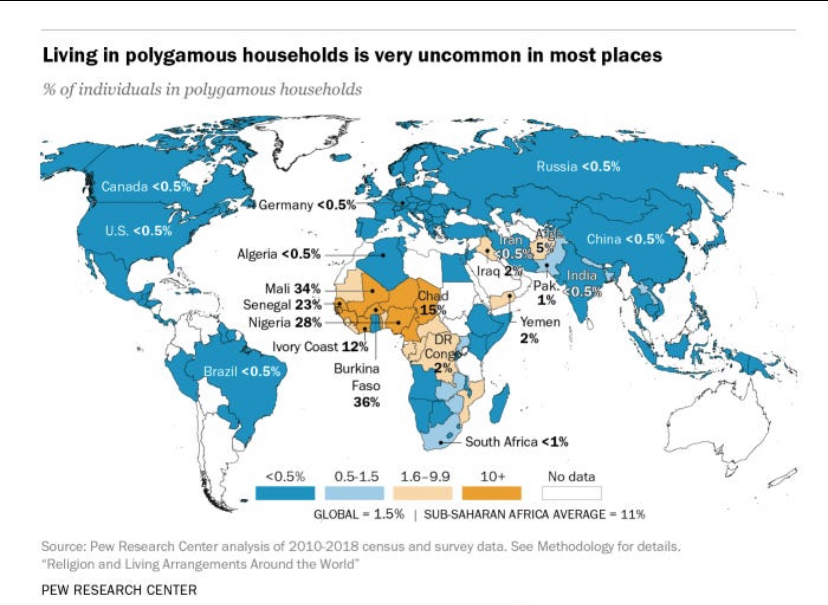
11. Africans really like polygyny. Missionaries have been constantly frustrated by their inability to impose monogamy south of the Sahara. Take the unique position of the oldest Christian Church community in Africa, that of Ethiopia.
12. Going back to the rationalization of society, I suspect that Christianity likely won because of its internal consistency. While to secular people today, the internal logic of Christianity might not be all that compelling, the new faith, coming out of the Jewish tradition, was more reflective and coherent than the paganism that it replaced. Pagans rolled their eyes at the ridiculous abstract debates that Christians had and were treated with cosmic seriousness. But when you imagine how awe-inspiring nature seemed at the time, and how bewildering man’s place in the universe was, highly literate Romans must have been looking for answers. Ultimately, they turned to the teachings of a small Jewish sect, one that emerged from a community with a long history of valuing education and intellectual debate.
History often remembers Christianity as appealing to the poor and the forgotten, but my reading makes me suspect that the faith appealed to more intelligent and educated people of perhaps middling or lower levels of income. In other words, the ancient Roman equivalents of grad students or academics. While it may have been enough for rural bumpkins to just keep sacrificing to the old gods without thinking too much about what they were doing, for those who needed something with more explanatory power, theology played the role that science and politics do today. Early Christians were therefore disproportionately urban and literate. The Enlightenment involved the process of Christianity’s original strength being turned against it, and now the pattern has reversed, with secular humanism becoming the default dogma for elites.
Was Christianity the Original Incel Movement?
I learned about Diarmaid MacCulloch and his work from Tyler Cowen’s podcast, and decided to pick up a few of his books. The first one I’ve finished is Lower Than the Angels: A History of Sex and Christianity. The book is a journey through everything related to sex and Christianity from the era of the Old Testament to recent controversies over topics like the ordination of women and trans identity. I’ve been posting some of the juiciest excerpts on X:- On early Christians being tempted by women and Ethiopian kids
- The history of Catholics castrating boys to preserve their voices
- Early Christians castrating themselves to not be sexually tempted, and its modern relevance
- Eighteenth-century Scottish pioneers in gooning
1. Was Christianity the original incel religion? I was struck by how sex-negative the movement was in its earliest days. Paul’s letters basically had the message that “sex is so awful, but fine, get married if it lets you avoid fornication.” The idea that celibacy is better than marriage, which is better than sex outside of marriage, seems to have been the common Christian view, and for Catholics and Orthodox believers might still be. This is covered in detail in the chapter titled “Virgins, Celibates, Ascetics (c. 100-c. 300).” Beginning in the second century, you find a lot of Christian texts discussing the merits of celibacy, and very few talking about marriage, which was usually addressed in a much more negative light.
In order to reinforce this view, thinkers cited Jesus’ parable about different sowers getting yields of thirty times, sixty times, or one hundred times. Without any good reason, this was interpreted by an early third-century North African writer as representing married people who renounced sex, virginal ascetics, and martyrs. It was the consensus up to the Middle Ages that this biblical classification system referred to the married, widows, and virgins, with of course the more sex you are currently having or have had in the past, particularly for women, the lower you are in the ranking.
Early Christians were so sex-negative that it was even a live debate whether castration was desirable.
Here’s a satirical depiction of Origen castrating himself from late fifteenth-century France, included in the book.To begin with, the developing Christian hierarchy was not certain how to react to this zeal for castration; should it be commended as demonstrating Christian self-control? Thus the Athenian convert and philosopher Athenagoras, addressing his Plea for the Christians to the Emperor Marcus Aurelius in the mid-170s, emphasized that ‘remaining in virginity and in the state of a eunuch brings one nearer to God.’ At what point did rhetoric shade into practice? Justin Martyr, pioneer among the second-century literary defenders of Christianity now known as apologists, sympathetically described the disappointment of a young man in Alexandria who petitioned the Roman governor in the city for permission to seek castration from surgeons, to show to the world how far Christians were from indulging in free love. The governor rejected the proposal, leaving him to be ‘satisfied with his own approving conscience, and the approval of those who thought as he did’. The Emperor Antoninus Pius was the notional reader of this apology, so Justin must have believed that elite Romans would have found the tale impressive rather than risible. In a slightly later generation in Alexandria, the brilliant speculative theologian and biblical commentator Origen is said actually to have undergone castration through similar youthful enthusiasm. Yet during the course of the third century Christian official mood-music on voluntary castration changed, and the fourth-century Church historian Eusebios (Eusebius), author of an admiring biography of Origen, reports the story with a mixture of embarrassment and defiant commendation – a confusion that probably indicates its genuineness.

2. This got me thinking of another ideology that is less sex-positive toward family formation than rival worldviews, yet nonetheless has grown rapidly through conversion: liberalism. You would think that through the process of cultural evolution, more pro-natal ideologies would win out. Yet we have approximately three centuries now of liberalism being less conducive to forming and creating families than alternatives, and yet its growth has been rapid, outcompeting rival faiths.
Rodney Stark argues that Christians had an advantage in not practicing infanticide, preserving the lives of girls, and caring for the sick. The evidence that this is based on appears to be quite flimsy. When trying to explain the weirdness of a religion hostile to sex winning over Rome, perhaps we can say that the concerns of Christian intellectuals did not reflect how laymen actually behaved, and somehow the message of the faith nonetheless ended up being relatively pro-natal and pro-survival compared to paganism. The alternative possibility is that Christians didn’t have an advantage in terms of reproduction or survival, but rather growth was largely or entirely due to conversion. If this is true, and I would lean in that direction, then this is a remarkable historical example of cultural evolution not depending on competition between groups selecting for traits that are necessarily the most adaptive at the individual or familial level. That is perhaps good news for the future of liberalism, though I think that evolution in the classic sense has to win in the long run. Maybe the transition comes with universal access to birth control, plus reaching the point of near zero infant mortality? If so, then we may predict that the next century will not be as good for liberalism as the last century has been. But the story of Christian sex-negativity has updated me in the direction of thinking that winning new converts, rather than creating more members of a group, trumps everything else in the struggle over culture and ideas.
3. Scholars like Joe Henrich stress the importance of the fact that Christianity mandated monogamy, but this was already a unique feature of Greco-Roman society. In fact, Jewish custom made monogamy potentially problematic.
There is something very deep here in Western culture that transcended even a rupture as extreme as the transition from paganism to Christianity.In contrast to their neuroses about divorce, Christians did not have nearly so much problem in following the Lord on monogamy. One good reason for that was that monogamy was already the exclusive marriage custom in Greek and Roman society, into which Mediterranean Christianity proceeded to expand, regardless of what Jews continued to believe and practise in relation to marriage. One should remember that the early Church came to ignore other major elements of Jesus’s authentic pronouncements – for instance the shockingly cavalier ‘leave the dead to bury their own dead’ (Matt. 8.22), or his promise of imminent return. Monogamy might have been treated in the same fashion had there not been a powerful social impulse in the Roman Empire for Christians to stick with Jesus on this matter.
That still left Jesus’s followers with a biblical conundrum. Making monogamy the Christian norm left subsequent theologians having to explain away the polygyny of the Hebrew patriarchs; they have never fully succeeded. Early commentators from the second to the fourth century CE considered that what they called the patriarchs’ ‘immorality’ had been allowed by a special dispensation from God, although no such dispensation can actually be found in the text of the Hebrew Scripture. The Latin theologian Augustine of Hippo in the fifth century took a different and rather arbitrary line in defending the patriarchs against condemnation of them by Faustus, a formidable critic of Catholic Christianity from the parallel religion known as Manicheism. In the age of the patriarchs, Augustine said magisterially, ‘a plurality of wives was no crime when it was the custom; and it is a crime now, because it is no longer the custom…The only reason of its being a crime now to do this, is because custom and the laws forbid it.’ Augustine did not elucidate when exactly in history this crucial transition had taken place, or what the theological arguments for it might be.
4. The rise of Christianity was really slow. MacCulloch writes that “the earliest roughly dateable Christian building known, from Dura Europos in Syria, is a converted house no earlier than around 240 CE.” If I started a religion and two hundred years after my death there wasn’t a single building dedicated to it, you would probably think that this new faith wasn’t going anywhere. The triumph of Christianity is even more remarkable when put in this context.
MacCulloch cites an estimate of Christians being no more than 1-2% of the population of the Roman Empire at 300 CE. He continues that probably a few dozen to two hundred literate males in the century after Jesus’ death shaped the entirety of the faith. Rarely has such a small group had so much historical impact.
Rodney Stark has a much higher estimate of 8%-12%. Yet it appears to be based on speculative modeling, and MacCulloch says he doesn’t believe his estimates in Chapter 6, footnote 6. The main source that MacCulloch cites for his 1-2% estimate comes from Keith Hopkins’ “Christian Number and Its Implications.” The upshot of this article is that we don’t really have data we can trust, but that pagans and Jews did not consider Christians any more than a minor annoyance, often one that they either missed or thought not worth mentioning, into the third century. Considering that many if not most early Christians were converts from Judaism, the fact that rabbinic writings, which were copious, did not acknowledge their existence before the fourth century is striking. The high-end estimates of Christian penetration at the time of the conversion of Constantine seem to be a minority position among scholars, indicating that Christianity was a small faith before it achieved political power, well under 10% and perhaps below 5%.
5. The Church was uninvolved in marriage until surprisingly late: “even as Christianity became ever more dominant in the Roman Empire, and most of the population became at least nominally Christian, most people also went on marrying and having children as they had always done.” The Gregorian Revolution of the eleventh century, a term used to describe the reforms of Pope Gregory VII (1073-1085), created a framework of seven sacraments, beyond Baptism and Eucharist, which included marriage. This was the first time in the Western Church that all Christians were encouraged to get married in a religious ritual.
I thought religious marriage was pretty foundational to Christianity, but it’s only been an accepted rite in Catholicism for about half of the history of the Church.Western clergy had previously only been involved in negotiating or presiding over royal or noble marriages, but from the eleventh century a long campaign sought to make this requirement universal. This was a marked shift even from the new devotional activism of the Carolingian Church. Carolingian monarchs or high nobility might have considered a church ceremony as bonus legitimation for dynastic turning points, but it had still been optional. In an analogous liturgical situation, the Emperor Charlemagne did not consider giving an active role to the senior clergy present in his chapel in Aachen when he granted his imperial title to his son Louis in 813; the younger man simply took his crown from the altar while everyone present looked on as witnesses. An institution of marriage carefully constructed on the basis of family negotiations had not felt itself needing much confirmation in Christian liturgy. As late as the end of the eleventh century, the German romantic poem Ruodlieb included a prolonged description of decorously cheerful wedding ceremonial in a knightly family. It was still entirely domestic and did not involve a priest at all – all the more remarkable since the poet-author was a monk of the stately Benedictine house of Tegernsee in Bavaria.
6. MacCulloch traces the beginning of the move away from traditional sexual morality to 1690s Amsterdam and London. Of course, this was about the exact same place and time that the Industrial Revolution began. While throughout the rest of the book, MacCulloch traces practices and beliefs to the ideas of influential priests and thinkers, he points out that this change had not been argued for or theorized about. Economic growth took off, and this led to revolutions in how people lived, including with regard to sex. Maybe capitalism and the commercial society can be seen more generally as the triumph of the practical over the theoretical, and the more advanced civilization gets, the less that intellectuals matter.
7. What we think of as traditional Catholicism today was to a large extent the creation of nineteenth century Catholicism, which emerged in response to greater economic growth and the challenge of the French Revolution. It was only in 1854 that the Immaculate Conception, the idea that Mary was conceived without sin, became dogma. Before reading this book, I had actually always assumed that the Immaculate Conception referred to the idea that Jesus was born of a virgin. I went through First Communion and did not know any better. This doctrine was so controversial that when a Catholic priest preached against it, he was suspended, and then in anger stabbed and killed the Archbishop of Paris in 1857. Pope Pius IX’s 1869 bull called Apostolicae sedis for the first time put forth an absolute ban on abortion, though it would come to allow for a few rare exceptions. I thought that one of the appeals of Catholicism was that it has been consistent throughout its history, but this consistency is only relative to most other faiths.
8. How did they get to the total ban on abortion? Funny story. The logic of the absolutist pro-life position has always been that souls enter the body at conception. This was a doctrine that was rejected by early Christians. According to them, sex was a sin, so how could the moment of sin be the moment of ensoulment? This was apparently good enough for Thomas Aquinas. There were even early Irish hagiographical texts in which priests prayed for spontaneous abortions for nuns! The idea that life starts at conception had actually been affirmed by Pope Sixtus V in 1588, but it was repealed less than three years later by his successor.
The nineteenth-century return to the doctrine was based on the Church accepting the Immaculate Conception. So when it had been declared that Mary was conceived without sin, a chain of logic unfolded. Her moment of ensoulment needed to be contrasted with the rest of humanity, who were all conceived with sin, as apparently this elevated Mary’s status, instead of making her conception the only one in which personhood began at the moment she was in the womb. If Mary had a soul at conception, so must everyone else. And so here we are.
9. MacCulloch is a serious historian, but clearly has a political agenda, which he doesn’t hide. Upon finishing the book, I learned that he is gay and was a deacon in the Church of England, but refused ordination based on the church’s views of homosexuality. So keep that in mind when, in the final chapter, he declares that “contrary to many assertions over the last two centuries, a sustained journey through Christian history reveals that there is no such thing as a Christian theology of sex. There are multiple Christian theologies of sex, many of which have over two millennia been downright contradictions of each other.” This seems to be going too far. Sure, maybe there isn’t a lot that is continuous over two thousand years. But to have doctrines surviving for several hundred years at a time is quite impressive! And on homosexuality, the topic dear to the author’s heart, he is clear sighted and honest enough to implicitly acknowledge throughout the book that it has never been accepted, even if at some points repression was well short of absolute.
Christianity made concessions to heterosexual marriage, otherwise it wouldn’t have survived, but never fornication or the Greco-Roman practice of pederasty. Similarly, one has to do some real stretching to find precursors to transgenderism. MacCulloch cheekily refers to castration as a kind of early “gender modification surgery,” but the concerns and logic behind such practices shared little in common with ideas about freedom of choice and being born in the wrong body that have become popular today.
Depending on what is emphasized, one can tell a story of finding continuity or constant change in the history of Christianity, but I think it’s difficult to argue that mainstream Catholicism, Orthodoxy, or Protestantism adopting modern left-wing positions on abortion, sexual freedom, or LGBT issues would not be a momentous break with the past.
10. You’ve probably heard the idea that Western colonialism brought homophobia to the non-white world. More likely, actually, you’ve probably heard rightists online complain about the idea. MacCulloch appears to endorse a version of this argument, but it unsurprisingly comes off as much more plausible than the right-wing caricature.
This sounds to me like the idea that the West brought racism to the rest of the world. Yes, in the sense that racism is a scientific way of thinking about humanity, and the West introduced a scientific mindset. Before contact with Europeans, Muslims didn’t bother to go back and censor poetry to take out homoerotic passages, or philosophize about masturbation.In reaction to Muslim perception of Western Christian models of family and sex, many Islamic societies have therefore discarded much ambiguity and pluralism in their traditions. The past has been censored or rewritten. New editions of ancient Arabic literary works have come to omit verse that might be considered raunchily erotic, especially the abundant poetry of same-sex relationships. Islamic societies have found it extremely difficult to discuss in public matters that were once part of everyday Muslim life, but which are now defined by the Western term ‘homosexuality’ invented by Károly Mária Kertbeny and treated as alien imports from the West. Legal texts have added sections on masturbation or sodomy that would not previously have been considered necessary discussion. There has not only been subtraction, but innovation in the name of invented tradition: before the twentieth century, Islamic sources reveal hardly any evidence for executing males for mutual and consensual sexual activity.
Such were some unanticipated outcomes from the playing fields of Eton. The same Western self-confidence was present wherever Anglophone Protestant missions were allowed to flourish. In China, where the massive Protestant missionary effort was new in the nineteenth century yet also very conscious of three previous centuries of Catholic presence, the new arrivals often shared their predecessors’ sense of outrage against local customs: for instance, noting in disgust local same-sex activity that they could equally well have seen at home. They placed it alongside other customs that they regarded as the cultural femininity of Chinese males: the pigtail, or the pious avoidance of meat by Chinese Buddhists. Assumptions about gender marched alongside Western theological assumptions across the Reformation divide: once more Protestantism was echoing the Jesuit Matteo Ricci, who had vigorously critiqued Buddhist vegetarian practice in both men and women. Protestant missionaries consciously or unconsciously repeated his arguments, emphasized how vegetarianism feminized male practitioners and regarded it as a triumph of evangelism when a convert gingerly took to the consumption of meat. In Protestant terms, such conversion was also a rejection of the popish custom of fasting.
That was probably because there was no tendency to seek logical consistency between the doctrines of their faith and every aspect of human life. But the question for me is whether 1) the West caused them to get more conservative on sex because they were aping it; or 2) the West encouraged them to rationalize theological doctrine, law, and societal practice and bring them into harmony. Only 1 is consistent with the woke interpretation of history.
11. Africans really like polygyny. Missionaries have been constantly frustrated by their inability to impose monogamy south of the Sahara. Take the unique position of the oldest Christian Church community in Africa, that of Ethiopia.
Anglicans seem to have basically thrown in the towel.King Solomon was a role model for Christian kings of Ethiopia (from the thirteenth century the dynasty claimed Solomonic lineage), and that included his impressive array of wives. The habitual royal enthusiasm for multiple marriage was one of several long-term bones of contention between Ethiopian monarchy and clergy. The foundational compilation of local Christian literature, the medieval Kebra Nagast (‘Book of the Glory of Kings’, actually regarded as part of the canon of Scripture in Ethiopia), proclaims Ethiopian royal descent from Solomon and the Queen of Sheba, while tartly pointing out that ‘after Christ, it was given to live with one woman under the law of marriage’. Monarchs ignored this pronouncement, as did very many of their subjects. Ethiopia’s compromise remains that lay polygynists reverently refrain from becoming communicants, and instead centre their devotion on a rigorous programme of fasting.
This is the inverse of what happened in Europe, where Christians became monogamous in spite of their Old Testament heritage. In Africa, those reached by Christianity relatively late have largely held on to the practice of high-status men having many wives. I was surprised to learn from looking it up that there are African nations in which 30-40% of married women are in polygynous relationships. People talk about the role of Islam here, but it is also worth noting that polygyny is nearly non-existent in the Middle East and North Africa. Race appears to trump religion as a predictor!In 1863, Gray was instrumental in getting Colenso sacked. Colenso, supported by a large proportion of his diocese, refused to go quietly, and one of the main motives behind the first Lambeth Conference of ‘Anglican’ Bishops in 1867, the first collective action of worldwide Anglicanism, was to discipline him. Polygamy has troubled Lambeth Conferences ever since. The 1888 meeting sought to outlaw it among African Christians, with the concurrence of the one native African bishop present at the Conference, the Yoruba-born Samuel Ajayi Crowther, who stressed the injustice of polygyny for women.
Yet a mark of Anglican failure to hold that line in the face of African Anglican expansion is that exactly a century later, in 1988, a further Lambeth Conference resolution affirmed that men in polygamous marriages could be baptized and received into the Church. At no stage was much attention paid to what African women might have to say on the subject. Between 1988 and 1998, Lambeth resolutions went on to make the world safer for heterosexual polygynous African men, while making it considerably more unsafe for gay people of either sex. The problem did not just affect the Anglican Communion; the question of polygyny in Africa became inextricably tangled with the aspirations of Africans to make Christianity authentically African in self-understanding and leadership.
12. Going back to the rationalization of society, I suspect that Christianity likely won because of its internal consistency. While to secular people today, the internal logic of Christianity might not be all that compelling, the new faith, coming out of the Jewish tradition, was more reflective and coherent than the paganism that it replaced. Pagans rolled their eyes at the ridiculous abstract debates that Christians had and were treated with cosmic seriousness. But when you imagine how awe-inspiring nature seemed at the time, and how bewildering man’s place in the universe was, highly literate Romans must have been looking for answers. Ultimately, they turned to the teachings of a small Jewish sect, one that emerged from a community with a long history of valuing education and intellectual debate.
History often remembers Christianity as appealing to the poor and the forgotten, but my reading makes me suspect that the faith appealed to more intelligent and educated people of perhaps middling or lower levels of income. In other words, the ancient Roman equivalents of grad students or academics. While it may have been enough for rural bumpkins to just keep sacrificing to the old gods without thinking too much about what they were doing, for those who needed something with more explanatory power, theology played the role that science and politics do today. Early Christians were therefore disproportionately urban and literate. The Enlightenment involved the process of Christianity’s original strength being turned against it, and now the pattern has reversed, with secular humanism becoming the default dogma for elites.


