https://www.wsj.com/economy/housing/midwest-affordable-cb362b7c
https://archive.ph/Gfm9w

| Photography by Darren Hauck for WSJ
Jan. 2, 2026 at 9:00 pm ET
APPLETON, Wis.—Greg and Sara Cebulski enjoyed their years in Los Angeles, but when it came time to buy a bigger home for their family, they packed up and moved back to a place where they could actually afford one: the Midwest.
The couple, who grew up outside this quaint town in Wisconsin’s Fox River Valley, just closed on a 2,400-square-foot split level for $360,000—almost twice the size of the starter home they sold in the San Fernando Valley for more than twice that price. It’s not just housing, the Cebulskis say. Utilities, gasoline and dance and piano lessons for their two children are cheaper in Appleton, too.
Affordability has become a political buzzword, with Americans increasingly voicing discontent about the high cost of everything from housing to groceries to daycare. Workers in many parts of the country say they feel priced out of their communities, unable to afford a mortgage or even monthly rent payments.
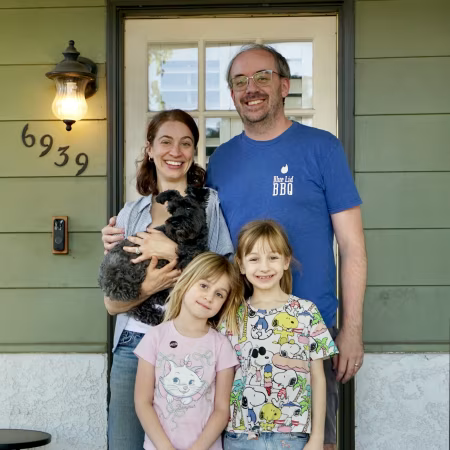
Greg and Sara Cebulski and their two children in front of their old home in California before moving to Wisconsin. KD MOELLER
That imbalance helped bring a socialist mayor to power in New York City and elect a Democratic mayor in Miami for the first time in nearly 30 years. Hotly contested political races across the country are already centering on affordability as a central issue of the midterm elections.
Residents in many parts of the Midwest have fewer reasons to gripe. The region has the lowest median sales price for existing homes in the country, at $319,400 in November versus $409,200 nationwide, according to the National Association of Realtors. Rents in major Midwestern cities are also lower than the national median, according to Bank of America data.
The bank defines the Midwest as Indiana, Iowa, Illinois, Kansas, Michigan, Minnesota, Ohio, Missouri, Wisconsin, Nebraska, North Dakota and South Dakota.
The Midwest has historically been cheaper than many other parts of the country, but the other side of the affordability equation is wages, and the Midwest seems to be winning on that score lately, too. Year-over-year wage growth has been climbing more steadily in the Midwest over the past year than it has in other regions, according to Bank of America deposit data.
Those wage trends, combined with more reasonable housing costs, have allowed Midwesterners of late to spend more on discretionary items than Americans in other regions, according to Bank of America credit- and debit-card data.
“It is the value play of the United States,” said Joe Wadford, an economist at the Bank of America Institute. “It is a great place to put down roots.”
This stretch of Wisconsin, along the Fox River from Oshkosh to Green Bay, is a particular bright spot. In the six counties around Appleton, Oshkosh, Neenah and Green Bay, just 1 homeowner in 7 spends more than 30% of their income on shelter costs, compared with 1 in 5 nationwide. About 40% of renters spend more, compared with half of renters nationwide. Manufacturing accounts for more than twice the share of jobs than it does nationwide, keeping average wages above national levels.
“There’s a little bit more of a scalable ladder here,” Greg Cebulski, 38, said from a large sunroom overlooking a generous yard. He was able to keep his L.A. job as an editor for the Discovery Channel, which brings in about $180,000 a year.
Affordability here isn’t just for coastal transplants. Jason Brown, a manager at an Appleton hotel, recently bought a four-bedroom house with his partner for $305,000. Their combined income of $72,000 covers the mortgage and allows them to support one child and another on the way, he said. “Between us, we make a pretty decent living,” Brown said.
Low-cost housing can signal economic malaise and a declining population, but that’s not true in this corner of Wisconsin. The population in the area grew 3% from 2019 to 2024, versus 2% statewide. The regional economy is growing slowly but in line with the state’s economy, according to the Bureau of Economic Analysis.
Kimberly-Clark, maker of diapers and Kleenex, was founded in the nearby city of Neenah in 1872 and has manufacturing and research facilities in the region. Gulfstream Aerospace employs hundreds of people who customize jets. Another local manufacturer produces the Bevi flavored-water machines that are fixtures in many offices.
Some people are now returning to the area after stints in more expensive regions—in some cases bringing their salaries with them and immediately improving their standard of living.
Josh Griggs recently closed on a $403,000, four-bedroom home near Green Bay after concluding he could never afford one in Pensacola or Orlando, Fla., where he previously lived. It wasn’t just housing prices but also the high cost of homeowners’ insurance and utilities, he said. His electric bill in Florida was about $300 a month, which he expects to drop in half in Wisconsin.
Griggs earns about $140,000 a year as a remote worker for an insurance company, a job he kept when he moved. He grew up on the Upper Peninsula of Michigan, near the Wisconsin border, and has family near Green Bay. “It’s very affordable in this area, but the one thing I will say is it’s very competitive,” Griggs said of the housing market. He was hoping to spend about $350,000 for a house but had to raise his limit. “I put offers in on six houses before I got this,” he said.
That competition is pushing up prices and causing frustration among some local residents—a risk for Midwestern communities looking to strike a balance between growth and affordability.
Zak Gravunder, a longtime Appleton resident, bought his modest two-bedroom home in 2019 for $138,000. After a recent divorce, the 39-year-old needs to sell the home and he is worried he will be priced out of the market. Gravunder, who earns about $65,000 a year as a sales representative for a company that sells first-aid products, said he is also frustrated by high grocery prices.

Zak Gravunder is worried he will be priced out of the market after he sells his current home.
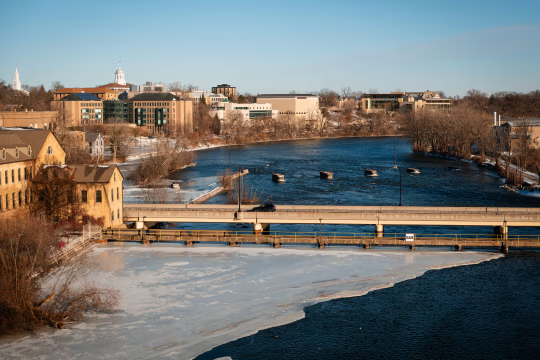
The Fox River near downtown Appleton was partly frozen over in December.
“I watched the president of the United States give a speech yesterday about affordability and he was like, ‘What are you complaining about, things are great,’ ” Gravunder said, referring to the president’s speech on Dec. 17. “I don’t know how far removed you are from the situation, but it’s not that great out here.”
The price spikes have spurred local developers and officials to accelerate home construction. New subdivisions and apartment buildings are rising around Appleton. The city of Neenah recently purchased a large plot of land that it is gradually selling to a developer as new houses are built, to help the developer manage the expense of construction. In 2024 Neenah started construction on its highest number of single-family homes since 2010, said Mayor Jane Lang.
Despite rising prices, the region has enabled home buying among many middle and working-class residents who might struggle to purchase real estate elsewhere.
Willow Bayer, an artist who earns a living tending bar at a chic restaurant on Appleton’s main drag, bought her three-bedroom, one-bath home in 2022 for $169,000.
The house is small and has a cramped staircase to the upper floor, but she pays her mortgage without difficulty and usually tacks on an extra $200 payment toward the principal, she said. Now married to a welder, Bayer says the couple have considered moving somewhere else for an adventure. “I dreamed about Washington, the outskirts of Seattle,” she said. “But then you look at the prices.”
Brian Bartelt, who grew up in Appleton, said his wife sometimes daydreams about warmer weather, but he sees no need to look elsewhere. His family just upgraded to a bigger home, paying $400,000 for a place with an extra bathroom, a bigger yard and about 1,000 more square feet than their starter home.
The bigger garage gives them more room to store their snowblower, lawn mower and kids’ bikes, and the extra bathroom means “I don’t have to share a shower with an 8-year-old,” Bartelt said.
The father of two, who sells HVAC maintenance services to industrial companies, had hoped to keep the price under $350,000, but even as he bumped up his budget, it never occurred to him that he wouldn’t be able to afford something, he said.
If “you can get past the crappy winters here,” Bartelt said, “it’s way more affordable” than other parts of the country. He and his wife, who works for the county, have a household income of about $175,000.
“I’m 40 years old,” he added. “Pretty much everybody we know owns their house. I honestly can’t think of anyone in my age range that rents.”
Write to Jeanne Whalen at Jeanne.Whalen@wsj.com and Paul Overberg at paul.overberg@wsj.com
Appeared in the January 3, 2026, print edition as 'Americans Find Affordability in Midwest'.
https://archive.ph/Gfm9w
The region offers housing costs below the national median and steady wage growth
By Jeanne Whalen and Paul Overberg| Photography by Darren Hauck for WSJ
Jan. 2, 2026 at 9:00 pm ET
The Midwest has the lowest median existing home sales price in the U.S. at $319,400, compared to $409,200 nationwide in November.APPLETON, Wis.—Greg and Sara Cebulski enjoyed their years in Los Angeles, but when it came time to buy a bigger home for their family, they packed up and moved back to a place where they could actually afford one: the Midwest.
The couple, who grew up outside this quaint town in Wisconsin’s Fox River Valley, just closed on a 2,400-square-foot split level for $360,000—almost twice the size of the starter home they sold in the San Fernando Valley for more than twice that price. It’s not just housing, the Cebulskis say. Utilities, gasoline and dance and piano lessons for their two children are cheaper in Appleton, too.
Affordability has become a political buzzword, with Americans increasingly voicing discontent about the high cost of everything from housing to groceries to daycare. Workers in many parts of the country say they feel priced out of their communities, unable to afford a mortgage or even monthly rent payments.
Greg and Sara Cebulski and their two children in front of their old home in California before moving to Wisconsin. KD MOELLER
That imbalance helped bring a socialist mayor to power in New York City and elect a Democratic mayor in Miami for the first time in nearly 30 years. Hotly contested political races across the country are already centering on affordability as a central issue of the midterm elections.
Residents in many parts of the Midwest have fewer reasons to gripe. The region has the lowest median sales price for existing homes in the country, at $319,400 in November versus $409,200 nationwide, according to the National Association of Realtors. Rents in major Midwestern cities are also lower than the national median, according to Bank of America data.
The bank defines the Midwest as Indiana, Iowa, Illinois, Kansas, Michigan, Minnesota, Ohio, Missouri, Wisconsin, Nebraska, North Dakota and South Dakota.
The Midwest has historically been cheaper than many other parts of the country, but the other side of the affordability equation is wages, and the Midwest seems to be winning on that score lately, too. Year-over-year wage growth has been climbing more steadily in the Midwest over the past year than it has in other regions, according to Bank of America deposit data.
Those wage trends, combined with more reasonable housing costs, have allowed Midwesterners of late to spend more on discretionary items than Americans in other regions, according to Bank of America credit- and debit-card data.
“It is the value play of the United States,” said Joe Wadford, an economist at the Bank of America Institute. “It is a great place to put down roots.”
This stretch of Wisconsin, along the Fox River from Oshkosh to Green Bay, is a particular bright spot. In the six counties around Appleton, Oshkosh, Neenah and Green Bay, just 1 homeowner in 7 spends more than 30% of their income on shelter costs, compared with 1 in 5 nationwide. About 40% of renters spend more, compared with half of renters nationwide. Manufacturing accounts for more than twice the share of jobs than it does nationwide, keeping average wages above national levels.
“There’s a little bit more of a scalable ladder here,” Greg Cebulski, 38, said from a large sunroom overlooking a generous yard. He was able to keep his L.A. job as an editor for the Discovery Channel, which brings in about $180,000 a year.
Affordability here isn’t just for coastal transplants. Jason Brown, a manager at an Appleton hotel, recently bought a four-bedroom house with his partner for $305,000. Their combined income of $72,000 covers the mortgage and allows them to support one child and another on the way, he said. “Between us, we make a pretty decent living,” Brown said.
Low-cost housing can signal economic malaise and a declining population, but that’s not true in this corner of Wisconsin. The population in the area grew 3% from 2019 to 2024, versus 2% statewide. The regional economy is growing slowly but in line with the state’s economy, according to the Bureau of Economic Analysis.
Kimberly-Clark, maker of diapers and Kleenex, was founded in the nearby city of Neenah in 1872 and has manufacturing and research facilities in the region. Gulfstream Aerospace employs hundreds of people who customize jets. Another local manufacturer produces the Bevi flavored-water machines that are fixtures in many offices.
Some people are now returning to the area after stints in more expensive regions—in some cases bringing their salaries with them and immediately improving their standard of living.
Josh Griggs recently closed on a $403,000, four-bedroom home near Green Bay after concluding he could never afford one in Pensacola or Orlando, Fla., where he previously lived. It wasn’t just housing prices but also the high cost of homeowners’ insurance and utilities, he said. His electric bill in Florida was about $300 a month, which he expects to drop in half in Wisconsin.
Griggs earns about $140,000 a year as a remote worker for an insurance company, a job he kept when he moved. He grew up on the Upper Peninsula of Michigan, near the Wisconsin border, and has family near Green Bay. “It’s very affordable in this area, but the one thing I will say is it’s very competitive,” Griggs said of the housing market. He was hoping to spend about $350,000 for a house but had to raise his limit. “I put offers in on six houses before I got this,” he said.
That competition is pushing up prices and causing frustration among some local residents—a risk for Midwestern communities looking to strike a balance between growth and affordability.
Zak Gravunder, a longtime Appleton resident, bought his modest two-bedroom home in 2019 for $138,000. After a recent divorce, the 39-year-old needs to sell the home and he is worried he will be priced out of the market. Gravunder, who earns about $65,000 a year as a sales representative for a company that sells first-aid products, said he is also frustrated by high grocery prices.
Zak Gravunder is worried he will be priced out of the market after he sells his current home.
The Fox River near downtown Appleton was partly frozen over in December.
“I watched the president of the United States give a speech yesterday about affordability and he was like, ‘What are you complaining about, things are great,’ ” Gravunder said, referring to the president’s speech on Dec. 17. “I don’t know how far removed you are from the situation, but it’s not that great out here.”
The price spikes have spurred local developers and officials to accelerate home construction. New subdivisions and apartment buildings are rising around Appleton. The city of Neenah recently purchased a large plot of land that it is gradually selling to a developer as new houses are built, to help the developer manage the expense of construction. In 2024 Neenah started construction on its highest number of single-family homes since 2010, said Mayor Jane Lang.
Despite rising prices, the region has enabled home buying among many middle and working-class residents who might struggle to purchase real estate elsewhere.
Willow Bayer, an artist who earns a living tending bar at a chic restaurant on Appleton’s main drag, bought her three-bedroom, one-bath home in 2022 for $169,000.
The house is small and has a cramped staircase to the upper floor, but she pays her mortgage without difficulty and usually tacks on an extra $200 payment toward the principal, she said. Now married to a welder, Bayer says the couple have considered moving somewhere else for an adventure. “I dreamed about Washington, the outskirts of Seattle,” she said. “But then you look at the prices.”
Brian Bartelt, who grew up in Appleton, said his wife sometimes daydreams about warmer weather, but he sees no need to look elsewhere. His family just upgraded to a bigger home, paying $400,000 for a place with an extra bathroom, a bigger yard and about 1,000 more square feet than their starter home.
The bigger garage gives them more room to store their snowblower, lawn mower and kids’ bikes, and the extra bathroom means “I don’t have to share a shower with an 8-year-old,” Bartelt said.
The father of two, who sells HVAC maintenance services to industrial companies, had hoped to keep the price under $350,000, but even as he bumped up his budget, it never occurred to him that he wouldn’t be able to afford something, he said.
If “you can get past the crappy winters here,” Bartelt said, “it’s way more affordable” than other parts of the country. He and his wife, who works for the county, have a household income of about $175,000.
“I’m 40 years old,” he added. “Pretty much everybody we know owns their house. I honestly can’t think of anyone in my age range that rents.”
Write to Jeanne Whalen at Jeanne.Whalen@wsj.com and Paul Overberg at paul.overberg@wsj.com
Appeared in the January 3, 2026, print edition as 'Americans Find Affordability in Midwest'.


