Deconstructing @0da2’s Entire Argument, Point by Point:
One of the things that
@0da2 states is that I use AI. This is true. I use AI for spell-checking and grammar-checking (not generating sentences or prompts), but this does not invalidate my arguments.

What it does show is that, despite me making several solid points that refuted some of
@0da2’s claims, instead of addressing my main arguments, he chose to focus on my use of AI as a distraction from the stronger points I raised against him. When
@0da2 says that I use AI and specifically refers to the fact I use the words "the user" this is actually how I normally write. None of what I write is randomly prompted text or generated. Most of what I write is by myself. and I use a tool (AI) to enhance what I write.
View attachment 8349987
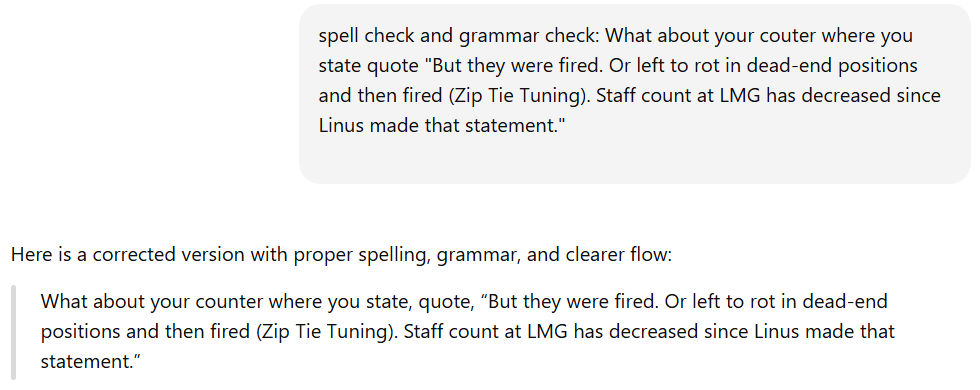
I also use AI to reformat points I wrote in advance so they flow better with additional sentences I add. Sometimes, when I write, I have difficulty figuring out how to make two paragraphs flow together, so I use AI as a tool to help with that. The person speaking is Luke, not Linus." Yeah this was a clear common mistake on my end as you outlined there tends to be a mix-up of people and one of the things I was totally off-base on is likely mixing up these two people which is just a simple error on my part. As stated prior, your argument was trying to use a "what-if" scenario that was made instead of something of actual substance. Is this really the case? The clip suggests otherwise. In
@0da2's own quote about the the clip,
@0da2 says quote "he was not sure the training at LFMG for phishing attacks was working." This point was refuted by adding the context I included, but what about
@0da2’s additional counter with the context
he added?
@0da2 says, quote: “Luke is literally staring at Linus when he says, ‘YOU need to take this more seriously.’ And it’s not the first time he’s said that.” Here is the clip.
The user
@0da2 only provides part of the quote and not the full context. Here is the complete quote:
“If someone fails their training multiple times or makes mistakes multiple times, and it is the same person, then it starts to feel like, ‘Oh, okay, you need to take this more seriously,’ because we are going to send out phishing tests again. We did one, and we are going to do more in the future. If the same person keeps coming up, that is a red flag. But if you make one mistake, ideally on one of the tests, and then you don’t make a mistake again, then we’re good.”
Why does the fuller quote matter? As stated before,
@0da2 is leaving out the full context that explains the situation. If we look at the specific wording, “what if someone fails their training multiple times”, Luke is giving a hypothetical example of what would happen
if a situation of that nature were to occur.
@0da2 cuts out the fuller quote in order to fit the narrative he is trying to paint against Linus. What about Luke continuously staring at Linus while saying words like “you”?
@0da2 states, quote: “Notice the ‘or,’ the emphasis on ‘you,’ and the staring at Linus. Now, this could, of course, mean just some random person, an employee, failing the internal phishing test that LMG just started running. Before we deconstruct this point, let’s screenshot the moments when Luke looks at Linus throughout the entire clip.


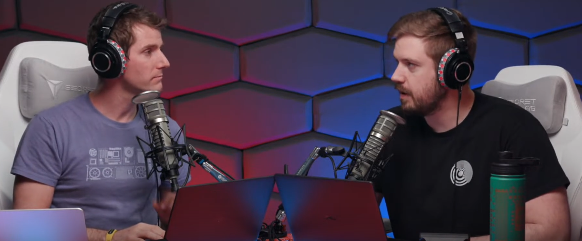


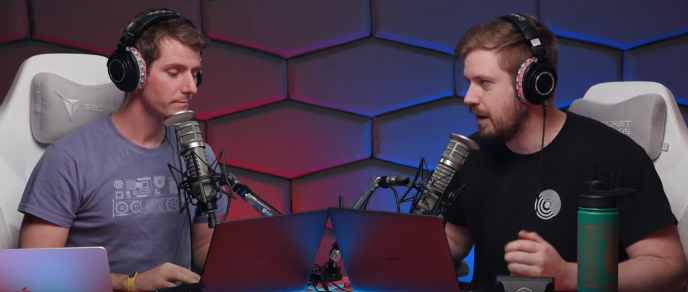


It is understandable why
@0da2 jumped to the conclusions he did because it does appear like based on body language that Luke is talking about Linus. The problem is that throughout the entire interview, Luke maintains consistent eye contact with Linus.
@0da2's claim could be true but the issue at hand is this is both speculative and lacks any evidence. Furthermore,
@0da2 tries uses a stronger point that may have evidence to support his prior point that lacks any substance or good argumentation.
 @0da2
@0da2 further points to Linus joking about spamming the “He does not know” button while Luke was attempting to discuss genuine security failures that had occurred at LMG. However, this behavior, whether one views it as unprofessional still does not serve as proof that Luke was addressing Linus when discussing phishing training failures. At best, it is another cherry-picked moment used to imply intent where none is demonstrably shown. Moreover,
@0da2 tries to indirectly victim-blame Linus for being a victim of Honey. On our prior post, we outlined how Linus was a victim of Honey by showing that Honey was exploiting his brand's image. What did Honey do to Linus? Honey removed Linus’s affiliate cookie and replaced it with their own, allowing them to claim credit for the sale and receive the commission that was supposed to go to Linus. Moreover, when clicking apply discount Honey opened a new tab which quote "acts like a simulated referral click" again as if they were the ones who did the referral when in fact it was Linus. Once Honey inserts its affiliate link and the page finishes loading, the tab closes. Overall, this demonstrates that creators who partnered with or were sponsored by Honey were effectively screwed over, as Honey was actively taking their commissions so Honey in essence was taking Linus's own commissions.
@0da2 then points to a recent example from the latest season of
Scrapyard Wars, where Linus falls for a scam, as evidence that this somehow makes Linus less of a victim in the Honey situation. What the example actually demonstrates is that Linus has repeated a similar mistake, not that he bears moral fault or deserves less sympathy. Repeating a mistake is not a character flaw or moral failing. At most, it indicates a need for greater caution moving forward, particularly to avoid becoming the victim of another scam. The example
@0da2 outlines does not undermine Linus’s position as a victim, nor does it justify reframing responsibility. In fact, rather than supporting
@0da2’s claim, the example reinforces a pretty easy conclusion: Linus should be more careful. The final point that
@0da2 brings up to claim that Luke hates working at the company/Linus is asking how many shares that Luke has in the company and asked what his living situation is like. I do not know the answer to these two questions. What I do know however is Linus has explained this and I outlined it in my prior post. Here was what I stated:
The first claim centers on Luke being denied a raise, with the user portraying Linus’s explanation as illogical or unreasonable. This framing is misleading. Linus explicitly refused the raise because of his personal friendship with Luke, a decision rooted in fairness and ethical leadership. Granting raises or opportunities to close friends in a workplace reasonably raises concerns about favoritism and bias. Rather than acting unfairly, Linus chose to hold Luke to the same standard as every other employee to avoid even the appearance of preferential treatment. The user omits this crucial nuance and instead attempts to construct a narrative that misrepresents the situation, rather than engaging with it critically or in good faith.
What are the last two points that
@0da2 uses against me to refute my credible arguments and to counter them? Here are the last two points:
Holy shit, read the first part of that post—it's clearly AI-written. E.g., em-dashes, "not X, but Y" sentence structure.
Honey exploited the MrBeast and Linus brands—full stop. Responsibility therefore lies with those who carried out the exploitative actions, not with creators whose names or images were misused after the fact
Self-prompting, chain-of-thought.
The first question to ask is whether this tweet actually exists. To verify its authenticity, we can visit Emily’s main Twitter account, @EmilyAYoung1, and search for the exact keywords highlighted in the screenshot
This does not refute my main arguments at all; instead, it distracts from them by pointing out that I use AI. I use AI for spell-checking, grammar-checking, and improving the flow between paragraphs when I have difficulty connecting ideas. I have always been honest and transparent about this. Using a tool to correct errors or improve clarity in writing is not inherently bad, nor is it comparable to auto-generating arguments, prompts, or large sections of sentences/paragraphs. This is just designed to deflect from the good points I made against
@0da2. Another user known as
@Spiral Architect rightfully pointed out that my prior assessment on the conflict with Stephen and Linus.
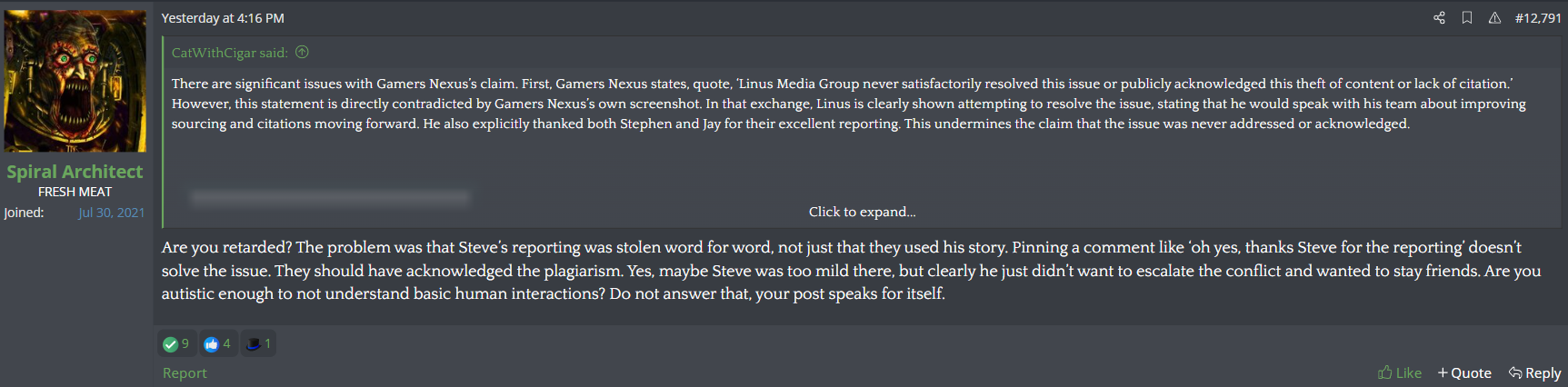
The problem, as
@Spiral Architect states, quote: “Steve’s reporting was stolen word for word, not just that they used his story. Pinning a comment like ‘oh yes, thanks Steve for the reporting’ doesn’t solve the issue. They should have acknowledged the plagiarism.” But this does not weaken my defense of Linus. Why not? Let's look at my prior statement regarding the subject.
There are significant issues with Gamers Nexus’s claim. First, Gamers Nexus states, quote, ‘Linus Media Group never satisfactorily resolved this issue or publicly acknowledged this theft of content or lack of citation.’ However, this statement is directly contradicted by Gamers Nexus’s own screenshot. In that exchange, Linus is clearly shown attempting to resolve the issue, stating that he would speak with his team about improving sourcing and citations moving forward. He also explicitly thanked both Stephen and Jay for their excellent reporting. This undermines the claim that the issue was never addressed or acknowledged.
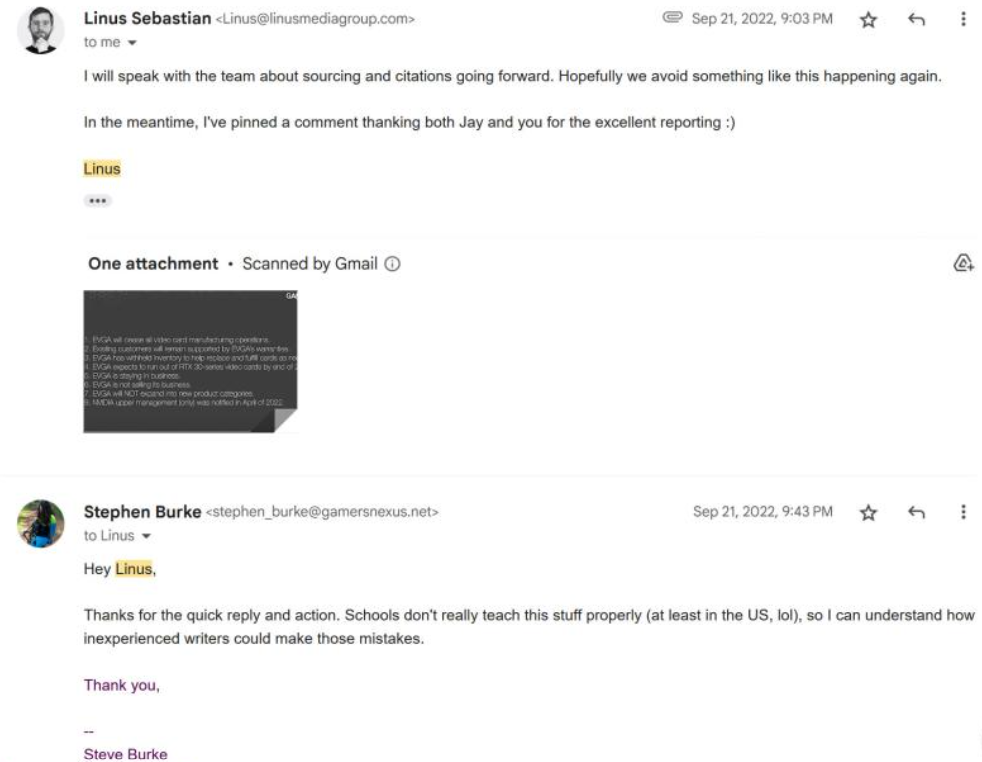
The second issue to highlight is Gamers Nexus’s statement that, quote, ‘The only change made, after responding to our email, was a pinned comment stating “shoutout to Jayztwocents and Steve.” The problem with this claim is that it omits critical context. The pinned comment cited by Gamers Nexus was not presented in full.

The complete pinned comment reads: ‘Massive shout out to Jayztwocents and Steve for their excellent reporting on the EVGA/NVIDIA break-up. Great reporting, guys!’

By truncating the comment, Gamers Nexus minimizes the acknowledgment and makes it appear less substantive than it actually was. In reality, the full comment clearly credits both JayzTwoCents and Steve for their reporting on the EVGA/NVIDIA break-up, directly contradicting the implication that proper acknowledgment was not given. The third point to focus on is Stephen’s own reply to Linus in the email chain. Stephen not only expressed satisfaction with Linus’s resolution, but also never requested public acknowledgment of plagiarism or specific attribution to Gamers Nexus.
However, my point while valid does not address what
@Spiral Architect said rightfully. Regardless of this email communication, Linus was still wrong here to take Stephen's report and copy it word for it. It should have been given credit after but again what matters is that Linus did try to mend things and Stephen has held a grudge which led to his faulty reporting of Linus (a victim of Honey) being targeted by him over this petty grudge. However, while my point is valid, it does not directly address what
@Spiral Architect rightly pointed out. Regardless of the email communication, Linus was still wrong to take Stephen’s report and copy it word for word. Credit should have been given at the time fully instead of just a shoutout specifically attribution to GamersNexus and a proper citation.


