r/fuckcars / Not Just Bikes / Urbanists / New Urbanism / Car-Free / Anti-Car - People and grifters who hate personal transport, freedom, cars, roads, suburbs, and are obsessed with city planning and urban design

  • Want to keep track of this thread?
    Accounts can bookmark posts, watch threads for updates, and jump back to where you stopped reading.
    Create account
Road Guy Rob (who has a Multimedia thread here) posted about a major train delay he experienced:
1765409076642.png
There weren't as many fuckcars types as I thought, but there were a few. Just one more track bro:
1765409175294.png
The government would fix everything (paging @quaawaa to dump some facts about government-ran rail lines):
1765409216844.png
1765409236411.png
The usual car-hating:
1765409268462.png
Which one of you is Derek?
1765409306546.png
1765409343697.png
 
The usual car-hating:
1765409268462.png
This fuckhead. Humans aren't cattle, we're not products, not goods to be optimized by a shipping algorithm and packaged to be sent to a destination. We're individuals with our own needs, wants, and dreams. Who are you to decide I shouldn't be allowed to have my own car? What if I want to go somewhere and there's no train?
 
I totally get his fear of doing that many train changes, especially because one fuck up that might not even be your own will lead to a domino effect and possibly ruin the whole trip.
But that's the problem with mass transit in itself, you can rarely get from your destination directly with mass transit and in many cases have to rely on a schedule, with one mess-up either by your fault or the schedule means your commute is totally ruined. Transit advocates insist that if you're running buses and trains every 5 minutes that's not a problem but you'll never get critical mass for that to work without empty trains and buses running everywhere at the taxpayer dollar, neither cheap or efficient.

For things like airplanes you want to plan in layovers which suck but with the unreliability of airplanes and the confusing airport layouts better safe than sorry. Besides, "good" train stations have amenities similar to airports...this would be a perfect time to take a picture of your favorite mixed drink of choice at a bar inside the airport and act like this is the way to travel. (We all know how much they love alcohol).

I have been on every major mode of transport, I'd still say trains are comfiest when they work and aren't delayed, horridly expensive or filled with browns
I don't think I've ever done a train for long-distance travel, and frankly I'm not sure why I would want to. It's going to take a longer time than flying a plane, about as expensive, and misses all the fun places and sights you get with traditional road driving.

When it comes to max comfy holiday travel, that would be my family's minivan growing up on holidays. Sure, it could get cramped especially if my (adult) cousin was wedged between me and my brother, but I had my pillow, my Game Boy Color, and my brother who in many ways was my best friend. Unfortunately those days are long gone, but I still enjoy driving.

I believe I mentioned this before but on holiday travel car is absolutely GOAT because you can take anything with you like bulky Christmas gifts and other items that would be banned or heavily restricted on trains and planes. (The list is almost identical.)

Plus, unless your a big spender you likely won't even have a hotel centrally.
I don't know why train advocates claim you need that train stations need to be in the "center of the city". Those places suck and vastly overpriced for what you get. Their restaurants seem to do all right financially but that's mostly because of the captive audience. Even if you rent a car they'll double dip on the parking charge. In suburban hotels with free parking (near, but not in the airport) you can leave, find a good restaurant, and come back.

Even in 10 minutes of driving you'll probably find something you'll like. 10 minutes of walking in a downtown area? Not so much, especially as a lot of places aren't open for dinner.

There weren't as many fuckcars types as I thought, but there were a few. Just one more track bro:
The thing about double-tracking is that in America there's already functional 2+ tracks on lots of lines, they just aren't directly parallel to each other.

This fuckhead. Humans aren't cattle, we're not products, not goods to be optimized by a shipping algorithm and packaged to be sent to a destination. We're individuals with our own needs, wants, and dreams. Who are you to decide I shouldn't be allowed to have my own car? What if I want to go somewhere and there's no train?
It's not just that they want to treat people like goods, but treating goods like people. No, you can't have a system where a trailer goes from being "plugged in" directly from a warehouse to being "plugged in" into a store, you have to navigate to difficult locations where they have to use cargo bikes and tiny trucks and you still bitch about where they can park.

Unsurprisingly, one of the reasons why downtowns started to fail was that they didn't make sense for modern logistics.
 
I don't know why train advocates claim you need that train stations need to be in the "center of the city".
I've talked about it before, but every train station that's in the "center" of a large city that was founded before the invention of the steam engine was actually built on the outskirts and the city sprawled around it.

As another example, take a look at Manhattan circa 1836:
1765429543390.png
The first railroad building where the modern day Grand Central terminal stands was built in 1837. The map shows the land where Grand Central will be built, as well as 2/3rds of Manhattan Island as undeveloped.

Ironically, the only way this would not be the case is if Big Railroad razed cities to build stations, yards, and tracks, which would distress urbanists because they believe that "destroying" cities to build road infrastructure is a cardinal sin.

Even to this day, young cities, like those in China, build their intercity railway stations on the outskirts of the city. They're massive structures that require a ton of land, so it's impractical to build one in a developed area.

By the way, Amsterdam's central train station, which is actually in the historical city center, was built on artificial islands which destroyed the waterfront of the mainland:
Wikipedia said:
As with the Rijksmuseum, the station's overall architecture reminded many contemporaries of medieval cathedrals. For that reason, as well as for the fact that it became increasingly clear that the national government wanted the station to be built at the city's waterfront effectively separating the city from the IJ lake, the plan was highly controversial. In his book on the history of city, Amsterdam historian Geert Mak writes that:
Almost all of Amsterdam's own experts and others involved thought this to be a catastrophic plan, 'the most disgusting possible attack on the beauty and glory of the capital'. Nevertheless, the building of the Central Station in front of the open harbour was forced through by the railway department of the Ministry of Transport in The Hague, and the Home Secretary, Thorbecke. Finally, the plan made its way through the Amsterdam municipal council by a narrow majority.
Urbanists hate highways that run along the water because they believe that all waterfronts should be parks, but you'll never see them bitch about this.
 
posted about a major train delay he experienced
There was also recently a thread on the Reddit Amtrak forum about someone from the NRPA getting stuck in Michigan (on Amtrak-owned tracks!) because their new locomotives are trash and can't handle snow.

He was relating how embarrassing it was to be a staffer at a rail advocacy group and have your wife say 'we're never taking this fucking thing again'.
 
I've talked about it before, but every train station that's in the "center" of a large city that was founded before the invention of the steam engine was actually built on the outskirts and the city sprawled around it.

As another example, take a look at Manhattan circa 1836:
1765429543390.png
The first railroad building where the modern day Grand Central terminal stands was built in 1837. The map shows the land where Grand Central will be built, as well as 2/3rds of Manhattan Island as undeveloped.

Ironically, the only way this would not be the case is if Big Railroad razed cities to build stations, yards, and tracks, which would distress urbanists because they believe that "destroying" cities to build road infrastructure is a cardinal sin.
I don't know, all the European cities have big train stations in their cores with freeway-width rail corridors. In Rome, just a mile north of the Colosseum is a huge train station and accompanying wide corridors...though Rome is somewhat unique in that it was more or less destroyed since the days of the Empire; indeed, by the 16th century, with the Colosseum and the Circus Maximus in the positions they're in, the modern train station would be just farmland.
 
But that's the problem with mass transit in itself, you can rarely get from your destination directly with mass transit and in many cases have to rely on a schedule, with one mess-up either by your fault or the schedule means your commute is totally ruined. Transit advocates insist that if you're running buses and trains every 5 minutes that's not a problem but you'll never get critical mass for that to work without empty trains and buses running everywhere at the taxpayer dollar, neither cheap or efficient.
I'd say the main issue is the nonsensical way those schedules are handled. It feels often entirely arbitrary where and when the trains stop and almost no consideration for those who might want to step over to another train which makes it even shittier when trains sometimes do at the worst places, you'll breeze by a metropolitan area but stop at a bumfuck town for 10 minutes. Not to mention there not being a direct line to really important areas leading to very confusing train changes which are not at all overseeable. Everything feels like it's decided by the conductor arbitrarily rather than something planned out.

Now you obviously can't accomodate for everything, but at least in the Netherlands the trains are not even doing the bare minimum.
For things like airplanes you want to plan in layovers which suck but with the unreliability of airplanes and the confusing airport layouts better safe than sorry. Besides, "good" train stations have amenities similar to airports...this would be a perfect time to take a picture of your favorite mixed drink of choice at a bar inside the airport and act like this is the way to travel. (We all know how much they love alcohol).
The main thing I hate about flying vs trains is that missing a train can definitely fuck up WHEN you get to your destination, but not IF you get there like missing a plane can. Missing a flight and being alone and in panic at an airport scrambling to get enough money to pay for a return trip, questioning whether you'll get home or not is not fun. At least with trains I can use the same ticket for every subsequent train and my main worry is just that I'll be late. Now trains can definitely leave you stranded for a night, which also isn't fun but at least you know that you will be able to get home eventually.
I don't think I've ever done a train for long-distance travel, and frankly I'm not sure why I would want to. It's going to take a longer time than flying a plane, about as expensive, and misses all the fun places and sights you get with traditional road driving.
Yeah, the price is the crux of the issue. To tackle your later point though, there are some cool sights that you can have when riding a train, especially in the mountains. I actually often like the sights you get on trains better than when driving. I've gone to Italy with my family by car plenty of times and while in Austria and in Switzerland you get some really nice mountainous sights, you tend to have a lot of highways that are just surrounded trees or gas stations.
When it comes to max comfy holiday travel, that would be my family's minivan growing up on holidays. Sure, it could get cramped especially if my (adult) cousin was wedged between me and my brother, but I had my pillow, my Game Boy Color, and my brother who in many ways was my best friend. Unfortunately those days are long gone, but I still enjoy driving.
feels
I believe I mentioned this before but on holiday travel car is absolutely GOAT because you can take anything with you like bulky Christmas gifts and other items that would be banned or heavily restricted on trains and planes. (The list is almost identical.)
Yeah, that's definitely the biggest plus a car has over everything else. You don't get some asshole security guard at the airport throwing a pot of honey you bought into the trash due to security reasons (Because a random white dutch guy would make a bomb with a fucking pot of honey, obviously)
 
Urbanists are now complaining that elevators are too big:
1765472422777.png
Source (Archive)

Why do they hate normal sized elevators? Because their existence makes it impractical to build "single-stair apartments".
1765472467918.png

American urbanists are obsessed with the idea that American apartment buildings are more expensive than they should be because they have hallways that "waste" space. The solution is to build a bunch of small buildings centered around a stairwell, like in historical parts of Europe, instead of one large apartment building. Of course, when you compare apples to apples, the larger apartment building has fewer stairwells per unit because the hallway allows many units to share the same stairwell whereas the "townhouse" style that the urbanists want requires every unit to be directly connected to one.

Single-stairwell buildings are already legal in much of the country, but they're not built because they're not economical for developers, which is why urbanists are now blaming elevator size for the lack of their preferred aesthetic.

Most people rightfully recognize that elevators are useful:
1765473371932.png
1765473467078.png
1765473377995.png
1765473385003.png
1765473443096.png
1765473449152.png

1765473420968.png
1765473570141.png
1765473575946.png
1765473217636.png

However there are still plenty of idiots:
1765473404972.png
1765473481944.png
1765473515018.png
1765473528766.png
1765473564837.png

1765473239357.png
1765473243918.png 1765473250235.png
1765473282932.png
1765473301133.png
Source (Archive)

Remember everyone, walkable cities are better for the disabled as long as your "disability" is being an internet addict and not something like needing a wheelchair!
 
Last edited:
I don't know, all the European cities have big train stations in their cores with freeway-width rail corridors. In Rome, just a mile north of the Colosseum is a huge train station and accompanying wide corridors...though Rome is somewhat unique in that it was more or less destroyed since the days of the Empire; indeed, by the 16th century, with the Colosseum and the Circus Maximus in the positions they're in, the modern train station would be just farmland.
Cities pre-cars were usually pretty small and not the sprawling urban conglomerations they are today. Pliny describes Rome at near its Imperial Height as having a completely solid built up area of around 9 sq miles Manhattan is 22 sq Miles.
 
Honestly I'm all in on this, elevators are a fucking menace and expensive to maintain.
That's a weird stance. They're making life easier for everyone, allowing people (old, disabled, pregnant, delivery people, people carrying groceries, etc etc) a much greater degree of freedom and mobility. That itself is worth the cost
 
Most people rightfully recognize that elevators are useful
Even forgetting that people might have medical emergencies a big elevator is critical for families with young children. I had to navigate Osaka with two strollers and it sucks to find one of those tiny elevators as the only option.
 
That's a weird stance. They're making life easier for everyone, allowing people (old, disabled, pregnant, delivery people, people carrying groceries, etc etc) a much greater degree of freedom and mobility. That itself is worth the cost
Wait till your forking out for them in your flat maintenance charges because it breaks down every 6 months.
 
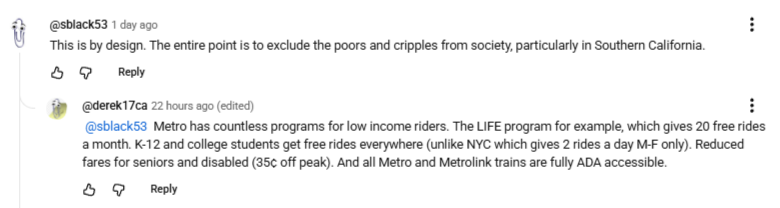
I keep waiting on them to turn on the ADA also because of the looming customer service disaster that the FRA's definition of 'full ADA compliance' has wrought on new Amtrak equipment.

The urbanists haven't twigged onto that yet because that equipment hasn't hit the Boston-NYC-DC corridor yet but it's-a comin'.
 
I don't know, all the European cities have big train stations in their cores with freeway-width rail corridors.
Cities pre-cars were usually pretty small and not the sprawling urban conglomerations they are today. Pliny describes Rome at near its Imperial Height as having a completely solid built up area of around 9 sq miles Manhattan is 22 sq Miles.
Prior to the industrial revolution, cities were A LOT smaller. This wasn't just because of a lack of transportation, but also because there were a lot fewer people and because most of the population lived in rural areas. Farming yields were also a lot lower. What is the "core" today was the exurbs when the stations were built.

For a more modern example of the same phenomenon, look at Dallas-Fort Worth airport, which was deliberately built in the middle of nowhere between two relatively equally sized cities, Dallas and Fort Worth. They have since sprawled into one contiguous city and now the airport is in the center of the metro area in a location more convenient for the average resident than either city's downtown. 200 years in the future, people may be saying "who wants to go to the spaceport in the middle of nowhere when the airport is right in the city center?".
 
Yeah, the price is the crux of the issue. To tackle your later point though, there are some cool sights that you can have when riding a train, especially in the mountains. I actually often like the sights you get on trains better than when driving. I've gone to Italy with my family by car plenty of times and while in Austria and in Switzerland you get some really nice mountainous sights, you tend to have a lot of highways that are just surrounded trees or gas stations.
It depends where you are. If you look at American railroads, even ones for designated for freight, you'll end up with much of the same stuff that drivers see. I mentioned Bush's funeral train before but if you looked at the route, it more or less parallels roads the entire time, save for a part that goes through forest areas (much like the nearby road). Part of that is the geography--as the highway system started well organized and started straightening out (instead of "turn left to stay on Highway 91", e.g.) they built not too far away from (or in some cases, on top of old) railroad corridors.

Single-stairwell buildings are already legal in much of the country, but they're not built because they're not economical for developers, which is why urbanists are now blaming elevator size for the lack of their preferred aesthetic.
The official line is that they were outlawed, but that's not true, I've seen apartments like that built in the early 2010s in a city that is often pretty picky with how buildings are built.

However there are still plenty of idiots:
Not specifically elevators but this isn't the first time Euroboos have been hating on fire code. Besides, why do they care about construction costs? They never complain about high cost of permits in New York, Portland, and California, and building tiny elevators doesn't mean that apartment rent will be cheaper.

Besides, isn't "missing middle" already small apartment buildings and 4-plexes, which already (despite their complaints) exist in abundance?

Prior to the industrial revolution, cities were A LOT smaller. This wasn't just because of a lack of transportation, but also because there were a lot fewer people and because most of the population lived in rural areas. Farming yields were also a lot lower. What is the "core" today was the exurbs when the stations were built.

For a more modern example of the same phenomenon, look at Dallas-Fort Worth airport, which was deliberately built in the middle of nowhere between two relatively equally sized cities, Dallas and Fort Worth. They have since sprawled into one contiguous city and now the airport is in the center of the metro area in a location more convenient for the average resident than either city's downtown. 200 years in the future, people may be saying "who wants to go to the spaceport in the middle of nowhere when the airport is right in the city center?".
The idea of upper-class density is a relatively recent phenomenon, in the past and still in much of the third world, density = poverty. Modern logistics (based on roads) also facilitates the growth of cities and livability, despite ongoing efforts to make that as difficult as possible.

For a more modern example of the same phenomenon, look at Dallas-Fort Worth airport, which was deliberately built in the middle of nowhere between two relatively equally sized cities, Dallas and Fort Worth. They have since sprawled into one contiguous city and now the airport is in the center of the metro area in a location more convenient for the average resident than either city's downtown. 200 years in the future, people may be saying "who wants to go to the spaceport in the middle of nowhere when the airport is right in the city center?".
It should also be mentioned that even when it comes to the freeways, which they wring their hands over, most of that did not affect "the city", it was single-family homes, which urbanists hate anyway. They look at something like the Pierce Elevated (which TxDOT has long-range plans to remove, likely in response to land value) and talk about "dividing" the city since density exists on both sides, but that was well outside of the downtown area when it was built.
 
It depends where you are. If you look at American railroads, even ones for designated for freight, you'll end up with much of the same stuff that drivers see. I mentioned Bush's funeral train before but if you looked at the route, it more or less parallels roads the entire time, save for a part that goes through forest areas (much like the nearby road).
Since trains suck at climbing hills you have to lay track over the flattest route possible, and then later when automobiles come along it makes sense to follow the railroad tracks, except in places where you'd have to blast out a whole valley or build excessive bridgework. Autos don't need that.
 
I know you can give many criticisms for building design in America, but one of the things we do great at is accessibility for the disabled. I've heard older European cities are quite troubling for those who are walking impaired
 
Since trains suck at climbing hills you have to lay track over the flattest route possible, and then later when automobiles come along it makes sense to follow the railroad tracks, except in places where you'd have to blast out a whole valley or build excessive bridgework. Autos don't need that.
I should mention that the funeral train was in a fairly flat area. Not "flatter than Kansas" flat, but enough that there's no significant grade changes, no major bends, and so on, with the rail accommodating by just building up the railbed, which often results in some steep crossings on lesser-used streets, but that's not for the train to worry about.

I know you can give many criticisms for building design in America, but one of the things we do great at is accessibility for the disabled. I've heard older European cities are quite troubling for those who are walking impaired
The funny thing is the ADA, while great for disabled people, has turned into a whole grift machine through various court rulings and addendums like the Civil Rights Act became (not quite nearly to the same extent but the same sort of principal), and you aren't going to hear them arguing against it, even if it is to blame for many of their bugaboos (like "infinite switchback" pedestrian ramps).

The comments are weird:
Biden doesn't have the same cult of personality Trump has and it's weird to see them glazing Biden as hard as they are, especially given how despite Trump's advanced age they think Joe's looking better than Trump does now.

Also, thinking Biden is humbling himself by riding the Acela is delusional with the commoners, because the Acela NextGen is not cheap. I'm sure that in first-class planes, especially flying out of places like Los Angeles or New York, there's a small chance that you'll end up sitting next to someone recognizable. (If they have their own private plane or security detail, probably not). Plus, you can see that Biden is surrounded by Secret Service agents, so so much for the "mingling with us common folk" line.

Note that Joe has spotted our intrepid train autist friend, looking at him with rightful suspicion, judging him neither as a threat or someone you want to engage with. Good choice.
 
Back
Top Bottom