By Casey Parks
Today at 6:00 a.m. EDT
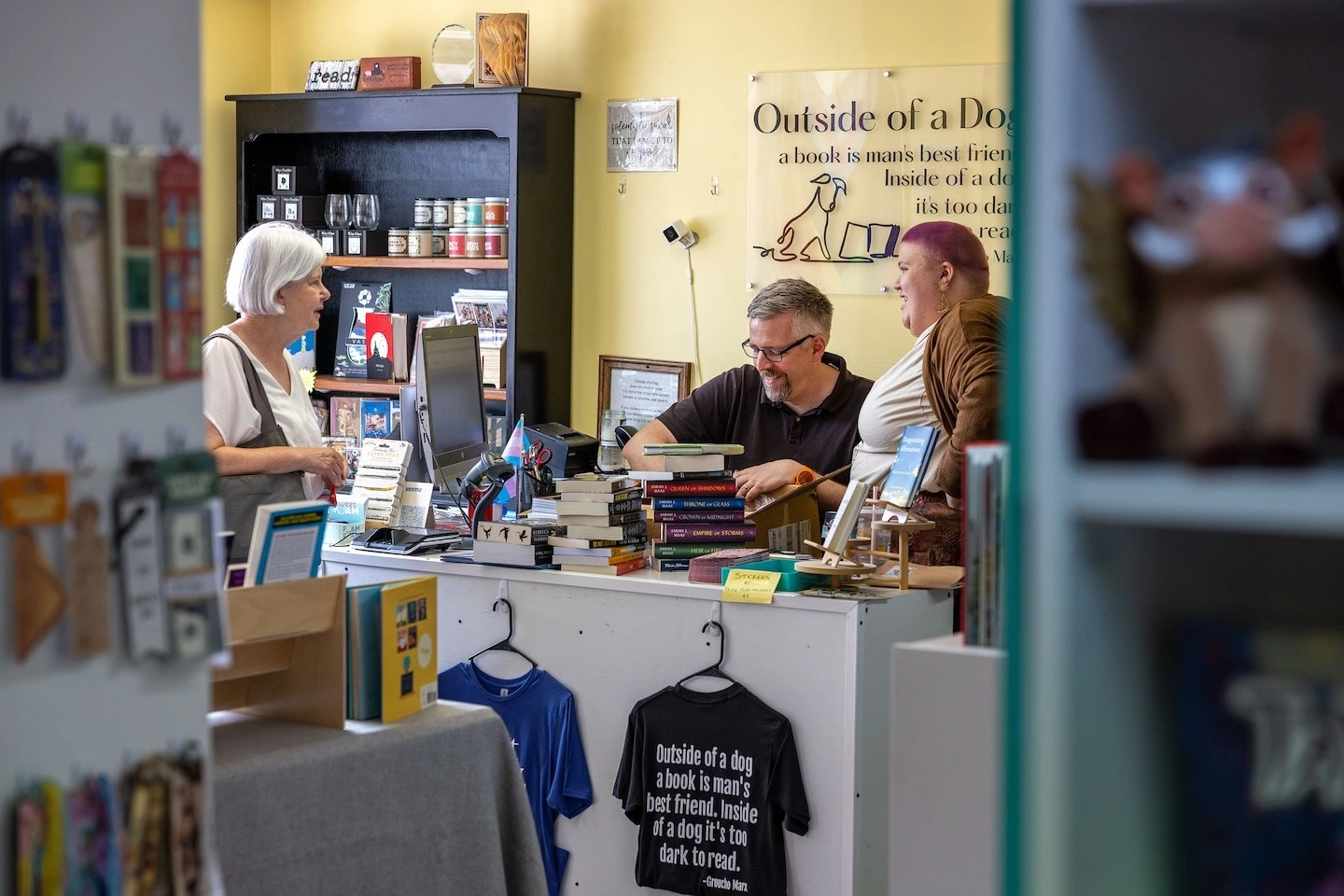
Customer Susan Tuve, left, talks with Mike Phelan and Nova Donstad at the Outside of a Dog bookstore in Vermillion, South Dakota. (Jay Pickthorn/For The Washington Post)
VERMILLION, S.D. — Their time in this small Midwestern town was nearly over, but for now, Mike Phelan still had a business to run, so he and his daughter leashed their dog and headed up the street.
The commute took three minutes. The Phelans passed sprawling Victorian houses with wraparound porches, then, Mike pulled out his keys. When they moved here from Chicago five years ago, Mike discovered Vermillion had a university, locally made bread Oprah Magazine once declared the best in the world, and an author who’d won the National Book Award. But Vermillion didn’t have a bookstore. No university town should exist without a place to buy novels and new nonfiction, Mike thought, so he’d opened one and named it “Outside of a Dog” after a Groucho Marx quote — “Outside of a dog, a book is man’s best friend.”
Mike twisted the key and looked down Main Street. Nearly all of downtown’s quaint brick storefronts had Pride flags in their windows. He’d once dreaded moving to a red state, but Vermillion had surprised him. He wanted to stay here for the rest of his life. But in the morning, his wife and son would head east with a trailer, and soon, Mike and his daughter, whom The Washington Post is not naming to protect her, would follow with a truck.
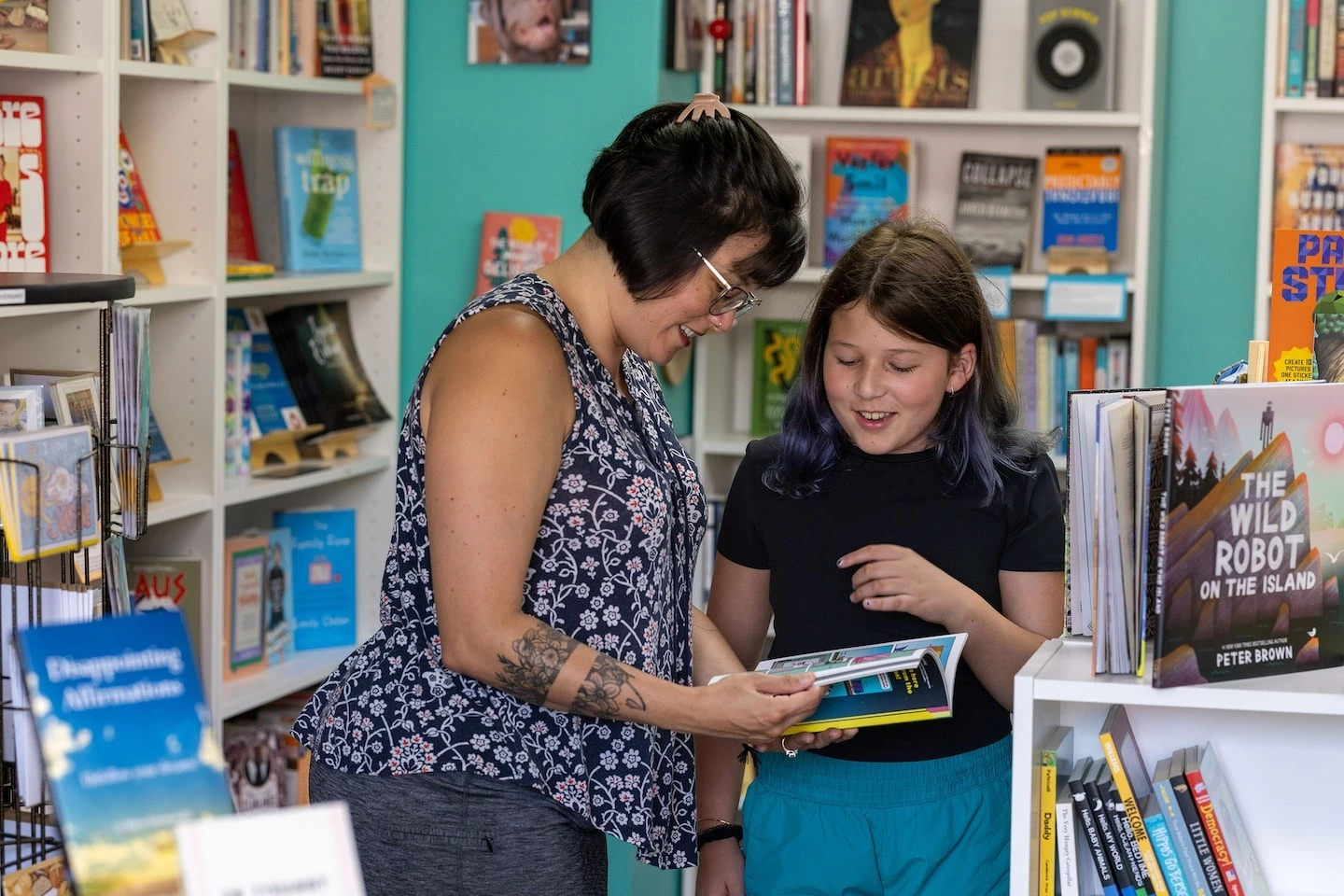
Jen Phelan and her daughter hang out at the family's bookstore. (Jay Pickthorn/For The Washington Post)
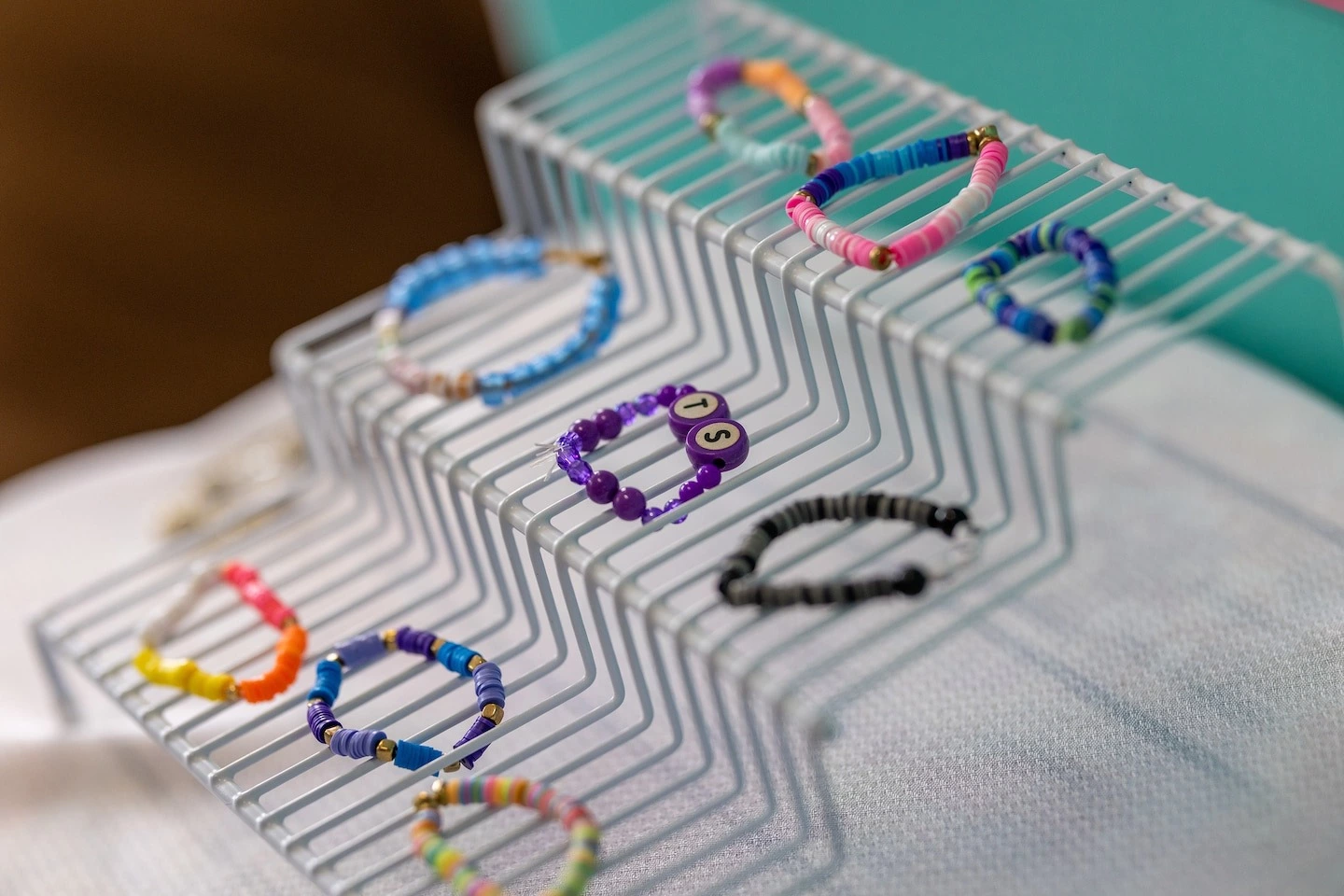
Handmade bracelets are displayed at the bookstore. (Jay Pickthorn/For The Washington Post)
Mike had tried to assure his daughter she wasn’t the reason the family was leaving South Dakota, but the 10-year-old was savvy. She knew the state had passed a measure preventing transgender young people like her from using girls’ bathrooms. And she knew that right after that law passed, her parents had said they were moving. Soon, they’d live in a New England town with explicit protections for her but none of her friends or the bookstore where she sold handmade bracelets for $5.
Mike pushed the door open. His dog, Waldo, took his place as the store’s greeter. His daughter went to the back to finish the summer homework he’d assigned, and three customers appeared.
“I hear you’re closing?” a middle-aged man in a John Deere hat said.
“Well,” Mike said. “We may have found a buyer.”
Mike knew people sometimes talked about laws that limit trans rights as if they only affect transgender people and their families. But those laws have ripple effects, he knew. Vermillion wasn’t just losing a random family. It was losing beloved community members, and if the sale didn’t work out, the town would lose its bookstore, too.
And so the town had pooled its resources. If their gambit worked, the store would soon have what Mike considered to be the ideal successors.
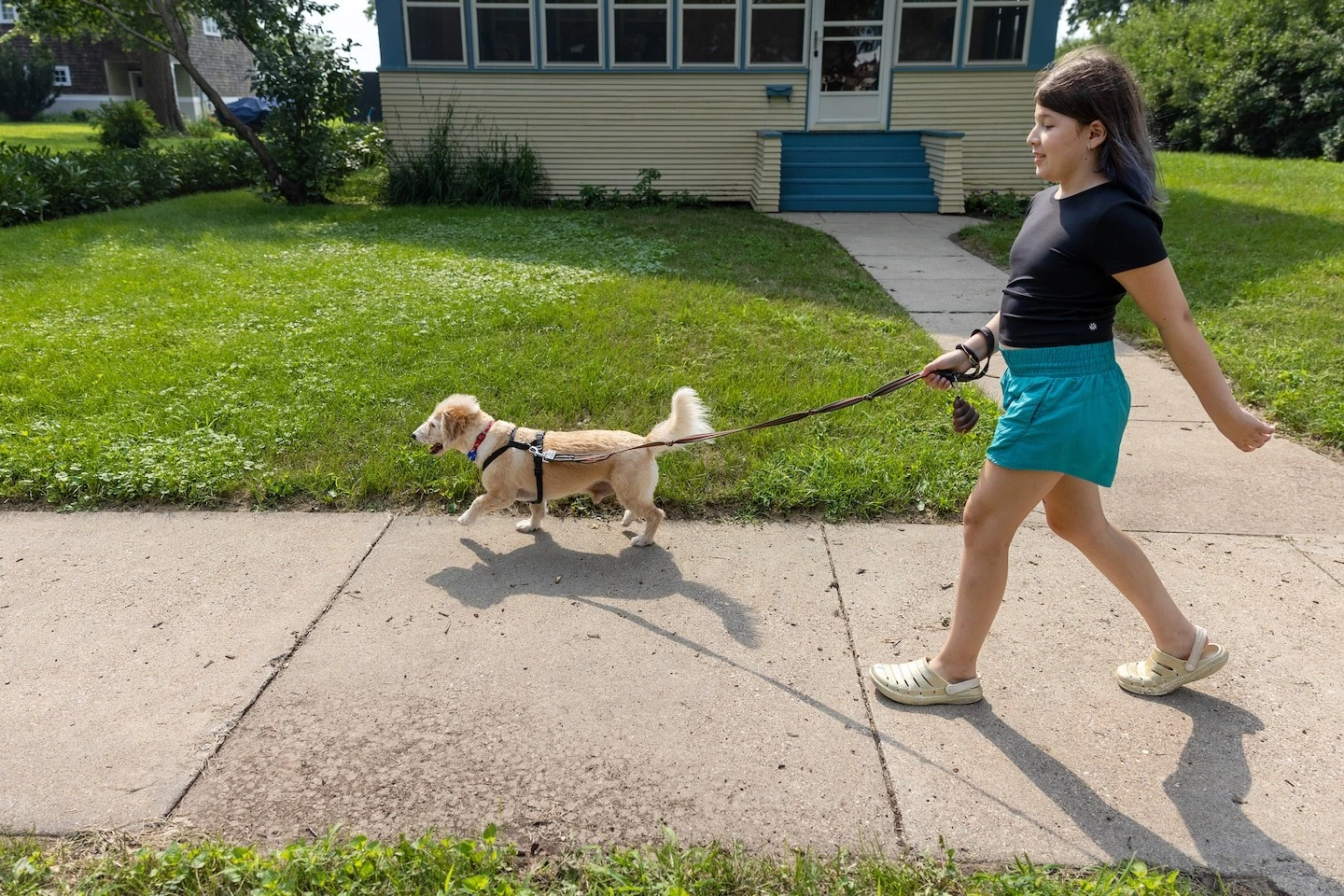
Mike and Jen Phelan's daughter walks Waldo, the family dog. (Jay Pickthorn/For The Washington Post)
Mike’s daughter told him and his wife, Jen, at 3 or 4 that she thought it was “stupid” she had to wear boy clothes. It felt “much better” when she wore dresses and other girl items. She understood that her older brother Calvin was a boy, but her heart felt like being a girl, she told them at bedtime each night.
When she started kindergarten, school leaders said she could use the nurse’s bathroom. But the other kids wondered why their classmate made such frequent trips to the nurse. For a while, the 5-year-old held her arm in the hallway and pretended it was broken, but eventually, she stopped eating and drinking at school to avoid having to go.
The next year, Mike and Jen petitioned the Vermillion School Board to let their daughter use the girls’ bathroom. The board discussed what they described as “restroom practices” at four meetings in 2021. People testified both for and against the proposal, but the board adopted a policy that allowed her to use the girls’ bathroom.
Though Vermillion is more split, South Dakota is a deeply red state. Just nine of its 105 lawmakers are Democrats, and when Vermillion passed its policy, it became the only district in the state to explicitly allow trans girls to use the girls’ bathroom.
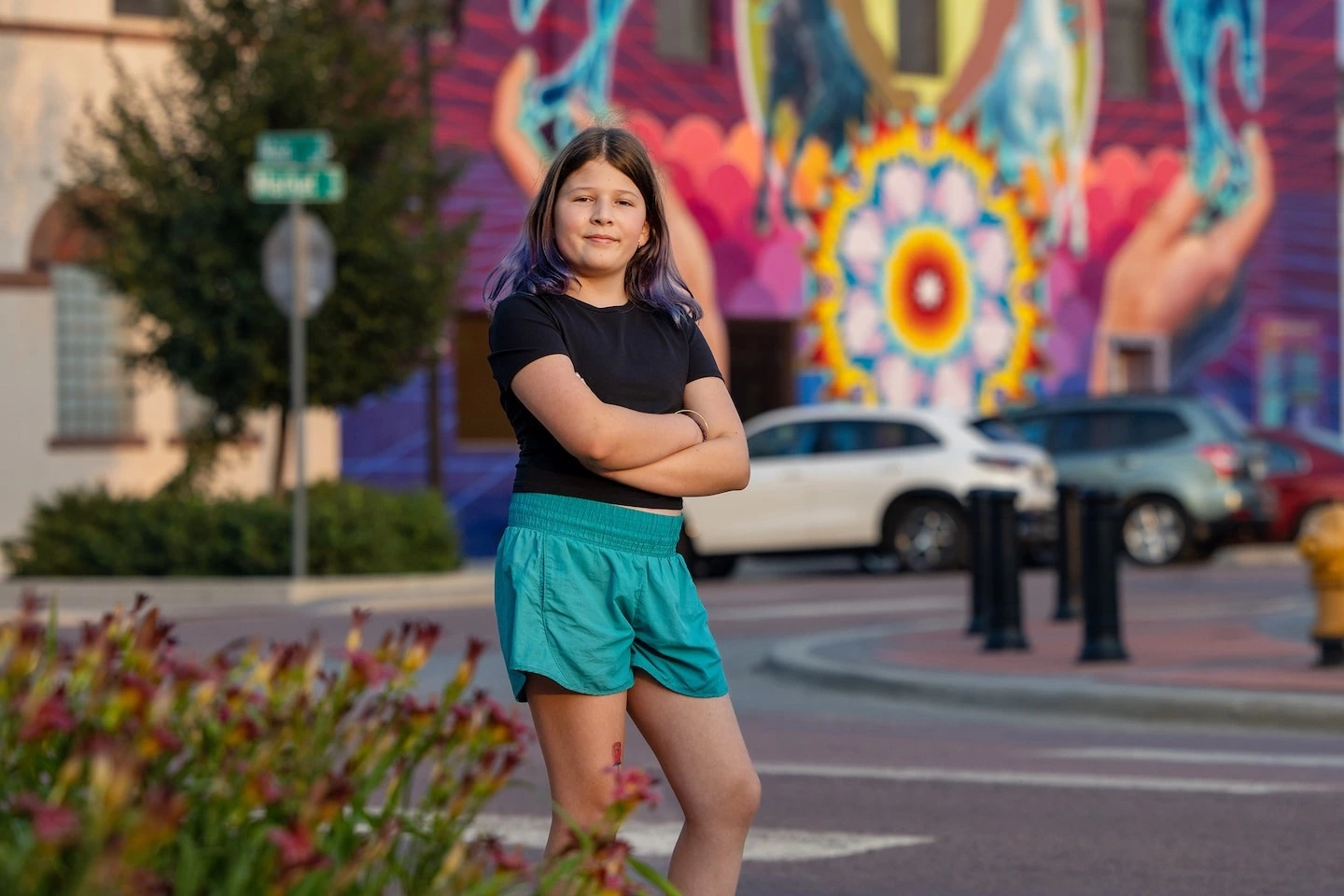
Mike and Jen Phelan's daughter in downtown Vermillion, South Dakota. (Jay Pickthorn/For The Washington Post)
Still, for some lawmakers, one was enough. The next legislative session, in early 2022, Republican state Rep. Fred Deutsch introduced a bill to ban trans girls from girls bathrooms. Deutsch argued that “biology matters,” but many of his fellow Republicans said the issue was best left to local school boards. They rejected the bill.
In the years that followed, Republicans spent hundreds of millions of dollars on ads targeting the trans community. Most Americans support restrictions for trans people, according to a February Pew Research study.
At the beginning of this year’s session, the South Dakota legislature considered another bathroom bill. This time, it passed.
The Phelans knew other families with trans kids had fled South Dakota, but they’d always hoped they wouldn’t have to. Their daughter is too young for medical interventions, and she is more interested in theater than sports, so none of the state’s other anti-trans bills had affected them. But neither Mike nor Jen could bear to force their daughter to use the boys’ bathroom, and even returning to the nurse’s office felt untenable.
And so, Jen, an audiologist, applied for jobs in states that had vowed to protect children like hers. Soon, she had a new gig and a U-Haul rental for the first weekend in August. Now, all the Phelans needed was a plan for the bookstore.
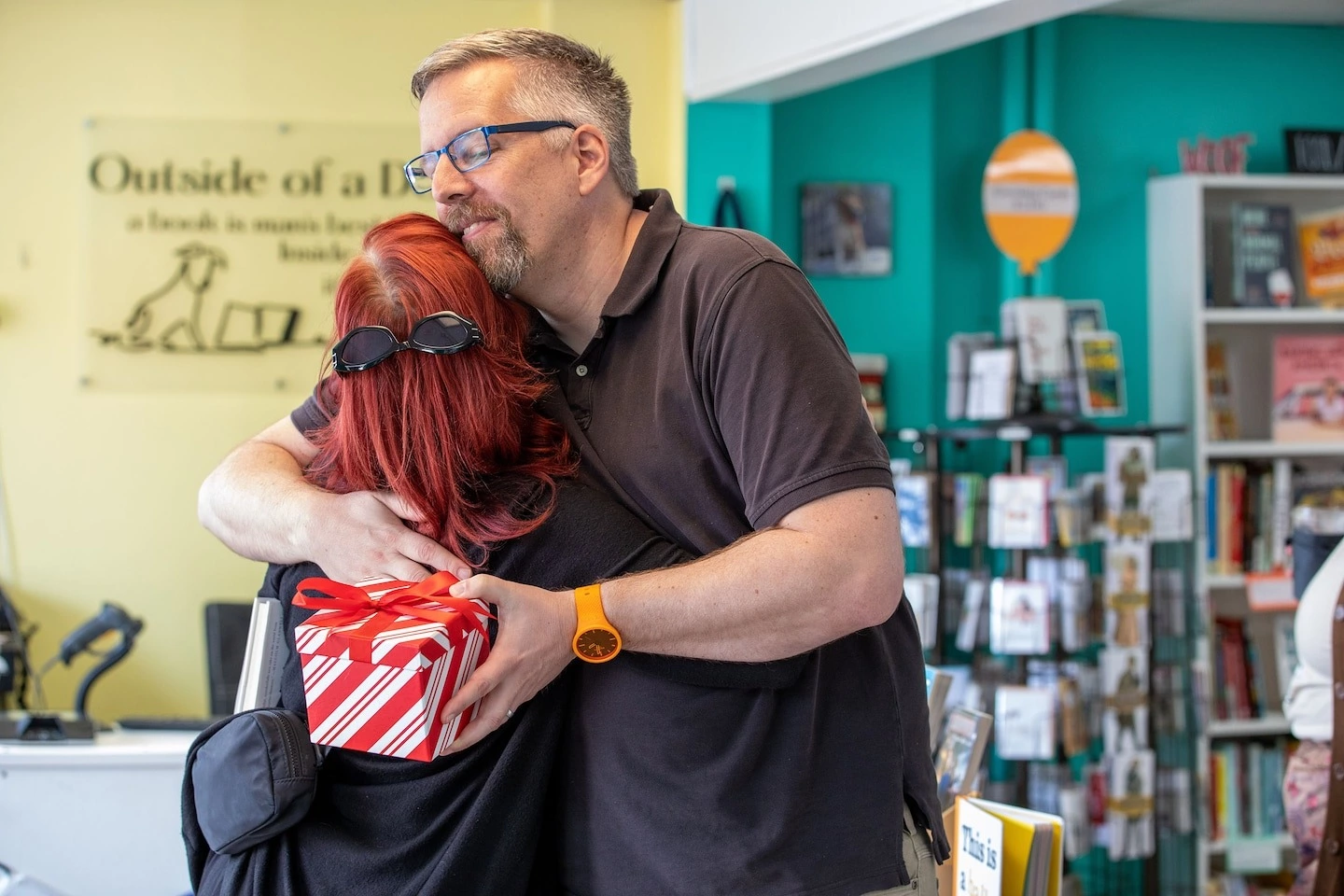
Mike Phelan embraces loyal customer and friend Mandie Weinandt at the bookstore. (Jay Pickthorn/For The Washington Post)
The day before half the family left for the East Coast, Mike’s daughter approached the counter with her math pages all worked out. She said she was bored, and he suggested she pick out a book to read.
“It’s my one and only summer!” she said. “How evil!”
Though the state’s anti-trans bills had come to dominate their life the past few years, most of the Phelans’ parenting consisted of the normal stuff — they negotiated bedtimes and dirty bedrooms, junk food intake and the best way to spend a summer. Their daughter loved Taylor Swift, and for her 10th birthday, had only requested a trip to the mall with her mom.
A bell tied to the door rang, and Mike stood. It was time to relinquish the counter. The potential new owners were here.
Nova and Elias Donstad were a young trans couple who’d met after they both moved to South Dakota for school. He was a trans man who wrote poetry. Nova was a nonbinary person who worked at the local hospital. They fell in love reading next to each other most evenings, and they fell for South Dakota the way many transplants did — accidentally. They’d come to treasure the community theater and the sandwich shop tucked into a corner of the Ace Hardware.
But as soon as Mike said he was leaving, Elias knew he didn’t want to live in a town without a bookstore. He wasn’t sure how a grad student and a nurse’s assistant could afford to buy a business, but they called Mike to ask if they could take it over. Before they’d even settled on a price, another Mike in town talked them into starting a GoFundMe so all of Vermillion could help pay for it. They raised nearly $22,000 for a down payment.
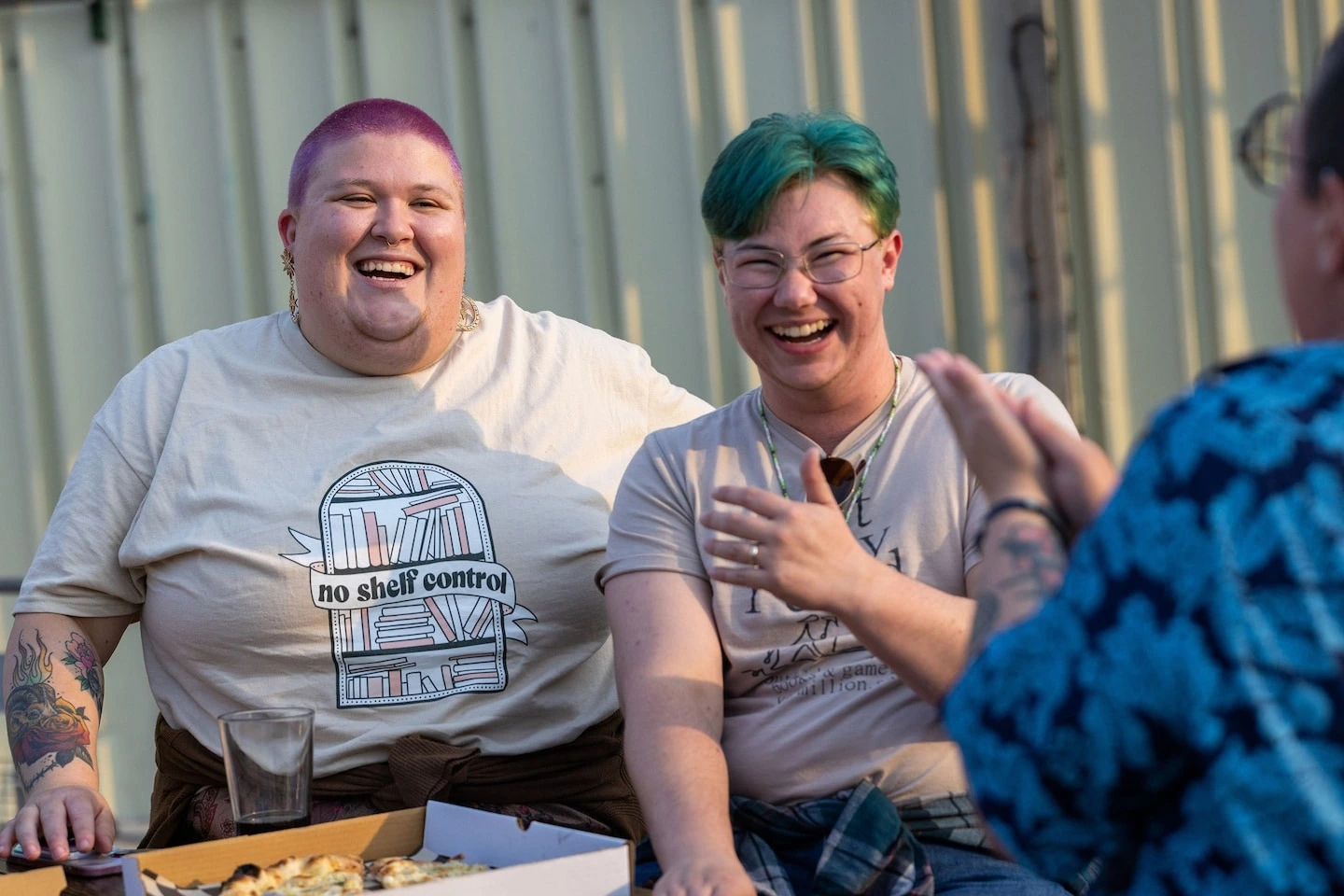
Nova and Elias Donstad talk with a friend during the Phelan family farewell party at XIX Brewing Company. (Jay Pickthorn/For The Washington Post)
Now, the sale was almost official. It was, on one hand, a dream come true for the couple, and on the other, terrifying. Mike is tall and affable, the kind of guy people might see as a family man supporting his child. Nova’s hair was buzzed and dyed pink, and Elias’s fresh cut was a shade somewhere between blue and green. They were both quiet, prone to wearing book-themed T-shirts, but they worried some might see them as outsiders.
“We look like what we are,” Nova said one afternoon. “Visibly queer.”
Mike hadn’t been sure he’d find a buyer. While he has always turned a small profit, bookstores aren’t exactly cash cows in the age of online shopping.
And yet, it was clear Vermillion wanted to keep their bookstore. That afternoon, half the town seemed to stop by to express its grief.
“I was honestly worried when you announced you were leaving that we would lose the bookstore,” a man named Daniel Milroy said.
Milroy had been the shop’s first customer. He works in the Vermillion landfill, and he met Mike when Mike was clearing out junk from the retail space. Milroy had always wished Vermillion had a bookstore, and when he heard Mike was opening one, he placed an order right there from the landfill.
“I’m sorry to see you go,” Milroy said. His voice broke, and he held out his hand.
The store was crowded, then it was quiet, and around 5 p.m., Mike turned off the lights. It was time to say goodbye to Vermillion.
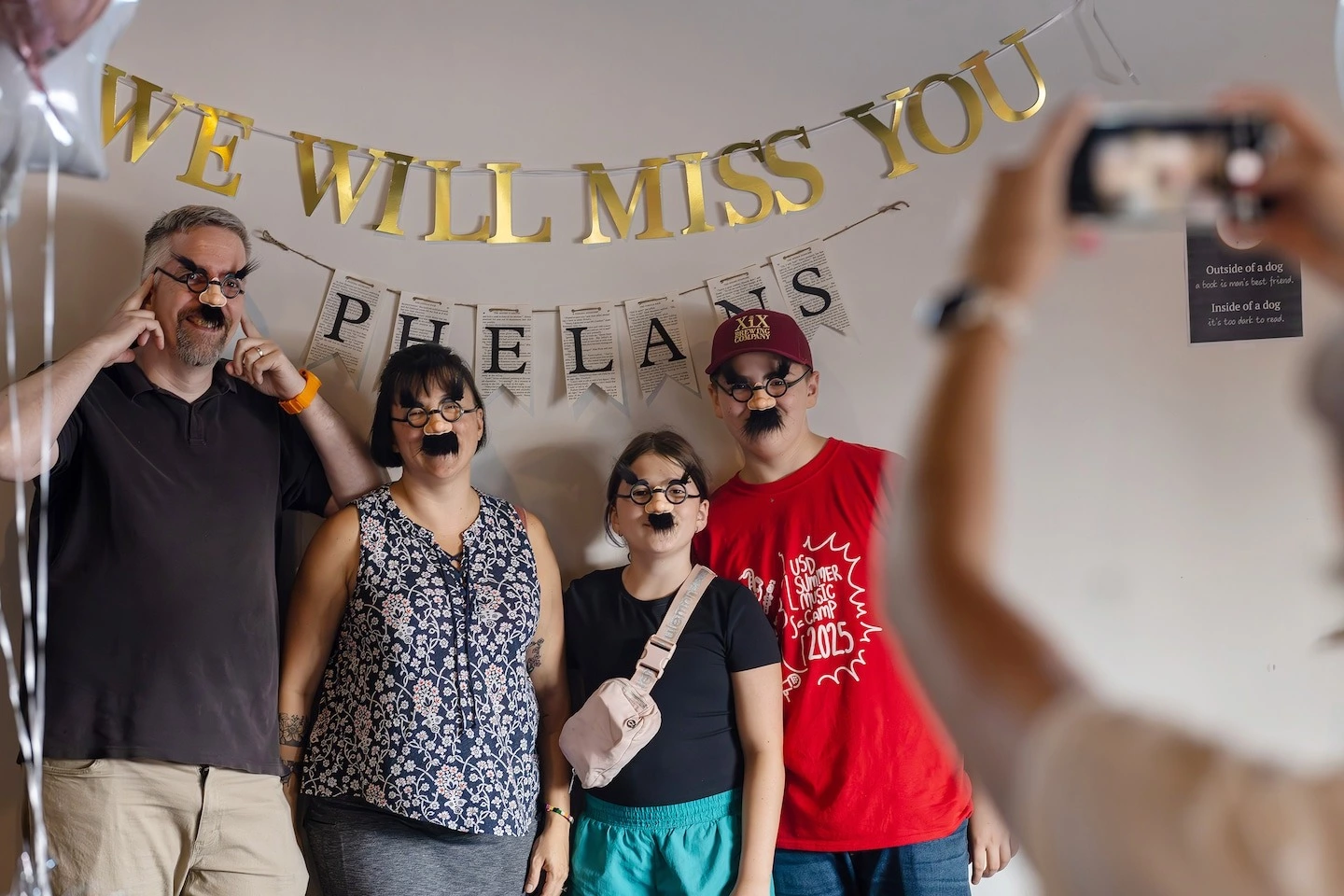
Mike and Jen Phelan wear Groucho Marx glasses while posing for a photo with their daughter and son during the Phelan family's farewell party. (Jay Pickthorn/For The Washington Post)
A group of customers had told Mike they were planning a “Phelan Pharewell” at a brewery on Main Street, and when Mike walked over, he expected he’d find maybe a small group. Only eight people attended their send-off when they left Chicago. But as soon as Mike opened the brewery door, he could see more than 100 people were there.
Many attendees didn’t seem to understand why the state government had gotten involved in an issue the town had already handled locally.
A man in his 70s pointed to the Phelans’ daughter, who was playing Old Maid with two other girls.
“What did that little girl do to hurt anybody?” he asked his wife. “Why are they going after such a small group of people?”
While guests asked Mike about his new town, a group of adults with disabilities begged Jen for selfies. Every Wednesday, she helps teach them how to dance.
“But I don’t want you to leave,” one woman said before wrapping her arms around Jen. “I want to dance with you!”
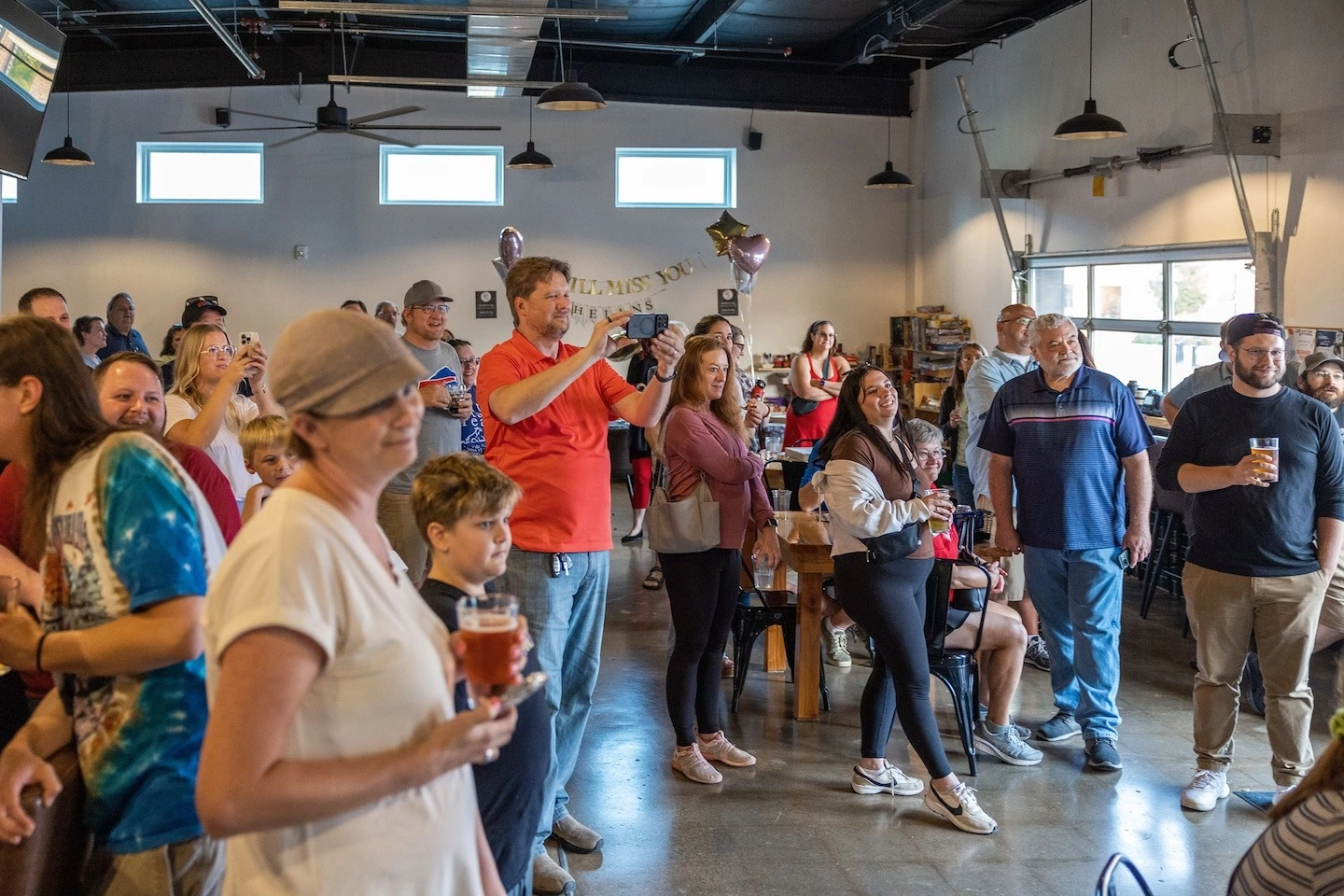
Well-wishers and friends listen as the Phelans address the crowd at their farewell party. (Jay Pickthorn/For The Washington Post)
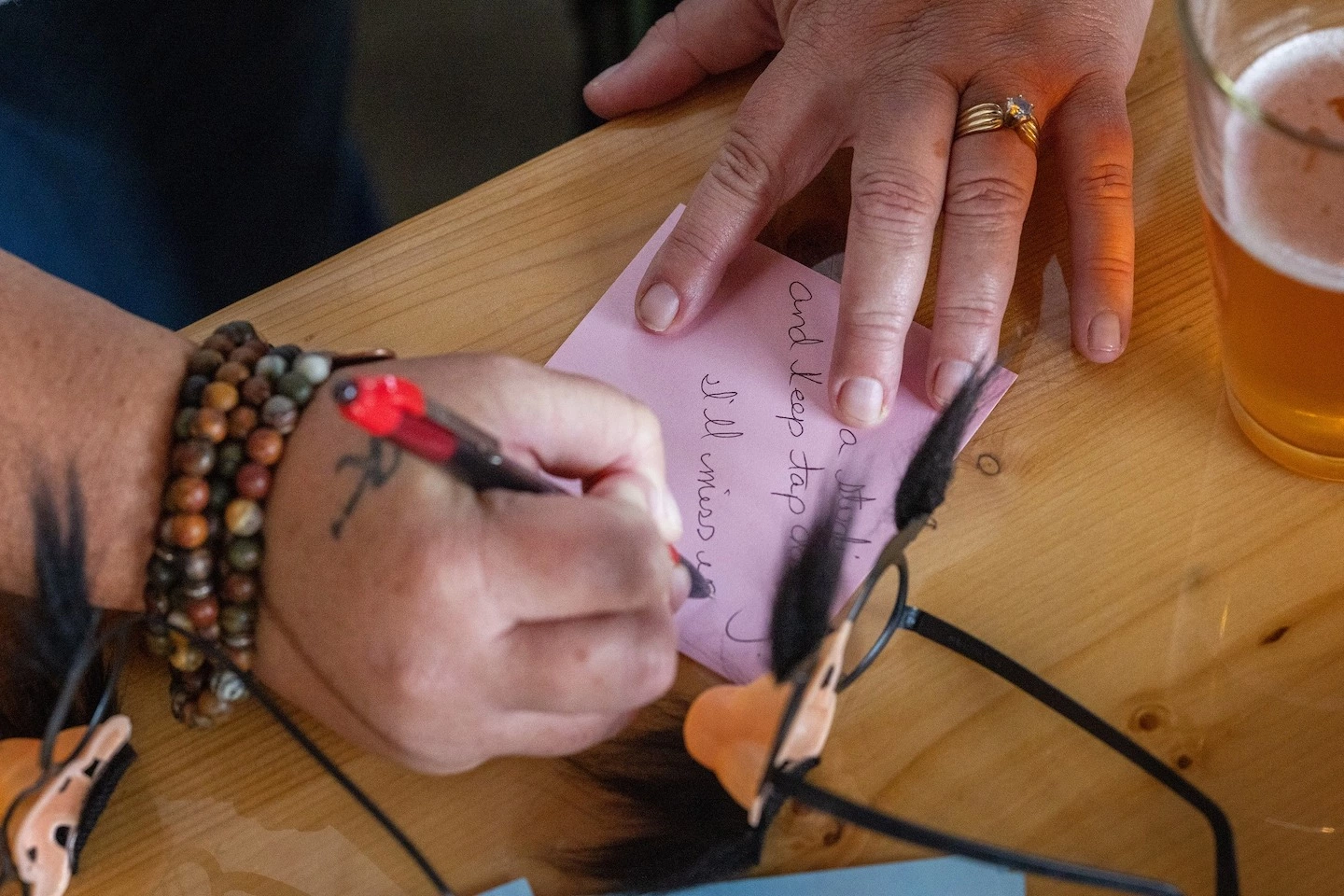
A guest writes a personal note to the Phelans. (Jay Pickthorn/For The Washington Post)
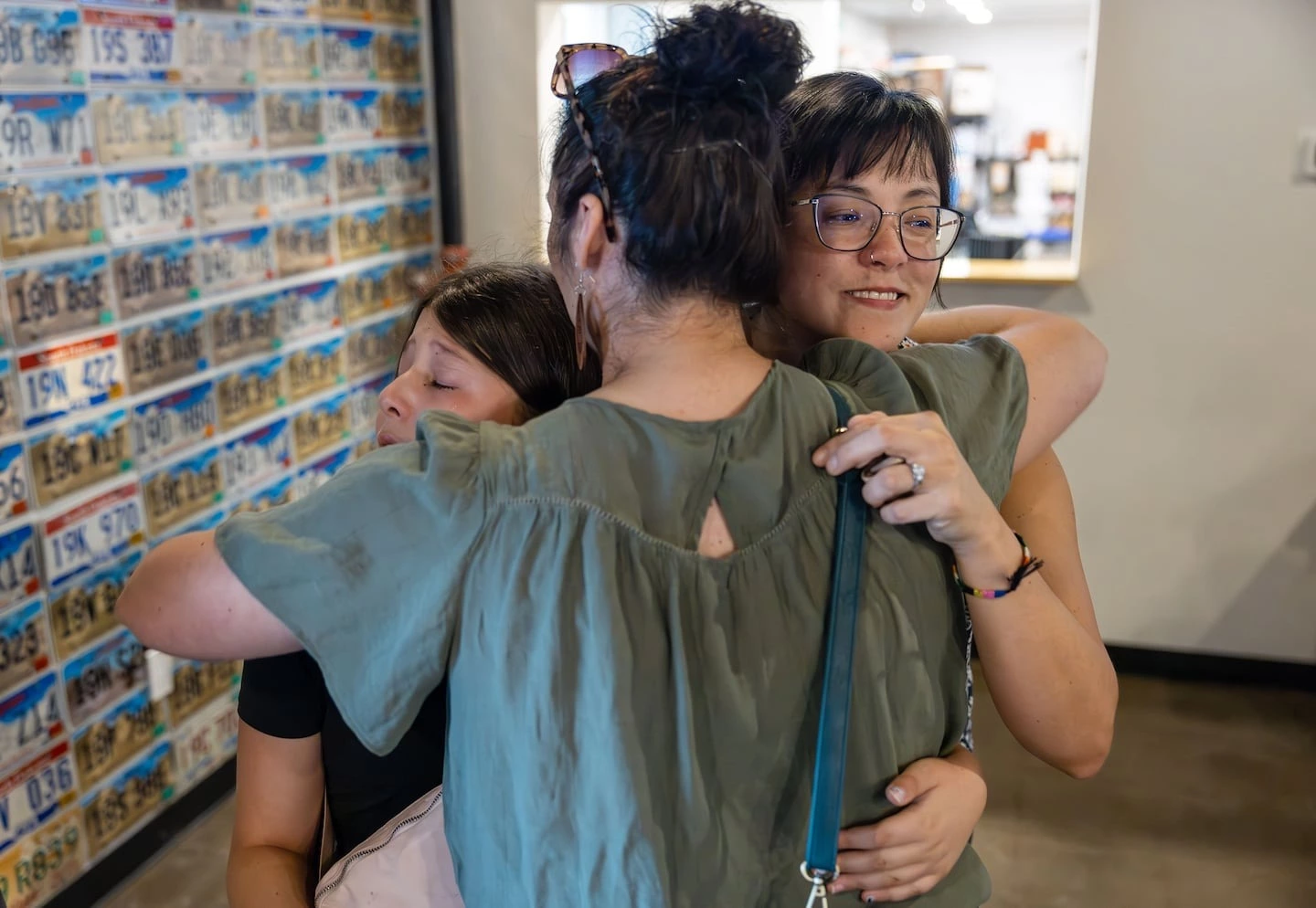
Jen Phelan and her daughter hug a well-wisher after becoming emotional. (Jay Pickthorn/For The Washington Post)
Elias and Nova hung near the back, quietly sipping root beers.
“Are you the new owners?” a Unitarian couple asked. “We will support you. We want you here.”
The party seemed like it might never end. The sun fell, and no one left, but Mike knew Jen and Calvin needed to get on the road early, so he grabbed a microphone and thanked everyone for the past few years.
“This is a nice send-off,” he said. “I’m sorry that there is an end to our time in Vermillion.”
In the future, when Mike thought about Vermillion, he knew he’d always feel it had been taken from his family too soon. But here was his daughter, surrounded by people who loved her.
Maybe some politicians didn’t want her living the life she was supposed to live, he said, but Vermillion had always felt safe. The Phelans’ children could walk downtown from their rambling two-story Victorian, and Mike and Jen never worried about them. That was a gift, wasn’t it? To belong somewhere, even if only for a few years?
“So thank you all for being a part of that,” Mike said, “for making that happen for us — and for each other, too.”
Source (Archive)
Today at 6:00 a.m. EDT
Customer Susan Tuve, left, talks with Mike Phelan and Nova Donstad at the Outside of a Dog bookstore in Vermillion, South Dakota. (Jay Pickthorn/For The Washington Post)
VERMILLION, S.D. — Their time in this small Midwestern town was nearly over, but for now, Mike Phelan still had a business to run, so he and his daughter leashed their dog and headed up the street.
The commute took three minutes. The Phelans passed sprawling Victorian houses with wraparound porches, then, Mike pulled out his keys. When they moved here from Chicago five years ago, Mike discovered Vermillion had a university, locally made bread Oprah Magazine once declared the best in the world, and an author who’d won the National Book Award. But Vermillion didn’t have a bookstore. No university town should exist without a place to buy novels and new nonfiction, Mike thought, so he’d opened one and named it “Outside of a Dog” after a Groucho Marx quote — “Outside of a dog, a book is man’s best friend.”
Mike twisted the key and looked down Main Street. Nearly all of downtown’s quaint brick storefronts had Pride flags in their windows. He’d once dreaded moving to a red state, but Vermillion had surprised him. He wanted to stay here for the rest of his life. But in the morning, his wife and son would head east with a trailer, and soon, Mike and his daughter, whom The Washington Post is not naming to protect her, would follow with a truck.
Jen Phelan and her daughter hang out at the family's bookstore. (Jay Pickthorn/For The Washington Post)
Handmade bracelets are displayed at the bookstore. (Jay Pickthorn/For The Washington Post)
Mike had tried to assure his daughter she wasn’t the reason the family was leaving South Dakota, but the 10-year-old was savvy. She knew the state had passed a measure preventing transgender young people like her from using girls’ bathrooms. And she knew that right after that law passed, her parents had said they were moving. Soon, they’d live in a New England town with explicit protections for her but none of her friends or the bookstore where she sold handmade bracelets for $5.
Mike pushed the door open. His dog, Waldo, took his place as the store’s greeter. His daughter went to the back to finish the summer homework he’d assigned, and three customers appeared.
“I hear you’re closing?” a middle-aged man in a John Deere hat said.
“Well,” Mike said. “We may have found a buyer.”
Mike knew people sometimes talked about laws that limit trans rights as if they only affect transgender people and their families. But those laws have ripple effects, he knew. Vermillion wasn’t just losing a random family. It was losing beloved community members, and if the sale didn’t work out, the town would lose its bookstore, too.
And so the town had pooled its resources. If their gambit worked, the store would soon have what Mike considered to be the ideal successors.
Mike and Jen Phelan's daughter walks Waldo, the family dog. (Jay Pickthorn/For The Washington Post)
Mike’s daughter told him and his wife, Jen, at 3 or 4 that she thought it was “stupid” she had to wear boy clothes. It felt “much better” when she wore dresses and other girl items. She understood that her older brother Calvin was a boy, but her heart felt like being a girl, she told them at bedtime each night.
When she started kindergarten, school leaders said she could use the nurse’s bathroom. But the other kids wondered why their classmate made such frequent trips to the nurse. For a while, the 5-year-old held her arm in the hallway and pretended it was broken, but eventually, she stopped eating and drinking at school to avoid having to go.
The next year, Mike and Jen petitioned the Vermillion School Board to let their daughter use the girls’ bathroom. The board discussed what they described as “restroom practices” at four meetings in 2021. People testified both for and against the proposal, but the board adopted a policy that allowed her to use the girls’ bathroom.
Though Vermillion is more split, South Dakota is a deeply red state. Just nine of its 105 lawmakers are Democrats, and when Vermillion passed its policy, it became the only district in the state to explicitly allow trans girls to use the girls’ bathroom.
Mike and Jen Phelan's daughter in downtown Vermillion, South Dakota. (Jay Pickthorn/For The Washington Post)
Still, for some lawmakers, one was enough. The next legislative session, in early 2022, Republican state Rep. Fred Deutsch introduced a bill to ban trans girls from girls bathrooms. Deutsch argued that “biology matters,” but many of his fellow Republicans said the issue was best left to local school boards. They rejected the bill.
In the years that followed, Republicans spent hundreds of millions of dollars on ads targeting the trans community. Most Americans support restrictions for trans people, according to a February Pew Research study.
At the beginning of this year’s session, the South Dakota legislature considered another bathroom bill. This time, it passed.
The Phelans knew other families with trans kids had fled South Dakota, but they’d always hoped they wouldn’t have to. Their daughter is too young for medical interventions, and she is more interested in theater than sports, so none of the state’s other anti-trans bills had affected them. But neither Mike nor Jen could bear to force their daughter to use the boys’ bathroom, and even returning to the nurse’s office felt untenable.
And so, Jen, an audiologist, applied for jobs in states that had vowed to protect children like hers. Soon, she had a new gig and a U-Haul rental for the first weekend in August. Now, all the Phelans needed was a plan for the bookstore.
Mike Phelan embraces loyal customer and friend Mandie Weinandt at the bookstore. (Jay Pickthorn/For The Washington Post)
The day before half the family left for the East Coast, Mike’s daughter approached the counter with her math pages all worked out. She said she was bored, and he suggested she pick out a book to read.
“It’s my one and only summer!” she said. “How evil!”
Though the state’s anti-trans bills had come to dominate their life the past few years, most of the Phelans’ parenting consisted of the normal stuff — they negotiated bedtimes and dirty bedrooms, junk food intake and the best way to spend a summer. Their daughter loved Taylor Swift, and for her 10th birthday, had only requested a trip to the mall with her mom.
A bell tied to the door rang, and Mike stood. It was time to relinquish the counter. The potential new owners were here.
Nova and Elias Donstad were a young trans couple who’d met after they both moved to South Dakota for school. He was a trans man who wrote poetry. Nova was a nonbinary person who worked at the local hospital. They fell in love reading next to each other most evenings, and they fell for South Dakota the way many transplants did — accidentally. They’d come to treasure the community theater and the sandwich shop tucked into a corner of the Ace Hardware.
But as soon as Mike said he was leaving, Elias knew he didn’t want to live in a town without a bookstore. He wasn’t sure how a grad student and a nurse’s assistant could afford to buy a business, but they called Mike to ask if they could take it over. Before they’d even settled on a price, another Mike in town talked them into starting a GoFundMe so all of Vermillion could help pay for it. They raised nearly $22,000 for a down payment.
Nova and Elias Donstad talk with a friend during the Phelan family farewell party at XIX Brewing Company. (Jay Pickthorn/For The Washington Post)
Now, the sale was almost official. It was, on one hand, a dream come true for the couple, and on the other, terrifying. Mike is tall and affable, the kind of guy people might see as a family man supporting his child. Nova’s hair was buzzed and dyed pink, and Elias’s fresh cut was a shade somewhere between blue and green. They were both quiet, prone to wearing book-themed T-shirts, but they worried some might see them as outsiders.
“We look like what we are,” Nova said one afternoon. “Visibly queer.”
Mike hadn’t been sure he’d find a buyer. While he has always turned a small profit, bookstores aren’t exactly cash cows in the age of online shopping.
And yet, it was clear Vermillion wanted to keep their bookstore. That afternoon, half the town seemed to stop by to express its grief.
“I was honestly worried when you announced you were leaving that we would lose the bookstore,” a man named Daniel Milroy said.
Milroy had been the shop’s first customer. He works in the Vermillion landfill, and he met Mike when Mike was clearing out junk from the retail space. Milroy had always wished Vermillion had a bookstore, and when he heard Mike was opening one, he placed an order right there from the landfill.
“I’m sorry to see you go,” Milroy said. His voice broke, and he held out his hand.
The store was crowded, then it was quiet, and around 5 p.m., Mike turned off the lights. It was time to say goodbye to Vermillion.
Mike and Jen Phelan wear Groucho Marx glasses while posing for a photo with their daughter and son during the Phelan family's farewell party. (Jay Pickthorn/For The Washington Post)
A group of customers had told Mike they were planning a “Phelan Pharewell” at a brewery on Main Street, and when Mike walked over, he expected he’d find maybe a small group. Only eight people attended their send-off when they left Chicago. But as soon as Mike opened the brewery door, he could see more than 100 people were there.
Many attendees didn’t seem to understand why the state government had gotten involved in an issue the town had already handled locally.
A man in his 70s pointed to the Phelans’ daughter, who was playing Old Maid with two other girls.
“What did that little girl do to hurt anybody?” he asked his wife. “Why are they going after such a small group of people?”
While guests asked Mike about his new town, a group of adults with disabilities begged Jen for selfies. Every Wednesday, she helps teach them how to dance.
“But I don’t want you to leave,” one woman said before wrapping her arms around Jen. “I want to dance with you!”
Well-wishers and friends listen as the Phelans address the crowd at their farewell party. (Jay Pickthorn/For The Washington Post)
A guest writes a personal note to the Phelans. (Jay Pickthorn/For The Washington Post)
Jen Phelan and her daughter hug a well-wisher after becoming emotional. (Jay Pickthorn/For The Washington Post)
Elias and Nova hung near the back, quietly sipping root beers.
“Are you the new owners?” a Unitarian couple asked. “We will support you. We want you here.”
The party seemed like it might never end. The sun fell, and no one left, but Mike knew Jen and Calvin needed to get on the road early, so he grabbed a microphone and thanked everyone for the past few years.
“This is a nice send-off,” he said. “I’m sorry that there is an end to our time in Vermillion.”
In the future, when Mike thought about Vermillion, he knew he’d always feel it had been taken from his family too soon. But here was his daughter, surrounded by people who loved her.
Maybe some politicians didn’t want her living the life she was supposed to live, he said, but Vermillion had always felt safe. The Phelans’ children could walk downtown from their rambling two-story Victorian, and Mike and Jen never worried about them. That was a gift, wasn’t it? To belong somewhere, even if only for a few years?
“So thank you all for being a part of that,” Mike said, “for making that happen for us — and for each other, too.”
Source (Archive)

 )
)


