L A
By Joyce Jiang, CNN
Published 9:27 PM EDT, Sun August 18, 2024

David Pollack/Corbis/Getty Images
A 1980s-era poster in China reads: "To rejuvenate the nation, control the population growth."
CNN
—
“What are your parents’ names?”
Fang, then a third grader, hemmed and hawed at the simple question as her teacher waited impatiently, unaware the 9-year-old was caught in a dilemma.
Since preschool, Fang had been officially registered as the daughter of her eldest uncle – an attempt by her birth parents to circumvent harsh penalties for having a second baby under China’s controversial one-child policy that was enforced from 1980 to 2015.
“I really had no idea which parents I was supposed to name,” Fang told CNN years later, using a pseudonym for privacy reasons.
Since then, Beijing has gradually lifted the birth caps from one to two children, then to three in 2021, in a bid to arrest a looming demographic crisis.
The one-child rules have gone, but the wounds of the past cast long shadows. A new generation of women like Fang, haunted by their parents’ struggles and their own sacrifices as children under the one-child policy, now eye parenthood with reluctance – making Beijing’s current pro-birth push a tough sell.
Fang was born in the 1990s – when the one-child limit was at its strictest – and became a big sister just a year later, when her mother “illegally” became pregnant again. To avoid punishment, the family sent Fang to live with extended family members, while her mother pretended her second pregnancy was her first.
Fang, now 30 and married, doesn’t want children at all.
“All the fears, drifts and insecurity felt throughout my own childhood have, more or less, played a part in my current call,” she said.
Sacrifices of eldest daughters
Keeping their firstborn secret spared Fang’s parents ruinous fines, job loss and even forced abortion and sterilization – the heavy price for having an “unauthorized” second child, another daughter.
Fang was finally allowed to return home at age 10 – but was still registered as her eldest uncle’s daughter and told to “stick with her official registration” whenever she was asked about her parents.
After the one-child policy was dismantled in 2015, Fang’s parents tried for another child. Fang sensed their unstated wish for a son, but her mother gave birth to a girl – her third.
Over 30 years of China’s one-child policy, an estimated 20 million baby girls “disappeared” due to sex-selective abortions or infanticide, according to Li Shuzhuo, director of the Center for Population and Social Policy Research at China’s Xi’an Jiaotong University.
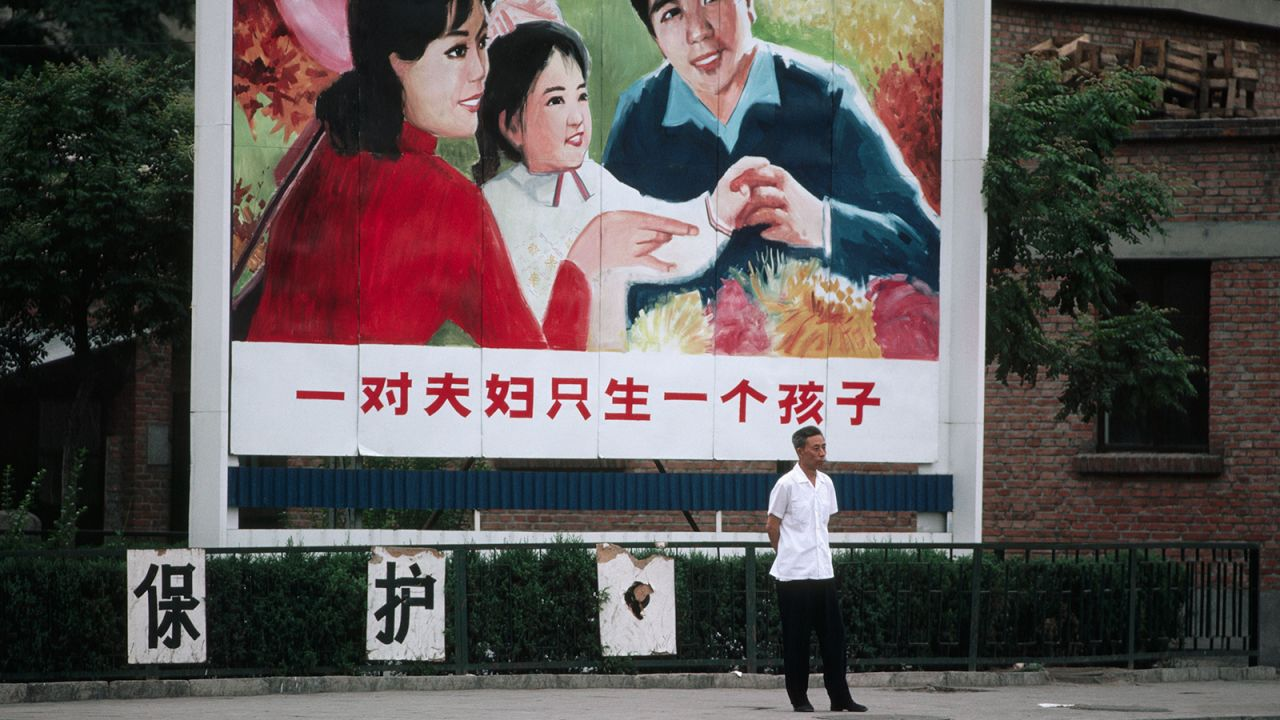
Bettmann/Getty Images
A billboard encourages Chinese couples to have only one child in Beijing on January 1, 1983.
Twenty-five-year-old Yao, the eldest of three siblings, shared a similar childhood marred by the policy and asked CNN to use only her surname for privacy reasons.
She was born in a rural village in northeastern Shandong, one of the 19 provinces that allowed rural couples to have a second child – if their first was a girl – during the single child policy’s reign.
This “one-and-a-half child policy” variant, introduced in 1984, reinforced the traditional Chinese preference for sons by implying that girls were worth “half” as much as boys, as noted in a leading Chinese academic study published last year.
Yao’s first sibling was a girl – allowed under the policy – but then her mother fell pregnant with a third child – a forbidden one – and soon fled to another village with Yao’s sister, leaving Yao in the care of her grandparents.
Yao said her mother was forced to keep her pregnancy secret to avoid a potential forced abortion. But after the “extra baby” arrived, she sought to officially register him as her son – and paid a crushing fine of 50,000 yuan (about $7,000).
For Yao, it meant losing her mother’s companionship for nearly a year when she moved out to carry her son to term.
“I was only a first grader then and had no one to walk me to and from school,” Yao recalled.
“I felt all alone at that time.”
CNN is unable to independently verify Fang’s and Yao’s accounts.
From one to three – or none?
Since the shift to a three-child policy in 2021, Beijing has been running national campaigns to foster a “pro-birth culture” as China’s population shrinks and grays at an alarming rate.
Posters and slogans once warning of the perils of having more than one child have been replaced with ones encouraging more births. Local governments have rolled out a flurry of policy incentives, from cash handouts and real estate subsidies to the extension of maternity leave.
The policy U-turn, from birth limits to birth boost, has left Yao “speechless.”
“How ‘well-planned’ the family-planning policy is!” Yao mocked. “(The government) used to slap us for having two (babies) and now expects us to have three?”
Fang said she was “somewhat nettled” by Beijing’s initiatives to spur births, arguing: “Having kids or not is purely a woman’s personal choice, not out of any policy, be it a stick or a carrot.”
In May, China’s National Health Commission issued a dozen “birth-friendly theme posters” to local bureaus, calling for a “widespread dissemination” from social media to community parks.
The move was met with wry comments online, referencing past one-child slogans like “Fewer kids, happier lives,” and, “If you want to be rich, have fewer children and plant more trees.”
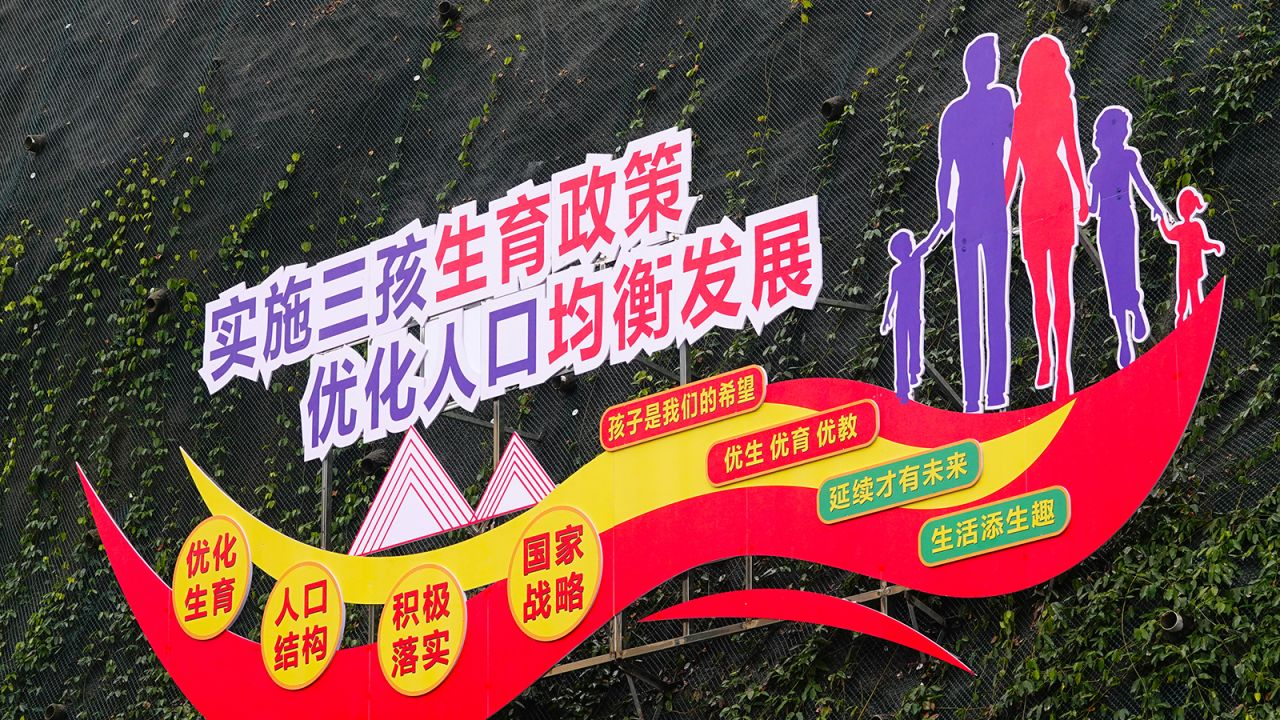
CFOTO/Future Publishing/Getty Images
A billboard says, "Implement three-child policy and optimize population growth" in Yichang, Hubei province of China, on January 17, 2024.
These chants are not just recounted for ridicule – people have found new resonance with the ruling Chinese Communist Party’s old teachings and are now acting on them earnestly.
Last year, the country’s total fertility rate (TFR) – meaning the average number of children a woman delivers during her reproductive years – stood at around 1.0, according to the 2024 China Birth Report from the YuWa Population Research Institute, a China-based think tank.
That’s far lower than the 2.1 rate needed to maintain a stable population, or the “replacement rate” in demographic terms, and ranks as the second lowest among the world’s major economies.
The birth deficit is even grimmer in China’s richest city, Shanghai, where roughly half of all women do not have children throughout their reproductive periods, based on the city’s 2023 TFR figure (0.6) announced in May.
Rock kicked off cliff
Yi Fuxian, an expert on China’s demographics at the University of Wisconsin, says the country faces three major obstacles to reversing its shrinking population: low fertility desire, high child-raising costs and a climbing infertility rate.
Of these, “the sole challenge Beijing has any capacity to impact is the affordability issue,” Yi said.
Last month, the Communist Party proposed boosting incentives, including childbirth subsidies and more affordable childcare, at a key meeting of party leaders.
Yet, debt-stricken local governments – including many that are struggling to recover from three years of strict pandemic controls and a loss of revenue from a real estate crash – can only carry them out on a shoestring budget, dooming the party’s birth boost attempt, according to Yi.
Chinese state-run media outlet Jiemian reported in early June that the highest childcare subsidies nationwide amount to only 57,800 yuan (about $8,000) – a drop in the bucket for one of the world’s priciest countries to raise kids.
The cost of raising a child to age 18 in China is 6.3 times its gross domestic product (GDP) per capita - second only to its neighbor South Korea at 7.79 times, according to a YuWa report.
The hefty price tag means some people are putting off parenthood until later in life, when their fertility and openness to child-rearing might be on the wane.
“China has fallen into a ‘low-fertility trap’ and the figure will only dip further,” warned Yi.
A “low fertility trap” describes a self-reinforcing cycle, where low fertility rates (typically under 1.5) drive population aging and economic stagnation – which further deter childbearing and sink the figure even lower.
“China’s fertility rate should have been falling naturally as its economy advances, like a giant rock gradually rolling down along a hillside,” Yi said. “But the one-child policy kicked the rock right down the cliff – it’s extremely hard to lift the rock back now.”
‘State violence’
Online discussions in China about childbirth decisions are often dominated by economic concerns, but some have also thrown shade at the country’s one-child policy by sharing decades-old receipts for over-quota birth fines on Xiaohongshu, China’s version of Instagram.
“Childbearing isn’t just a financial matter,” said Lü Pin, a prominent Chinese feminist.
“Coercive family planning, as a form of state violence, has scarred women deeply … and people just haven’t got over it yet,” added Lü, who’s pursuing a doctorate in women and politics at Rutgers University in the United States.

Stringer/AFP/Getty Images
People pose next to a newly renovated statue with two more kids added to the original one-child family design in Hankou Park, Wuhan, in China's Hubei province on January 5, 2024.
Forced abortion and sterilization, arguably the most ghoulish facet of China’s one-child “social engineering,” have left an indelible mark on hundreds of millions of Chinese women, physically and mentally.
According to state-owned news outlet The Paper, between 1980 and 2014, 324 million Chinese women were fitted with intrauterine devices (IUDs) and 107 million underwent tubal ligations to prevent pregnancy.
Decades after the one-child policy’s introduction in 1980, those contraceptive devices – only meant to remain in women’s bodies for five to 20 years – have long outlived their safe stay.
But family planning officials, who once had performance targets to push women to fit IUDs after having their first child, now lack similar incentives to remove those devices in a timely manner, demographer Sun Xiaoming told The Beijing News, a state-linked newspaper.
“The government has stretched its hands far enough – even into common folks’ bodies!” Yi said.
Lü added that Beijing had not conducted any “open self-reflection, nor even admission (of the state-inflicted trauma).”
“Now it expects women to forget all this and embrace its lurch to birth boost? Fat chance.”
CNN’s Jessie Yeung, Nectar Gan and Simone McCarthy contributed to this story.
By Joyce Jiang, CNN
Published 9:27 PM EDT, Sun August 18, 2024
David Pollack/Corbis/Getty Images
A 1980s-era poster in China reads: "To rejuvenate the nation, control the population growth."
CNN
—
“What are your parents’ names?”
Fang, then a third grader, hemmed and hawed at the simple question as her teacher waited impatiently, unaware the 9-year-old was caught in a dilemma.
Since preschool, Fang had been officially registered as the daughter of her eldest uncle – an attempt by her birth parents to circumvent harsh penalties for having a second baby under China’s controversial one-child policy that was enforced from 1980 to 2015.
“I really had no idea which parents I was supposed to name,” Fang told CNN years later, using a pseudonym for privacy reasons.
Since then, Beijing has gradually lifted the birth caps from one to two children, then to three in 2021, in a bid to arrest a looming demographic crisis.
The one-child rules have gone, but the wounds of the past cast long shadows. A new generation of women like Fang, haunted by their parents’ struggles and their own sacrifices as children under the one-child policy, now eye parenthood with reluctance – making Beijing’s current pro-birth push a tough sell.
Fang was born in the 1990s – when the one-child limit was at its strictest – and became a big sister just a year later, when her mother “illegally” became pregnant again. To avoid punishment, the family sent Fang to live with extended family members, while her mother pretended her second pregnancy was her first.
Fang, now 30 and married, doesn’t want children at all.
“All the fears, drifts and insecurity felt throughout my own childhood have, more or less, played a part in my current call,” she said.
Sacrifices of eldest daughters
Keeping their firstborn secret spared Fang’s parents ruinous fines, job loss and even forced abortion and sterilization – the heavy price for having an “unauthorized” second child, another daughter.
Fang was finally allowed to return home at age 10 – but was still registered as her eldest uncle’s daughter and told to “stick with her official registration” whenever she was asked about her parents.
After the one-child policy was dismantled in 2015, Fang’s parents tried for another child. Fang sensed their unstated wish for a son, but her mother gave birth to a girl – her third.
Over 30 years of China’s one-child policy, an estimated 20 million baby girls “disappeared” due to sex-selective abortions or infanticide, according to Li Shuzhuo, director of the Center for Population and Social Policy Research at China’s Xi’an Jiaotong University.
Bettmann/Getty Images
A billboard encourages Chinese couples to have only one child in Beijing on January 1, 1983.
Twenty-five-year-old Yao, the eldest of three siblings, shared a similar childhood marred by the policy and asked CNN to use only her surname for privacy reasons.
She was born in a rural village in northeastern Shandong, one of the 19 provinces that allowed rural couples to have a second child – if their first was a girl – during the single child policy’s reign.
This “one-and-a-half child policy” variant, introduced in 1984, reinforced the traditional Chinese preference for sons by implying that girls were worth “half” as much as boys, as noted in a leading Chinese academic study published last year.
Yao’s first sibling was a girl – allowed under the policy – but then her mother fell pregnant with a third child – a forbidden one – and soon fled to another village with Yao’s sister, leaving Yao in the care of her grandparents.
Yao said her mother was forced to keep her pregnancy secret to avoid a potential forced abortion. But after the “extra baby” arrived, she sought to officially register him as her son – and paid a crushing fine of 50,000 yuan (about $7,000).
For Yao, it meant losing her mother’s companionship for nearly a year when she moved out to carry her son to term.
“I was only a first grader then and had no one to walk me to and from school,” Yao recalled.
“I felt all alone at that time.”
CNN is unable to independently verify Fang’s and Yao’s accounts.
From one to three – or none?
Since the shift to a three-child policy in 2021, Beijing has been running national campaigns to foster a “pro-birth culture” as China’s population shrinks and grays at an alarming rate.
Posters and slogans once warning of the perils of having more than one child have been replaced with ones encouraging more births. Local governments have rolled out a flurry of policy incentives, from cash handouts and real estate subsidies to the extension of maternity leave.
The policy U-turn, from birth limits to birth boost, has left Yao “speechless.”
“How ‘well-planned’ the family-planning policy is!” Yao mocked. “(The government) used to slap us for having two (babies) and now expects us to have three?”
Fang said she was “somewhat nettled” by Beijing’s initiatives to spur births, arguing: “Having kids or not is purely a woman’s personal choice, not out of any policy, be it a stick or a carrot.”
In May, China’s National Health Commission issued a dozen “birth-friendly theme posters” to local bureaus, calling for a “widespread dissemination” from social media to community parks.
The move was met with wry comments online, referencing past one-child slogans like “Fewer kids, happier lives,” and, “If you want to be rich, have fewer children and plant more trees.”
CFOTO/Future Publishing/Getty Images
A billboard says, "Implement three-child policy and optimize population growth" in Yichang, Hubei province of China, on January 17, 2024.
These chants are not just recounted for ridicule – people have found new resonance with the ruling Chinese Communist Party’s old teachings and are now acting on them earnestly.
Last year, the country’s total fertility rate (TFR) – meaning the average number of children a woman delivers during her reproductive years – stood at around 1.0, according to the 2024 China Birth Report from the YuWa Population Research Institute, a China-based think tank.
That’s far lower than the 2.1 rate needed to maintain a stable population, or the “replacement rate” in demographic terms, and ranks as the second lowest among the world’s major economies.
The birth deficit is even grimmer in China’s richest city, Shanghai, where roughly half of all women do not have children throughout their reproductive periods, based on the city’s 2023 TFR figure (0.6) announced in May.
Rock kicked off cliff
Yi Fuxian, an expert on China’s demographics at the University of Wisconsin, says the country faces three major obstacles to reversing its shrinking population: low fertility desire, high child-raising costs and a climbing infertility rate.
Of these, “the sole challenge Beijing has any capacity to impact is the affordability issue,” Yi said.
Last month, the Communist Party proposed boosting incentives, including childbirth subsidies and more affordable childcare, at a key meeting of party leaders.
Yet, debt-stricken local governments – including many that are struggling to recover from three years of strict pandemic controls and a loss of revenue from a real estate crash – can only carry them out on a shoestring budget, dooming the party’s birth boost attempt, according to Yi.
Chinese state-run media outlet Jiemian reported in early June that the highest childcare subsidies nationwide amount to only 57,800 yuan (about $8,000) – a drop in the bucket for one of the world’s priciest countries to raise kids.
The cost of raising a child to age 18 in China is 6.3 times its gross domestic product (GDP) per capita - second only to its neighbor South Korea at 7.79 times, according to a YuWa report.
The hefty price tag means some people are putting off parenthood until later in life, when their fertility and openness to child-rearing might be on the wane.
“China has fallen into a ‘low-fertility trap’ and the figure will only dip further,” warned Yi.
A “low fertility trap” describes a self-reinforcing cycle, where low fertility rates (typically under 1.5) drive population aging and economic stagnation – which further deter childbearing and sink the figure even lower.
“China’s fertility rate should have been falling naturally as its economy advances, like a giant rock gradually rolling down along a hillside,” Yi said. “But the one-child policy kicked the rock right down the cliff – it’s extremely hard to lift the rock back now.”
‘State violence’
Online discussions in China about childbirth decisions are often dominated by economic concerns, but some have also thrown shade at the country’s one-child policy by sharing decades-old receipts for over-quota birth fines on Xiaohongshu, China’s version of Instagram.
“Childbearing isn’t just a financial matter,” said Lü Pin, a prominent Chinese feminist.
“Coercive family planning, as a form of state violence, has scarred women deeply … and people just haven’t got over it yet,” added Lü, who’s pursuing a doctorate in women and politics at Rutgers University in the United States.
Stringer/AFP/Getty Images
People pose next to a newly renovated statue with two more kids added to the original one-child family design in Hankou Park, Wuhan, in China's Hubei province on January 5, 2024.
Forced abortion and sterilization, arguably the most ghoulish facet of China’s one-child “social engineering,” have left an indelible mark on hundreds of millions of Chinese women, physically and mentally.
According to state-owned news outlet The Paper, between 1980 and 2014, 324 million Chinese women were fitted with intrauterine devices (IUDs) and 107 million underwent tubal ligations to prevent pregnancy.
Decades after the one-child policy’s introduction in 1980, those contraceptive devices – only meant to remain in women’s bodies for five to 20 years – have long outlived their safe stay.
But family planning officials, who once had performance targets to push women to fit IUDs after having their first child, now lack similar incentives to remove those devices in a timely manner, demographer Sun Xiaoming told The Beijing News, a state-linked newspaper.
“The government has stretched its hands far enough – even into common folks’ bodies!” Yi said.
Lü added that Beijing had not conducted any “open self-reflection, nor even admission (of the state-inflicted trauma).”
“Now it expects women to forget all this and embrace its lurch to birth boost? Fat chance.”
CNN’s Jessie Yeung, Nectar Gan and Simone McCarthy contributed to this story.


