Airline Passengers Will Be Forced to Pay for $5 Trillion Carbon Cleanup
Bloomberg (archive.ph)
By Angus Whitley
2023-08-11 00:38:05GMT
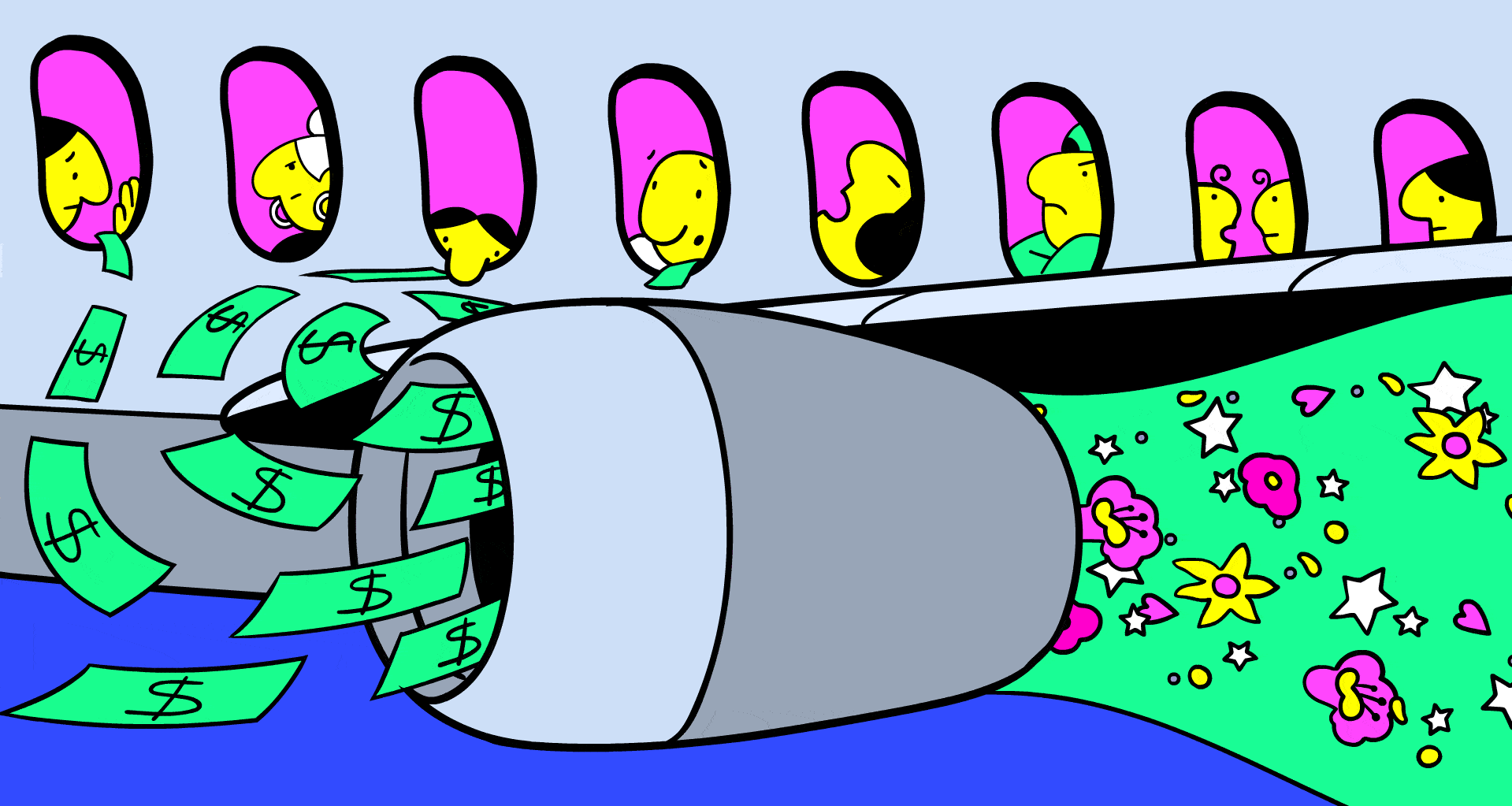
Illustration: Khylin Woodrow
Fresh from surviving the Covid-19 pandemic, the aviation industry is about to hand passengers the multi-trillion dollar bill to fight its next existential threat: decarbonization.
Cleaning up flying is a mission of improbable scale: Neutralize the carbon emissions of about 25,000 planes in the world’s commercial fleet that typically ferry some 4 billion people a year and burn close to 100 billion gallons of jet kerosene.
That’s more dirty liquid to launder than all the beer drunk in the world in a year.
Some $5 trillion of capital investment may be needed to deliver on aviation’s goal of reaching carbon neutrality by 2050, almost all of it plowed into sustainable fuel production and renewable power generation, according to McKinsey & Co. It's a mountain of money so large it could wipe out global airline revenue for the best part of a decade.

Climate activists protest against fossil fuel financing at the global climate summit in Paris on June 23.Photographer: Benjamin Girette/Bloomberg
With the clock ticking, industry leaders are starting to voice an uncomfortable truth. It’s clear, they say, that the costs of weaning air travel off fossil fuels will land on passengers.
“There’s just no way around it,” said veteran airline chief Willie Walsh, who now heads the International Air Transport Association, the industry’s main global lobby group.
Through seven decades of nearly unfettered expansion, the aviation industry had to pay little attention to emissions. Passengers grew accustomed to ever-improving connectivity, increasing competition and cheap tickets.
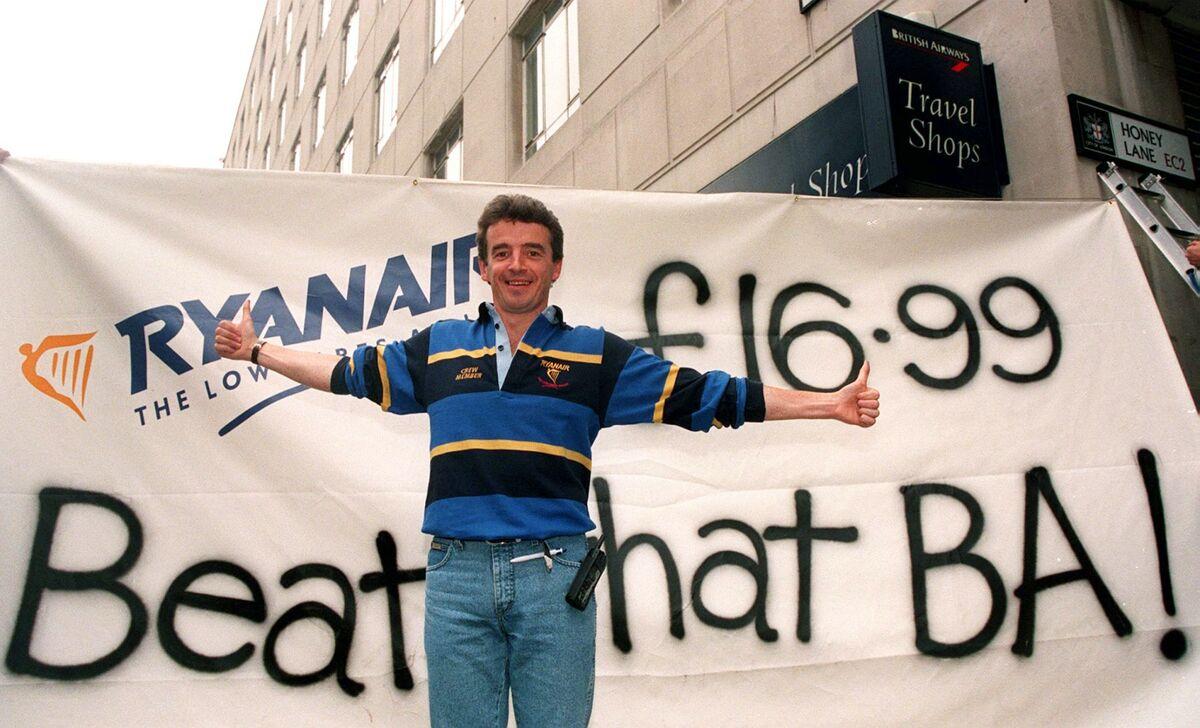
Ryanair CEO Michael O’Leary, who led Europe’s boom in low-cost flying, kicks off the sale of 1 million cheap flights in September 1998.Photographer: Stefan Rousseau/PA Images/Getty Images
Suddenly, carriers find themselves in an environmental squeeze, with governments setting deadlines and activists gluing themselves to runways to call attention to global warming. While Greta Thunberg introduced flight-shaming to the public before the pandemic, record temperatures this summer have only underscored climate campaigners’ point. Aviation’s expensive transition to cleaner fuels has the power to put the democratization of flying into reverse, leading to higher fares, and fewer routes and airlines.
While international air travel is just one of the many ways humans are heating the planet, its share of CO2 output is set to climb dramatically as other segments decarbonize — to an estimated 22% by 2050 from about 2% today if emissions aren’t cut fast enough.
Governments are also increasingly aware that unabated climate change will have great economic and human costs. After a summer of lethal heatwaves, with tourists in Greece and Hawaii being evacuated from deadly wildfires, the impact on the airline industry is no longer theoretical.
For passengers, the cleanup push means little prospect of relief from a post-Covid price surge that’s left domestic US fares, for example, more than 8% higher than 2019 levels. Incorporating the cost of decarbonization into ticket prices will be a more permanent affair, reflecting mammoth long-term investments by manufacturers Boeing Co. and Airbus SE, along with fuel refiners, airports and airlines.
“We need to be very upfront with passengers about what this will all mean,” said Christian Bennett, head of sustainability at Brisbane-based Virgin Australia Airlines. The cost to travelers of decarbonization is “the elephant in the room.”
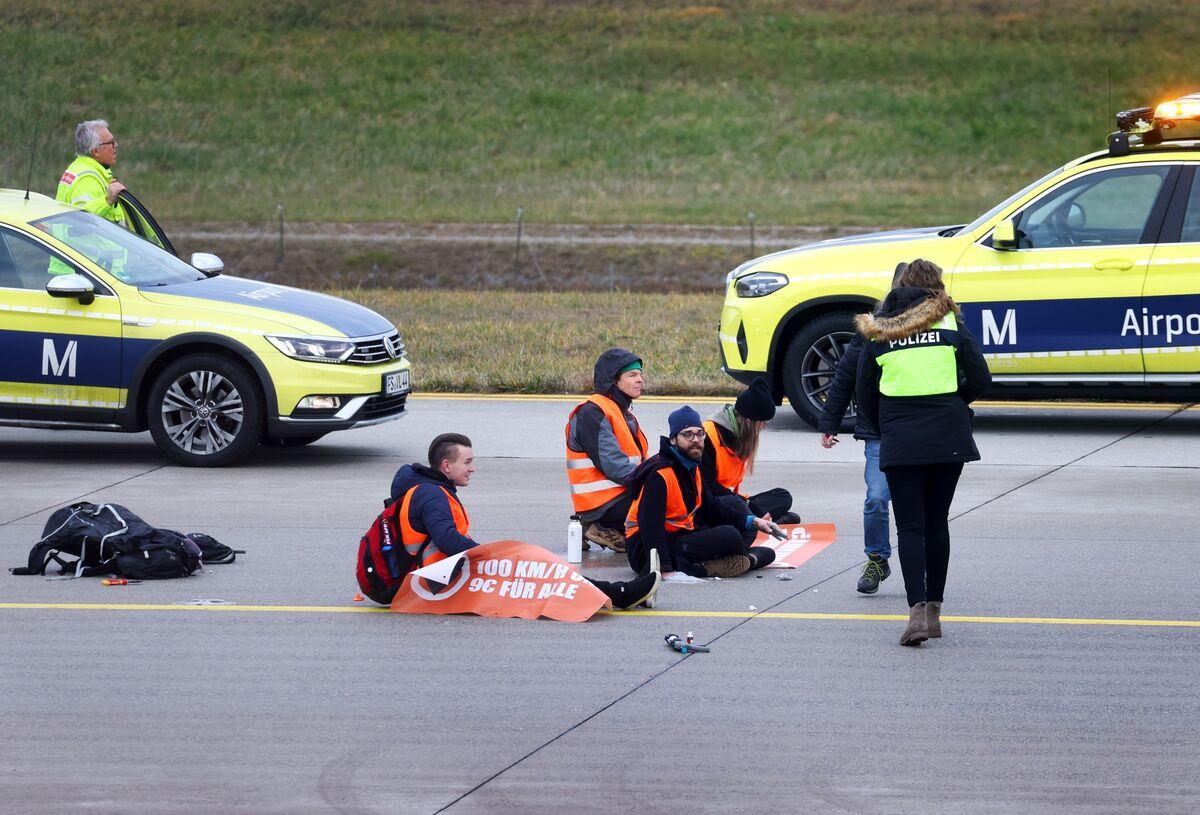
Climate activists sit with their hands glued to the runway at Franz-Josef-Strauss Airport in Munich on Dec. 8.Photographer: Karl-Josef Hildenbrand/Picture Alliance/Getty Images
Airline executives are grappling with tough questions: How to meaningfully lower their carbon footprint at a cost that won’t destroy profit, and how to fend off growth-killing demands to simply fly less.
Since they don’t make the aircraft or provide the fuel, carriers are dependent on other players like planemakers, engine manufacturers and energy companies to spur technical advances.
Even with unprecedented coordination, the options are limited. Commercial jets being delivered today may still be flying in 2050, and new designs powered by batteries or hydrogen will take years, if not decades, to materialize. So for now, the best option is to fill up conventional airliners with less-polluting copycat fuels that don’t require more drilling for oil. Even that will entail a monumental effort to stand up an alternative-fuel production system that barely exists today.
All told, it will make flying vastly more expensive.
Estimates vary, but the costs are significant. According to data from the International Civil Aviation Organization Environmental Report, sustainability measures will add as much as $73 to the cost of a one-way seat on a long-haul flight from Singapore to Dubai or New York to Paris.
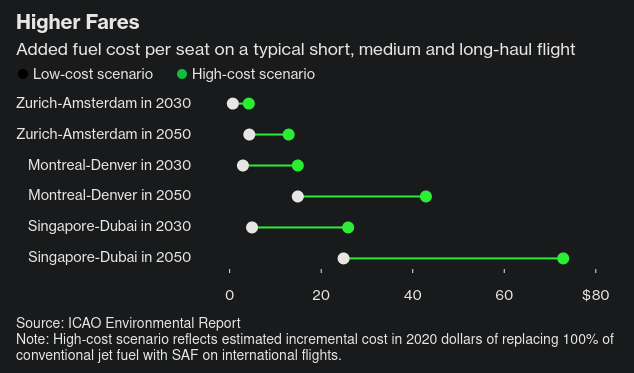
Passengers may have to fork out sooner than they think.
In the European Union, regulations coming into force are poised to drive up ticket prices almost immediately. The new RefuelEU rule will require airlines to fill their planes with a 2% sustainable aviation fuel blend by 2025, rising to 6% by 2030 and reaching 70% by 2050.
This year, the Franco-Dutch airline group Air France-KLM doubled a mandatory surcharge in place since 2022 to help pay for greener fuel, to between €2 ($2.20) and €24 per ticket on flights from Paris and Amsterdam. By 2035, European mandates will drive €230 in extra costs for a round-trip flight from Barcelona to Tokyo through Deutsche Lufthansa AG’s Frankfurt hub, according to the carrier.
SAF — as the biofuel is commonly called — is at least twice as expensive as normal jet fuel, so airline costs will swell, according to ING Bank. Carriers in Europe will also lose free carbon allowances, leading to full taxing on their emissions.
“Ticket prices are set to climb structurally,” ING economist Rico Luman and analyst Oleksiy Soroka wrote in a note. “Sustainability is increasingly impacting airline markets.”

Refueling an Air France passenger aircraft with SAF at Charles de Gaulle airport in France. For now, the best option is to fill up conventional airliners with less-polluting replacement fuels that don’t require more drilling for oil.Photographer: Nathan Laine/Bloomberg
Covid dealt the airline industry losses totaling about $180 billion over 2020 and 2021. The switch to sustainable fuels dwarfs that burden — and stretches over decades. The extra costs to airlines will reach as much as $4 trillion through 2050, according to ICAO, the United Nations agency which helps set aviation standards.
Airlines say the financial blow will be far too heavy to bear on their own.
Even in good times, carriers typically eke out just a few dollars of profit from every passenger. To survive the pandemic, the industry required at least $243 billion in government aid. While they’ve mostly bounced back, airlines are hardly on stable ground. This year’s profit margin from $803 billion of worldwide commercial airline revenue will be just 1.2%, or $2.25 per passenger — enough to buy only a pint or two of new clean-burning fuel.
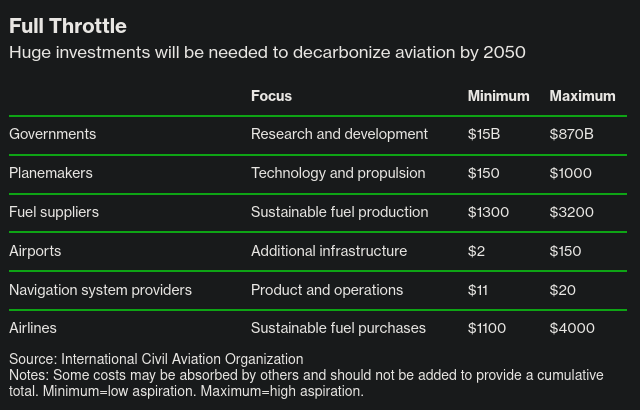
Failure to abate the industry risks hitting passengers’ pockets even harder than success, because any remaining emissions would have to be canceled out with costly carbon credits.
Rather than force airlines to pay for their own carbon cleanup, other proposals have emerged, including a tax on passengers. Raising enough money in this way would require a $25-per-person surcharge on every flight, according to the International Council on Clean Transportation, a policy and research think tank. Alternatively, a sliding-scale levy targeting frequent fliers might charge $177 for someone on their 20th flight of the year.
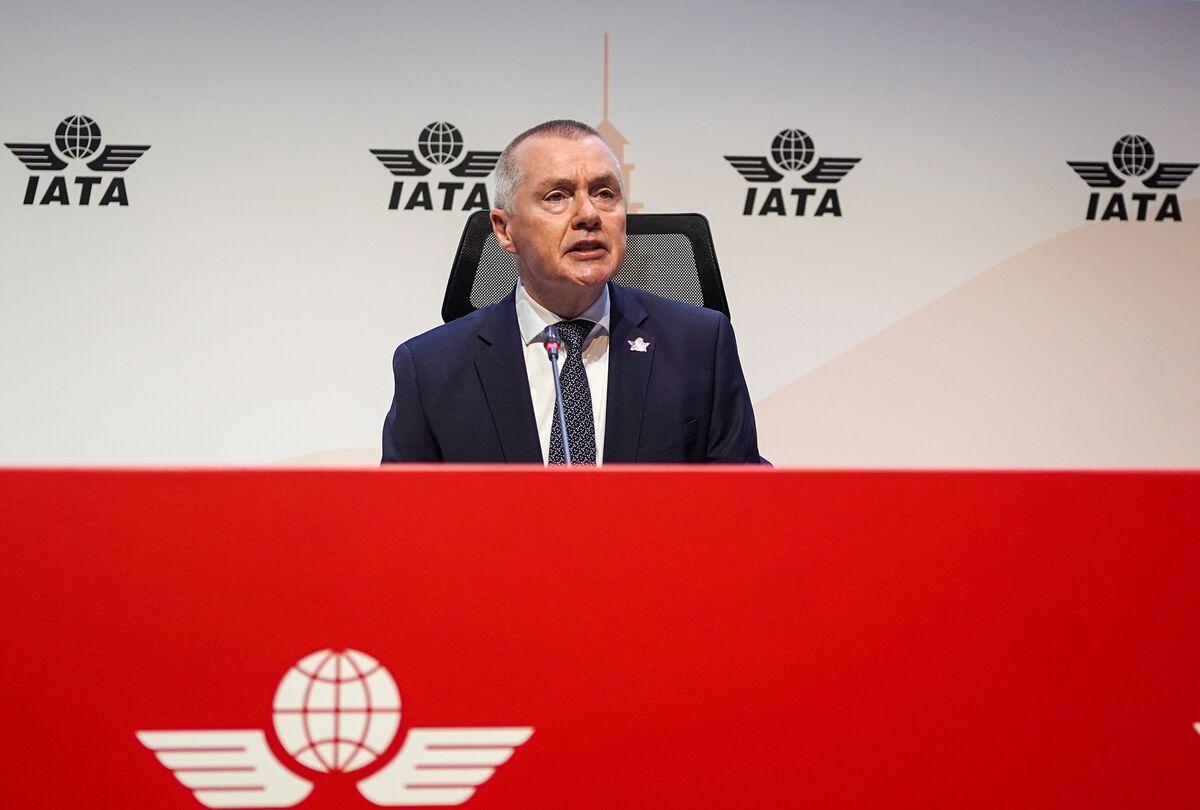
International Air Transport Association head Willie Walsh says that the costs of weaning air travel off fossil fuels will hit passengers.Photographer: Moe Zoyari/Bloomberg
Other measures threaten to hinder growth if adopted widely, adding to the upward pressure on fares. France has banned a handful of domestic flights and is preparing to tax airplane tickets
to fund rail alternatives. Amsterdam’s state-controlled Schiphol Airport won court permission to cut capacity, forcing Air France-KLM to review its operations there.
In Asia, Japan aims to replace 10% of fuel used by local airlines with SAF by 2030. Jet kerosene in Indonesia must include 5% biofuel by 2025, ICAO documents show.
Under economic pressure and with political demands on the rise, airlines have honed their sustainability messages, deterring punitive action. Nearly every aircraft purchase is now spun as a commitment to carbon reduction — even if the jets will be used for expansion rather than replacing older, less-efficient planes.
At fast-growing IndiGo, the Indian airline’s young fleet places it “ahead of the pack when it comes to CO2 emissions,” Chief Executive Officer Pieter Elbers said in a June interview, adding that the low-cost carrier will “continue to deliver on the reduction of our footprint.” Days later, he placed a record order for 500 Airbus jets to ride the travel boom underway in the world’s most populous country.

Pieter Elbers, left, and Airbus commercial chief Christian Scherer shake hands after IndiGo announced a record order at the Paris Air Show on June 19.Photographer: Nathan Laine/Bloomberg
Having rallied around SAF, airlines are stepping up their commitment to a technology they say could cut emissions by almost 80% if it fully replaces jet kerosene.
Large carriers like United Airlines Holdings Inc. and British Airways parent IAG SA are breaking out of their traditional role as energy customers to help fund alternative-fuel initiatives. Airbus, which is working on a hydrogen-powered jetliner, is also investing in SAF production.
Industry lobbying paid off in the US with the 2022 Inflation Reduction Act, which will provide subsidies of up to $1.75 per gallon for production of SAF. Airline executives have hailed the measure, targeting annual output of 3 billion gallons by 2030, as a model for other regions.
Also in airlines’ favor: The introduction, over time, of newer and more-efficient aircraft that will enter the global fleet and gradually reduce average fuel consumption. And there are dozens of other ways to make incremental fuel savings, such as taxiing on the runway using only one engine, navigating in the air more smartly, and fitting out cabins with lighter equipment.
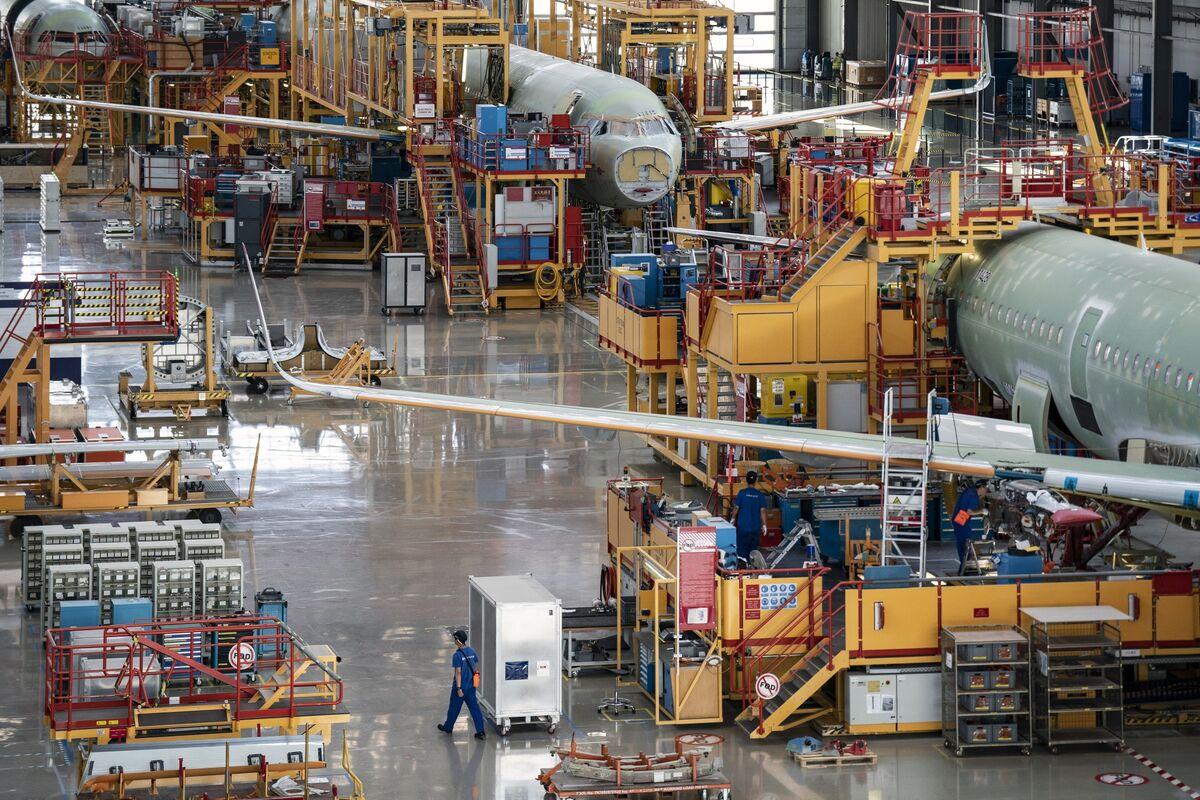
The Airbus manufacturing plant in Tianjin, China. Commercial jets being delivered today may still be flying in 2050.Photographer: Qilai Shen/Bloomberg
But there’s no getting around the fact that reaching net-zero will require an off-the-chart increase in SAF production from current levels of less than 1% of aviation’s global fuel requirements. And at every juncture, even the largest players are crying poor, underscoring the industry’s inability — or unwillingness — to fully shoulder its path to emissions neutrality.
Subsidies would help establish the nascent SAF marketplace, just as they did with renewable energy, according to Lauren Riley, chief sustainability officer at United. For the IRA incentives to spur investments in new plants, they need to be extended beyond 2027, she said. “We don’t have the profitability or the margins to carry this investment,” Riley said in an interview. “Certainly not at the pace that we all really want to see change happen.”
The term SAF is an umbrella for various alternatives to fossil-based kerosene. Each has its own production method, cost profile and carbon-reduction impact. Fuels made from sources such as waste oils and fats are being used to start, but there are limited amounts available. Other feedstocks include forest products and agricultural byproducts.
To reach further-out targets will require adding in other approaches, potentially at greater cost — turning alcohol into jet fuel, for example, or generating massive amounts of renewable energy to create fully synthetic fuels.
“We need to get on with this,’’ said Jonathan Wood, an executive at Finland’s Neste Oyj, the largest producer of aviation biofuels. “We have no time to look for the perfect solution.”

The Neste Singapore refinery facility is the world’s biggest renewable diesel refinery and largest producer of sustainable aviation fuel, according to the Finnish company.Photographer: Lauryn Ishak/Bloomberg
IATA, the group representing about 300 airlines, estimates getting to net zero by 2050 will require annual investments averaging close to $180 billion. Even if carriers pay only 65% to 75% of the total, the outlay may be too much to bear.
“I do not think this is affordable or sustainable, given the size of the industry and its projected growth,” said Volodymyr Bilotkach, associate professor in aviation management at Indiana’s Purdue University and author of The Economics of Airlines.
What happens after that depends on how hard individual governments pursue a decarbonization agenda, said Bilotkach. It’s foreseeable, for example, that the EU could bar airlines that don’t use enough sustainable fuel, he said.
There are major questions about whether the cleanup plans are even doable, especially since rising SAF volumes depend more on untested and costlier technologies as the timeline moves to the right. The aviation industry is “not on track” to hit its net-zero target, according to the International Energy Agency.
Growing demand for air travel will also work against efforts to reach carbon-neutrality. Passenger numbers are projected to double from 2019 to over 8 billion in two decades.
Alternative fuel supplier SkyNRG said in a May report that Europe will need to build 150 SAF refineries by 2050. The US needs 250. Further growth would require imports or greater investment. All of this will strain feedstock supplies such as waste fats and vegetable oils, it said.

Akbar Al Baker exits a jet at the Paris Air Show.Photographer: Nathan Laine/Bloomberg
All told, there won’t be enough SAF for all the world’s airlines, and fares will inevitably climb, Qatar Airways’ outspoken CEO, Akbar Al Baker, said at the Paris Air Show in June. The 2050 net-zero targets are unattainable, he said.
“Let us not fool ourselves,” Al Baker said in an interview. “What do you expect?”
Should alternative fuels and new designs fail to carry the industry to its 2050 goal, counterbalancing residual emissions could cost up to $18 billion in that year alone, according to McKinsey. Qantas Airways Ltd. is among airlines that have said there’s no route to net zero without offsets.
Commercial airlines belch out close to 1 billion metric tons of carbon dioxide each year. Yet it’s far from clear that the public is ready to take financial responsibility. Voluntary programs to offset emissions typically sign up only 1% to 3% of passengers.
The tool itself has come under question after a number of studies and investigations questioned whether carbon credits result in any actual emission reductions.
A person flying economy from London to New York on a Boeing 777 would rack up 402 kilograms of emissions, according to IATA’s pollutants calculator. More spacious seats in business class leave a 1.6-ton carbon dioxide footprint, and more than 2 tons in first class.
The numbers wash over most passengers, partly because it’s tough to imagine what a kilogram of gassy emissions looks like, said Adam Nieman, creative director at Bristol, England-based Real World Visuals, whose clients include the UN.
“It’s really hard to act on invisible things,” Nieman said. “The first step in helping someone engage with data is to make it real.”

https://twitter.com/RealWorldVis/status/1645381390576283649 (archive.ph)
Technological advances may not come soon enough. Electric aircraft due in a few years won’t have the range for longer flights. ICAO doesn’t expect hydrogen-powered aircraft to have a significant impact on emissions before 2050.
Even those at the vanguard of alternative propulsion point to its limitations.
Aaron Shaw, founder and managing director of Sydney Seaplanes, aims to use battery-powered Cessna Caravans to operate tourist flights over the city’s iconic harbor and beaches in 2026. The trips will last just 15 minutes, he said — flights of an hour or more might be possible by 2030.
“Unless there’s some major change in battery technology, those ranges are going to be where we’re at to begin with,” said Shaw, who’s also co-founder of Dovetail Electric Aviation, a startup working to convert turbine-powered aircraft to electric propulsion.
Hit or miss, as the industry chases its 2050 goal of carbon neutrality, some carriers will get closer to the target than others. The worst-polluting airlines might have to abandon flights to destinations with onerous mandates or taxes on fossil fuels.

The under-construction Western Sydney International Airport risks being priced out of the global aviation network.Photographer: Brent Lewin/Bloomberg
Higher costs could ultimately force some airlines to avoid the world’s most distant destinations. Australia, for example, risks being “priced out of the global aviation network once emissions reductions strategies and carbon pricing begin to take effect,” according to the country’s airports association.
The changes could test the financial viability of some carriers entirely, said Subhas Menon, director general of the Association of Asia Pacific Airlines. That could leave the industry with fewer competitors, shrinking global connectivity and pushing fares higher, he said.
“I don’t know that airlines have ever been good 30-year planners,” Shane Tackett, chief financial officer at Alaska Air Group Inc., said
in June. “It’s an industry that doesn’t lend itself to that.”
While there’s still division, he added, “I do think people are starting to realize: we’ve got to figure this 2040, 2050 thing out.”
— With William Wilkes, Albertina Torsoli, and Siddharth Vikram Philip
Bloomberg (archive.ph)
By Angus Whitley
2023-08-11 00:38:05GMT
Illustration: Khylin Woodrow
Fresh from surviving the Covid-19 pandemic, the aviation industry is about to hand passengers the multi-trillion dollar bill to fight its next existential threat: decarbonization.
Cleaning up flying is a mission of improbable scale: Neutralize the carbon emissions of about 25,000 planes in the world’s commercial fleet that typically ferry some 4 billion people a year and burn close to 100 billion gallons of jet kerosene.
That’s more dirty liquid to launder than all the beer drunk in the world in a year.
Some $5 trillion of capital investment may be needed to deliver on aviation’s goal of reaching carbon neutrality by 2050, almost all of it plowed into sustainable fuel production and renewable power generation, according to McKinsey & Co. It's a mountain of money so large it could wipe out global airline revenue for the best part of a decade.
Climate activists protest against fossil fuel financing at the global climate summit in Paris on June 23.Photographer: Benjamin Girette/Bloomberg
With the clock ticking, industry leaders are starting to voice an uncomfortable truth. It’s clear, they say, that the costs of weaning air travel off fossil fuels will land on passengers.
“There’s just no way around it,” said veteran airline chief Willie Walsh, who now heads the International Air Transport Association, the industry’s main global lobby group.
Through seven decades of nearly unfettered expansion, the aviation industry had to pay little attention to emissions. Passengers grew accustomed to ever-improving connectivity, increasing competition and cheap tickets.
Ryanair CEO Michael O’Leary, who led Europe’s boom in low-cost flying, kicks off the sale of 1 million cheap flights in September 1998.Photographer: Stefan Rousseau/PA Images/Getty Images
Suddenly, carriers find themselves in an environmental squeeze, with governments setting deadlines and activists gluing themselves to runways to call attention to global warming. While Greta Thunberg introduced flight-shaming to the public before the pandemic, record temperatures this summer have only underscored climate campaigners’ point. Aviation’s expensive transition to cleaner fuels has the power to put the democratization of flying into reverse, leading to higher fares, and fewer routes and airlines.
While international air travel is just one of the many ways humans are heating the planet, its share of CO2 output is set to climb dramatically as other segments decarbonize — to an estimated 22% by 2050 from about 2% today if emissions aren’t cut fast enough.
Governments are also increasingly aware that unabated climate change will have great economic and human costs. After a summer of lethal heatwaves, with tourists in Greece and Hawaii being evacuated from deadly wildfires, the impact on the airline industry is no longer theoretical.
For passengers, the cleanup push means little prospect of relief from a post-Covid price surge that’s left domestic US fares, for example, more than 8% higher than 2019 levels. Incorporating the cost of decarbonization into ticket prices will be a more permanent affair, reflecting mammoth long-term investments by manufacturers Boeing Co. and Airbus SE, along with fuel refiners, airports and airlines.
“We need to be very upfront with passengers about what this will all mean,” said Christian Bennett, head of sustainability at Brisbane-based Virgin Australia Airlines. The cost to travelers of decarbonization is “the elephant in the room.”
Climate activists sit with their hands glued to the runway at Franz-Josef-Strauss Airport in Munich on Dec. 8.Photographer: Karl-Josef Hildenbrand/Picture Alliance/Getty Images
Airline executives are grappling with tough questions: How to meaningfully lower their carbon footprint at a cost that won’t destroy profit, and how to fend off growth-killing demands to simply fly less.
Since they don’t make the aircraft or provide the fuel, carriers are dependent on other players like planemakers, engine manufacturers and energy companies to spur technical advances.
Even with unprecedented coordination, the options are limited. Commercial jets being delivered today may still be flying in 2050, and new designs powered by batteries or hydrogen will take years, if not decades, to materialize. So for now, the best option is to fill up conventional airliners with less-polluting copycat fuels that don’t require more drilling for oil. Even that will entail a monumental effort to stand up an alternative-fuel production system that barely exists today.
All told, it will make flying vastly more expensive.
Estimates vary, but the costs are significant. According to data from the International Civil Aviation Organization Environmental Report, sustainability measures will add as much as $73 to the cost of a one-way seat on a long-haul flight from Singapore to Dubai or New York to Paris.
Passengers may have to fork out sooner than they think.
In the European Union, regulations coming into force are poised to drive up ticket prices almost immediately. The new RefuelEU rule will require airlines to fill their planes with a 2% sustainable aviation fuel blend by 2025, rising to 6% by 2030 and reaching 70% by 2050.
This year, the Franco-Dutch airline group Air France-KLM doubled a mandatory surcharge in place since 2022 to help pay for greener fuel, to between €2 ($2.20) and €24 per ticket on flights from Paris and Amsterdam. By 2035, European mandates will drive €230 in extra costs for a round-trip flight from Barcelona to Tokyo through Deutsche Lufthansa AG’s Frankfurt hub, according to the carrier.
SAF — as the biofuel is commonly called — is at least twice as expensive as normal jet fuel, so airline costs will swell, according to ING Bank. Carriers in Europe will also lose free carbon allowances, leading to full taxing on their emissions.
“Ticket prices are set to climb structurally,” ING economist Rico Luman and analyst Oleksiy Soroka wrote in a note. “Sustainability is increasingly impacting airline markets.”
Refueling an Air France passenger aircraft with SAF at Charles de Gaulle airport in France. For now, the best option is to fill up conventional airliners with less-polluting replacement fuels that don’t require more drilling for oil.Photographer: Nathan Laine/Bloomberg
Covid dealt the airline industry losses totaling about $180 billion over 2020 and 2021. The switch to sustainable fuels dwarfs that burden — and stretches over decades. The extra costs to airlines will reach as much as $4 trillion through 2050, according to ICAO, the United Nations agency which helps set aviation standards.
Airlines say the financial blow will be far too heavy to bear on their own.
Even in good times, carriers typically eke out just a few dollars of profit from every passenger. To survive the pandemic, the industry required at least $243 billion in government aid. While they’ve mostly bounced back, airlines are hardly on stable ground. This year’s profit margin from $803 billion of worldwide commercial airline revenue will be just 1.2%, or $2.25 per passenger — enough to buy only a pint or two of new clean-burning fuel.
Failure to abate the industry risks hitting passengers’ pockets even harder than success, because any remaining emissions would have to be canceled out with costly carbon credits.
Rather than force airlines to pay for their own carbon cleanup, other proposals have emerged, including a tax on passengers. Raising enough money in this way would require a $25-per-person surcharge on every flight, according to the International Council on Clean Transportation, a policy and research think tank. Alternatively, a sliding-scale levy targeting frequent fliers might charge $177 for someone on their 20th flight of the year.
International Air Transport Association head Willie Walsh says that the costs of weaning air travel off fossil fuels will hit passengers.Photographer: Moe Zoyari/Bloomberg
Other measures threaten to hinder growth if adopted widely, adding to the upward pressure on fares. France has banned a handful of domestic flights and is preparing to tax airplane tickets
to fund rail alternatives. Amsterdam’s state-controlled Schiphol Airport won court permission to cut capacity, forcing Air France-KLM to review its operations there.
In Asia, Japan aims to replace 10% of fuel used by local airlines with SAF by 2030. Jet kerosene in Indonesia must include 5% biofuel by 2025, ICAO documents show.
Under economic pressure and with political demands on the rise, airlines have honed their sustainability messages, deterring punitive action. Nearly every aircraft purchase is now spun as a commitment to carbon reduction — even if the jets will be used for expansion rather than replacing older, less-efficient planes.
At fast-growing IndiGo, the Indian airline’s young fleet places it “ahead of the pack when it comes to CO2 emissions,” Chief Executive Officer Pieter Elbers said in a June interview, adding that the low-cost carrier will “continue to deliver on the reduction of our footprint.” Days later, he placed a record order for 500 Airbus jets to ride the travel boom underway in the world’s most populous country.
Pieter Elbers, left, and Airbus commercial chief Christian Scherer shake hands after IndiGo announced a record order at the Paris Air Show on June 19.Photographer: Nathan Laine/Bloomberg
Having rallied around SAF, airlines are stepping up their commitment to a technology they say could cut emissions by almost 80% if it fully replaces jet kerosene.
Large carriers like United Airlines Holdings Inc. and British Airways parent IAG SA are breaking out of their traditional role as energy customers to help fund alternative-fuel initiatives. Airbus, which is working on a hydrogen-powered jetliner, is also investing in SAF production.
Industry lobbying paid off in the US with the 2022 Inflation Reduction Act, which will provide subsidies of up to $1.75 per gallon for production of SAF. Airline executives have hailed the measure, targeting annual output of 3 billion gallons by 2030, as a model for other regions.
Also in airlines’ favor: The introduction, over time, of newer and more-efficient aircraft that will enter the global fleet and gradually reduce average fuel consumption. And there are dozens of other ways to make incremental fuel savings, such as taxiing on the runway using only one engine, navigating in the air more smartly, and fitting out cabins with lighter equipment.
The Airbus manufacturing plant in Tianjin, China. Commercial jets being delivered today may still be flying in 2050.Photographer: Qilai Shen/Bloomberg
But there’s no getting around the fact that reaching net-zero will require an off-the-chart increase in SAF production from current levels of less than 1% of aviation’s global fuel requirements. And at every juncture, even the largest players are crying poor, underscoring the industry’s inability — or unwillingness — to fully shoulder its path to emissions neutrality.
Subsidies would help establish the nascent SAF marketplace, just as they did with renewable energy, according to Lauren Riley, chief sustainability officer at United. For the IRA incentives to spur investments in new plants, they need to be extended beyond 2027, she said. “We don’t have the profitability or the margins to carry this investment,” Riley said in an interview. “Certainly not at the pace that we all really want to see change happen.”
The term SAF is an umbrella for various alternatives to fossil-based kerosene. Each has its own production method, cost profile and carbon-reduction impact. Fuels made from sources such as waste oils and fats are being used to start, but there are limited amounts available. Other feedstocks include forest products and agricultural byproducts.
To reach further-out targets will require adding in other approaches, potentially at greater cost — turning alcohol into jet fuel, for example, or generating massive amounts of renewable energy to create fully synthetic fuels.
“We need to get on with this,’’ said Jonathan Wood, an executive at Finland’s Neste Oyj, the largest producer of aviation biofuels. “We have no time to look for the perfect solution.”
The Neste Singapore refinery facility is the world’s biggest renewable diesel refinery and largest producer of sustainable aviation fuel, according to the Finnish company.Photographer: Lauryn Ishak/Bloomberg
IATA, the group representing about 300 airlines, estimates getting to net zero by 2050 will require annual investments averaging close to $180 billion. Even if carriers pay only 65% to 75% of the total, the outlay may be too much to bear.
“I do not think this is affordable or sustainable, given the size of the industry and its projected growth,” said Volodymyr Bilotkach, associate professor in aviation management at Indiana’s Purdue University and author of The Economics of Airlines.
What happens after that depends on how hard individual governments pursue a decarbonization agenda, said Bilotkach. It’s foreseeable, for example, that the EU could bar airlines that don’t use enough sustainable fuel, he said.
There are major questions about whether the cleanup plans are even doable, especially since rising SAF volumes depend more on untested and costlier technologies as the timeline moves to the right. The aviation industry is “not on track” to hit its net-zero target, according to the International Energy Agency.
Growing demand for air travel will also work against efforts to reach carbon-neutrality. Passenger numbers are projected to double from 2019 to over 8 billion in two decades.
Alternative fuel supplier SkyNRG said in a May report that Europe will need to build 150 SAF refineries by 2050. The US needs 250. Further growth would require imports or greater investment. All of this will strain feedstock supplies such as waste fats and vegetable oils, it said.
Akbar Al Baker exits a jet at the Paris Air Show.Photographer: Nathan Laine/Bloomberg
All told, there won’t be enough SAF for all the world’s airlines, and fares will inevitably climb, Qatar Airways’ outspoken CEO, Akbar Al Baker, said at the Paris Air Show in June. The 2050 net-zero targets are unattainable, he said.
“Let us not fool ourselves,” Al Baker said in an interview. “What do you expect?”
Should alternative fuels and new designs fail to carry the industry to its 2050 goal, counterbalancing residual emissions could cost up to $18 billion in that year alone, according to McKinsey. Qantas Airways Ltd. is among airlines that have said there’s no route to net zero without offsets.
Commercial airlines belch out close to 1 billion metric tons of carbon dioxide each year. Yet it’s far from clear that the public is ready to take financial responsibility. Voluntary programs to offset emissions typically sign up only 1% to 3% of passengers.
The tool itself has come under question after a number of studies and investigations questioned whether carbon credits result in any actual emission reductions.
A person flying economy from London to New York on a Boeing 777 would rack up 402 kilograms of emissions, according to IATA’s pollutants calculator. More spacious seats in business class leave a 1.6-ton carbon dioxide footprint, and more than 2 tons in first class.
The numbers wash over most passengers, partly because it’s tough to imagine what a kilogram of gassy emissions looks like, said Adam Nieman, creative director at Bristol, England-based Real World Visuals, whose clients include the UN.
“It’s really hard to act on invisible things,” Nieman said. “The first step in helping someone engage with data is to make it real.”
https://twitter.com/RealWorldVis/status/1645381390576283649 (archive.ph)
Technological advances may not come soon enough. Electric aircraft due in a few years won’t have the range for longer flights. ICAO doesn’t expect hydrogen-powered aircraft to have a significant impact on emissions before 2050.
Even those at the vanguard of alternative propulsion point to its limitations.
Aaron Shaw, founder and managing director of Sydney Seaplanes, aims to use battery-powered Cessna Caravans to operate tourist flights over the city’s iconic harbor and beaches in 2026. The trips will last just 15 minutes, he said — flights of an hour or more might be possible by 2030.
“Unless there’s some major change in battery technology, those ranges are going to be where we’re at to begin with,” said Shaw, who’s also co-founder of Dovetail Electric Aviation, a startup working to convert turbine-powered aircraft to electric propulsion.
Hit or miss, as the industry chases its 2050 goal of carbon neutrality, some carriers will get closer to the target than others. The worst-polluting airlines might have to abandon flights to destinations with onerous mandates or taxes on fossil fuels.
The under-construction Western Sydney International Airport risks being priced out of the global aviation network.Photographer: Brent Lewin/Bloomberg
Higher costs could ultimately force some airlines to avoid the world’s most distant destinations. Australia, for example, risks being “priced out of the global aviation network once emissions reductions strategies and carbon pricing begin to take effect,” according to the country’s airports association.
The changes could test the financial viability of some carriers entirely, said Subhas Menon, director general of the Association of Asia Pacific Airlines. That could leave the industry with fewer competitors, shrinking global connectivity and pushing fares higher, he said.
“I don’t know that airlines have ever been good 30-year planners,” Shane Tackett, chief financial officer at Alaska Air Group Inc., said
in June. “It’s an industry that doesn’t lend itself to that.”
While there’s still division, he added, “I do think people are starting to realize: we’ve got to figure this 2040, 2050 thing out.”
— With William Wilkes, Albertina Torsoli, and Siddharth Vikram Philip


