Archive only because NY Times sucks and has a paywall: https://archive.ph/zlQmh#selection-275.0-279.136
Jay Miles has lived his 52 years without marriage or children, which has suited his creative ambitions as a videographer in Connecticut and, he said, his mix of “independence and stubbornness.” But he worries about who will take care of him as he gets older.
Donna Selman, a 55-year old college professor in Illinois, is mostly grateful to be single, she said, because her mother and aunts never had the financial and emotional autonomy that she enjoys.
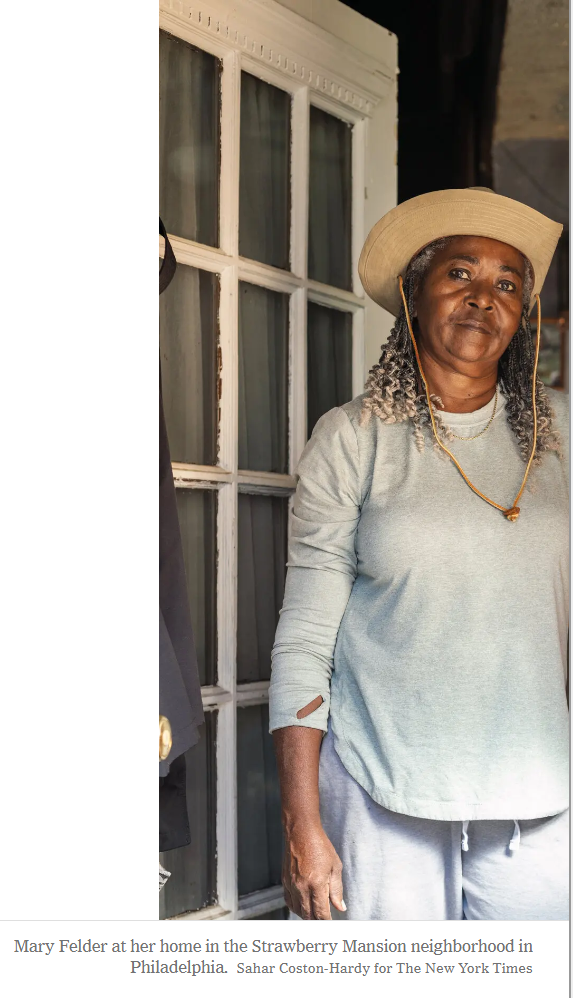
Mary Felder, 65, raised her children, now grown, in her rowhouse in Philadelphia. Her home has plenty of space for one person, but upkeep is expensive on the century-old house.
Ms. Felder, Mr. Miles and Ms. Selman are members of one of the country’s fastest-growing demographic groups: people 50 and older who live alone.
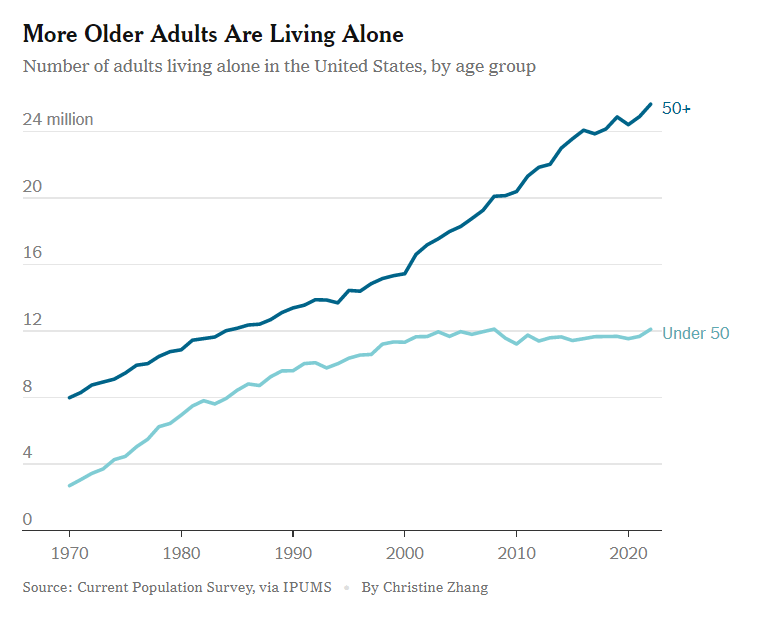
In 1960, just 13 percent of American households had a single occupant. But that figure has risen steadily, and today it is approaching 30 percent. For households headed by someone 50 or older, that figure is 36 percent.
Nearly 26 million Americans 50 or older now live alone, up from 15 million in 2000. Older people have always been more likely than others to live by themselves, and now that age group — baby boomers and Gen Xers — makes up a bigger share of the population than at any time in the nation’s history.
The trend has also been driven by deep changes in attitudes surrounding gender and marriage. People 50-plus today are more likely than earlier generations to be divorced, separated or never married.
Women in this category have had opportunities for professional advancement, homeownership and financial independence that were all but out of reach for previous generations of older women. More than 60 percent of older adults living by themselves are female.
“There is this huge, kind of explosive social and demographic change happening,” said Markus Schafer, a sociologist at Baylor University who studies older populations.
In interviews, many older adults said they feel positively about their lives.
But while many people in their 50s and 60s thrive living solo, research is unequivocal that people aging alone experience worse physical and mental health outcomes and shorter life spans.
And even with an active social and family life, people in this group are generally more lonely than those who live with others, according to Dr. Schafer’s research.
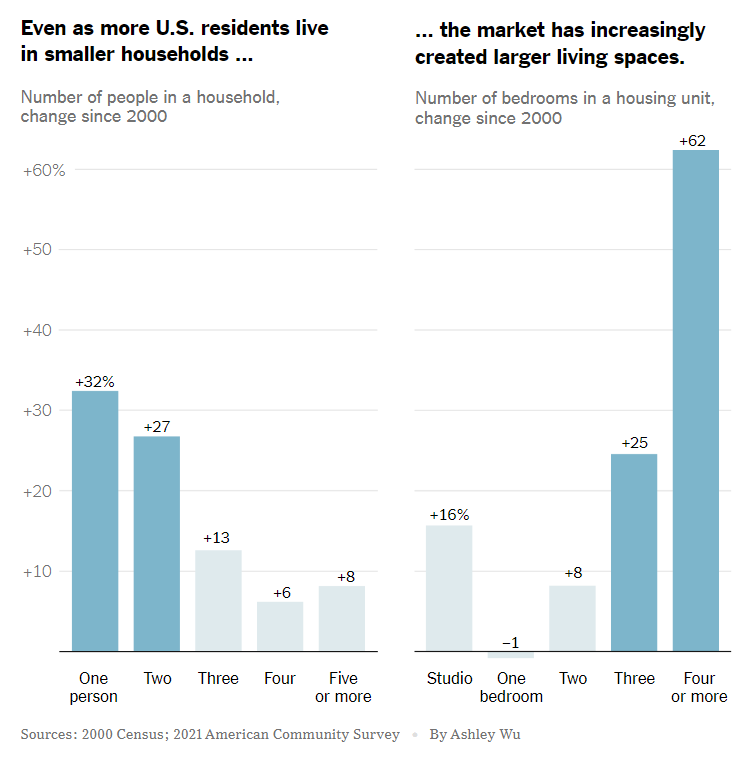
In many ways, the nation’s housing stock has grown out of sync with these shifting demographics. Many solo adults live in homes with at least three bedrooms, census data shows, but find that downsizing is not easy because of a shortage of smaller homes in their towns and neighborhoods.
Compounding the challenge of living solo, a growing share of older adults — about 1 in 6 Americans 55 and older — do not have children, raising questions about how elder care will be managed in the coming decades.
“What will happen to this cohort?” Dr. Schafer asked. “Can they continue to find other supports that compensate for living alone?”

Ms. Selman, the 55-year-old professor, lived in Terre Haute, Ind., when Covid-19 hit. Divorced for 17 years, she said she used the enforced isolation to establish new routines to stave off loneliness and depression. She quit drinking and began regularly calling a group of female friends.
This year, she got a new job and moved to Normal, Ill., in part because she wanted to live in a state that better reflected her progressive politics. She has met new friends at a farmers’ market, she said, and is happier than she was before the pandemic, even though she occasionally wishes she had a romantic partner to take motorcycle rides with her or just to help carry laundry up and down the stairs of her three-bedroom home.
She regularly drives 12 hours round trip to care for her parents near Detroit, an obligation that has persuaded her to put away her retirement fantasy of living near the beach, and move someday closer to her daughter and grandson, who live in Louisville, Ky.
“I don’t want my daughter to stress out about me,” she said.
Watching their own parents age seems to have had a profound effect on many members of Gen X, born between 1965 and 1980, who say they doubt that they can lean on the same supports that their parents did: long marriages, pensions, homes that sometimes skyrocketed in value.
When his mother died two years ago, Mr. Miles, the videographer, took comfort in moving some of her furniture into his house in New Haven, Conn.
“It was a coming home psychologically,” he said, allowing him to feel rooted after decades of cross-country moves and peripatetic career explorations, shifting from the music business to high school teaching to producing films for nonprofits and companies.
“I still feel pretty indestructible, foolishly or not,” he said.
Still, caring for his divorced mother made him think about his own future. She had a government pension, security he lacks. Nor does he have children.
“I can’t call my kid,” he added, “the way I used to go to my mom’s house to change light bulbs.”
His options for maintaining independence are “all terrible,” he said. “I’m totally freaked out by it.”
Several Gen X solo dwellers said they had begun exploring options to live communally as they age, inspired, in part, by living arrangements they had enjoyed in college years and young adulthood.
“I’ve been talking to friends about end-of-life issues and how we might want to get together,” said Patrick McComb, 56, of Riverview, Mich., a graphic artist. “Being alone till the end would not be the worst thing in the world. But I would prefer to be with people.”
The question for her, and many other single homeowners, is whether they can cash in when they get older.
Ms. Mattingly said she did not think she would ever be able to pay down the mortgage and build wealth.
“It’s implausible that I’ll ever be able to retire,” she said.
Living solo in homes with three or more bedrooms sounds like a luxury but, experts said, it is a trend driven less by personal choice than by the nation’s limited housing supply. Because of zoning and construction limitations in many cities and towns, there is a nationwide shortage of homes below 1,400 square feet, which has driven up the cost of the smaller units that do exist, according to research from Freddie Mac.
Forty years ago, units of less than 1,400 square feet made up about 40 percent of all new home construction; today, just 7 percent of new builds are smaller homes, despite the fact that the number of single-person households has surged.
This has made it more difficult for older Americans to downsize, as a large, aging house can often command less than what a single adult needs to establish a new, smaller home and pay for their living and health care expenses in retirement.
People in this group often face the reality that “it’s more expensive to get a smaller condo than the single family you’re selling — and that presumes the condo exists, which may not be the case,” said Jennifer Molinsky, director of the Housing an Aging Society Program at Harvard University.
And when they hold onto family-size houses well into retirement, there are fewer spacious homes placed on the market for young families, who in turn squeeze into smaller units or withstand long commutes in a search for affordable housing.
“Both ends of the age distribution are getting squeezed,” said Jenny Schuetz, an expert on housing and urban economics at the Brookings Institution.
The constraints are especially severe for many older Black Americans, for whom the legacy of redlining and segregation has meant that homeownership has not generated as much wealth. The percentage of people living alone in large houses is highest in many low-income, historically Black neighborhoods. In those areas, many homes are owned by single, older women.
One of them is Ms. Felder of Strawberry Mansion, a neighborhood in Philadelphia. She and her ex-husband bought their two-story brick rowhouse in the mid-1990s for a song, after it was damaged in a fire.
While raising three children, Ms. Felder worked a series of jobs, including retail, hotel housekeeping and airport security. She retired in 2008 and has lived by herself for more than a decade, though her sisters, children and grandchildren live nearby.
Maintaining her home is a challenge. In rainstorms, she sometimes had to use every piece of fabric in the house to sop up water pouring down a kitchen wall. And she worries about her safety.
At times, she dreams about relocating to small-town South Carolina, where she was born and raised.
She imagines a small home there, perhaps even a trailer.
But the median value of a home in her neighborhood was $59,000, according to recent census data. Ms. Felder thinks she could sell her house and net about $40,000.
“That’s not enough” to retire down south, she said, sighing, sitting in her living room filled with plants.
Ms. Felder is a fixture in her neighborhood, keeping watch over it, and has received help from Habitat for Humanity to repair her roof.
But in September, living alone became harder.
While she was cleaning the trash out of a nearby alley with neighbors, a masked gunman looked her in the eyes and shot her twice in the legs.
Ms. Felder had no clue who shot her, and there has been no arrest. She recovered at her daughter’s home across town, where the ground floor has a bedroom and bathroom, unlike in her own house.
By late November, she was feeling much better — physically, if not mentally, she said. But she had not stayed overnight in her own home. She is still a little afraid.
“But I’m working on it,” she said. “I really love my house.”
As Gen X and Boomers Age, They Confront Living Alone
More older Americans are living by themselves than ever before. That shift presents issues on housing, health care and personal finance.Jay Miles has lived his 52 years without marriage or children, which has suited his creative ambitions as a videographer in Connecticut and, he said, his mix of “independence and stubbornness.” But he worries about who will take care of him as he gets older.
Donna Selman, a 55-year old college professor in Illinois, is mostly grateful to be single, she said, because her mother and aunts never had the financial and emotional autonomy that she enjoys.
Mary Felder, 65, raised her children, now grown, in her rowhouse in Philadelphia. Her home has plenty of space for one person, but upkeep is expensive on the century-old house.
Ms. Felder, Mr. Miles and Ms. Selman are members of one of the country’s fastest-growing demographic groups: people 50 and older who live alone.
In 1960, just 13 percent of American households had a single occupant. But that figure has risen steadily, and today it is approaching 30 percent. For households headed by someone 50 or older, that figure is 36 percent.
Nearly 26 million Americans 50 or older now live alone, up from 15 million in 2000. Older people have always been more likely than others to live by themselves, and now that age group — baby boomers and Gen Xers — makes up a bigger share of the population than at any time in the nation’s history.
The trend has also been driven by deep changes in attitudes surrounding gender and marriage. People 50-plus today are more likely than earlier generations to be divorced, separated or never married.
Women in this category have had opportunities for professional advancement, homeownership and financial independence that were all but out of reach for previous generations of older women. More than 60 percent of older adults living by themselves are female.
“There is this huge, kind of explosive social and demographic change happening,” said Markus Schafer, a sociologist at Baylor University who studies older populations.
In interviews, many older adults said they feel positively about their lives.
But while many people in their 50s and 60s thrive living solo, research is unequivocal that people aging alone experience worse physical and mental health outcomes and shorter life spans.
And even with an active social and family life, people in this group are generally more lonely than those who live with others, according to Dr. Schafer’s research.
In many ways, the nation’s housing stock has grown out of sync with these shifting demographics. Many solo adults live in homes with at least three bedrooms, census data shows, but find that downsizing is not easy because of a shortage of smaller homes in their towns and neighborhoods.
Compounding the challenge of living solo, a growing share of older adults — about 1 in 6 Americans 55 and older — do not have children, raising questions about how elder care will be managed in the coming decades.
“What will happen to this cohort?” Dr. Schafer asked. “Can they continue to find other supports that compensate for living alone?”
Planning for the Future
For many solo adults, the pandemic highlighted the challenges of aging.Ms. Selman, the 55-year-old professor, lived in Terre Haute, Ind., when Covid-19 hit. Divorced for 17 years, she said she used the enforced isolation to establish new routines to stave off loneliness and depression. She quit drinking and began regularly calling a group of female friends.
This year, she got a new job and moved to Normal, Ill., in part because she wanted to live in a state that better reflected her progressive politics. She has met new friends at a farmers’ market, she said, and is happier than she was before the pandemic, even though she occasionally wishes she had a romantic partner to take motorcycle rides with her or just to help carry laundry up and down the stairs of her three-bedroom home.
She regularly drives 12 hours round trip to care for her parents near Detroit, an obligation that has persuaded her to put away her retirement fantasy of living near the beach, and move someday closer to her daughter and grandson, who live in Louisville, Ky.
“I don’t want my daughter to stress out about me,” she said.
Watching their own parents age seems to have had a profound effect on many members of Gen X, born between 1965 and 1980, who say they doubt that they can lean on the same supports that their parents did: long marriages, pensions, homes that sometimes skyrocketed in value.
When his mother died two years ago, Mr. Miles, the videographer, took comfort in moving some of her furniture into his house in New Haven, Conn.
“It was a coming home psychologically,” he said, allowing him to feel rooted after decades of cross-country moves and peripatetic career explorations, shifting from the music business to high school teaching to producing films for nonprofits and companies.
“I still feel pretty indestructible, foolishly or not,” he said.
Still, caring for his divorced mother made him think about his own future. She had a government pension, security he lacks. Nor does he have children.
“I can’t call my kid,” he added, “the way I used to go to my mom’s house to change light bulbs.”
His options for maintaining independence are “all terrible,” he said. “I’m totally freaked out by it.”
Several Gen X solo dwellers said they had begun exploring options to live communally as they age, inspired, in part, by living arrangements they had enjoyed in college years and young adulthood.
“I’ve been talking to friends about end-of-life issues and how we might want to get together,” said Patrick McComb, 56, of Riverview, Mich., a graphic artist. “Being alone till the end would not be the worst thing in the world. But I would prefer to be with people.”
With Space to Spare
Katy Mattingly, 52, an executive secretary, bought a house in Ypsilanti, Mich., three years ago. It is small but offers plenty of space, with three bedrooms.The question for her, and many other single homeowners, is whether they can cash in when they get older.
Ms. Mattingly said she did not think she would ever be able to pay down the mortgage and build wealth.
“It’s implausible that I’ll ever be able to retire,” she said.
Living solo in homes with three or more bedrooms sounds like a luxury but, experts said, it is a trend driven less by personal choice than by the nation’s limited housing supply. Because of zoning and construction limitations in many cities and towns, there is a nationwide shortage of homes below 1,400 square feet, which has driven up the cost of the smaller units that do exist, according to research from Freddie Mac.
Forty years ago, units of less than 1,400 square feet made up about 40 percent of all new home construction; today, just 7 percent of new builds are smaller homes, despite the fact that the number of single-person households has surged.
This has made it more difficult for older Americans to downsize, as a large, aging house can often command less than what a single adult needs to establish a new, smaller home and pay for their living and health care expenses in retirement.
People in this group often face the reality that “it’s more expensive to get a smaller condo than the single family you’re selling — and that presumes the condo exists, which may not be the case,” said Jennifer Molinsky, director of the Housing an Aging Society Program at Harvard University.
And when they hold onto family-size houses well into retirement, there are fewer spacious homes placed on the market for young families, who in turn squeeze into smaller units or withstand long commutes in a search for affordable housing.
“Both ends of the age distribution are getting squeezed,” said Jenny Schuetz, an expert on housing and urban economics at the Brookings Institution.
The constraints are especially severe for many older Black Americans, for whom the legacy of redlining and segregation has meant that homeownership has not generated as much wealth. The percentage of people living alone in large houses is highest in many low-income, historically Black neighborhoods. In those areas, many homes are owned by single, older women.
One of them is Ms. Felder of Strawberry Mansion, a neighborhood in Philadelphia. She and her ex-husband bought their two-story brick rowhouse in the mid-1990s for a song, after it was damaged in a fire.
While raising three children, Ms. Felder worked a series of jobs, including retail, hotel housekeeping and airport security. She retired in 2008 and has lived by herself for more than a decade, though her sisters, children and grandchildren live nearby.
Maintaining her home is a challenge. In rainstorms, she sometimes had to use every piece of fabric in the house to sop up water pouring down a kitchen wall. And she worries about her safety.
At times, she dreams about relocating to small-town South Carolina, where she was born and raised.
She imagines a small home there, perhaps even a trailer.
But the median value of a home in her neighborhood was $59,000, according to recent census data. Ms. Felder thinks she could sell her house and net about $40,000.
“That’s not enough” to retire down south, she said, sighing, sitting in her living room filled with plants.
Ms. Felder is a fixture in her neighborhood, keeping watch over it, and has received help from Habitat for Humanity to repair her roof.
But in September, living alone became harder.
While she was cleaning the trash out of a nearby alley with neighbors, a masked gunman looked her in the eyes and shot her twice in the legs.
Ms. Felder had no clue who shot her, and there has been no arrest. She recovered at her daughter’s home across town, where the ground floor has a bedroom and bathroom, unlike in her own house.
By late November, she was feeling much better — physically, if not mentally, she said. But she had not stayed overnight in her own home. She is still a little afraid.
“But I’m working on it,” she said. “I really love my house.”


