He might be reading some comparative religious stuff, but that’s a field that’s more specialized than Rudyard normally reads imo. This man revels in only reading pop-history and only that. If he was to get exposed to comparative religion it would almost certainly be limited to stuff like Deus pater to Jupiter/Zeus connections. Maybe throw indra and in there too since iirc he has a weird worship of Indian spirituality.
His interest is sincere. He's like a victim of circumstance, because he's said that growing up as a Quaker was his springboard into Jordan Peterson and Jung. In the original 'Spirit World' video, he says that Hudson Smith is one of his favorite authors, singling out the 200 page
Forgotten Truth as a favorite (
33:30). Smith was close to Ram Dass if that means anything to you.
I've always been interested by his appropriation of the Axial Age concept
https://en.wikipedia.org/wiki/Axial_Age. This was a periodization thought up by somebody older than Spengler, that has been reinvented many times over by people trying to falsify a cause. The story goes that all of the major religious and philosophical movements happened in Europe and Asia at the same time and all reached comparable conclusions. We don't know why. Karl Jaspers never said when he pitched the concept. Rudyard actually picked all this up from David Graeber, who used to be a visible leftist intellectual. He was a libertarian socialist, anarchist if you prefer, and Rudyard read his two best selling works,
Bullshit Jobs and
Debt: The First 5000 Years. Bullshit Jobs was a big influence on this video about economics.
Debt is a book about money, debt, and the history of thinking of money and debt. Chapter Nine covers the Axial Age. Graeber suspects that B.C. ascetic movements were inspired by alienation from coinage, then a recent technology. Rudyard did a whole podcast about it, and it's just an unrigorous talk about syncretism.
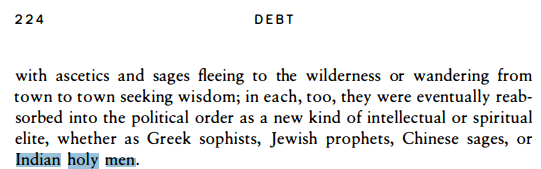
To be clear, Debt: The First 5000 Years is not meant to be an academic work. The first chapter explains that it's really supposed to be a history of anarchy, because Graeber thought his friends needed a history lesson. It wouldn't be a great primary source. However, I've noticed Rudyard quoting this book literally word for word. In Spirit World, he talks about "Buddhist and Hindu holy men" at
10:44, which he took from page 224.