What Happens When an Artist’s Technology Becomes Obsolete?
Curators and conservators are working to save — and update — art made with aging hardware.
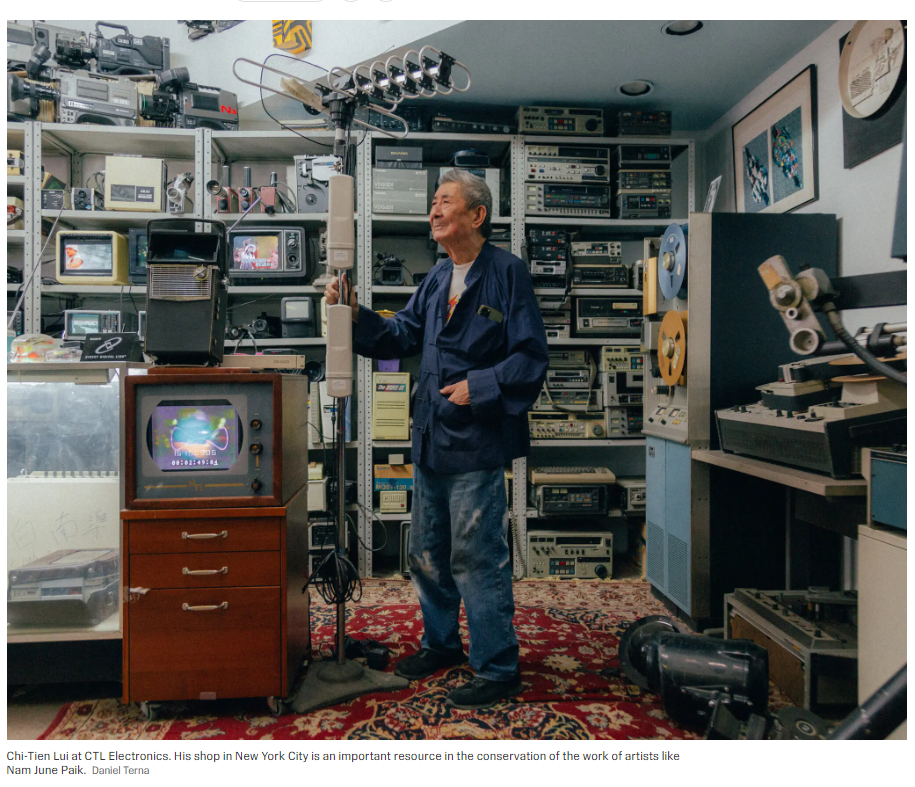
UP A BUCKLING flight of stairs on Murray Street in Lower Manhattan, the dusty workshop of CTL Electronics is crammed with once-novel relics: cathode-ray tube (CRT) televisions, three-beam projectors and laserdisc players from the previous century. Hundreds of outdated monitors are arranged beside money trees and waving maneki neko cats, an installation in a kind of mini-museum run by CTL’s proprietor, Chi-Tien Lui, who has worked as a TV and radio repairman since immigrating from Taiwan in 1961. At CTL, which he opened in 1968, Lui initially sold closed-circuit TV systems and video equipment, but for the past couple of decades, his business has had a unique focus: repairing video artworks that, since the onset of the digital age, are increasingly likely to malfunction and decay.
Many of CTL’s clients are museums looking to restore works by a single artist, the video art pioneer Nam June Paik, who died in 2006. Known for his sculptures and room-size installations of flickering CRT monitors, Paik began visiting the shop in the 1970s on breaks from his studio in nearby SoHo. While some conservators have updated his work by replacing old tubes with LCD screens, Lui is one of the only technicians who can rebuild Paik’s sets from spare parts, as if they were new.
Paik’s work was on view, along with video works from dozens of other artists, in “Signals,” a sweeping exhibition at the Museum of Modern Art in New York earlier this year. Many pieces in the show, such as those in the video collectives section, played on boxy Sony CRT monitors, long favored by artists for their austere, stackable design, and which stopped being produced in the 2000s. The cube CRTs are essentially worthless to consumers, but museums are willing to pay a premium for them on eBay — “if you can even get your hands on one,” said Stuart Comer, the chief curator of media and performance at MoMA, who helped organize the show. “I had to tell security, ‘Pretend these are Donald Judds,’ because they’re basically priceless at this point.”
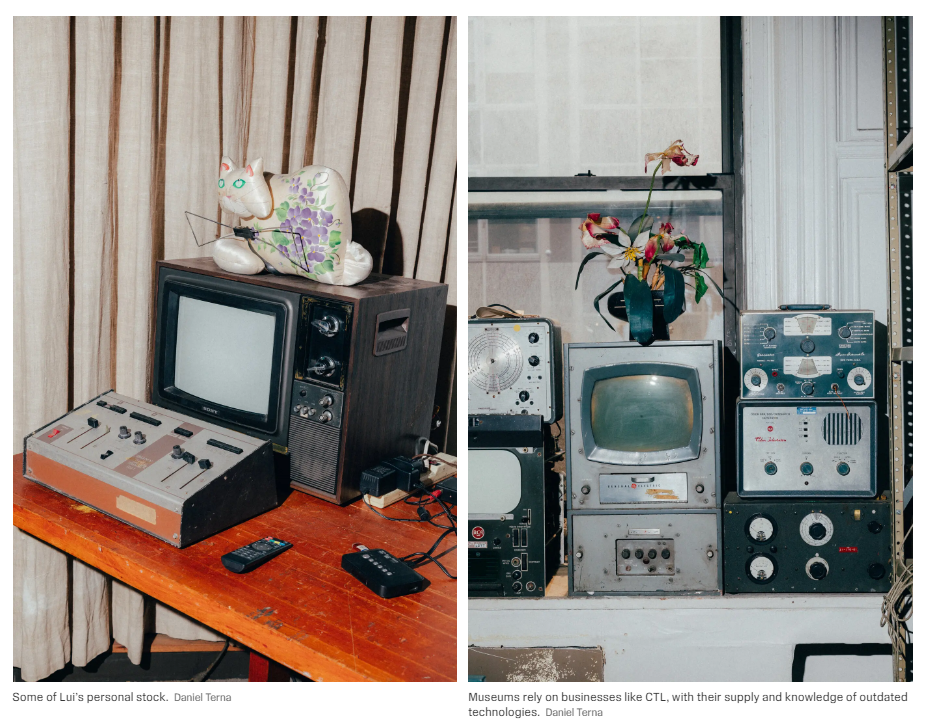
Some of Lui’s personal stock.Credit...Daniel Terna
Museums rely on businesses like CTL, with their supply and knowledge of outdated technologies.Credit...Daniel Terna
It’s an ongoing dilemma for the modern-art institution: New technologies are only ever new for so long. When the phaseout of the incandescent light bulb, a go-to material for artists from Robert Rauschenberg to Felix Gonzalez-Torres, began in 2012, museums either amassed stockpiles of the old bulbs or found a reliable supplier. Dan Flavin, who spent his entire career working with fluorescent light, always had his preferred manufacturers. Last year, the Biden administration proposed as part of its climate policy a sunsetting of compact fluorescents, and a few states have recently enacted legislation that in the coming years will also ban the longer tube lights that Flavin used. For now, museums continue to go through the estate of the artist, who died in 1996, to replace burned-out lights. Not all artists are so precious about their materials, however: In 2012, when Diana Thater presented her 1992 video installation “Oo Fifi, Five Days in Claude Monet’s Garden” at the Los Angeles gallery 1301PE, where it had first been shown 20 years earlier, she updated its clunky CRT projectors to digital ones. She digitized the video, a collage of film footage from Monet’s garden in Giverny, France — itself a technological update of the Impressionist painter’s vistas in oil — because, she said, “I don’t want my work to look fake old.” Paik, for his part, left behind a page of instructions specifying that his works could be updated, as long as the integrity of the original look of the sculpture was respected, to the best of what the technology would allow.
In conserving works made with more mundane materials, museums generally rely on an artist like Thater or on the artist’s estate to provide guidance — or even the materials themselves, as is the case with Flavin. But technology now moves at a much faster pace. A museum’s task of protecting art in perpetuity has remained fixed, even as artists’ materials have changed. Art institutions are likely the only places in the world that are currently planning how they might be able to fix an Oculus Rift 50 years from now. Rather than keep stockpiles of expensive and obsolete technology in storage, museums have to find clever ways around software updates, from video game emulators to server farms to niche businesses like CTL. But they, too, have a life span as short as, or shorter than, those of light bulbs. There are far more obscure materials for artists to choose from than ever before.
GLENN WHARTON WAS hired in 2007 as MoMA’s first conservator of time-based media, or works that often depend on commercial technology that can have a limited shelf life. “I saw the writing on the wall that it was hard to even buy videotapes anymore,” Wharton said. In the early days, he was making decisions “about changing the works of art” that were the equivalent of a painting conservator using acrylic instead of oil paint: “We were swapping out CRTs and sometimes moving toward flat-screen technology, or changing projectors or even digitizing.” Ultimately, Wharton decided, “defining the authentic state of a work of art is central to what conservators do.” So when the museum acquired a work dependent on a specific technology from a living artist, he’d ask how they wanted it to be conserved and displayed.
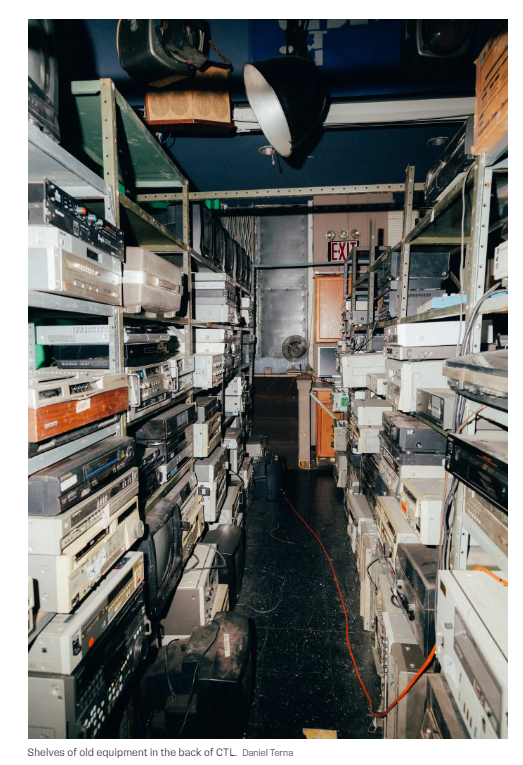
Shelves of old equipment in the back of CTL.Credit...Daniel Terna
Wharton now runs a program at U.C.L.A. that has helped to clarify one of the main issues in the emerging field of digital conservation: digital obsolescence. If certain art is dependent on an extinct technology, how does one preserve the art so that it outlasts the technology itself? Sometimes by addressing a phenomenon called bit rot: As Caroline Gil, the director of media collections and preservation at the New York nonprofit Electronic Arts Intermix, explained, “Digital files of all stripes are made up of data — zeros and ones — and, every so often, a zero can turn into a one through electrostatic discharge in your hard drive or in a big server farm. That corrupts the file.” There are methods for fixing this, she said, “but that’s a very niche level of understanding, and I don’t think a lot of archives or collecting institutions do that, really.”
Coding expertise is still uncommon in museum conservation departments, but that may have to change. “The art world is kind of running on an old operating system of Modernism,” said Cass Fino-Radin, a conservator and founder of the upstate New York firm Small Data Industries, even as museums are collecting newer artworks that, at their core, are composed of code. In 2016, the Cooper Hewitt, Smithsonian Design Museum in New York contacted Fino-Radin for help with a two-year-long assessment of digital materials in its permanent collection. The project included a detailed case study of a defunct iOS app called Planetary, acquired by the museum in 2013, which allowed users to browse a music library like astronauts soaring through the Milky Way. Debuting in 2011, Planetary had been rendered incompatible with iOS software updates within a few years, so the museum decided to share the source code on GitHub for anyone to try to fix it. Ultimately, it was an Australian developer, Kemal Enver, who got it functioning again, releasing it in 2020 as Planetary Remastered. To Fino-Radin, it was a warning sign: “For museums, hiring a professional software developer to do that kind of annual maintenance isn’t something that’s ever been remotely needed in history, and so institutions just don’t have the money to do it. It’s a new line item in their budgets.”
For works dependent on old hardware, conservators sometimes rely on a method known as emulation: “You’re fooling a current computer into thinking that it’s running on an older system, meaning I can turn my MacBook Pro into a virtual machine where I can run a net art piece in a Netscape 1.1 browser,” said Christiane Paul, the curator of digital art at the Whitney Museum of American Art. This approach was adopted at Rhizome, a New York nonprofit dedicated to promoting and preserving digital art, which in 2012 presented (along with the New Museum of Contemporary Art) an online exhibition of interactive computer games for preteen girls co-created by Theresa Duncan that had first been released on CD-ROM in the mid-1990s. Visitors to the Rhizome website can play Chop Suey, a delirious adventure through a small Ohio town, by connecting virtually to a server running the game on its 1995 software.
A diagram and circuit board in Lui’s workspace.Credit...Daniel Terna
Many artists don’t think about what will happen to their work when they are gone. Or they never imagined certain pieces having much of a future. In “Super Mario Clouds” (2002), an early video installation by the artist Cory Arcangel, the 1985 Super Mario Bros. video game plays off a Nintendo console with all of the game’s animated features, apart from sky and clouds, erased. Obsolescence was partly the point of the work because, as a then-unknown artist, Arcangel didn’t expect to be showing it 20 years later — and by 2002 the consoles “were considered trash,” he said. An edition of “Super Mario Clouds” was bought by the Whitney, whose conservators were aware that the console might not function much longer. But the source code remains available, and Arcangel has granted the museum permission to use a Nintendo emulator to show the work.
Yet is an emulated artwork, even if indistinguishable from the original, really the same artwork? This riddle is sometimes known as the paradox of Theseus’s ship: According to Plutarch’s legend, as the Athenians preserved their former king’s boat through the decades by gradually replacing its decaying old planks with new ones, philosophers wondered, could the ship still be considered authentic if none of its original parts remained?
The conundrum is why some artists and conservators have now incorporated outwitting obsolescence into their practices. Lynn Hershman Leeson, an 82-year-old artist who was a contemporary of Paik’s, has been working with A.I. technology since the late 1990s and in 1983 made one of the first interactive video art pieces: “Lorna,” created originally for a groundbreaking new technology called laserdisc. Twenty years later, she upgraded to another now-bygone technology — the DVD. Lately, she’s been experimenting with a futuristic method of archiving her work. Looking to preserve a series of videos and documents from her research on genetic manipulation and synthetic biology, she turned to a technology at once far older and more cutting-edge than anything else on the market: DNA. Hershman Leeson first converted her research into a video timeline on Final Cut Pro, and then enlisted Twist Bioscience in San Francisco, which manufactures DNA products, to chemically synthesize it into a sequence. The resulting genetic material is kept in two vials in her studio, as well as in the San Francisco Museum of Modern Art and the Center for Art and Media in Karlsruhe, Germany. “DNA has a 500-year half-life,” she said. “I also saw it as a metaphor, a poetic conclusion to all of this work, to create something that’s relatively invisible and holds our past and our future.”
The problem is, neither Hershman Leeson nor the museums that collect her work are able to retrieve it from the sequence. In theory, the process is reversible, but it’s also expensive and time-consuming. At least for now, the work belongs to the future.
A version of this article appears in print on , Page 56 of T Magazine with the headline: The Futureof the Past. Order Reprints | Today’s Paper | Subscribe
(+)
Source : https://www.nytimes.com/2023/10/17/t-magazine/technology-art-ctl-electronics.html
Curators and conservators are working to save — and update — art made with aging hardware.
UP A BUCKLING flight of stairs on Murray Street in Lower Manhattan, the dusty workshop of CTL Electronics is crammed with once-novel relics: cathode-ray tube (CRT) televisions, three-beam projectors and laserdisc players from the previous century. Hundreds of outdated monitors are arranged beside money trees and waving maneki neko cats, an installation in a kind of mini-museum run by CTL’s proprietor, Chi-Tien Lui, who has worked as a TV and radio repairman since immigrating from Taiwan in 1961. At CTL, which he opened in 1968, Lui initially sold closed-circuit TV systems and video equipment, but for the past couple of decades, his business has had a unique focus: repairing video artworks that, since the onset of the digital age, are increasingly likely to malfunction and decay.
Many of CTL’s clients are museums looking to restore works by a single artist, the video art pioneer Nam June Paik, who died in 2006. Known for his sculptures and room-size installations of flickering CRT monitors, Paik began visiting the shop in the 1970s on breaks from his studio in nearby SoHo. While some conservators have updated his work by replacing old tubes with LCD screens, Lui is one of the only technicians who can rebuild Paik’s sets from spare parts, as if they were new.
Paik’s work was on view, along with video works from dozens of other artists, in “Signals,” a sweeping exhibition at the Museum of Modern Art in New York earlier this year. Many pieces in the show, such as those in the video collectives section, played on boxy Sony CRT monitors, long favored by artists for their austere, stackable design, and which stopped being produced in the 2000s. The cube CRTs are essentially worthless to consumers, but museums are willing to pay a premium for them on eBay — “if you can even get your hands on one,” said Stuart Comer, the chief curator of media and performance at MoMA, who helped organize the show. “I had to tell security, ‘Pretend these are Donald Judds,’ because they’re basically priceless at this point.”
Some of Lui’s personal stock.Credit...Daniel Terna
Museums rely on businesses like CTL, with their supply and knowledge of outdated technologies.Credit...Daniel Terna
It’s an ongoing dilemma for the modern-art institution: New technologies are only ever new for so long. When the phaseout of the incandescent light bulb, a go-to material for artists from Robert Rauschenberg to Felix Gonzalez-Torres, began in 2012, museums either amassed stockpiles of the old bulbs or found a reliable supplier. Dan Flavin, who spent his entire career working with fluorescent light, always had his preferred manufacturers. Last year, the Biden administration proposed as part of its climate policy a sunsetting of compact fluorescents, and a few states have recently enacted legislation that in the coming years will also ban the longer tube lights that Flavin used. For now, museums continue to go through the estate of the artist, who died in 1996, to replace burned-out lights. Not all artists are so precious about their materials, however: In 2012, when Diana Thater presented her 1992 video installation “Oo Fifi, Five Days in Claude Monet’s Garden” at the Los Angeles gallery 1301PE, where it had first been shown 20 years earlier, she updated its clunky CRT projectors to digital ones. She digitized the video, a collage of film footage from Monet’s garden in Giverny, France — itself a technological update of the Impressionist painter’s vistas in oil — because, she said, “I don’t want my work to look fake old.” Paik, for his part, left behind a page of instructions specifying that his works could be updated, as long as the integrity of the original look of the sculpture was respected, to the best of what the technology would allow.
In conserving works made with more mundane materials, museums generally rely on an artist like Thater or on the artist’s estate to provide guidance — or even the materials themselves, as is the case with Flavin. But technology now moves at a much faster pace. A museum’s task of protecting art in perpetuity has remained fixed, even as artists’ materials have changed. Art institutions are likely the only places in the world that are currently planning how they might be able to fix an Oculus Rift 50 years from now. Rather than keep stockpiles of expensive and obsolete technology in storage, museums have to find clever ways around software updates, from video game emulators to server farms to niche businesses like CTL. But they, too, have a life span as short as, or shorter than, those of light bulbs. There are far more obscure materials for artists to choose from than ever before.
GLENN WHARTON WAS hired in 2007 as MoMA’s first conservator of time-based media, or works that often depend on commercial technology that can have a limited shelf life. “I saw the writing on the wall that it was hard to even buy videotapes anymore,” Wharton said. In the early days, he was making decisions “about changing the works of art” that were the equivalent of a painting conservator using acrylic instead of oil paint: “We were swapping out CRTs and sometimes moving toward flat-screen technology, or changing projectors or even digitizing.” Ultimately, Wharton decided, “defining the authentic state of a work of art is central to what conservators do.” So when the museum acquired a work dependent on a specific technology from a living artist, he’d ask how they wanted it to be conserved and displayed.
Shelves of old equipment in the back of CTL.Credit...Daniel Terna
Wharton now runs a program at U.C.L.A. that has helped to clarify one of the main issues in the emerging field of digital conservation: digital obsolescence. If certain art is dependent on an extinct technology, how does one preserve the art so that it outlasts the technology itself? Sometimes by addressing a phenomenon called bit rot: As Caroline Gil, the director of media collections and preservation at the New York nonprofit Electronic Arts Intermix, explained, “Digital files of all stripes are made up of data — zeros and ones — and, every so often, a zero can turn into a one through electrostatic discharge in your hard drive or in a big server farm. That corrupts the file.” There are methods for fixing this, she said, “but that’s a very niche level of understanding, and I don’t think a lot of archives or collecting institutions do that, really.”
Coding expertise is still uncommon in museum conservation departments, but that may have to change. “The art world is kind of running on an old operating system of Modernism,” said Cass Fino-Radin, a conservator and founder of the upstate New York firm Small Data Industries, even as museums are collecting newer artworks that, at their core, are composed of code. In 2016, the Cooper Hewitt, Smithsonian Design Museum in New York contacted Fino-Radin for help with a two-year-long assessment of digital materials in its permanent collection. The project included a detailed case study of a defunct iOS app called Planetary, acquired by the museum in 2013, which allowed users to browse a music library like astronauts soaring through the Milky Way. Debuting in 2011, Planetary had been rendered incompatible with iOS software updates within a few years, so the museum decided to share the source code on GitHub for anyone to try to fix it. Ultimately, it was an Australian developer, Kemal Enver, who got it functioning again, releasing it in 2020 as Planetary Remastered. To Fino-Radin, it was a warning sign: “For museums, hiring a professional software developer to do that kind of annual maintenance isn’t something that’s ever been remotely needed in history, and so institutions just don’t have the money to do it. It’s a new line item in their budgets.”
For works dependent on old hardware, conservators sometimes rely on a method known as emulation: “You’re fooling a current computer into thinking that it’s running on an older system, meaning I can turn my MacBook Pro into a virtual machine where I can run a net art piece in a Netscape 1.1 browser,” said Christiane Paul, the curator of digital art at the Whitney Museum of American Art. This approach was adopted at Rhizome, a New York nonprofit dedicated to promoting and preserving digital art, which in 2012 presented (along with the New Museum of Contemporary Art) an online exhibition of interactive computer games for preteen girls co-created by Theresa Duncan that had first been released on CD-ROM in the mid-1990s. Visitors to the Rhizome website can play Chop Suey, a delirious adventure through a small Ohio town, by connecting virtually to a server running the game on its 1995 software.
A diagram and circuit board in Lui’s workspace.Credit...Daniel Terna
Many artists don’t think about what will happen to their work when they are gone. Or they never imagined certain pieces having much of a future. In “Super Mario Clouds” (2002), an early video installation by the artist Cory Arcangel, the 1985 Super Mario Bros. video game plays off a Nintendo console with all of the game’s animated features, apart from sky and clouds, erased. Obsolescence was partly the point of the work because, as a then-unknown artist, Arcangel didn’t expect to be showing it 20 years later — and by 2002 the consoles “were considered trash,” he said. An edition of “Super Mario Clouds” was bought by the Whitney, whose conservators were aware that the console might not function much longer. But the source code remains available, and Arcangel has granted the museum permission to use a Nintendo emulator to show the work.
Yet is an emulated artwork, even if indistinguishable from the original, really the same artwork? This riddle is sometimes known as the paradox of Theseus’s ship: According to Plutarch’s legend, as the Athenians preserved their former king’s boat through the decades by gradually replacing its decaying old planks with new ones, philosophers wondered, could the ship still be considered authentic if none of its original parts remained?
The conundrum is why some artists and conservators have now incorporated outwitting obsolescence into their practices. Lynn Hershman Leeson, an 82-year-old artist who was a contemporary of Paik’s, has been working with A.I. technology since the late 1990s and in 1983 made one of the first interactive video art pieces: “Lorna,” created originally for a groundbreaking new technology called laserdisc. Twenty years later, she upgraded to another now-bygone technology — the DVD. Lately, she’s been experimenting with a futuristic method of archiving her work. Looking to preserve a series of videos and documents from her research on genetic manipulation and synthetic biology, she turned to a technology at once far older and more cutting-edge than anything else on the market: DNA. Hershman Leeson first converted her research into a video timeline on Final Cut Pro, and then enlisted Twist Bioscience in San Francisco, which manufactures DNA products, to chemically synthesize it into a sequence. The resulting genetic material is kept in two vials in her studio, as well as in the San Francisco Museum of Modern Art and the Center for Art and Media in Karlsruhe, Germany. “DNA has a 500-year half-life,” she said. “I also saw it as a metaphor, a poetic conclusion to all of this work, to create something that’s relatively invisible and holds our past and our future.”
The problem is, neither Hershman Leeson nor the museums that collect her work are able to retrieve it from the sequence. In theory, the process is reversible, but it’s also expensive and time-consuming. At least for now, the work belongs to the future.
A version of this article appears in print on , Page 56 of T Magazine with the headline: The Futureof the Past. Order Reprints | Today’s Paper | Subscribe
(+)
Source : https://www.nytimes.com/2023/10/17/t-magazine/technology-art-ctl-electronics.html


