Link/(no archive; entire, much longer report attached below)

The far-right landscape in the UK has undergone significant transformation since the 2024 general election, becoming larger, more confident and increasingly confrontational.
At the centre of this shift is Reform UK, which achieved an unprecedented breakthrough in 2024. Since then, the party has expanded rapidly, establishing nearly 500 local branches and claiming a membership of more than 270,000. With increased funding, high-profile defections from the Conservative Party, and growing organisational capacity, Reform is now a major political force.
Reform UK currently has eight MPs and holds 965 council seats, with outright control of ten councils and minority control in three others. Its policy platform reflects a hardline agenda, particularly on immigration. Party leader Nigel Farage has proposed detaining and deporting around 600,000 asylum seekers over five years — a plan that would require withdrawal from multiple international human rights conventions and the repeal of the Human Rights Act, replacing it with a “British Bill of Rights”.
Worryingly, things are set to get worse in the coming year. Reform anticipates large gains in council elections in England, possibly taking control of more than a dozen councils, challenging Plaid Cymru to become the largest party in the Welsh Senedd elections, and possibly coming second in Scotland this spring. The party hopes that heavy losses for Labour and the Conservatives will further its ambitions to be seen as the next government-in-waiting.
With Reform giving Conservative MPs a deadline of early May to defect, the party will be hoping to add to its parliamentary total before then. A strong performance in May’s local elections will greatly destabilise Labour and the Conservatives, and could lead to damaging and divisive leadership challenges within each party, further allowing Reform UK to present themselves as the only serious and stable party out there.

PRESSURE FROM THE RIGHT
As mainstream political parties struggle to deal with the threat of Reform, Nigel Farage might find more trouble coming from his right flank, both electorally and on the streets.
Alongside Reform UK, splinter groups such as Restore Britain and Advance UK have emerged. Advance UK, led by Ben Habib, has received backing from figures such as Tommy Robinson, and positions itself to the right of Reform. Advance UK boasts 40,000 members, though many are likely to jump ship to Rupert Lowe’s new operation.
Restore Britain, formerly a pressure group, has transformed into a political party. At the launch event, Lowe delighted the audience with his policy of mass deportations. “Millions will have to go,” he said. It is this type of extreme rhetoric that has made Lowe the darling of the far right over the last year, and won his new party the support of overt fascists on the very fringes of our politics. Everyone from Katie Hopkins through to Steve Laws and Michael Wright (AKA Morgoth) welcomed the news.
A number of the most influential alternative far-right media outlets have already pledged their support. While these will be considered fringe by most, some have a dedicated following of hundreds of thousands, much of which is young and male, and potentially more radical. Significantly, it has also received the backing of the world’s richest man, Elon Musk, who owns X — the platform through which Lowe has built his support.
According to Restore, membership is about to hit 100,000, but there’s no restrictions on who can join and HOPE not hate is already aware of supporters from overseas signing up.
While Lowe himself is already by far the most extreme MP, the team around him is even more radical, with key figures openly advocating for “remigration”. There is a perception in some quarters of the extreme right that his team is essentially ventriloquising him, and these quarters are placing hope in his team rather than Lowe himself.
Stephen Lennon (AKA Tommy Robinson) remains a key mobilising figure. Following his release from prison in May 2025, he organised the largest far-right protest in UK history: a “Unite the Kingdom” (UTK) rally in London in September, drawing in excess of 150,000 people. Lennon has distanced himself from Reform UK, and many of his supporters now favour Advance UK, further fragmenting the movement while sustaining mass mobilisation.
While the media seemed keen to stress how “normal” much of the crowd were, the same could not be said of the speakers. Several described multiculturalism as a “failed experiment”, many described Islam as supremacist and claimed that the only answer was to expel Muslims from Europe, while others called for the banning of non-Christian places of worship in the UK.
More worrying is the level of support for Lennon’s Unite the Kingdom movement amongst the general public. Polling suggests that among men aged 25-34, support is running at almost 50%. Polling of more than 8,000 people commissioned by HOPE not hate indicated that 26% of adults view UTK positively. While many more do not, the fact that a quarter of Britons may have a positive view of Lennon’s movement is deeply worrying, and reflects just how big the reach of the far right has become and how polarised British society is becoming.
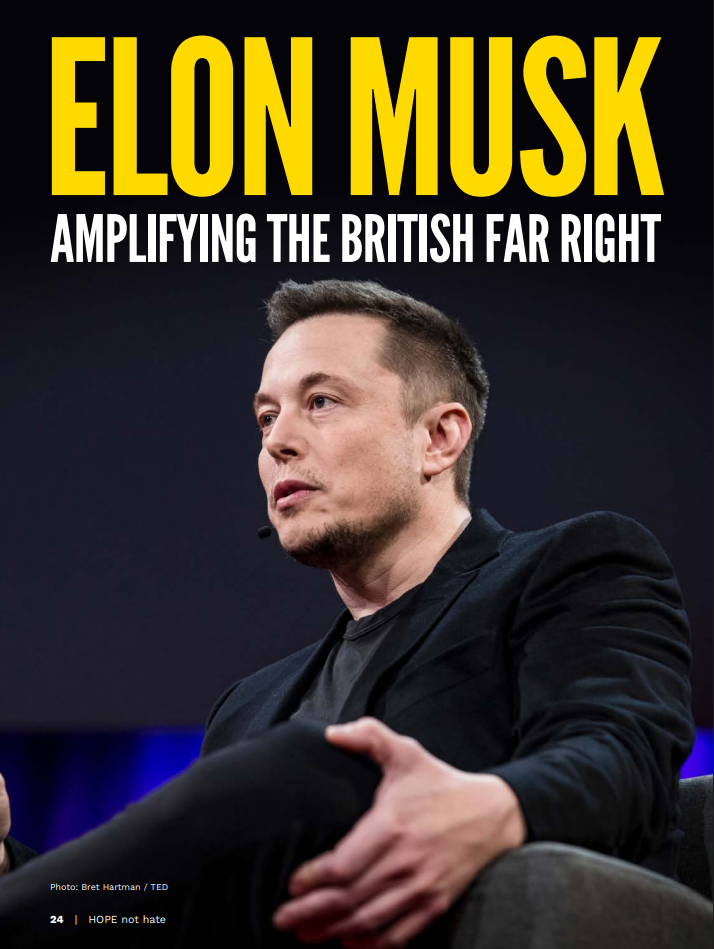
The combination of the strength of Lennon’s support, Rupert Lowe’s Restore Party (and his own personal antagonism to Reform) and Elon Musk’s online clout has forced Farage to shift his party rightwards. After six months of Reform UK moderating its stated policies on immigration and Muslims in a bid to attract the more moderate voters it requires to win a parliamentary majority, the pendulum has now swung back, with the party announcing increasingly hardline policies in a bid to stem the defections to Restore Britain.
Its new policies to create an ICE-style deportation agency, its decision to deport the 600,000 to 1,000,000 people who are in the UK with Indefinite Leave to Remain — on top of the estimated 400,000 asylum seekers who have no current status to stay — and its pledges to ban the burqa and repeal the Employment Rights Act and Equality legislation, clearly put the party in step with other far-right and populist-right parties across Europe and North America.
However, even this will not be enough for Lowe, Lennon and Musk, and it is likely that Reform UK will have to shift further right if Restore Britain retains its support in the polls — currently at 5-7% — and threatens to deprive Farage his chance of becoming prime minister.
PROTESTS
A major feature of the current threat environment has been the wave of anti-migrant protests that reignited in Epping in July 2025. HOPE not hate tracked 251 demonstrations throughout the year, often outside hotels housing asylum seekers. These continuing protests frequently exploit fears about crime and sexual violence, and while some are genuinely local in origin, others are coordinated or amplified by organised far-right networks.
The emergence of the so-called “Pink Ladies” protests — which feature women dressed in pink, and are framed around women’s and children’s safety — has provided a softer public image for strongly anti-migrant messaging.
One worrying feature is that these anti-migrant protests have persisted through the winter months in key areas, with some attracting several thousand people. As we head towards the hot summer months, we will very likely see a surge in activity once again.
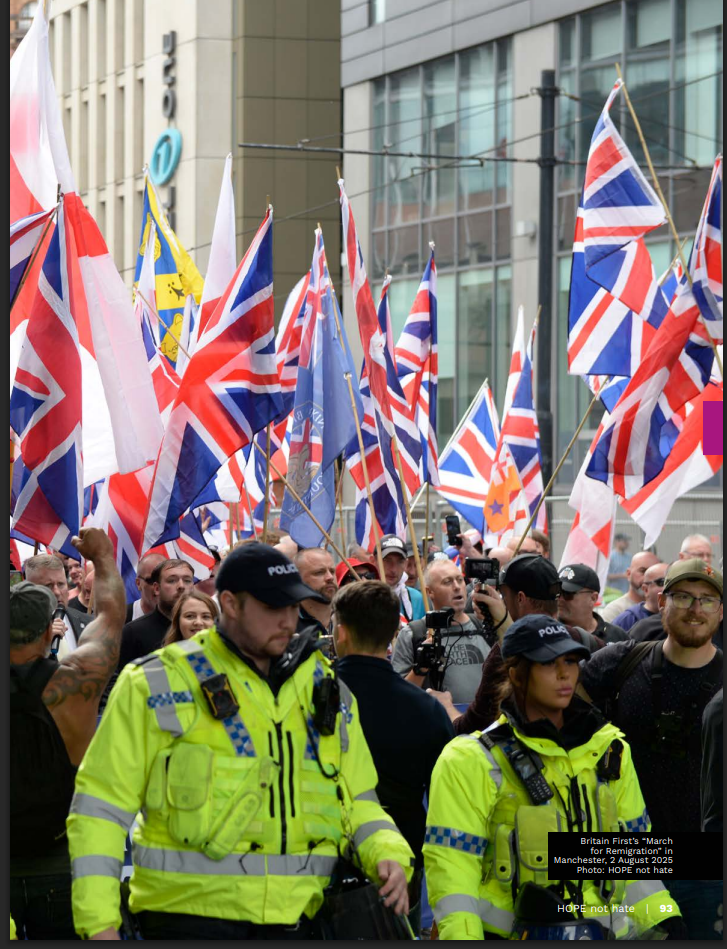
Symbolism plays a significant role in these protests. Union Jack and St George’s Cross flags are ubiquitous, and activism has escalated from flag displays to vandalism, including painting roundabouts and crossings with nationalist symbols. The initial “Operation Raise the Colours” initiative was organised by Andrew Currien, a former English Defence League member with a violent criminal history, illustrating the overlap between grassroots activism and hardened extremists.
Since then, a Birmingham-based group formed off the back of the campaign, known only as “Raise the Colours”, evolved into a separate organisation running operations in Calais. While the flag movement has recently suffered splits between Danny Tommo (real name Daniel Thomas) and the Raise the Colours team, and some of the momentum behind the protests has waned of late, we are likely to see a resurgence as we approach the summer, against the backdrop of the World Cup.
Many traditional far-right groups are in a period of flux. The anti-Muslim group Britain First has abandoned elections and pivoted to protests, organising a series of “March for Remigration” events, the largest of which brought roughly 800 people to the streets of Manchester in August.
UKIP has seen modest growth under Nick Tenconi, who has transformed it into an aggressive street group, but remains constrained by its extremism.
At the more extreme end of the spectrum, the organised fascist scene remains small but persistent. The Homeland Party became the largest fascist group in the UK, growing to roughly 1,400 members by April, but has suffered a remarkable collapse, with many of its newest members retreating to longer-standing groups such as Patriotic
Alternative and the British Democrats — and now Restore Britain.
Of particular concern is the rapid growth of the Active Club network, a series of fascist fight clubs which have established regional chapters across England and Scotland and are actively preparing for conflict.
HOPE not hate has recently exposed new fascist threats in the form of two organisations: White Vanguard and Aryan Front, which, while tiny, are highly confrontational and potentially violent. Far-right terrorism arrests continue in large numbers, underscoring the ongoing security threat posed by these networks.

Finally, the most expansive element of the contemporary far right is the “post-organisational” space: vast, decentralised online networks with no formal leadership. Thousands of individuals contribute time, money, and digital activity to shared causes, often guided by influencers such as Lennon.
Online platforms, forums, gaming spaces, and social media allow anonymous participation, dramatically lowering the barriers to engagement. These loose, transnational networks function as hubs for information-sharing and mobilisation, and act as incubators for offline protest activity.
Together, these dynamics reveal a far right that is no longer confined to fringe organisations, but one that spans electoral politics, street mobilisation, extremist subcultures, and global online ecosystems, posing a complex and evolving challenge.
RISING RACIAL NATIONALISM
One of the most worrying trends within the far right over the last year is the rising prevalence of racial nationalist thinking. Debates over who belongs to the nation have always sat at the core of far-right politics, but in Britain they are being fought through the language of civic versus ethnic nationalism.
While civic and cultural nationalists claim that Britishness can be earned through values, contribution, or cultural conformity, this inclusion is rarely secure. In practice, people of colour are treated as conditionally British, with their belonging open to challenge or withdrawal.
Over the last two decades, the supposedly non-racial approach dominated much of the far right, particularly through movements fixated on Islam and Muslims. Yet recent years have seen a clear re-racialisation of the scene, with ethnonationalist ideas about blood, ancestry, and immutable difference gaining traction.
Figures who once avoided explicit racial politics now openly argue that being born in Britain is insufficient, and that black Britons can never truly belong. Of course, the supposed divide between civic and ethnic nationalism is often overstated, as both rest on the assumption that national belonging must be policed and restricted.
At the same time, racialised definitions of Englishness are aired by mainstream commentators and politicians, who frame demographic change as a crisis and question the legitimacy of non-white English identity.
While most people in England continue to reject racial definitions of identity, the steady normalisation of these ideas in public debate risks dragging extremist thinking into the mainstream, with profound consequences for how citizenship, equality and belonging are understood.
So mainstream has this discussion over Britishness become, that former prime
minister Rishi Sunak felt forced to defend his own British identity in the national media.

CIVIL WAR
Another dangerous trend is the growth in confidence and aggression displayed by much of the movement, including the idea that a civil war is inevitable, or even something to be welcomed. Once confined to the fringes of the counter-jihad scene or neo-Nazi groups, these narratives are now much more widespread.
New HOPE not hate polling shows how far this thinking has travelled. A third of British adults have read or seen material about civil war in the past two years, which is probably not surprising given that major newspapers like the Daily Telegraph, Guardian and The Times have all covered it.
More worrying, though, is the number of people who think a civil war could happen. Eight per cent of Britons in our poll of 8,200 people think there will definitely be a civil war within the next five years, either between communities or against the state, with another 23% saying it is possible. Amongst Reform UK members, 66% think a civil war will happen, whilst amongst those who strongly like Stephen Lennon, the figure is 78%.
The precise likelihood of a civil war matters less than what these figures reveal about the mood on the far right, which is markedly more aggressive and antagonistic than it was even a few years ago. The magma chamber of anger and resentment beneath British society, laid bare during the riots of 2024, has not cooled; if anything, it has intensified.
Almost two thirds of those who strongly like Stephen Lennon (60%) think political violence is justified for a cause they believe in.
This escalation is taking place in a global context where the far right is no longer relegated to the margins but increasingly holds power, whether in parliaments, governing coalitions, or as the state itself. That shift emboldens extremists, hardens rhetoric, and blurs the boundary between fantasy and action, creating a volatile environment in which violent ideas feel not just imaginable, but legitimate.

A WORRYING YEAR AHEAD
There is no doubt these are extremely uncertain times. The far right, in its various forms, poses a larger threat than at any time in HOPE not hate’s existence. Whether on our streets or at the ballot box, the far right is larger, more confident and ever more confrontational.
Adding to this, there are foreign actors, both states and individuals, who are only too keen to further widen divisions in British society.
In its 2025 National Security Strategy, published in December 2025, the Trump administration set out a more confrontational stance towards Europe, building on, and cementing into policy, JD Vance’s February 2025 speech at the Munich Security Conference.
The speech took aim at Western liberalism and inferred a policy to actively support anti-immigration movements and parties — a truly frightening prospect. As the respected Dutch political scientist Cas Mudde noted, “Trump’s new national security strategy seeks to destroy liberal democracy as we know it.”
And let us not forget Elon Musk’s words when he was interviewed on video at Tommy Robinson’s Unite the Kingdom rally. “Whether you choose violence or not, violence is coming to you. You either fight back or you die, that’s the truth, I think.”
Earlier that morning, he posted on X: “Either we fight back or they will kill us.”
The causes of the far right’s growth are complex, but much can be explained by the growing feeling in the UK that the country is declining and mainstream politicians have failed. De-industrialisation, the financial crash and the more recent cost-of-living crisis have left many families struggling and parents fearing their kids will have a worse life than their own.
While, as this report shows, there is often a big difference between reality and perception, a feeling of decline is sweeping the country, and personal and political scandals appear to be sinking Labour like they did the Conservatives before them.
The far right poses its most significant threat in Britain for decades, perhaps ever. The threat is at the ballot box, on the streets and in our communities.
The sense among many members of the far right that they are in an existential battle for their very survival, coupled with the promotion of these sentiments by Elon Musk and by Donald Trump, could very well signal real trouble ahead. In last year’s State of Hate report we complained about the absence of a cohesion strategy from the government. While that strategy has only just begun to materialise, the situation we are in goes beyond this. This is a threat to our national security. It is that serious.
There are no easy fixes to this. If we are to prevent the far right from gaining power, or even just from making more disturbances in our communities, then we need to step up and get organised.
But never underestimate the power of people, because people can do amazing things. Time and again, when given an option, people will usually choose HOPE over hate. It’s just that we need to give them the HOPE — offer them a better future, and provide them with the skills, resources and arguments to use, and give them the confidence to believe that a better tomorrow is possible.
The far-right landscape in the UK has undergone significant transformation since the 2024 general election, becoming larger, more confident and increasingly confrontational.
At the centre of this shift is Reform UK, which achieved an unprecedented breakthrough in 2024. Since then, the party has expanded rapidly, establishing nearly 500 local branches and claiming a membership of more than 270,000. With increased funding, high-profile defections from the Conservative Party, and growing organisational capacity, Reform is now a major political force.
Reform UK currently has eight MPs and holds 965 council seats, with outright control of ten councils and minority control in three others. Its policy platform reflects a hardline agenda, particularly on immigration. Party leader Nigel Farage has proposed detaining and deporting around 600,000 asylum seekers over five years — a plan that would require withdrawal from multiple international human rights conventions and the repeal of the Human Rights Act, replacing it with a “British Bill of Rights”.
Worryingly, things are set to get worse in the coming year. Reform anticipates large gains in council elections in England, possibly taking control of more than a dozen councils, challenging Plaid Cymru to become the largest party in the Welsh Senedd elections, and possibly coming second in Scotland this spring. The party hopes that heavy losses for Labour and the Conservatives will further its ambitions to be seen as the next government-in-waiting.
With Reform giving Conservative MPs a deadline of early May to defect, the party will be hoping to add to its parliamentary total before then. A strong performance in May’s local elections will greatly destabilise Labour and the Conservatives, and could lead to damaging and divisive leadership challenges within each party, further allowing Reform UK to present themselves as the only serious and stable party out there.
PRESSURE FROM THE RIGHT
As mainstream political parties struggle to deal with the threat of Reform, Nigel Farage might find more trouble coming from his right flank, both electorally and on the streets.
Alongside Reform UK, splinter groups such as Restore Britain and Advance UK have emerged. Advance UK, led by Ben Habib, has received backing from figures such as Tommy Robinson, and positions itself to the right of Reform. Advance UK boasts 40,000 members, though many are likely to jump ship to Rupert Lowe’s new operation.
Restore Britain, formerly a pressure group, has transformed into a political party. At the launch event, Lowe delighted the audience with his policy of mass deportations. “Millions will have to go,” he said. It is this type of extreme rhetoric that has made Lowe the darling of the far right over the last year, and won his new party the support of overt fascists on the very fringes of our politics. Everyone from Katie Hopkins through to Steve Laws and Michael Wright (AKA Morgoth) welcomed the news.
A number of the most influential alternative far-right media outlets have already pledged their support. While these will be considered fringe by most, some have a dedicated following of hundreds of thousands, much of which is young and male, and potentially more radical. Significantly, it has also received the backing of the world’s richest man, Elon Musk, who owns X — the platform through which Lowe has built his support.
According to Restore, membership is about to hit 100,000, but there’s no restrictions on who can join and HOPE not hate is already aware of supporters from overseas signing up.
While Lowe himself is already by far the most extreme MP, the team around him is even more radical, with key figures openly advocating for “remigration”. There is a perception in some quarters of the extreme right that his team is essentially ventriloquising him, and these quarters are placing hope in his team rather than Lowe himself.
Stephen Lennon (AKA Tommy Robinson) remains a key mobilising figure. Following his release from prison in May 2025, he organised the largest far-right protest in UK history: a “Unite the Kingdom” (UTK) rally in London in September, drawing in excess of 150,000 people. Lennon has distanced himself from Reform UK, and many of his supporters now favour Advance UK, further fragmenting the movement while sustaining mass mobilisation.
While the media seemed keen to stress how “normal” much of the crowd were, the same could not be said of the speakers. Several described multiculturalism as a “failed experiment”, many described Islam as supremacist and claimed that the only answer was to expel Muslims from Europe, while others called for the banning of non-Christian places of worship in the UK.
More worrying is the level of support for Lennon’s Unite the Kingdom movement amongst the general public. Polling suggests that among men aged 25-34, support is running at almost 50%. Polling of more than 8,000 people commissioned by HOPE not hate indicated that 26% of adults view UTK positively. While many more do not, the fact that a quarter of Britons may have a positive view of Lennon’s movement is deeply worrying, and reflects just how big the reach of the far right has become and how polarised British society is becoming.
The combination of the strength of Lennon’s support, Rupert Lowe’s Restore Party (and his own personal antagonism to Reform) and Elon Musk’s online clout has forced Farage to shift his party rightwards. After six months of Reform UK moderating its stated policies on immigration and Muslims in a bid to attract the more moderate voters it requires to win a parliamentary majority, the pendulum has now swung back, with the party announcing increasingly hardline policies in a bid to stem the defections to Restore Britain.
Its new policies to create an ICE-style deportation agency, its decision to deport the 600,000 to 1,000,000 people who are in the UK with Indefinite Leave to Remain — on top of the estimated 400,000 asylum seekers who have no current status to stay — and its pledges to ban the burqa and repeal the Employment Rights Act and Equality legislation, clearly put the party in step with other far-right and populist-right parties across Europe and North America.
However, even this will not be enough for Lowe, Lennon and Musk, and it is likely that Reform UK will have to shift further right if Restore Britain retains its support in the polls — currently at 5-7% — and threatens to deprive Farage his chance of becoming prime minister.
PROTESTS
A major feature of the current threat environment has been the wave of anti-migrant protests that reignited in Epping in July 2025. HOPE not hate tracked 251 demonstrations throughout the year, often outside hotels housing asylum seekers. These continuing protests frequently exploit fears about crime and sexual violence, and while some are genuinely local in origin, others are coordinated or amplified by organised far-right networks.
The emergence of the so-called “Pink Ladies” protests — which feature women dressed in pink, and are framed around women’s and children’s safety — has provided a softer public image for strongly anti-migrant messaging.
One worrying feature is that these anti-migrant protests have persisted through the winter months in key areas, with some attracting several thousand people. As we head towards the hot summer months, we will very likely see a surge in activity once again.
Symbolism plays a significant role in these protests. Union Jack and St George’s Cross flags are ubiquitous, and activism has escalated from flag displays to vandalism, including painting roundabouts and crossings with nationalist symbols. The initial “Operation Raise the Colours” initiative was organised by Andrew Currien, a former English Defence League member with a violent criminal history, illustrating the overlap between grassroots activism and hardened extremists.
Since then, a Birmingham-based group formed off the back of the campaign, known only as “Raise the Colours”, evolved into a separate organisation running operations in Calais. While the flag movement has recently suffered splits between Danny Tommo (real name Daniel Thomas) and the Raise the Colours team, and some of the momentum behind the protests has waned of late, we are likely to see a resurgence as we approach the summer, against the backdrop of the World Cup.
Many traditional far-right groups are in a period of flux. The anti-Muslim group Britain First has abandoned elections and pivoted to protests, organising a series of “March for Remigration” events, the largest of which brought roughly 800 people to the streets of Manchester in August.
UKIP has seen modest growth under Nick Tenconi, who has transformed it into an aggressive street group, but remains constrained by its extremism.
At the more extreme end of the spectrum, the organised fascist scene remains small but persistent. The Homeland Party became the largest fascist group in the UK, growing to roughly 1,400 members by April, but has suffered a remarkable collapse, with many of its newest members retreating to longer-standing groups such as Patriotic
Alternative and the British Democrats — and now Restore Britain.
Of particular concern is the rapid growth of the Active Club network, a series of fascist fight clubs which have established regional chapters across England and Scotland and are actively preparing for conflict.
HOPE not hate has recently exposed new fascist threats in the form of two organisations: White Vanguard and Aryan Front, which, while tiny, are highly confrontational and potentially violent. Far-right terrorism arrests continue in large numbers, underscoring the ongoing security threat posed by these networks.
Finally, the most expansive element of the contemporary far right is the “post-organisational” space: vast, decentralised online networks with no formal leadership. Thousands of individuals contribute time, money, and digital activity to shared causes, often guided by influencers such as Lennon.
Online platforms, forums, gaming spaces, and social media allow anonymous participation, dramatically lowering the barriers to engagement. These loose, transnational networks function as hubs for information-sharing and mobilisation, and act as incubators for offline protest activity.
Together, these dynamics reveal a far right that is no longer confined to fringe organisations, but one that spans electoral politics, street mobilisation, extremist subcultures, and global online ecosystems, posing a complex and evolving challenge.
RISING RACIAL NATIONALISM
One of the most worrying trends within the far right over the last year is the rising prevalence of racial nationalist thinking. Debates over who belongs to the nation have always sat at the core of far-right politics, but in Britain they are being fought through the language of civic versus ethnic nationalism.
While civic and cultural nationalists claim that Britishness can be earned through values, contribution, or cultural conformity, this inclusion is rarely secure. In practice, people of colour are treated as conditionally British, with their belonging open to challenge or withdrawal.
Over the last two decades, the supposedly non-racial approach dominated much of the far right, particularly through movements fixated on Islam and Muslims. Yet recent years have seen a clear re-racialisation of the scene, with ethnonationalist ideas about blood, ancestry, and immutable difference gaining traction.
Figures who once avoided explicit racial politics now openly argue that being born in Britain is insufficient, and that black Britons can never truly belong. Of course, the supposed divide between civic and ethnic nationalism is often overstated, as both rest on the assumption that national belonging must be policed and restricted.
At the same time, racialised definitions of Englishness are aired by mainstream commentators and politicians, who frame demographic change as a crisis and question the legitimacy of non-white English identity.
While most people in England continue to reject racial definitions of identity, the steady normalisation of these ideas in public debate risks dragging extremist thinking into the mainstream, with profound consequences for how citizenship, equality and belonging are understood.
So mainstream has this discussion over Britishness become, that former prime
minister Rishi Sunak felt forced to defend his own British identity in the national media.
CIVIL WAR
Another dangerous trend is the growth in confidence and aggression displayed by much of the movement, including the idea that a civil war is inevitable, or even something to be welcomed. Once confined to the fringes of the counter-jihad scene or neo-Nazi groups, these narratives are now much more widespread.
New HOPE not hate polling shows how far this thinking has travelled. A third of British adults have read or seen material about civil war in the past two years, which is probably not surprising given that major newspapers like the Daily Telegraph, Guardian and The Times have all covered it.
More worrying, though, is the number of people who think a civil war could happen. Eight per cent of Britons in our poll of 8,200 people think there will definitely be a civil war within the next five years, either between communities or against the state, with another 23% saying it is possible. Amongst Reform UK members, 66% think a civil war will happen, whilst amongst those who strongly like Stephen Lennon, the figure is 78%.
The precise likelihood of a civil war matters less than what these figures reveal about the mood on the far right, which is markedly more aggressive and antagonistic than it was even a few years ago. The magma chamber of anger and resentment beneath British society, laid bare during the riots of 2024, has not cooled; if anything, it has intensified.
Almost two thirds of those who strongly like Stephen Lennon (60%) think political violence is justified for a cause they believe in.
This escalation is taking place in a global context where the far right is no longer relegated to the margins but increasingly holds power, whether in parliaments, governing coalitions, or as the state itself. That shift emboldens extremists, hardens rhetoric, and blurs the boundary between fantasy and action, creating a volatile environment in which violent ideas feel not just imaginable, but legitimate.
A WORRYING YEAR AHEAD
There is no doubt these are extremely uncertain times. The far right, in its various forms, poses a larger threat than at any time in HOPE not hate’s existence. Whether on our streets or at the ballot box, the far right is larger, more confident and ever more confrontational.
Adding to this, there are foreign actors, both states and individuals, who are only too keen to further widen divisions in British society.
In its 2025 National Security Strategy, published in December 2025, the Trump administration set out a more confrontational stance towards Europe, building on, and cementing into policy, JD Vance’s February 2025 speech at the Munich Security Conference.
The speech took aim at Western liberalism and inferred a policy to actively support anti-immigration movements and parties — a truly frightening prospect. As the respected Dutch political scientist Cas Mudde noted, “Trump’s new national security strategy seeks to destroy liberal democracy as we know it.”
And let us not forget Elon Musk’s words when he was interviewed on video at Tommy Robinson’s Unite the Kingdom rally. “Whether you choose violence or not, violence is coming to you. You either fight back or you die, that’s the truth, I think.”
Earlier that morning, he posted on X: “Either we fight back or they will kill us.”
The causes of the far right’s growth are complex, but much can be explained by the growing feeling in the UK that the country is declining and mainstream politicians have failed. De-industrialisation, the financial crash and the more recent cost-of-living crisis have left many families struggling and parents fearing their kids will have a worse life than their own.
While, as this report shows, there is often a big difference between reality and perception, a feeling of decline is sweeping the country, and personal and political scandals appear to be sinking Labour like they did the Conservatives before them.
The far right poses its most significant threat in Britain for decades, perhaps ever. The threat is at the ballot box, on the streets and in our communities.
The sense among many members of the far right that they are in an existential battle for their very survival, coupled with the promotion of these sentiments by Elon Musk and by Donald Trump, could very well signal real trouble ahead. In last year’s State of Hate report we complained about the absence of a cohesion strategy from the government. While that strategy has only just begun to materialise, the situation we are in goes beyond this. This is a threat to our national security. It is that serious.
There are no easy fixes to this. If we are to prevent the far right from gaining power, or even just from making more disturbances in our communities, then we need to step up and get organised.
But never underestimate the power of people, because people can do amazing things. Time and again, when given an option, people will usually choose HOPE over hate. It’s just that we need to give them the HOPE — offer them a better future, and provide them with the skills, resources and arguments to use, and give them the confidence to believe that a better tomorrow is possible.


