L | A
By Richard D. McClellan

Louis A. Bertrand Rendition produced by Heatherly McClellan, wife of the author. Heatherly is an accomplished, published illustrator, who taught classes at Utah Valley State College and is currently attending the Cleveland Institute of Art. The original photograph was found in the Improvement Era XI (December 1907): 80-89, but has since been lost or destroyed.
“The events of my life have been such . . . that my Autobiography, if ever I shall publish such a thing, will certainly form one of the most singular & romantic books of the age.”
One of the most colorful European converts to The Church of Jesus Christ of Latter-day Saints during the nineteenth century, Louis Alphonse Bertrand has not been recognized by many LDS historians as an individual worthy of attention.
A world traveler by the age of thirty, a member of the people’s committee in the French Revolution of 1848, the political editor of the largest communist periodical in Paris, an associate of Etienne Cabet, and persona non grata to the French government, Bertrand certainly made a political name for himself in France.
He was also a fierce proponent of the Latter-day Saint cause there, serving in three mission presidencies, translating the Book of Mormon and other Church literature into the French language, preaching to Victor Hugo, authoring numerous books and articles, and appealing to Louis Napoleon III for permission to preach the tenets of the LDS faith.
In Utah, Bertrand developed a close personal relationship with Brigham Young, served as a correspondent for the Deseret News (along with various Parisian periodicals), aided French immigrants as they adjusted to new surroundings, actively engaged in debates on wine production, and was considered an expert in silk culture, which he advocated with a zeal that eclipsed even President Young’s desires to see this industry reach fruition in the territory.
A man possessed of incredible talents and a brilliant mind, Bertrand had lofty ambitions and was tragically disappointed in nearly all of them. He called his life “quite troubled and rich in romantic experiences.”
His early career as a daguerreotyper was cut short by a mugging in the Philippines. His efforts in the Revolution of 1848 were recompensed by a three-month tenure in a Paris prison. His translation of the Doctrine and Covenants was lost before it could be published.
His five-year term as mission president resulted in ridicule from the French emperor and, in Bertrand’s own mind, only minimal success. His work for Brigham Young ended in an abrupt dismissal and unwarranted accusations. His refusal to respond to President Young’s encouragement to take other wives, after leaving his own wife in Paris, led to a lonely death after a brief period of dementia.
John Flandin before Mormonism—Early Life and Travels
Born on 8 January 1808 near Marseilles, France, Bertrand was given the name at birth of John Francis Elias Flandin (Jean Francois Elie Flandin).
He likely changed his name during the political intrigue leading up to the Revolution of 1848 to protect his family. Temple records, his naturalization papers, and a personal letter to Brigham Young are the only existing proof of his real name, and secondary sources that mention him do not generally acknowledge that he had another.
Furthermore, most of the details of his life before he joined the Church are sketchy at best. It is apparent that he traveled much of the world between the ages of sixteen and thirty-six, but it is with some degree of guesswork that the order of his travels is pieced together—for lack of reliable, reconcilable sources.
John Flandin was the son of a well-to-do olive oil merchant. His father’s hopes of John’s becoming a clergyman put John into a Catholic ministerial school at an early age, where he studied Greek, Latin, and French. However, in 1823, at the age of sixteen, John abandoned the ministry to join a shipping company.
He had become “restless in the scholastic surroundings and . . . set out to see the world.” He records that “when only twenty years old [1828] I had already visited all the nooks and crannies of the Mediterranean Sea.” John then traveled farther and farther from France, even living for some time in the West Indies before arriving in Brazil, where he lived for a year and participated in the coronation of Don Pedros II in 1831.
Flandin next went to the United States, where his purposes were quite simple—to make a small fortune and return with it to France. Accordingly, in 1832, he was naturalized an American citizen “by the Marine Court of the City of New York, a few days before the second election of General Jackson.”
In the U.S., he got a “glimpse of the political mechanism of the work of Washington, of the social tendencies of the sons of the first settlers, of the practice of the most absolute freedom and of the gigantic progresses of the Anglo-Saxon race upon that new hemisphere.”
However, after seven years, all he had to show for his time in the United States was fluent English. Though he then returned “to France to settle down to a more prosaic life,” Flandin’s life in France was anything but conventional.
By 1842, Flandin arrived in Paris, where he witnessed the funeral of the Duke of Orleans; however, he was soon abroad once more:
On his return from the East, Flandin pressed himself into the intellectual community of Paris, beginning by publishing “a few leaves from [his] autobiography.” He says, “I then devoted myself body and spirit to politics and more particularly to the study of the questions brulantes posces upon the first French Revolution, which have been since developed by socialism.”
Thirty-eight years old, Flandin became steeped in Paris’s teeming political arena as a communist after the order of Etienne Cabet (1788–1856); he also studied the tenets of Wronski (1778–1953) and joined the philosophical circles of Buchez (1796–1865).
With the merger of the Socialist and Republican parties having taken place in 1843, Bertrand’s seemingly paradoxical socialist ideals and involvement in the democratic military movement resulted in his being voted by the people to the Revolutionary Committee of 1848.
Though the revolution was successful, it culminated in the ascension to power of Louis Napoleon III, who was primarily concerned with self-preservation, unfortunately for the Socialists; and Bertrand found himself “imprisoned [for] 3 months in 1848, merely for his opinions.”
Bertrand’s Conversion
When John Taylor and Curtis E. Bolton first visited Etienne Cabet’s Paris headquarters in the summer of 1850, the leader of the communist “Icarians” was busy salvaging his first “Icaria,” moving the remnants of a destroyed Texan colony to Nauvoo, Illinois, where he found that the abandoned homes and empty, plowed fields suited his budget.
Bertrand was working as the political editor of Cabet’s newspaper, Le Populaire, and it was in this capacity that Taylor and Bolton encountered him (along with another editor named Krolikowski, whom Taylor later referred to in several sermons in the Tabernacle).
These visionaries shared a common dream of developing the perfect society; however, unlike the Icarians, the two Mormons felt that the success of such a Utopia depended on a faith centered in Jesus Christ. Eventually, Bertrand concurred, and he was baptized by John Taylor on 1 December.
One who was prone to complain of his “poor, broken English,” Bertrand wrote the following of his conversion:
Unfortunately for Bertrand, his wife did not share his enthusiasm for the Mormon faith, and neither she nor their two sons ever converted.
A Mormon Socialist in France
On 8 December, only a week after his baptism, Bertrand was one of eight members present at the creation of the first Paris branch and was ordained a priest by John Taylor.
During the next year, he became deeply involved in the happenings of the Church, which, with the exception of brief visits from possibly two elders, dated its beginnings in France to the establishment of the French Mission by Elder Taylor only two months before Bertrand met him.
The infant church immediately tapped the editor’s skills; and over the next year, he translated and authored numerous pieces, though he continued to attract negative government attention for his involvement with Le Populaire.
Cabet, having returned to Paris and finding that the flavor of his periodical had changed drastically during his absence, dismissed Bertrand on 18 November 1851. Bolton wrote the following in his journal:

Louis A. Bertrand, Courtesy of Richard D. McClellan
Bertrand began helping Bolton full time on the Book of Mormon translation the next morning, and after the day’s work, a gratefully impressed Bolton recorded: “I hope his ardor will continue. He is an elegant writer.”
On 2 December 1851—the anniversary of Napoleon’s coronation and victory at Austerlitz—Louis Napoleon III undertook a coup d’etat after the Assembly refused to extend his four-year term. For Bertrand, the possibilities were terrifying.
With riots in the streets, news reached Bolton that many of Bertrand’s friends had been captured and thrown into prison: “On account of his safety we concluded to leave Paris for a day or two, which we did at 4 Oclock. Fighting had commenced in Paris. The streets are full of dismal looking faces.”
The two men returned two days later and resumed translation, despite continued fighting in the street.
This political unrest led to immediate changes in the leadership of the mission. Among the ideas taught and published by John Taylor during his time in France was the notion that the Kingdom of God, as established by the Church, would subdue all other political entities; understandably, this doctrine was not received well by the French government.
Taylor was in hiding by the time he reorganized the French mission presidency on 20 December 1851, with Bolton as president and Bertrand, now a high priest, as counselor and president of the Paris Conference. A few days later, Taylor narrowly escaped capture and caught a boat out of the country.
Book of Mormon Translation Issue
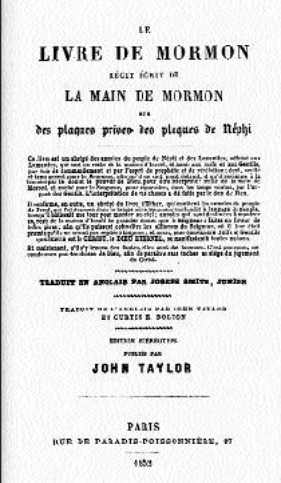
Title page of the Book of Mormon French translation. Note John Taylor’s name as the translator, assisted by Curtis Bolton. Correctly, the page should say that Bertrand helped Bolton, or that the two worked together on the translation
Amid further political problems for Bertrand, the Book of Mormon was published in January 1852. Though the title page shows Taylor as the translator and Bolton assisting, John Taylor, who never learned much French, did little besides raise money for the book’s publication.
Bolton, whose name appeared in the book only after many loud complaints, doubtless contributed the most time to the work and adamantly maintained that Taylor had nothing to do with the translation.
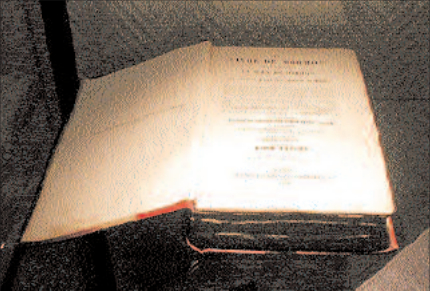
First French edition of the Book of Mormon, 1852, located in an LDS Information Center in Paris. Photo by Alexander L. Baugh
Louis Bertrand, a seasoned editor and the only person on the project who was fluent in both languages necessary for the translation, probably accomplished more during his three months of fulltime work (and over two months part time) than Bolton was able to do off and on during the preceding year and a half.
Still, given the time Bolton had already spent on the translation, much of Bertrand’s work was likely reworking what had already been done. One source says the following:
By his own hand, Bertrand simply asserts, “I contributed considerably.” At any rate, the title page would be most accurate if it listed Bolton as the translator, assisted by Bertrand, or the two men as cotranslators. Also, there is no evidence that Bertrand and Bolton ever quibbled over who deserved credit, as Taylor and Bolton did vehemently.
New Mission Presidency

Site of the Book of Mormon translation, #7 Rue de Tournon, Paris, France. Photo by Alexander L. Baugh
Only nine months after his appointment as mission president, Bolton was released at a special conference in Salt Lake City, where Andrew L. Lamoureaux was appointed to relieve him.
Bolton had become increasingly unstable and paranoid as a leader, loudly accusing Taylor, Bertrand, and others of various crimes against him. With James Hart and Louis Bertrand as counselors, Lamoureaux lethargically took up “his residence on the Channel Islands and confined his activity in France largely to visiting the members.”
Bertrand, on the other hand, increased his efforts:
Unfortunately, Richards’ office misplaced the manuscript for the Doctrine and Covenants, which has never been found;25 over a hundred years transpired before a complete translation appeared again.
An Elder John Oakley, who was acquainted with Bertrand and the work being done by him, explained in a letter to Brigham Young that Bertrand was able to put his revolutionary connections to good use:
Likely, Bertrand was closely connected to Hugo or some other revolutionary then on the island, and it was because of this association that the group granted him a hearing.
Bertrand’s time on Jersey must have been one of great spiritual growth. He wrote that the gift of tongues was frequently manifested in meetings there, and on 12 November 1854, he published at least one personal poem.
Titled “Les Prairies” and prepared with a particular tune in mind, the hymn romanticizes the experience of crossing the plains to the West—something Bertrand was already looking forward to. A signed copy was found among the papers in the Thomas L. and Elizabeth W. Kane Collection at the Harold B. Lee Library at BYU.
An English translation follows:
Only a month later, Franklin D. Richards released Bertrand to go to Utah so Bertrand could receive his endowments. The rest of the mission presidency was also released at this time, and William C. Dunbar was appointed as the new president.
In Utah
Sponsored by the Perpetual Emigrating Fund, Bertrand left Liverpool for the United States on the Chimborazo on 17 April 1855, and he sailed from Philadelphia to St. Louis aboard the S. Curling, which landed 2 June. There, Lamoureaux died of a severe case of diarrhea, and Erastus Snow published a few letters from Bertrand in the St. Louis Luminary.
Bertrand’s group then traveled upstream aboard the Ben Bolt (with him serving as secretary) and arrived in the Salt Lake Valley late in the fall by wagon train. Bertrand’s efforts to establish himself in Utah were not immediately as successful as he wished, though he received at least ten awards for his produce.
Still, he was forced to request firewood from Brigham Young twice during 1858—the beginning of a relationship wherein Bertrand would eventually love the famous colonizer more than his own father.
Despite his poverty, Bertrand remained active ecclesiastically and politically. He translated into French a proclamation by Brigham Young and had it published in various French newspapers, along with several political and religious correspondences of his own.
Bertrand also called himself the “natural defender” of the French-speaking Saints in Utah; a prime example of his efforts, he took up the cause of a young French lady, who was being badly beaten by her polygamous husband, and petitioned a bill of divorce from President Young in her behalf.
Four years after he arrived in the Salt Lake Valley, on 21 August 1859, Bertrand finally received his endowments. Two days later, he penned an important letter to Brigham Young, from which the following extracts are taken:
With the war already over, Brigham Young responded with a call for Bertrand to serve as mission president in France in only a few days.
On 18 September 1859, Wilford Woodruff, Brigham Young, Heber C. Kimball, and Orson Pratt set apart the new missionary, who left for France shortly thereafter. Bertrand had some adventurous encounters with Native Americans on his return journey to the east coast and also enjoyed a short stay with George Q. Cannon in Philadelphia before heading to Europe.
New Mission President, 1859–1860
The new mission president and only missionary in France found a branch of thirteen persons in Paris and a larger one in Le Havre on his arrival on 10 December 1859. In Bertrand’s absence, the French Mission “had dwindled to very meager proportions.”
By the end of 1855, President Dunbar had withdrawn all missionaries from France, and until the time Bertrand arrived, the only missionary work done there was on the Channel Islands.
Bertrand’s first difficulty was the Paris Branch itself, heavily influenced by a self-reappointed president named Herail, whom Bertrand had informed of his excommunication earlier that year.
Previous elders and authorities had been rejected and refused an audience by the branch under the apostate’s direction, and it required some effort on Bertrand’s part “to get the members to give up their allegiance to Herail and . . . conform to the accepted teachings of the Church.” But soon the members accepted the authority of Bertrand and were rebaptized.
After preaching in Switzerland and visiting his two brothers in Marseilles (where he found that his large inheritance had been commandeered by creditors), Bertrand began a tireless political struggle for Church recognition in Paris, hoping for permission to preach, hold public meetings, or enjoy any other such privileges.
On 10 April, he wrote to Brigham Young of his lack of progress, saying that after several letters and interviews he was informed by the chief secretary of the Prefecture of Police that “not only my request for preaching publickly the Gospel in Paris has not been granted, but that I was forbidden to attend the private meetings of the saints.”
He bitterly added, “Here is a very singular sample of political liberty and religious tolerance, as we now enjoy [it] in France.”
By May, things were looking up. Bertrand had begun to use his political and literary connections to make positive progress for the Church. On 3 May, he attended an interview with M. Louis Jourdan—principal editor of the most influential paper in Paris. Jourdan had requested the interview, and when Bertrand arrived, more than a dozen literary men had convened to ask him questions on polygamy, Brigham Young, Utah, etc.
“They were a little puzzled to find in their midst an old red republican now professing such principles, and especially a French Mormon capable of discussing and writing on nearly every subject.” After the interview, Jourdan expressed his willingness to publish anything Bertrand wished in his paper, and the elated mission president went to work immediately authoring articles.
Bertrand also began attending Masonic meetings, where he received highest honors and preached on both Mormonism and Utopianism. Unfortunately, it was not long before Napoleon’s government shut down all Masonic lodges in Paris.
Letter to Louis Napoleon III
The Latter-day Saints’ Millennial Star of 2 March 1861 contains the text of Bertrand’s finished appeal for permission to preach publicly in France, introduced with the hope “that the Emperor will give the petition a favourable reception and grant the prayer of the petitioner.”
On 14 March, Bertrand sent the petition to Louis Napoleon III. By 25 April, Bertrand had still heard nothing, and he took this as a foreboding omen, stating that “as long as the present government shall stand, no religious or political liberty is to be expected in my native land.”
Meanwhile, “the letter was transmitted to the proper authorities, and Elder Bertrand was later informed by Mr. Moquard, the private secretary to Napoleon III, that the emperor had been given the letter, read it, and then broke into laughter and tore it to pieces.”
Bertrand thereafter foresaw the imminent destruction of the French government and looked forward to writing a pamphlet entitled “Mormonism and Louis Napoleon”—not a terribly sympathetic piece.
It is especially interesting to note, in light of this, that Louis Napoleon III was one of the one hundred “noted men of the seventeenth and eighteenth century” for whom Wilford Woodruff performed temple ordinances after his vision in the St. George Temple, August 1877.
Memoirs d’un Mormon
Not deterred even by rejection from the highest authority in France, Bertrand now produced his most widely read work—Memoirs d’un Mormon, an apologetic, theological treatise on Mormonism whose first edition sold over two thousand copies. Before becoming a book in early 1862, the memoirs were published in serial format.
The book’s foreword, written by the publisher, gives some indication of the prevailing Parisian attitudes toward Mormonism and helps explain Bertrand’s motives in writing the book:
Memoirs received both positive and negative reviews from many important papers. The first of these, mostly quite positive, appeared in the London Daily Telegraph on 15 May 1862. By 1863, Memoirs was being reviewed as far away as Cedar Falls, Iowa, in The North American Review.
The book (and Mormonism in general) received a sneering criticism in Charles Dickens’ All the Year Round weekly London journal. As described in a more sympathetic Mormon periodical, the book was, “no doubt, the first of its kind, not only in French, but in English, and preceded by some eight or ten years any similar biographical work published in Utah.”
It was further termed “not a theological treatise merely, but a practical book, in which the temporal as well as the spiritual side of ‘Mormonism’ is presented in clear language and entertaining style.”

Reproduction of Bertrand’s title page, taken from a copy owned by the Harold B. Lee Library at Brigham Young University
The Final Efforts of the French Mission and Bertrand’s “Failure”
Despite all the connections and the positive attentions he received from the media, during his last two years in France, Bertrand became increasingly disillusioned regarding his fellow Frenchmen and discouraged with himself as a missionary.
By July 1863, he called France the “most skeptical and the most corrupt nation in Europe,” believing that the country would sooner or later be conquered by Austria, Prussia, or Spain. Though he had refused several times to return to Utah, he finally requested a release, wanting a better man to take his place and adding, “I am far from being as good a Saint as I wish to be.”
Although Bertrand felt like a failure on his mission to France, he was better suited to find success by his connections, experience, and love for the people than any other. Held to the standard of the thousands baptized by the Twelve in Great Britain, his more moderate success was understandably disappointing—records indicate his baptisms in France, Switzerland, and Belgium by fives and tens, not hundreds.
Bertrand’s greatest disappointment as mission president was the continued rejection of his persistent applications for permission to preach; his greatest personal disappointment was his failure to convince his family to return to Utah with him. He concluded his last letter to Brigham Young from France as follows:
After Bertrand’s return to Utah, the French Mission was closed for all but two of the next sixty years.
Back in Utah
Now fifty-six, the motivated Frenchman again worked to support himself in Utah, where his residence vacillated between Salt Lake and Tooele County. During his first stay in the Great Basin, he had sought to establish himself as an agriculturalist; having returned, he resumed this ambition with gusto.
Though he wrote articles for the Deseret News and various periodicals in Paris, wherein his topics ranged from French politics and Utah Mormonism to Indians and olive oil production, two major interests dominated the rest of Bertrand’s days—viniculture and sericulture.
By 1867, Bertrand had established a substantial grape farm in Tooele and thought himself an expert viniculturalist. From June 1868 until April of the next year, a sophisticated argument raged between him and a man named Daniel Bonnelli. The argument, aside from the rhetoric, boiled down to a war over whether wines produced in southern Utah and Arizona could be as palatable as those produced in southern France.
Bertrand naturally argued no, while Bonnelli, raising grapes in St. Thomas, Arizona, believed that Utah soon would be known worldwide for its fine wines. Accusing and even downright cruel at some points, the discussion lasted nearly a year and was sponsored by the Deseret News.
Sericulture
Aside from Bertrand’s grapes, he also took a keen interest in sericulture. While Bertrand was still serving as mission president, Brigham Young began to foster an interest in silk and ordered worms and mulberry seeds from him. After Bertrand returned from France, he published a series of articles on sericulture in 1868 and became something of a “Dear Abbey” of silk for the Deseret News.
In this role, he urged the following:
It is not surprising that the French editor, now old friends with Brigham Young, was soon hired to oversee President Young’s cocoonery. “Though he filled the building with 800,000 worms, covering 62 hurdles and requiring 30 bushels of leaves per day, Bertrand, ‘through mismanagement, made a failure,’ and was thereafter referred to as ‘a questionable expert in the silk line.’”
His “failure” included two points: first, the ruining of a large number of eggs by a worker for which Bertrand was unduly blamed and, second, his vengeful destruction of some important records.
Responding to these issues (mostly the first), Brigham Young called him into his office, stated that Bertrand had never seen a silkworm before in his life, and fired him for incompetence. The Deseret News then received a moratorium on publishing articles by Bertrand, who felt the blow severely.
His subsequent bill to Brigham Young is the shortest and most disheartening letter Bertrand ever sent him. In it, he wrote, “I seize the present opportunity to express to you my deep regret for having accepted the management of your cocoonery not on account of my incompetency but because I was too old for such a burden.”
Much to Bertrand’s justification, the industry deteriorated even further under the man who succeeded him, “and the cocoonery was empty in 1874 because of the failures. . . . Brigham Young momentarily lost interest in sericulture and advertised to give away his eggs and mulberry leaves.”
After Bertrand was fired, he retreated to Tooele, where he continued his interests in sericulture and headed a silk plantation. In 1871, he penned an explanatory letter to Brigham Young, in which he asked that he be allowed to write for the Deseret News once more.
Thereafter, several more articles on sericulture were published by Bertrand, who had connections in France that he was regularly sending samples to in an effort to gain international attention for the Utah-based industry. These correspondents sent highly favorable reviews of Bertrand’s worms.
For the rest of his life, Bertrand continued his research and writing, for which he was termed the “one-man champion of sericulture” by one historian. Even so, “ultimately, the silk industry in Utah fizzled out, unable to compete with cheaper fabrics from outside, but while it lasted those who had had some experience with it on the Continent were listened to.”
A Few Words about Mrs. Flandin
Bertrand had a singular relationship with his wife who, according to the International Genealogical Index records, was born “about 1810” in Paris. Bertrand first arrived in Paris in 1842 but did not stay there for an extended period of time until 1846, at which time both he and his wife were in their late thirties.
Their two boys were born before 1853, when Bertrand abandoned his family under the counsel of President Lamoureaux so he could translate Church literature at Jersey. At the conclusion of this mission, he headed to Utah, where he spent the next five years living “in the most complete state of celibacy.”
When he returned to Paris as mission president, there is a good chance Bertrand moved in with his family for the duration of his presidency, for he wrote to Brigham Young: “I was affectionately received by my wife. She do[es]n’t belong to the Church, but now I hope & trust that she will embrace the Gospel and emigrate to Zion with me & my children, as soon as my present mission in France is over.”
In letters to Brigham Young, he often expressed his desire that she and their two sons embrace Mormonism and migrate with him to Utah. Bertrand’s first doubts regarding this hope emerge in an 1863 letter: “My most excellent wife is still an unbeliever, but she is extremely kind to me. Whether she will ever obey the Gospel is quite uncertain.”
Within a year of his return to Utah, Bertrand had apparently saved enough money to pay for his wife and children’s travel to the United States. When in January 1865 he asked a favor of Brigham Young, he added, “I will improve that opportunity for emigrating my wife and my two intelligent boys.”
Whether Mrs. Flandin and her sons were brought to the United States and set up in New York or some other place, though, is not known. In 1867, Bertrand complained to Brigham Young, who had instructed him to take additional wives, that “I am still wifeless and I don’t possess a single foot of land.”
In his Memoirs, he stated that he would have more wives than Brigham Young—had he accepted every offer of marriage he had received during his first stay in Utah. Still, despite his new faith’s teachings regarding plural marriage, his wife’s refusal to return with him to Utah, and his own expressed request for “a nice, young Zion wife,” Bertrand never did remarry. Rather, “he remained faithful to his wife, until he died.”
With as little as Bertrand advertised his own real name, someone else must have been aware of it besides Brigham Young because, nearly fifty years after both men were dead, ordinance work was performed on behalf of his wife; on 17 December 1923, “Mrs. John Francis Elias Flandin” received baptism and confirmation by proxy (Amanda M. H. Wessman), at the instance of John F. E. Flandin, who is listed as her deceased husband.
On 13 February 1924, she received her endowments for the dead, also at the instance of her dead husband; the proxy in this case was Matilda Cecilia Steed, a self-advertised expert in French genealogies who had emigrated with her parents from Switzerland years before.
Bertrand’s Death
Bertrand’s love for his wife may have hastened his own demise. The Deseret Evening News carried the following article on 11 March 1875:
Interestingly, Andrew Jenson’s personal notes on Bertrand include information from Cecilia Steed (who performed Mrs. Flandin’s ordinance work), suggesting that Bertrand’s dementia was anxiety induced, brought on by information that he had received a substantial inheritance and would be required to make known his true identity to receive it.
After being detained by officials in the City Hall for a few days, Bertrand was admitted into the sanitarium because the illness was “increasing in intensity.” On 19 March, “sanity returned, but with returning reason there was great physical prostration, which terminated in death at mid-day on Sunday,” 21 March 1875.
Conclusion
“If seeing is sufficient to know much, then I should have a pretty good experience of men and things. I have closely studied several peoples and have witnessed some of the greatest marvels of nature.”
Louis A. Bertrand was the most influential and the most colorful early Church pioneer in France.
Embodied in him was a grand conglomerate of the noblest ideals drawn from every movement that described his fiery age: he was a world traveler, Romantic Socialist, pacifist Icarian, militant democrat, Red Republican, religious revolutionary, intellectual Mormon, philosophical missionary, and well-read agriculturalist.
His boundless mental capacities ran the gamut of human understanding. To occupy himself, he read voraciously and maintained influential connections in both France and Utah; he was also a merchant, photographer, editor, farmer, preacher, writer, and an expert in wine and silk production.
With all his connections and capabilities, Bertrand was constantly disappointed in his most meaningful endeavors—nearly every effort resulted in rejection.
Imprisoned for a desire to make society better, suspected and scorned by the government that he helped bring to power, cast out from the Icarians to whom he had given loyal service, and even rejected by the two people he loved the most—Brigham Young and his own wife—Bertrand remained until his death a stunning example of action, intellect, political involvement, perseverance, compassion, and immutable faith.
By Richard D. McClellan
Louis A. Bertrand Rendition produced by Heatherly McClellan, wife of the author. Heatherly is an accomplished, published illustrator, who taught classes at Utah Valley State College and is currently attending the Cleveland Institute of Art. The original photograph was found in the Improvement Era XI (December 1907): 80-89, but has since been lost or destroyed.
“The events of my life have been such . . . that my Autobiography, if ever I shall publish such a thing, will certainly form one of the most singular & romantic books of the age.”
One of the most colorful European converts to The Church of Jesus Christ of Latter-day Saints during the nineteenth century, Louis Alphonse Bertrand has not been recognized by many LDS historians as an individual worthy of attention.
A world traveler by the age of thirty, a member of the people’s committee in the French Revolution of 1848, the political editor of the largest communist periodical in Paris, an associate of Etienne Cabet, and persona non grata to the French government, Bertrand certainly made a political name for himself in France.
He was also a fierce proponent of the Latter-day Saint cause there, serving in three mission presidencies, translating the Book of Mormon and other Church literature into the French language, preaching to Victor Hugo, authoring numerous books and articles, and appealing to Louis Napoleon III for permission to preach the tenets of the LDS faith.
In Utah, Bertrand developed a close personal relationship with Brigham Young, served as a correspondent for the Deseret News (along with various Parisian periodicals), aided French immigrants as they adjusted to new surroundings, actively engaged in debates on wine production, and was considered an expert in silk culture, which he advocated with a zeal that eclipsed even President Young’s desires to see this industry reach fruition in the territory.
A man possessed of incredible talents and a brilliant mind, Bertrand had lofty ambitions and was tragically disappointed in nearly all of them. He called his life “quite troubled and rich in romantic experiences.”
His early career as a daguerreotyper was cut short by a mugging in the Philippines. His efforts in the Revolution of 1848 were recompensed by a three-month tenure in a Paris prison. His translation of the Doctrine and Covenants was lost before it could be published.
His five-year term as mission president resulted in ridicule from the French emperor and, in Bertrand’s own mind, only minimal success. His work for Brigham Young ended in an abrupt dismissal and unwarranted accusations. His refusal to respond to President Young’s encouragement to take other wives, after leaving his own wife in Paris, led to a lonely death after a brief period of dementia.
John Flandin before Mormonism—Early Life and Travels
Born on 8 January 1808 near Marseilles, France, Bertrand was given the name at birth of John Francis Elias Flandin (Jean Francois Elie Flandin).
He likely changed his name during the political intrigue leading up to the Revolution of 1848 to protect his family. Temple records, his naturalization papers, and a personal letter to Brigham Young are the only existing proof of his real name, and secondary sources that mention him do not generally acknowledge that he had another.
Furthermore, most of the details of his life before he joined the Church are sketchy at best. It is apparent that he traveled much of the world between the ages of sixteen and thirty-six, but it is with some degree of guesswork that the order of his travels is pieced together—for lack of reliable, reconcilable sources.
John Flandin was the son of a well-to-do olive oil merchant. His father’s hopes of John’s becoming a clergyman put John into a Catholic ministerial school at an early age, where he studied Greek, Latin, and French. However, in 1823, at the age of sixteen, John abandoned the ministry to join a shipping company.
He had become “restless in the scholastic surroundings and . . . set out to see the world.” He records that “when only twenty years old [1828] I had already visited all the nooks and crannies of the Mediterranean Sea.” John then traveled farther and farther from France, even living for some time in the West Indies before arriving in Brazil, where he lived for a year and participated in the coronation of Don Pedros II in 1831.
Flandin next went to the United States, where his purposes were quite simple—to make a small fortune and return with it to France. Accordingly, in 1832, he was naturalized an American citizen “by the Marine Court of the City of New York, a few days before the second election of General Jackson.”
In the U.S., he got a “glimpse of the political mechanism of the work of Washington, of the social tendencies of the sons of the first settlers, of the practice of the most absolute freedom and of the gigantic progresses of the Anglo-Saxon race upon that new hemisphere.”
However, after seven years, all he had to show for his time in the United States was fluent English. Though he then returned “to France to settle down to a more prosaic life,” Flandin’s life in France was anything but conventional.
By 1842, Flandin arrived in Paris, where he witnessed the funeral of the Duke of Orleans; however, he was soon abroad once more:
Still remaining a worshiper of the golden calf, a foolish thought struck my mind which so fascinated me, that I was soon plunged into new commercial speculations; deceived by the seducing hope of gain, I again left my home for a voyage of four years in the Indian and China seas.
It was about the time of the first productions of the daguerreotype, and I traveled as a professor of that admirable invention. My debut was brilliant, and my first success exceeded all my hopes and expectations; but at the moment I was about to realize the dream of my whole life, I was made the victim of a deception, the most cruel and distressing.
Whilst I was staying at Manila, the capital of the Archipelago of the Philippine Islands, I lost nearly all my property, being robbed of nearly all I had. I was thus roughly chastened, by which means my eyes were opened in some measure, and I began to understand the folly and futility of human speculations.
On his return from the East, Flandin pressed himself into the intellectual community of Paris, beginning by publishing “a few leaves from [his] autobiography.” He says, “I then devoted myself body and spirit to politics and more particularly to the study of the questions brulantes posces upon the first French Revolution, which have been since developed by socialism.”
Thirty-eight years old, Flandin became steeped in Paris’s teeming political arena as a communist after the order of Etienne Cabet (1788–1856); he also studied the tenets of Wronski (1778–1953) and joined the philosophical circles of Buchez (1796–1865).
With the merger of the Socialist and Republican parties having taken place in 1843, Bertrand’s seemingly paradoxical socialist ideals and involvement in the democratic military movement resulted in his being voted by the people to the Revolutionary Committee of 1848.
Though the revolution was successful, it culminated in the ascension to power of Louis Napoleon III, who was primarily concerned with self-preservation, unfortunately for the Socialists; and Bertrand found himself “imprisoned [for] 3 months in 1848, merely for his opinions.”
Bertrand’s Conversion
When John Taylor and Curtis E. Bolton first visited Etienne Cabet’s Paris headquarters in the summer of 1850, the leader of the communist “Icarians” was busy salvaging his first “Icaria,” moving the remnants of a destroyed Texan colony to Nauvoo, Illinois, where he found that the abandoned homes and empty, plowed fields suited his budget.
Bertrand was working as the political editor of Cabet’s newspaper, Le Populaire, and it was in this capacity that Taylor and Bolton encountered him (along with another editor named Krolikowski, whom Taylor later referred to in several sermons in the Tabernacle).
These visionaries shared a common dream of developing the perfect society; however, unlike the Icarians, the two Mormons felt that the success of such a Utopia depended on a faith centered in Jesus Christ. Eventually, Bertrand concurred, and he was baptized by John Taylor on 1 December.
One who was prone to complain of his “poor, broken English,” Bertrand wrote the following of his conversion:
I was born and reared up in the bosom of Catholicism, but had thrown off the yoke of priestcraft and the false traditions of my fathers for many years; yet I was distressed with doubt and uncertainty, and was assailed by skepticism in every form. I had lived till then absolutely indifferent to any matters of religion.
—My conversion was sudden, indeed it might be considered instantaneous. By my obedience to the gospel and by prayer I experienced a complete transformation, so that my eyes once blind were opened, and I can truly say that old things passed away and all things became new.
Unfortunately for Bertrand, his wife did not share his enthusiasm for the Mormon faith, and neither she nor their two sons ever converted.
A Mormon Socialist in France
On 8 December, only a week after his baptism, Bertrand was one of eight members present at the creation of the first Paris branch and was ordained a priest by John Taylor.
During the next year, he became deeply involved in the happenings of the Church, which, with the exception of brief visits from possibly two elders, dated its beginnings in France to the establishment of the French Mission by Elder Taylor only two months before Bertrand met him.
The infant church immediately tapped the editor’s skills; and over the next year, he translated and authored numerous pieces, though he continued to attract negative government attention for his involvement with Le Populaire.
Cabet, having returned to Paris and finding that the flavor of his periodical had changed drastically during his absence, dismissed Bertrand on 18 November 1851. Bolton wrote the following in his journal:
Mr. Auge came at 10, Bro Bertrand came in a few minutes after and said with tears in his eyes that Cabet had turned him out of his office and that he was without resources. My joy was extreme, for I knew that as long as he remained in that Newspaper Office (Communist) [the] government would be inimical to us.
But he looked only on the dark side of the picture and saw nothing but starvation staring him in the face. I then went to Mr. Auge and told him the circumstances, & that it would be my wish to let Elder Bertrand finish the Book of Mormon. He instantly saw the propriety of it, and bid me adieu for a while with strong expressions of lasting esteem and friendship.
This affair is glorious for the Church as it removes Bro Bertrand from his present political associations and from politics of which he is full. And now as he will devote his whole time to the church his mind will naturally [be] drawn towards the things of God. He never would have been worth anything to the church in 20 years if he had not been withdrawn from the political influences that surrounded him. All is well.
Louis A. Bertrand, Courtesy of Richard D. McClellan
Bertrand began helping Bolton full time on the Book of Mormon translation the next morning, and after the day’s work, a gratefully impressed Bolton recorded: “I hope his ardor will continue. He is an elegant writer.”
On 2 December 1851—the anniversary of Napoleon’s coronation and victory at Austerlitz—Louis Napoleon III undertook a coup d’etat after the Assembly refused to extend his four-year term. For Bertrand, the possibilities were terrifying.
With riots in the streets, news reached Bolton that many of Bertrand’s friends had been captured and thrown into prison: “On account of his safety we concluded to leave Paris for a day or two, which we did at 4 Oclock. Fighting had commenced in Paris. The streets are full of dismal looking faces.”
The two men returned two days later and resumed translation, despite continued fighting in the street.
This political unrest led to immediate changes in the leadership of the mission. Among the ideas taught and published by John Taylor during his time in France was the notion that the Kingdom of God, as established by the Church, would subdue all other political entities; understandably, this doctrine was not received well by the French government.
Taylor was in hiding by the time he reorganized the French mission presidency on 20 December 1851, with Bolton as president and Bertrand, now a high priest, as counselor and president of the Paris Conference. A few days later, Taylor narrowly escaped capture and caught a boat out of the country.
Book of Mormon Translation Issue
Title page of the Book of Mormon French translation. Note John Taylor’s name as the translator, assisted by Curtis Bolton. Correctly, the page should say that Bertrand helped Bolton, or that the two worked together on the translation
Amid further political problems for Bertrand, the Book of Mormon was published in January 1852. Though the title page shows Taylor as the translator and Bolton assisting, John Taylor, who never learned much French, did little besides raise money for the book’s publication.
Bolton, whose name appeared in the book only after many loud complaints, doubtless contributed the most time to the work and adamantly maintained that Taylor had nothing to do with the translation.
First French edition of the Book of Mormon, 1852, located in an LDS Information Center in Paris. Photo by Alexander L. Baugh
Louis Bertrand, a seasoned editor and the only person on the project who was fluent in both languages necessary for the translation, probably accomplished more during his three months of fulltime work (and over two months part time) than Bolton was able to do off and on during the preceding year and a half.
Still, given the time Bolton had already spent on the translation, much of Bertrand’s work was likely reworking what had already been done. One source says the following:
In later years [Bertrand] related that it was he who had translated almost all of the Book of Mormon into French. He felt that those who were not Mormons who had worked on it had not put its true spirit into the translation, and Curtis Bolton’s knowledge of the French language was not perfect enough to give a meaningful translation. He, therefore, felt that he had been obliged to redo the portion that had been translated as well as the remainder, and thus, in effect, he had done almost all of it.
By his own hand, Bertrand simply asserts, “I contributed considerably.” At any rate, the title page would be most accurate if it listed Bolton as the translator, assisted by Bertrand, or the two men as cotranslators. Also, there is no evidence that Bertrand and Bolton ever quibbled over who deserved credit, as Taylor and Bolton did vehemently.
New Mission Presidency
Site of the Book of Mormon translation, #7 Rue de Tournon, Paris, France. Photo by Alexander L. Baugh
Only nine months after his appointment as mission president, Bolton was released at a special conference in Salt Lake City, where Andrew L. Lamoureaux was appointed to relieve him.
Bolton had become increasingly unstable and paranoid as a leader, loudly accusing Taylor, Bertrand, and others of various crimes against him. With James Hart and Louis Bertrand as counselors, Lamoureaux lethargically took up “his residence on the Channel Islands and confined his activity in France largely to visiting the members.”
Bertrand, on the other hand, increased his efforts:
"By [Lamoureaux and Hart’s] counsel, I left my occupation, my wife and my children, and country, and took up my abode on the Island of Jersey, where I labored nearly two years, during which time I translated into the French tongue, the Voice of Warning, the book of Doctrine and Covenants, [and] the articles published by Orson Pratt in the Seer, upon Celestial marriage, and compiled a book of French Hymns, numbering two hundred and seventeen. The manuscript of these three last are now in the hands of Elder Franklin D. Richards."
Unfortunately, Richards’ office misplaced the manuscript for the Doctrine and Covenants, which has never been found;25 over a hundred years transpired before a complete translation appeared again.
An Elder John Oakley, who was acquainted with Bertrand and the work being done by him, explained in a letter to Brigham Young that Bertrand was able to put his revolutionary connections to good use:
"The island of Jersey was an asylum to the refugees from France and other nations; Victor Hugo the great dramatist and poet and others were there and gave the Emperor much uneasiness. Elder L. A. Bertrand, who was translating the “Voice of Warning” and the “Seer” once belonged to the Red Republican party. Victor Hugo and his fellow refugees granted him a hearing; they listened with attention at the time, but their heads were too full of revolution to think much about the gospel of Jesus Christ."
Likely, Bertrand was closely connected to Hugo or some other revolutionary then on the island, and it was because of this association that the group granted him a hearing.
Bertrand’s time on Jersey must have been one of great spiritual growth. He wrote that the gift of tongues was frequently manifested in meetings there, and on 12 November 1854, he published at least one personal poem.
Titled “Les Prairies” and prepared with a particular tune in mind, the hymn romanticizes the experience of crossing the plains to the West—something Bertrand was already looking forward to. A signed copy was found among the papers in the Thomas L. and Elizabeth W. Kane Collection at the Harold B. Lee Library at BYU.
An English translation follows:
The Prairies
A New Song
Tune: De la Barcarole de la Muette de Portici
Friends! This morning is beautiful;
Be quick! Gather to the camp.
Sing a new song, lively and soulful,
Wake this company from the damp!
Chorus:
Drive your oxen with care, Boy,
This is the rule; (bis.)
Step sure do not annoy, for
A tasty supper cooks for you. (bis.)
Marching over the blossoming fields,
Gun in hand, headlong to the wind,
A sea of scents this prairie yields
Making our path, happy hearts fall in.
Hail our leader, an honest man,
Ready to grant our every request.
When n’er a ration is at hand,
He cries: “Take up your muskets!”
Hunters, track down over the plains
Bears, bucks, elk, deer and buffalo too.
Stand up! Run ’til your breath be faint,
Our dinner depends on you.
Lay out your food on this flowered carpet.
Sip some water that’s cool,
Take some time to eat a bit,
Rest on the grass, it’s noon.
Look yonder at those wandering shadows,
A family of dark-skinned Indians.
In solemn step each doth follow:
These too are Israel’s children.
Oh sisters! Such charm on the journey!
Smile a bit at my songs.
While ere my heart from you was turning,
Now to your virtues my heart belongs.
Yes, Love, All things are at your command.
By you, the desert will flourish;
A rose will be born from the touch of your hand
On a dying bush most perished.
What do I see shining on the earth?
A lake appearing at the horizon.
The day finishes our toil and hurt:
Friends, at last, Zion!
Jersey, 12 November 1854
Only a month later, Franklin D. Richards released Bertrand to go to Utah so Bertrand could receive his endowments. The rest of the mission presidency was also released at this time, and William C. Dunbar was appointed as the new president.
In Utah
Sponsored by the Perpetual Emigrating Fund, Bertrand left Liverpool for the United States on the Chimborazo on 17 April 1855, and he sailed from Philadelphia to St. Louis aboard the S. Curling, which landed 2 June. There, Lamoureaux died of a severe case of diarrhea, and Erastus Snow published a few letters from Bertrand in the St. Louis Luminary.
Bertrand’s group then traveled upstream aboard the Ben Bolt (with him serving as secretary) and arrived in the Salt Lake Valley late in the fall by wagon train. Bertrand’s efforts to establish himself in Utah were not immediately as successful as he wished, though he received at least ten awards for his produce.
Still, he was forced to request firewood from Brigham Young twice during 1858—the beginning of a relationship wherein Bertrand would eventually love the famous colonizer more than his own father.
Despite his poverty, Bertrand remained active ecclesiastically and politically. He translated into French a proclamation by Brigham Young and had it published in various French newspapers, along with several political and religious correspondences of his own.
Bertrand also called himself the “natural defender” of the French-speaking Saints in Utah; a prime example of his efforts, he took up the cause of a young French lady, who was being badly beaten by her polygamous husband, and petitioned a bill of divorce from President Young in her behalf.
Four years after he arrived in the Salt Lake Valley, on 21 August 1859, Bertrand finally received his endowments. Two days later, he penned an important letter to Brigham Young, from which the following extracts are taken:
The events of my life have been such . . . that my Autobiography, if ever I shall publish such a thing, will certainly form one of the most singular & romantic books of the age.
On the first of December 1850 I was baptized in Paris by Elder John Taylor, under the names of Louis Alphonse Bertrand. These were only my french Political Names. I was then a mad Politician, the casher & editor of the Journal Le Populaire, a demagogick paper of the first water. I did spend about 10 years of my life in Paris, and I am extensively known in that city and by the French Government, under these names.
Now, I want [to] declare to you that never in my life I was so very happy than I feel at this time. I am, nevertheless, wifeless and I live alone in your house. I came here pennyless, and I am pennyless still, but I don’t care a fig about gold or silver: I am rich, indeed, very rich in my faith. . . .
Dear brother, you have been always and in every circumstance extremely kind to me. I love you [a] hundred times more than my father. I suppose that, as soon as the present war is over in Europe, you will send me to take charge of the French Mission. I should be very glad at any time to fill such a mission; and, God [being] my helper, I will bear a faithful testimony before my countryman of the divinity of that strange work. Mormonism is now every thing for me in this world. The only favour I ask at your hands is to let me know as soon as convenient your own determination on that subject.
With the war already over, Brigham Young responded with a call for Bertrand to serve as mission president in France in only a few days.
On 18 September 1859, Wilford Woodruff, Brigham Young, Heber C. Kimball, and Orson Pratt set apart the new missionary, who left for France shortly thereafter. Bertrand had some adventurous encounters with Native Americans on his return journey to the east coast and also enjoyed a short stay with George Q. Cannon in Philadelphia before heading to Europe.
New Mission President, 1859–1860
The new mission president and only missionary in France found a branch of thirteen persons in Paris and a larger one in Le Havre on his arrival on 10 December 1859. In Bertrand’s absence, the French Mission “had dwindled to very meager proportions.”
By the end of 1855, President Dunbar had withdrawn all missionaries from France, and until the time Bertrand arrived, the only missionary work done there was on the Channel Islands.
Bertrand’s first difficulty was the Paris Branch itself, heavily influenced by a self-reappointed president named Herail, whom Bertrand had informed of his excommunication earlier that year.
Previous elders and authorities had been rejected and refused an audience by the branch under the apostate’s direction, and it required some effort on Bertrand’s part “to get the members to give up their allegiance to Herail and . . . conform to the accepted teachings of the Church.” But soon the members accepted the authority of Bertrand and were rebaptized.
After preaching in Switzerland and visiting his two brothers in Marseilles (where he found that his large inheritance had been commandeered by creditors), Bertrand began a tireless political struggle for Church recognition in Paris, hoping for permission to preach, hold public meetings, or enjoy any other such privileges.
On 10 April, he wrote to Brigham Young of his lack of progress, saying that after several letters and interviews he was informed by the chief secretary of the Prefecture of Police that “not only my request for preaching publickly the Gospel in Paris has not been granted, but that I was forbidden to attend the private meetings of the saints.”
He bitterly added, “Here is a very singular sample of political liberty and religious tolerance, as we now enjoy [it] in France.”
By May, things were looking up. Bertrand had begun to use his political and literary connections to make positive progress for the Church. On 3 May, he attended an interview with M. Louis Jourdan—principal editor of the most influential paper in Paris. Jourdan had requested the interview, and when Bertrand arrived, more than a dozen literary men had convened to ask him questions on polygamy, Brigham Young, Utah, etc.
“They were a little puzzled to find in their midst an old red republican now professing such principles, and especially a French Mormon capable of discussing and writing on nearly every subject.” After the interview, Jourdan expressed his willingness to publish anything Bertrand wished in his paper, and the elated mission president went to work immediately authoring articles.
Bertrand also began attending Masonic meetings, where he received highest honors and preached on both Mormonism and Utopianism. Unfortunately, it was not long before Napoleon’s government shut down all Masonic lodges in Paris.
Letter to Louis Napoleon III
The Latter-day Saints’ Millennial Star of 2 March 1861 contains the text of Bertrand’s finished appeal for permission to preach publicly in France, introduced with the hope “that the Emperor will give the petition a favourable reception and grant the prayer of the petitioner.”
On 14 March, Bertrand sent the petition to Louis Napoleon III. By 25 April, Bertrand had still heard nothing, and he took this as a foreboding omen, stating that “as long as the present government shall stand, no religious or political liberty is to be expected in my native land.”
Meanwhile, “the letter was transmitted to the proper authorities, and Elder Bertrand was later informed by Mr. Moquard, the private secretary to Napoleon III, that the emperor had been given the letter, read it, and then broke into laughter and tore it to pieces.”
Bertrand thereafter foresaw the imminent destruction of the French government and looked forward to writing a pamphlet entitled “Mormonism and Louis Napoleon”—not a terribly sympathetic piece.
It is especially interesting to note, in light of this, that Louis Napoleon III was one of the one hundred “noted men of the seventeenth and eighteenth century” for whom Wilford Woodruff performed temple ordinances after his vision in the St. George Temple, August 1877.
Memoirs d’un Mormon
Not deterred even by rejection from the highest authority in France, Bertrand now produced his most widely read work—Memoirs d’un Mormon, an apologetic, theological treatise on Mormonism whose first edition sold over two thousand copies. Before becoming a book in early 1862, the memoirs were published in serial format.
The book’s foreword, written by the publisher, gives some indication of the prevailing Parisian attitudes toward Mormonism and helps explain Bertrand’s motives in writing the book:
Several expositions or apologies of Mormonism have already appeared in America, in England, and in other lands. But the work which we publish today is the first French book, written by one of our countrymen, a faithful member of the new faith. None of the writers who have spoken of the Mormons here has been placed in so favorable a position to relate what goes on among them.
Almost all of them have borrowed their information from turncoats or avowed enemies of the disciples of Joseph Smith. It can therefore be very interesting and useful to hear on this subject the voice of a converted man, and to admit, be it only for the sake of curiosity, the artless testimony of a believer.
The author of these memoirs has lived for several years among his fellow believers; he has been the eye witness of a number of events related here and no matter what our judgment may be of his religious and political convictions, we cannot deny to his account a certain stamp of candor and loyalty.
We are therefore appealing to the impartial attention of the French public in his behalf. The sacred principle of the free defense of the accused can be applied here and the floor can be granted at least once to a Mormon so that he may expose his point of view relative to events which have been known among us only by railing or hostile appreciations.
Memoirs received both positive and negative reviews from many important papers. The first of these, mostly quite positive, appeared in the London Daily Telegraph on 15 May 1862. By 1863, Memoirs was being reviewed as far away as Cedar Falls, Iowa, in The North American Review.
The book (and Mormonism in general) received a sneering criticism in Charles Dickens’ All the Year Round weekly London journal. As described in a more sympathetic Mormon periodical, the book was, “no doubt, the first of its kind, not only in French, but in English, and preceded by some eight or ten years any similar biographical work published in Utah.”
It was further termed “not a theological treatise merely, but a practical book, in which the temporal as well as the spiritual side of ‘Mormonism’ is presented in clear language and entertaining style.”
Reproduction of Bertrand’s title page, taken from a copy owned by the Harold B. Lee Library at Brigham Young University
The Final Efforts of the French Mission and Bertrand’s “Failure”
Despite all the connections and the positive attentions he received from the media, during his last two years in France, Bertrand became increasingly disillusioned regarding his fellow Frenchmen and discouraged with himself as a missionary.
By July 1863, he called France the “most skeptical and the most corrupt nation in Europe,” believing that the country would sooner or later be conquered by Austria, Prussia, or Spain. Though he had refused several times to return to Utah, he finally requested a release, wanting a better man to take his place and adding, “I am far from being as good a Saint as I wish to be.”
Although Bertrand felt like a failure on his mission to France, he was better suited to find success by his connections, experience, and love for the people than any other. Held to the standard of the thousands baptized by the Twelve in Great Britain, his more moderate success was understandably disappointing—records indicate his baptisms in France, Switzerland, and Belgium by fives and tens, not hundreds.
Bertrand’s greatest disappointment as mission president was the continued rejection of his persistent applications for permission to preach; his greatest personal disappointment was his failure to convince his family to return to Utah with him. He concluded his last letter to Brigham Young from France as follows:
Dear Brother, I went to my mission with 50 dollars in my pocket. I am returning home wifeless and entirely pennyless, but extremely rich by my faith. . . . The only thing I want is a good young Zion wife, and a little farm to make several agricultural experiments. I should be most happy to be judged worthy of receiving such a precious boon from your hands.
After Bertrand’s return to Utah, the French Mission was closed for all but two of the next sixty years.
Back in Utah
Now fifty-six, the motivated Frenchman again worked to support himself in Utah, where his residence vacillated between Salt Lake and Tooele County. During his first stay in the Great Basin, he had sought to establish himself as an agriculturalist; having returned, he resumed this ambition with gusto.
Though he wrote articles for the Deseret News and various periodicals in Paris, wherein his topics ranged from French politics and Utah Mormonism to Indians and olive oil production, two major interests dominated the rest of Bertrand’s days—viniculture and sericulture.
By 1867, Bertrand had established a substantial grape farm in Tooele and thought himself an expert viniculturalist. From June 1868 until April of the next year, a sophisticated argument raged between him and a man named Daniel Bonnelli. The argument, aside from the rhetoric, boiled down to a war over whether wines produced in southern Utah and Arizona could be as palatable as those produced in southern France.
Bertrand naturally argued no, while Bonnelli, raising grapes in St. Thomas, Arizona, believed that Utah soon would be known worldwide for its fine wines. Accusing and even downright cruel at some points, the discussion lasted nearly a year and was sponsored by the Deseret News.
Sericulture
Aside from Bertrand’s grapes, he also took a keen interest in sericulture. While Bertrand was still serving as mission president, Brigham Young began to foster an interest in silk and ordered worms and mulberry seeds from him. After Bertrand returned from France, he published a series of articles on sericulture in 1868 and became something of a “Dear Abbey” of silk for the Deseret News.
In this role, he urged the following:
In establishing his magnificent plantations of mulberry trees and in building up his beautiful and important cocoonery, President Young has done more for his own interests, and for Utah in general than the discovery of the richest gold mine on this continent. After the example of our own far-seeing leader, let every friend of social progress start a mulberry nursery on his farm.
It is not surprising that the French editor, now old friends with Brigham Young, was soon hired to oversee President Young’s cocoonery. “Though he filled the building with 800,000 worms, covering 62 hurdles and requiring 30 bushels of leaves per day, Bertrand, ‘through mismanagement, made a failure,’ and was thereafter referred to as ‘a questionable expert in the silk line.’”
His “failure” included two points: first, the ruining of a large number of eggs by a worker for which Bertrand was unduly blamed and, second, his vengeful destruction of some important records.
Responding to these issues (mostly the first), Brigham Young called him into his office, stated that Bertrand had never seen a silkworm before in his life, and fired him for incompetence. The Deseret News then received a moratorium on publishing articles by Bertrand, who felt the blow severely.
His subsequent bill to Brigham Young is the shortest and most disheartening letter Bertrand ever sent him. In it, he wrote, “I seize the present opportunity to express to you my deep regret for having accepted the management of your cocoonery not on account of my incompetency but because I was too old for such a burden.”
Much to Bertrand’s justification, the industry deteriorated even further under the man who succeeded him, “and the cocoonery was empty in 1874 because of the failures. . . . Brigham Young momentarily lost interest in sericulture and advertised to give away his eggs and mulberry leaves.”
After Bertrand was fired, he retreated to Tooele, where he continued his interests in sericulture and headed a silk plantation. In 1871, he penned an explanatory letter to Brigham Young, in which he asked that he be allowed to write for the Deseret News once more.
Thereafter, several more articles on sericulture were published by Bertrand, who had connections in France that he was regularly sending samples to in an effort to gain international attention for the Utah-based industry. These correspondents sent highly favorable reviews of Bertrand’s worms.
For the rest of his life, Bertrand continued his research and writing, for which he was termed the “one-man champion of sericulture” by one historian. Even so, “ultimately, the silk industry in Utah fizzled out, unable to compete with cheaper fabrics from outside, but while it lasted those who had had some experience with it on the Continent were listened to.”
A Few Words about Mrs. Flandin
Bertrand had a singular relationship with his wife who, according to the International Genealogical Index records, was born “about 1810” in Paris. Bertrand first arrived in Paris in 1842 but did not stay there for an extended period of time until 1846, at which time both he and his wife were in their late thirties.
Their two boys were born before 1853, when Bertrand abandoned his family under the counsel of President Lamoureaux so he could translate Church literature at Jersey. At the conclusion of this mission, he headed to Utah, where he spent the next five years living “in the most complete state of celibacy.”
My wife, a Parisian very fond of her native city, a mother without peer, did not wish to follow me to Utah. Brigham suggested that I form other matrimonial bonds in Utah and raise a new family. He thought that hearing about this my wife would promptly join me there, but I was of an opposite opinion and, with a view of later winning my wife and my two sons to the new religion, I refrained.
When he returned to Paris as mission president, there is a good chance Bertrand moved in with his family for the duration of his presidency, for he wrote to Brigham Young: “I was affectionately received by my wife. She do[es]n’t belong to the Church, but now I hope & trust that she will embrace the Gospel and emigrate to Zion with me & my children, as soon as my present mission in France is over.”
In letters to Brigham Young, he often expressed his desire that she and their two sons embrace Mormonism and migrate with him to Utah. Bertrand’s first doubts regarding this hope emerge in an 1863 letter: “My most excellent wife is still an unbeliever, but she is extremely kind to me. Whether she will ever obey the Gospel is quite uncertain.”
Within a year of his return to Utah, Bertrand had apparently saved enough money to pay for his wife and children’s travel to the United States. When in January 1865 he asked a favor of Brigham Young, he added, “I will improve that opportunity for emigrating my wife and my two intelligent boys.”
Whether Mrs. Flandin and her sons were brought to the United States and set up in New York or some other place, though, is not known. In 1867, Bertrand complained to Brigham Young, who had instructed him to take additional wives, that “I am still wifeless and I don’t possess a single foot of land.”
In his Memoirs, he stated that he would have more wives than Brigham Young—had he accepted every offer of marriage he had received during his first stay in Utah. Still, despite his new faith’s teachings regarding plural marriage, his wife’s refusal to return with him to Utah, and his own expressed request for “a nice, young Zion wife,” Bertrand never did remarry. Rather, “he remained faithful to his wife, until he died.”
With as little as Bertrand advertised his own real name, someone else must have been aware of it besides Brigham Young because, nearly fifty years after both men were dead, ordinance work was performed on behalf of his wife; on 17 December 1923, “Mrs. John Francis Elias Flandin” received baptism and confirmation by proxy (Amanda M. H. Wessman), at the instance of John F. E. Flandin, who is listed as her deceased husband.
On 13 February 1924, she received her endowments for the dead, also at the instance of her dead husband; the proxy in this case was Matilda Cecilia Steed, a self-advertised expert in French genealogies who had emigrated with her parents from Switzerland years before.
Bertrand’s Death
Bertrand’s love for his wife may have hastened his own demise. The Deseret Evening News carried the following article on 11 March 1875:
The many friends of Monsieur Louis A. Bertrand, of this city, will regret to learn that that aged and respected gentleman has become seriously affected in his mind. The cause of affliction has evidently proceeded from some intelligence he received a few weeks since, from Paris, of the serious illness of some members of his family residing there, which has appeared to weigh heavily upon his mind.
He manifested no signs of mental derangement, however, until last Monday, when his reason began to give way. When in full command and possession of his faculties he was a man of superior intelligence, and considerable ability in some directions, having had the advantage of a good education, and withal he was a respectable and unobtrusive gentleman. He is now under the care of the city authorities.
Interestingly, Andrew Jenson’s personal notes on Bertrand include information from Cecilia Steed (who performed Mrs. Flandin’s ordinance work), suggesting that Bertrand’s dementia was anxiety induced, brought on by information that he had received a substantial inheritance and would be required to make known his true identity to receive it.
After being detained by officials in the City Hall for a few days, Bertrand was admitted into the sanitarium because the illness was “increasing in intensity.” On 19 March, “sanity returned, but with returning reason there was great physical prostration, which terminated in death at mid-day on Sunday,” 21 March 1875.
Conclusion
“If seeing is sufficient to know much, then I should have a pretty good experience of men and things. I have closely studied several peoples and have witnessed some of the greatest marvels of nature.”
Louis A. Bertrand was the most influential and the most colorful early Church pioneer in France.
Embodied in him was a grand conglomerate of the noblest ideals drawn from every movement that described his fiery age: he was a world traveler, Romantic Socialist, pacifist Icarian, militant democrat, Red Republican, religious revolutionary, intellectual Mormon, philosophical missionary, and well-read agriculturalist.
His boundless mental capacities ran the gamut of human understanding. To occupy himself, he read voraciously and maintained influential connections in both France and Utah; he was also a merchant, photographer, editor, farmer, preacher, writer, and an expert in wine and silk production.
With all his connections and capabilities, Bertrand was constantly disappointed in his most meaningful endeavors—nearly every effort resulted in rejection.
Imprisoned for a desire to make society better, suspected and scorned by the government that he helped bring to power, cast out from the Icarians to whom he had given loyal service, and even rejected by the two people he loved the most—Brigham Young and his own wife—Bertrand remained until his death a stunning example of action, intellect, political involvement, perseverance, compassion, and immutable faith.
1. Letter to Brigham Young, 23 August 1859. All letters cited herein from Bertrand to Brigham Young are located at the LDS Church Historical Department Archives, Salt Lake City, Utah.
2. This article was derived from a much more extensive treatment of Bertrand’s life: Richard D. McClellan, “Louis A. Bertrand: One of the Most Singular and Romantic Figures of the Age,” Honor’s thesis, Brigham Young University, August 2000.
3. Louis A. Bertrand, Mémoires d’un Mormon, Gaston Chappuis, trans., Church Historical Department Archives, foreword. Hereafter cited as Bertrand.
4. “French Convert Aids as Translator,” Church News, 14 January 1967, 16.
5. Bertrand, 1.
6. In Bertrand’s opinion, “the inexhaustible fertility of the soil and the wide variety of its products promise a more brilliant future to South America than to its rival of the North,” Bertrand, 1.
7. Letter to Brigham Young, 23 August 1859. The Dictionaire de Biographie Francaise (Paris: Letouzey, 1954), 6:278 asserts that Bertrand was in the United States from 1825 to 1832 and cannot account for the following decade, but Bertrand admits that he had traveled only the Mediterranean by 1828, was in Brazil in 1831, and was naturalized in 1832; this information puts his seven-year stay in the U.S. between 1832 and 1840.
8. Bertrand, 1.
9. “French Convert.”
10. Letter to Erastus Snow, 17 June 1855, in St. Louis Luminary 1 (23 June 1855): 122–23.
11. Bertrand, 1.
12. Letter to Erastus Snow, 17 June 1855.
13. Diary of Curtis E. Bolton, 2 December 1851, LDS Church Historical Department Archives, Salt Lake City, Utah.
14. Letter to Brigham Young, 16 January 1860.
15. Letter to Erastus Snow, 17 June 1855.
16. On 22 March 1851, Bertrand sent Mr. Auge, a nonmember Frenchman, to aid Bolton in the translation of the Book of Mormon.
17. Diary of Curtis E. Bolton, 18 November 1851.
18. Ibid., 19 November 1851.
19. Ibid., 2 December 1851.
20. Bertrand began by revising Auge’s work at Bolton’s request in September 1851.
21. Gary Ray Chard, “A History of the French Mission of the Church of Jesus Christ of Latter-day Saints: 1850–1960,” M.A. thesis, Utah State University, 1965, 15–16.
22. Letter to Erastus Snow, 17 June 1855.
23. Chard, 31.
24. Letter to Erastus Snow, 17 June 1855.
25. A. A. Ramseyer, “The Memoirs of a ‘Mormon,’” Improvement Era 11, no. 2 (December 1907): 82.
26. L. R. Jacobs. Mormon Non-English Scriptures, Hymnals, & Periodicals, 1830–1986: A Descriptive Bibliography (Salt Lake City: L. R. Jacobs, 1991), 150.Ds; 152.DP.
27. Manuscript History of Brigham Young (1853), 133.
28. Hugo’s biographers make a major point of the eclectic religious beliefs that he acquired during the few years he lived at Jersey, spending most of his evenings in séances and deep discussions with dead world leaders. Hugo related that Napoleon Bonaparte liked his belittling essay on Louis Napoleon very much.
29. Bertrand, 107. He also mentions witnessing the gift of tongues in Liverpool and New York.
30. Bertrand later befriended Colonel Kane during the arbitration of the Utah War.
31. Both the French original and the English translation (by Michelle Stockman) of “Les Prairies” are found in the Mormon Americana Printed Works section of Special Collections at the Brigham Young University Harold B. Lee Library.
32. Letters to Brigham Young, January and 26 October 1858.
33. Letter to Brigham Young, 15 June 1858.
34. Ibid.
35. Bertrand is referring to the Italian War of 1859, in which Louis Napoleon III invaded Italy to expel the Austrians.
36. Letter to Brigham Young, 23 August 1859.
37. Journal History of The Church of Jesus Christ of Latter-day Saints, 18 September 1859. Woodruff served as voice in the blessing.
38. Andrew Jenson, Encyclopedic History of the Church of Jesus Christ of Latter-day Saints (Salt Lake City: Deseret News, 1941), 268.
39. Chard, 34.
40. Letters to Brigham Young, 16 and 17 January 1860.
41. Letter to Brigham Young, 10 April 1860.
42. Letter to Brigham Young, 3 May 1860.
43. The Latter-day Saint Millennial Star 23:220.
44. Letter to Brigham Young, 25 April 1861.
45. Chard, 37. One source indicates that Bertrand not only petitioned Napoleon for permission to preach but also “presented a copy of the Book of Mormon to the Emperor of France, Napoleon III,” Ramseyer, 86.
46. Manuscript History of Brigham Young (1860), 52.
47. Vicki Jo Anderson, The Other Eminent Men of Wilford Woodruff (Cottonwood, Arizona: Zichron Historical Research Institute, 1994), 2, 21–29. When Wilford Woodruff performed these ordinances, he ostensibly omitted ordinance work for other world leaders who had not been kind to the Mormons, stating in conference: “I then baptized him for every President of the United States, except three; and when their cause is just, somebody will do the work for them,” Journal of Discourses, 19:229.
48. Louis A. Bertrand, Memoirs d’un Mormon, Gaston Chappuis, trans., LDS Church Historical Department Archives, Salt Lake City, Utah, foreword.
49. “L. A. Bertrand’s ‘Mémoires d’un Mormon,’” The North American Review 96, no. 199 (April 1863): 563–64.
50. Ramseyer, 81.
51. Ibid., 87.
52. Letter to Brigham Young, 27 June–30 July 1863.
53. Letter to Brigham Young, 26 May 1864.
54. For instance, see letters to Brigham Young dated 27 June–30 July 1863 and 26 May 1864.
55. Deseret News 18 (28 June 1869): 227.
56. Chris Rigby Arrington, “The Finest of Fabrics: Mormon Women and the Silk Industry in Early Utah,” Utah Historical Quarterly 46 (197 : 384.
57. “Bill against the President,” letter to Brigham Young, 15 September 1869.
58. Arrington, “The Finest of Fabrics,” 385.
59. Helen Z. Papanikolas, ed., The Peoples of Utah (Salt Lake City: Utah State Historical Society, 1976), 243.
60. Ibid.
61. Bertrand, 113.
62. Ibid., 177.
63. Letter to Brigham Young, 16 January 1860.
64. Ibid., 23 January 1863.
65. Ibid., 31 January 1865.
66. Ibid., 26 May 1867.
67. Ibid., 26 May 1864.
68. LDS Biographical Encyclopedia, 4:334.
69. Deseret Evening News, 11 March 1875.
70. Andrew Jenson, Personal Notes on Louis A. Bertrand for LDS Biographical Encyclopedia, LDS Church History Department Archives, Salt Lake City, Utah.
71. Deseret Evening News 24 (22 March 1875): 124.
72. Bertrand, 1.
2. This article was derived from a much more extensive treatment of Bertrand’s life: Richard D. McClellan, “Louis A. Bertrand: One of the Most Singular and Romantic Figures of the Age,” Honor’s thesis, Brigham Young University, August 2000.
3. Louis A. Bertrand, Mémoires d’un Mormon, Gaston Chappuis, trans., Church Historical Department Archives, foreword. Hereafter cited as Bertrand.
4. “French Convert Aids as Translator,” Church News, 14 January 1967, 16.
5. Bertrand, 1.
6. In Bertrand’s opinion, “the inexhaustible fertility of the soil and the wide variety of its products promise a more brilliant future to South America than to its rival of the North,” Bertrand, 1.
7. Letter to Brigham Young, 23 August 1859. The Dictionaire de Biographie Francaise (Paris: Letouzey, 1954), 6:278 asserts that Bertrand was in the United States from 1825 to 1832 and cannot account for the following decade, but Bertrand admits that he had traveled only the Mediterranean by 1828, was in Brazil in 1831, and was naturalized in 1832; this information puts his seven-year stay in the U.S. between 1832 and 1840.
8. Bertrand, 1.
9. “French Convert.”
10. Letter to Erastus Snow, 17 June 1855, in St. Louis Luminary 1 (23 June 1855): 122–23.
11. Bertrand, 1.
12. Letter to Erastus Snow, 17 June 1855.
13. Diary of Curtis E. Bolton, 2 December 1851, LDS Church Historical Department Archives, Salt Lake City, Utah.
14. Letter to Brigham Young, 16 January 1860.
15. Letter to Erastus Snow, 17 June 1855.
16. On 22 March 1851, Bertrand sent Mr. Auge, a nonmember Frenchman, to aid Bolton in the translation of the Book of Mormon.
17. Diary of Curtis E. Bolton, 18 November 1851.
18. Ibid., 19 November 1851.
19. Ibid., 2 December 1851.
20. Bertrand began by revising Auge’s work at Bolton’s request in September 1851.
21. Gary Ray Chard, “A History of the French Mission of the Church of Jesus Christ of Latter-day Saints: 1850–1960,” M.A. thesis, Utah State University, 1965, 15–16.
22. Letter to Erastus Snow, 17 June 1855.
23. Chard, 31.
24. Letter to Erastus Snow, 17 June 1855.
25. A. A. Ramseyer, “The Memoirs of a ‘Mormon,’” Improvement Era 11, no. 2 (December 1907): 82.
26. L. R. Jacobs. Mormon Non-English Scriptures, Hymnals, & Periodicals, 1830–1986: A Descriptive Bibliography (Salt Lake City: L. R. Jacobs, 1991), 150.Ds; 152.DP.
27. Manuscript History of Brigham Young (1853), 133.
28. Hugo’s biographers make a major point of the eclectic religious beliefs that he acquired during the few years he lived at Jersey, spending most of his evenings in séances and deep discussions with dead world leaders. Hugo related that Napoleon Bonaparte liked his belittling essay on Louis Napoleon very much.
29. Bertrand, 107. He also mentions witnessing the gift of tongues in Liverpool and New York.
30. Bertrand later befriended Colonel Kane during the arbitration of the Utah War.
31. Both the French original and the English translation (by Michelle Stockman) of “Les Prairies” are found in the Mormon Americana Printed Works section of Special Collections at the Brigham Young University Harold B. Lee Library.
32. Letters to Brigham Young, January and 26 October 1858.
33. Letter to Brigham Young, 15 June 1858.
34. Ibid.
35. Bertrand is referring to the Italian War of 1859, in which Louis Napoleon III invaded Italy to expel the Austrians.
36. Letter to Brigham Young, 23 August 1859.
37. Journal History of The Church of Jesus Christ of Latter-day Saints, 18 September 1859. Woodruff served as voice in the blessing.
38. Andrew Jenson, Encyclopedic History of the Church of Jesus Christ of Latter-day Saints (Salt Lake City: Deseret News, 1941), 268.
39. Chard, 34.
40. Letters to Brigham Young, 16 and 17 January 1860.
41. Letter to Brigham Young, 10 April 1860.
42. Letter to Brigham Young, 3 May 1860.
43. The Latter-day Saint Millennial Star 23:220.
44. Letter to Brigham Young, 25 April 1861.
45. Chard, 37. One source indicates that Bertrand not only petitioned Napoleon for permission to preach but also “presented a copy of the Book of Mormon to the Emperor of France, Napoleon III,” Ramseyer, 86.
46. Manuscript History of Brigham Young (1860), 52.
47. Vicki Jo Anderson, The Other Eminent Men of Wilford Woodruff (Cottonwood, Arizona: Zichron Historical Research Institute, 1994), 2, 21–29. When Wilford Woodruff performed these ordinances, he ostensibly omitted ordinance work for other world leaders who had not been kind to the Mormons, stating in conference: “I then baptized him for every President of the United States, except three; and when their cause is just, somebody will do the work for them,” Journal of Discourses, 19:229.
48. Louis A. Bertrand, Memoirs d’un Mormon, Gaston Chappuis, trans., LDS Church Historical Department Archives, Salt Lake City, Utah, foreword.
49. “L. A. Bertrand’s ‘Mémoires d’un Mormon,’” The North American Review 96, no. 199 (April 1863): 563–64.
50. Ramseyer, 81.
51. Ibid., 87.
52. Letter to Brigham Young, 27 June–30 July 1863.
53. Letter to Brigham Young, 26 May 1864.
54. For instance, see letters to Brigham Young dated 27 June–30 July 1863 and 26 May 1864.
55. Deseret News 18 (28 June 1869): 227.
56. Chris Rigby Arrington, “The Finest of Fabrics: Mormon Women and the Silk Industry in Early Utah,” Utah Historical Quarterly 46 (197
: 384.57. “Bill against the President,” letter to Brigham Young, 15 September 1869.
58. Arrington, “The Finest of Fabrics,” 385.
59. Helen Z. Papanikolas, ed., The Peoples of Utah (Salt Lake City: Utah State Historical Society, 1976), 243.
60. Ibid.
61. Bertrand, 113.
62. Ibid., 177.
63. Letter to Brigham Young, 16 January 1860.
64. Ibid., 23 January 1863.
65. Ibid., 31 January 1865.
66. Ibid., 26 May 1867.
67. Ibid., 26 May 1864.
68. LDS Biographical Encyclopedia, 4:334.
69. Deseret Evening News, 11 March 1875.
70. Andrew Jenson, Personal Notes on Louis A. Bertrand for LDS Biographical Encyclopedia, LDS Church History Department Archives, Salt Lake City, Utah.
71. Deseret Evening News 24 (22 March 1875): 124.
72. Bertrand, 1.
Last edited:


