By Nathan Bernier
Published July 25, 2024 at 4:11 PM CDT

Nathan Bernier / KUT News
Capital Metro buses, both diesel and electric, parked at the transit agency's operations and maintenance center on McNeil Drive north of U.S. 183.
Capital Metro is slamming the brakes on an ambitious goal of transitioning to an all-electric bus fleet, citing problems with the range of battery-electric buses.
Austin voters were promised a transit system with exclusively electric vehicles when they authorized a tax increase in 2020 to fund Project Connect, the largest transit expansion in the city's history. Zero-emissions buses are quieter and don't blast hot exhaust in the faces of people on the sidewalk.
Manoo Sirivelu / KUT News
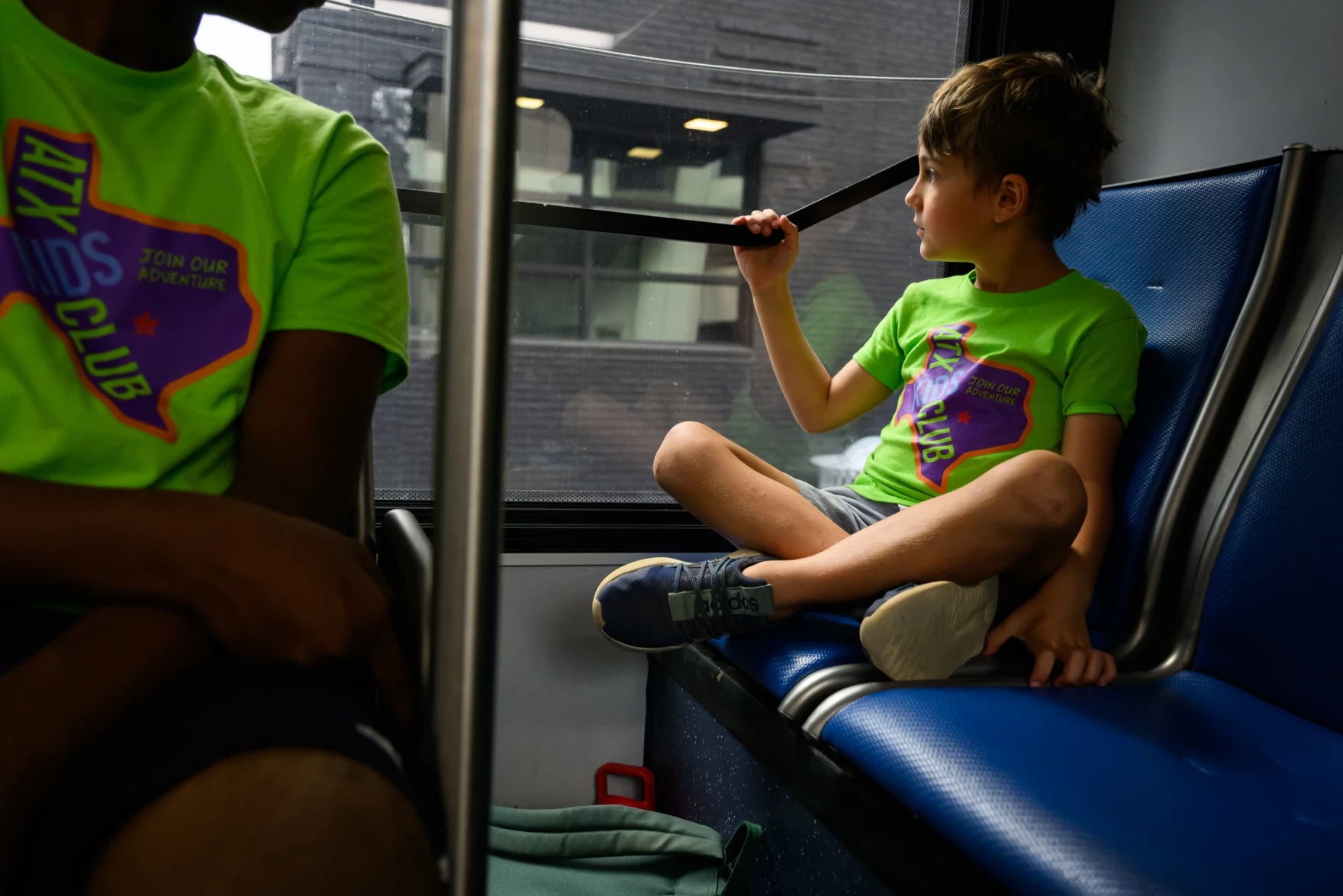
CapMetro provides more than 24 million rides per year, including to Jude, age 6, during the ATX Kids Club Summer Camp.
"Honestly, we thought and hoped that the technology would progress a little faster than it has," CapMetro CEO Dottie Watkins told KUT. "The biggest downside of a battery-electric bus today is its range."
Diesel buses can run from early in the morning until past midnight. A battery bus only runs about 8 to 10 hours before it needs to be recharged, creating tough logistical hurdles in scheduling routes.
An analysis by the Texas Transportation Institute (TTI) — a state-funded research agency at Texas A&M University — found battery-electric buses could only cover 36% of Capital Metro's bus schedules.
"If [the route] is too long, it won't make it," said John Overman, a research scientist with TTI. "You're going to have to charge them mid-route or wherever it is." Austin's hills drain batteries faster. So does trying to cool buses in the city's oppressive heat.

Karina Lujan / KUT News
Keeping buses cool in the Texas heat requires extra energy that drains bus batteries faster.
But range shortcomings are only part of the problem.
Data obtained by KUT through the Texas Public Information Act revealed CapMetro's battery-electric buses are far less reliable than their diesel counterparts. E-buses had mechanical failures on average every 1,623 miles over the last year — less than half the typical distance between failures for the fleet as a whole.

Mechanical problems, coupled with challenges in procuring parts and doing repairs, mean battery-electric buses are often unavailable for service. In 2022, almost 52% of e-buses were down, on average. In 2023, the number of vehicles out for repair improved slightly to an average of just under 50%.
"Getting the expertise up and being able to have those vehicles be as reliable as our old workhorse diesel buses have been is a challenge," Watkins said. "It's something that we are up to."
On top of range and reliability issues, both companies Capital Metro hired to build its battery-electric buses faced major financial challenges. Proterra and New Flyer blamed the problems on pandemic-related supply chain issues and inflation that drove up manufacturing costs after major contracts were signed.
One of the two bus builders didn't survive.
Proterra, a company from the San Francisco Bay area, went bankrupt last year and sold off the firm in pieces to pay back debtors. The new owner of Proterra's e-bus business — Anaheim, California-based Phoenix Motorcar — still has no battery provider or vehicle software ready to deploy, TTI's Overman said.
The other supplier — New Flyer — bled almost $300 million after the pandemic but appears to have staunched the wound. The Winnipeg, Canada company reported a smaller loss of $9 million in the first quarter of 2024 thanks to record-breaking order numbers.
CapMetro is operating 23 battery-electric buses among a fleet of 402 buses, not including commuter buses or shuttle buses. Another 87 e-buses already ordered are expected to be delivered by the end of the year. Some will replace aging diesel vehicles.
Once all the e-buses arrive, Watkins says, about a quarter of CapMetro's fleet will be battery-powered. The agency will then "sit for a minute while we wait for the battery technology to catch up."
"China is a leader in electric bus sales, and about a quarter of the bus fleet in China is electric today," said Elizabeth Connelly, a transportation electrification researcher at the Paris-based International Energy Agency. "So if Austin's reaching that same level, I think it's nothing to scoff at. I think it's pretty impressive."

Nathan Bernier / KUT News
Capital Metro has 23 battery-electric buses in the fleet with 87 more already on order and expected to arrive by the end of the year.
Santiago, Chile — considered a world leader in electric bus adoption — has 30% of its fleet running on batteries, Connelly said.
"Reaching the 100% level can be fairly tricky," she said. "It's not as easy as it seems."
New buses ordered by Capital Metro over the next two to three years will be hybrid diesel vehicles, which are electric buses powered by an on-board diesel generator. The transit agency also wants to use federal grants to buy a small number of hydrogen fuel cell buses, an even more cutting-edge and untested technology than battery-electric buses.
The hybrid and hydrogen vehicles would have a similar range to a diesel bus, Watkins said.
“This is it!” Clarke exclaimed to reporters. "We’re knocking down an old facility … to build the bus fleet facility of the future."

Mose Buchele / KUT News
Workers look on after a mattress factory was torn down in 2019 at the site of what is now a bus-charging facility in North Austin.
Later that day, the CapMetro board followed suit, authorizing the agency's largest electric bus purchase ever at the time: 10 vehicles from Proterra. Each bus cost more than a million dollars, almost twice as much as the diesel buses approved for purchase the same day.
"We're going to be able to save money, provide a better customer service and deal with climate change issues," Clarke pledged to the board. In 2022, Clarke left Austin to lead the transit system in the Washington, D.C. area.

Proterra / Capital Metro
This marketing image of a Proterra battery-electric bus was presented to CapMetro board members before they approved an $11 million contract for 10 buses and associated charging equipment in 2019.
Some were hesitant about betting big on emerging technology. Eric Stratton, a Williamson County representative then just four months into his tenure on the CapMetro board, wondered if Proterra would be able to stand by its relatively new product.
"So that five years in, six years in, eight years in, [if] things start happening, we've got the support behind it so we can continue to maintain it. Do you all feel comfortable this is the case?" Stratton grilled Watkins, then vice president in charge of bus services.
"Yes, that is indeed the case," said Watkins, enthusiastic about the future of electric propulsion. "Proterra's a very strong partner and I have no concerns at all that they won't be able to support the bus for the full life of the bus."
The board gave unanimous approval to the $11 million contract. But that was just the beginning.
In 2021, the board shoved its stack of chips on the table. Capital Metro would plop down up to $255 million for 197 electric buses. This time, the deal would be split between two manufacturers: Canada's New Flyer and Proterra, the politically connected California firm that hosted President Biden for a virtual tour earlier that year.
Long before CapMetro received all its electric buses, Proterra would be in a Delaware bankruptcy court chopping up the company and selling it off in pieces. Transit agencies across North America revealed private concerns in public court fillings, alleging the buses were mechanically unreliable, lost range in adverse weather and in rare cases would burst into flames.
Capital Metro admitted at the time of the bankruptcy proceedings that the shift to an all-electric fleet was hitting speed bumps.
"The reliability of electric buses no matter the manufacturer is less than a diesel bus. I'm not going to tell you they operate as well as diesel bus," CapMetro chief operating officer Andy Skabowski told KUT last December. "We're going to see some vehicles that are down a little bit longer than a diesel bus."

Nathan Bernier / KUT News
An overhead view of buses parked at CapMetro's North Ops facility on McNeil Drive north of U.S. 183.
While the shift to an all-electric fleet might be another Project Connect promise later revealed to be unrealistic — like the plans for a downtown subway system with underground shopping and dining — CapMetro has achieved other goals in the voter-approved transit expansion, even if some are running behind schedule.
A new CapMetro Rail station opened at Q2 Stadium, an additional set of rail tracks has been installed between Lakeline and Leander to allow for increased train frequency, more Pickup zones are being added and park and rides are under construction.
Michael Minasi / KUT News
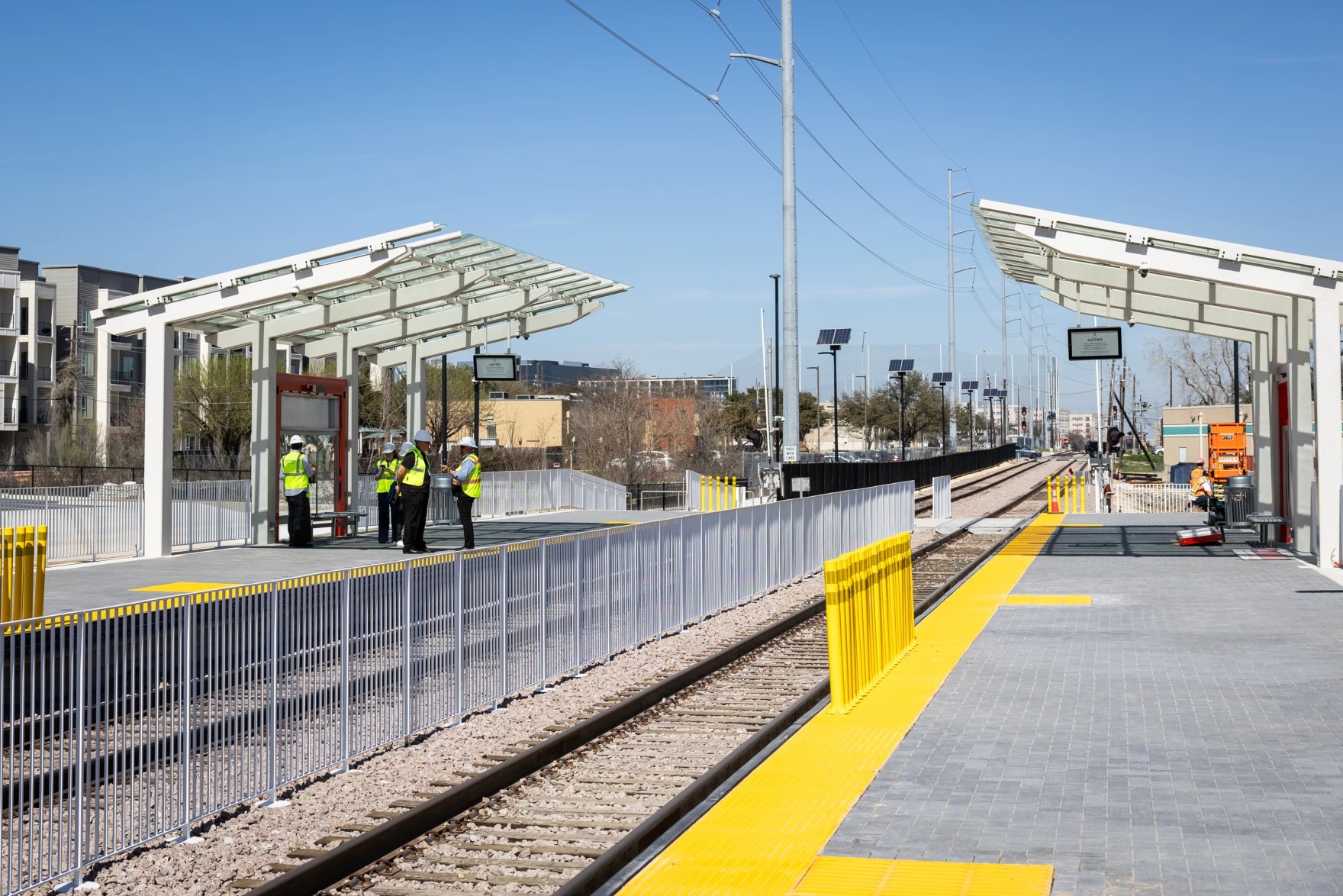
Construction workers putting the final touches McKalla Station at Q2 Stadium before it opened in February.
A pair of high-frequency bus lines — one from the Travis County Expo Center to downtown and another from southeast Austin to northeast Austin — are on track to begin operations in 2025, two years behind schedule.
Those CapMetro Rapid lines were promised to be run exclusively with electric buses. But end-of-line fast-chargers to top off bus batteries during the day might not be installed at park and rides in time for the routes to be all-electric on launch day.
"We likely are not going to wait until that infrastructure is complete, though, to put any service on those routes," Watkins said, but was unable to say when the new high-frequency routes would be run exclusively with e-buses.
Capital Metro now argues that having a reliable transit service, even with diesel buses, is better for the city and the environment than less reliable public transit with an all-electric fleet.
"If nobody wants to use the services, then we're not going to have a good system in which people will continue to use it, which gets other vehicles off the street," Stratton, the CapMetro board member, told KUT. "If that involves a stopgap measure to still ensure that we have the reliability on our system ... we're going to continue to do that now and into the future."
Source (Archive)
Published July 25, 2024 at 4:11 PM CDT
Nathan Bernier / KUT News
Capital Metro buses, both diesel and electric, parked at the transit agency's operations and maintenance center on McNeil Drive north of U.S. 183.
Capital Metro is slamming the brakes on an ambitious goal of transitioning to an all-electric bus fleet, citing problems with the range of battery-electric buses.
Austin voters were promised a transit system with exclusively electric vehicles when they authorized a tax increase in 2020 to fund Project Connect, the largest transit expansion in the city's history. Zero-emissions buses are quieter and don't blast hot exhaust in the faces of people on the sidewalk.
Manoo Sirivelu / KUT News
CapMetro provides more than 24 million rides per year, including to Jude, age 6, during the ATX Kids Club Summer Camp.
"Honestly, we thought and hoped that the technology would progress a little faster than it has," CapMetro CEO Dottie Watkins told KUT. "The biggest downside of a battery-electric bus today is its range."
Diesel buses can run from early in the morning until past midnight. A battery bus only runs about 8 to 10 hours before it needs to be recharged, creating tough logistical hurdles in scheduling routes.
An analysis by the Texas Transportation Institute (TTI) — a state-funded research agency at Texas A&M University — found battery-electric buses could only cover 36% of Capital Metro's bus schedules.
"If [the route] is too long, it won't make it," said John Overman, a research scientist with TTI. "You're going to have to charge them mid-route or wherever it is." Austin's hills drain batteries faster. So does trying to cool buses in the city's oppressive heat.
Karina Lujan / KUT News
Keeping buses cool in the Texas heat requires extra energy that drains bus batteries faster.
But range shortcomings are only part of the problem.
Data obtained by KUT through the Texas Public Information Act revealed CapMetro's battery-electric buses are far less reliable than their diesel counterparts. E-buses had mechanical failures on average every 1,623 miles over the last year — less than half the typical distance between failures for the fleet as a whole.
Mechanical problems, coupled with challenges in procuring parts and doing repairs, mean battery-electric buses are often unavailable for service. In 2022, almost 52% of e-buses were down, on average. In 2023, the number of vehicles out for repair improved slightly to an average of just under 50%.
"Getting the expertise up and being able to have those vehicles be as reliable as our old workhorse diesel buses have been is a challenge," Watkins said. "It's something that we are up to."
On top of range and reliability issues, both companies Capital Metro hired to build its battery-electric buses faced major financial challenges. Proterra and New Flyer blamed the problems on pandemic-related supply chain issues and inflation that drove up manufacturing costs after major contracts were signed.
One of the two bus builders didn't survive.
Proterra, a company from the San Francisco Bay area, went bankrupt last year and sold off the firm in pieces to pay back debtors. The new owner of Proterra's e-bus business — Anaheim, California-based Phoenix Motorcar — still has no battery provider or vehicle software ready to deploy, TTI's Overman said.
The other supplier — New Flyer — bled almost $300 million after the pandemic but appears to have staunched the wound. The Winnipeg, Canada company reported a smaller loss of $9 million in the first quarter of 2024 thanks to record-breaking order numbers.
CapMetro is operating 23 battery-electric buses among a fleet of 402 buses, not including commuter buses or shuttle buses. Another 87 e-buses already ordered are expected to be delivered by the end of the year. Some will replace aging diesel vehicles.
Once all the e-buses arrive, Watkins says, about a quarter of CapMetro's fleet will be battery-powered. The agency will then "sit for a minute while we wait for the battery technology to catch up."
'Not as easy as it seems'
By most measures, CapMetro is a leader in the shift to an all-electric fleet. With 25% electric buses, the transit agency's adoption rate would exceed that of countries with far more political and financial support for zero-emissions vehicles like Belgium, Norway and Switzerland."China is a leader in electric bus sales, and about a quarter of the bus fleet in China is electric today," said Elizabeth Connelly, a transportation electrification researcher at the Paris-based International Energy Agency. "So if Austin's reaching that same level, I think it's nothing to scoff at. I think it's pretty impressive."
Nathan Bernier / KUT News
Capital Metro has 23 battery-electric buses in the fleet with 87 more already on order and expected to arrive by the end of the year.
Santiago, Chile — considered a world leader in electric bus adoption — has 30% of its fleet running on batteries, Connelly said.
"Reaching the 100% level can be fairly tricky," she said. "It's not as easy as it seems."
New buses ordered by Capital Metro over the next two to three years will be hybrid diesel vehicles, which are electric buses powered by an on-board diesel generator. The transit agency also wants to use federal grants to buy a small number of hydrogen fuel cell buses, an even more cutting-edge and untested technology than battery-electric buses.
The hybrid and hydrogen vehicles would have a similar range to a diesel bus, Watkins said.
A big bet on young technology
Capital Metro announced the shift to an all-electric fleet in 2018 under then-CEO Randy Clarke. The next year, Clarke invited TV cameras to watch a demolition crew smash down an old mattress factory to make way for a bus charging yard in North Austin.“This is it!” Clarke exclaimed to reporters. "We’re knocking down an old facility … to build the bus fleet facility of the future."
Mose Buchele / KUT News
Workers look on after a mattress factory was torn down in 2019 at the site of what is now a bus-charging facility in North Austin.
Later that day, the CapMetro board followed suit, authorizing the agency's largest electric bus purchase ever at the time: 10 vehicles from Proterra. Each bus cost more than a million dollars, almost twice as much as the diesel buses approved for purchase the same day.
"We're going to be able to save money, provide a better customer service and deal with climate change issues," Clarke pledged to the board. In 2022, Clarke left Austin to lead the transit system in the Washington, D.C. area.
Proterra / Capital Metro
This marketing image of a Proterra battery-electric bus was presented to CapMetro board members before they approved an $11 million contract for 10 buses and associated charging equipment in 2019.
Some were hesitant about betting big on emerging technology. Eric Stratton, a Williamson County representative then just four months into his tenure on the CapMetro board, wondered if Proterra would be able to stand by its relatively new product.
"So that five years in, six years in, eight years in, [if] things start happening, we've got the support behind it so we can continue to maintain it. Do you all feel comfortable this is the case?" Stratton grilled Watkins, then vice president in charge of bus services.
"Yes, that is indeed the case," said Watkins, enthusiastic about the future of electric propulsion. "Proterra's a very strong partner and I have no concerns at all that they won't be able to support the bus for the full life of the bus."
The board gave unanimous approval to the $11 million contract. But that was just the beginning.
In 2021, the board shoved its stack of chips on the table. Capital Metro would plop down up to $255 million for 197 electric buses. This time, the deal would be split between two manufacturers: Canada's New Flyer and Proterra, the politically connected California firm that hosted President Biden for a virtual tour earlier that year.
Long before CapMetro received all its electric buses, Proterra would be in a Delaware bankruptcy court chopping up the company and selling it off in pieces. Transit agencies across North America revealed private concerns in public court fillings, alleging the buses were mechanically unreliable, lost range in adverse weather and in rare cases would burst into flames.
Capital Metro admitted at the time of the bankruptcy proceedings that the shift to an all-electric fleet was hitting speed bumps.
"The reliability of electric buses no matter the manufacturer is less than a diesel bus. I'm not going to tell you they operate as well as diesel bus," CapMetro chief operating officer Andy Skabowski told KUT last December. "We're going to see some vehicles that are down a little bit longer than a diesel bus."
Back to the future
Nathan Bernier / KUT News
An overhead view of buses parked at CapMetro's North Ops facility on McNeil Drive north of U.S. 183.
While the shift to an all-electric fleet might be another Project Connect promise later revealed to be unrealistic — like the plans for a downtown subway system with underground shopping and dining — CapMetro has achieved other goals in the voter-approved transit expansion, even if some are running behind schedule.
A new CapMetro Rail station opened at Q2 Stadium, an additional set of rail tracks has been installed between Lakeline and Leander to allow for increased train frequency, more Pickup zones are being added and park and rides are under construction.
Michael Minasi / KUT News
Construction workers putting the final touches McKalla Station at Q2 Stadium before it opened in February.
A pair of high-frequency bus lines — one from the Travis County Expo Center to downtown and another from southeast Austin to northeast Austin — are on track to begin operations in 2025, two years behind schedule.
Those CapMetro Rapid lines were promised to be run exclusively with electric buses. But end-of-line fast-chargers to top off bus batteries during the day might not be installed at park and rides in time for the routes to be all-electric on launch day.
"We likely are not going to wait until that infrastructure is complete, though, to put any service on those routes," Watkins said, but was unable to say when the new high-frequency routes would be run exclusively with e-buses.
Capital Metro now argues that having a reliable transit service, even with diesel buses, is better for the city and the environment than less reliable public transit with an all-electric fleet.
"If nobody wants to use the services, then we're not going to have a good system in which people will continue to use it, which gets other vehicles off the street," Stratton, the CapMetro board member, told KUT. "If that involves a stopgap measure to still ensure that we have the reliability on our system ... we're going to continue to do that now and into the future."
Source (Archive)


