- Joined
- Mar 24, 2021
@Aero the Alcoholic Bat inspired me to being the process of assembling this. That said, a few hours in I have page 1/19 completed and have a 12 page 5,500 word document to show for it. In the interest of getting input before I put in all of this work, and holding myself accountable by needing to deliver here I will be copying my progress here. It is an extremely enlightening and compelling read in my opinion. Given I am primarily aiming to make one sharable document with the full archive, I am going to attach that file and then copy+paste its contents here. I will fix some formatting for posts here but I've done about 95% of the work to sort this out already, keep that in mind if you have complaints about the remaining 5%. I am not arrogant enough to ask or appeal for assistance in transcribing this archive. That said, I will be working forward chronologically (i.e. starting work on thread page 2 after posting this). Pulling the text hidden by spoilers via inspect element is fairly straightforward if anyone chooses to transcribe portions of this.
Edit:
Also a major thank you to @Twix Eatr for completing this archiving where I failed to not be a lazy bastard.
Foreword
This transcript is originally sourced from the URL https://archive.ph/AJNMS which is an archive of the now defunct Salo-Forum.com. More specifically the thread ‘Patient Zero’ and the early days of HIV/AIDs by user “Niccolo and Donkey” (archived between 2017 and 2020). Original URL https://salo-forum.com/index.php?threads/patient-zero-and-the-early-days-of-hiv-aids.3167/ As presently preserved online, several technical bugs make reading the complete thread tedious and this archivist feels it is vital that ready access to this information be created. This is assembled free of charge for archiving and critique purposes, this archivist not only allows but strongly encourages the copying, re-use, modification, distribution, etc. of this work. While they cannot maintain this stance and impose limitations, they would implore anyone who does use this work to consider likewise freely licensing their own creation. Information’s value pays dividends as it is shared.
Formatting Notes
The primary issue making the online archive tedious is that the “spoilers” cannot be expanded as they normally should, and you must inspect elements to read the full text. The contents of these spoilers will appear just like this otherwise unformatted text. When a Salo Forum user has their own commentary, it will be transcribed in italics as this text is here. This archivist will try to indicate the user for each comment, in any case where it is not included it is safe to assume the commentary was authored by user Niccolo and Donkey. If an abbreviated name will be used, the user’s full name will be used first with the abbreviation appearing in parentheses afterwards. For example Niccolo and Donkey (ND) would further be referenced by ND as indicated here. >Archivist comments will be bracketed like so< Media will be included as thumbnails/scaled down images in the main text with full copies compiled at the end of this document. Preceding the media collection will be a collection of any URLs referenced as well as the page number where they appear in the archive. URLs will be cited in the main text as-archived. Known to be dead sites will be marked with an asterisks* and any found archives will be listed in the URL collection. (EDIT: Archive.ph is uncooperative with newest links, adding full PDF for reference to this post)
Page One url: https://archive.ph/AJNMS
Edit:
Archive of ‘Patient Zero' and the early days of HIV/AIDS Thread
Foreword
This transcript is originally sourced from the URL https://archive.ph/AJNMS which is an archive of the now defunct Salo-Forum.com. More specifically the thread ‘Patient Zero’ and the early days of HIV/AIDs by user “Niccolo and Donkey” (archived between 2017 and 2020). Original URL https://salo-forum.com/index.php?threads/patient-zero-and-the-early-days-of-hiv-aids.3167/ As presently preserved online, several technical bugs make reading the complete thread tedious and this archivist feels it is vital that ready access to this information be created. This is assembled free of charge for archiving and critique purposes, this archivist not only allows but strongly encourages the copying, re-use, modification, distribution, etc. of this work. While they cannot maintain this stance and impose limitations, they would implore anyone who does use this work to consider likewise freely licensing their own creation. Information’s value pays dividends as it is shared.
Formatting Notes
The primary issue making the online archive tedious is that the “spoilers” cannot be expanded as they normally should, and you must inspect elements to read the full text. The contents of these spoilers will appear just like this otherwise unformatted text. When a Salo Forum user has their own commentary, it will be transcribed in italics as this text is here. This archivist will try to indicate the user for each comment, in any case where it is not included it is safe to assume the commentary was authored by user Niccolo and Donkey. If an abbreviated name will be used, the user’s full name will be used first with the abbreviation appearing in parentheses afterwards. For example Niccolo and Donkey (ND) would further be referenced by ND as indicated here. >Archivist comments will be bracketed like so< Media will be included as thumbnails/scaled down images in the main text with full copies compiled at the end of this document. Preceding the media collection will be a collection of any URLs referenced as well as the page number where they appear in the archive. URLs will be cited in the main text as-archived. Known to be dead sites will be marked with an asterisks* and any found archives will be listed in the URL collection. (EDIT: Archive.ph is uncooperative with newest links, adding full PDF for reference to this post)
Page One url: https://archive.ph/AJNMS
Niccolo and Donkey (ND): I've been spending some time researching some history in respect to California during the 1960s and 1970s and it has taken me through events like the Counterculture, Occultism, cults like the Manson Family and Jim Jones' Peoples Temple, the proliferation of serial killers during that time, and the exploding population of homosexuals in San Francisco and the role they played in spreading HIV.
This led me back to a very popular figure in AIDS history, Quebecois flight attendant Gaetan Dugas aka "Patient Zero". Dugas was a very, very promiscuous homosexual who was showing symptoms of what would be later labelled as HIV/AIDS before the virus was discovered and even before they knew it was a virus or even sexually transmitted. He was having sex in bathhouses and other venues in places like New York City, Los Angeles, San Francisco, Vancouver, and Toronto. The CDC in Atlanta interviewed him and a cluster study was done in which he was found to be in the middle of a cluster of 40 of the first 260 diagnosed cases in the USA. (He told them that he first became active in 1972 and had 2,500 sexual partners by that point). These 40 gays were guys who either had sex with Dugas or were someone who had sex with someone else who had sex with Dugas. This cluster study helped prove at the CDC that the disease was sexually transmitted. The CDC continued to fly Dugas down to Atlanta for questioning and observation but they never publicly admitted that Dugas was their "Patient Zero" as per institutional policy in respect to confidentiality.
Dugas as "Patient Zero" appeared first in Randy Shilts' massive book "And the Band Played On" which documented the spread of the disease and the work done to start the fight against it as well as the bureaucratic hurdles that were in the way. Shilts claimed that he received a leaked copy of the cluster study naming Dugas. He then was pressured by his publisher to pump up the Patient Zero story to sex up the book so that it would sell more, which in retrospect was a successful strategy.
Dugas, of course, wasn't the individual who brought HIV to North America as many media outlets said when the book came out in 1987, but the belief that he did continues to be widely held.
Up until two weeks ago, all we had from Dugas were a few photos and the characterization of him in both Shilts' book and HBO movie based on it from 1993.
On July 10th, a Vancouver AIDS group released a video in which Gaetan Dugas can be seen asking very tough questions to a panel of AIDS activists and experts when this group launched in 1983. The group felt that his questions were simply unanswerable and very demoralizing.
This 13 minute video contains never before seen video footage of Gaetan Dugas which begins with a brief intro about him by his physician at the 5:45 mark.
As one of the first open cases in Vancouver (and Toronto), he would become subject to bouts of shunning at gay bars in those cities as word spread that he carried the disease (which was yet to be named and was still being referred to as "Gay Cancer" or "GRIDS").
Hyperlink, text: Patient Zero Speaks in Never Before Seen Footage, url: http://www.hivplusmag.com/case-studies/activism/2013/07/10/patient-zero-speaks-never-seen-footage OR https://archive.ph/qYpxG
As part of The 30 30 Campaign, which celebrates the organization's 30th anniversary, AIDS Vancouver released unseen footage of Gaëtan Dugas, commonly known as "Patient Zero" of the HIV/AIDS epidemic.
The footage shows Dugas speaking at the first AIDS Information Forum in March 1984 at Vancouver’s Westend Community Centre, asking difficult questions of some of the world’s top experts sitting on the forum’s panel. "So you shouldn't fear someone who has AIDS, or have symptoms of AIDS," Dugas says in the video, leading up to a question on AIDS testing at the time. "It seems like there's kind of a [fear] towards those people here."
“This never before seen footage provides us with a snapshot into the life of one of the most talked-about figures in the early days of the epidemic,” said Dr. Brian Chittock, the executive director of AIDS Vancouver. “For many, the name Gaetan Dugas embodies the start of HIV/AIDS – yet most have never heard his story.”
Noah Stewart, a founding member of AIDS Vancouver, also questions the origins of the "Patient Zero" theory and popular views of Dugas’s life within the video. Dugas has never been definitively pinpointed as the first North American with AIDS by the scientific community, but he gained notoriety as such in San Francisco Chronicle reporter Randy Shilts’s notorious book, “And the Band Played On: Politics, People, and the AIDS Epidemic".
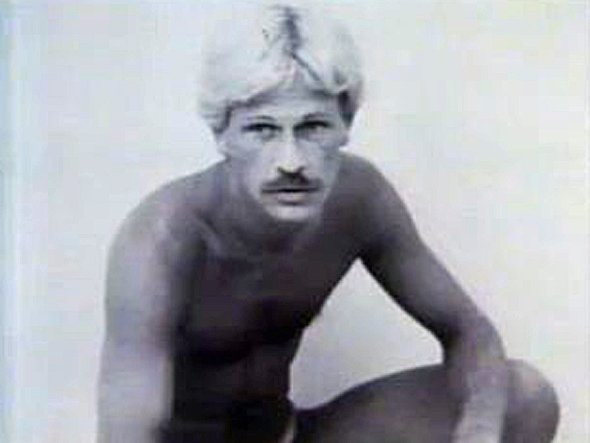
Some of the photos of Gaetan Dugas that have been available for some time:




Mike: >quoting ND<”I've been spending some time researching some history in respect to California during the 1960s and 1970s and it has taken me through events like the Counterculture, Occultism, cults like the Manson Family and Jim Jones' Peoples Temple, the proliferation of serial killers during that time, and the exploding population of homosexuals in San Francisco and the role they played in spreading HIV.”
Apparently California in the decades after the second world war has been a nexus of greater weirdness than I have taken notice of. I look forward to more threads on these topics.
>quoting ND<”"So you shouldn't fear someone who has AIDS, or have symptoms of AIDS," Dugas says in the video, leading up to a question on AIDS testing at the time. "It seems like there's kind of a [fear] towards those people here."”
It didn't take long for this active homosexual practitioner to take offense to being shunned for having a deadly infectious disease. It's hard to find the words to describe the arrogance of this filthy pervert figuratively wagging his finger at the very medical professionals trying their best to warn the homosexual "community" and to control the new epidemic. His attitude reinforces the idea sometimes bandied about that homosexuality is about narcissistic self-absorption at some deep level. Like many sodomite degenerates, he exhibits a callousness about the world and the fate of those to whom he has spread disease that is as repulsive and reprehensible as the filthy sexual habits themselves.
Here are some snippets from an article entitled Hyperlink, Text: Patient Zero, url: https://www.chicagotribune.com/ct-xpm-1987-11-01-8703230166-story.html*in the Chicago Tribune.
Dugas developed Kaposi's sarcoma, a form of skin cancer common to AIDS victims, in June 1980, before the epidemic had been perceived by physicians. Told later he was endangering anyone he slept with, Dugas unrepentantly carried on -- by his estimate, with 250 partners a year -- until his death in March 1984, adding countless direct and indirect victims.
After the examination, as Dugas was pulling on his stylish shirt, Conant mentioned that Dugas should stop having sex.
Dugas looked wounded, but his voice betrayed a fierce edge of bitterness. ``Of course, I`m going to have sex,`` he told Conant
``Nobody`s proven to me that you can spread cancer
``Somebody gave this thing to me,`` he said. ``I`m not going to give up sex.”
He had decided to settle in San Francisco. They had an interferon program at their GRID clinic, and besides, he had always wanted to live there.
It was at this time that rumors began on Castro Street in San Francisco about a strange guy at the Eighth and Howard bathhouse, a blond with a French accent. He would have sex with you, then turn up the lights in the cubicle, and point out his Kaposi`s sarcoma legions.
``I`ve got gay cancer,`` he`d say. ``I`m going to die, and so are you.``
Mind you, this freak is apparently considered some sort of hero or martyr to the homosexual movement. (The 30 30 AIDS Vancouver video is dedicated to him and one other person who croaked from AIDS.) In the end, all that these people care about is sodomy. They should not be considered a normal and responsible segment of civilized society.
ND >indicating this is in response to Mike<: I'm combing through the Hyperlink, text: Oral History the AIDS Epidemic in San Francisco, url: http://content.cdlib.org/view?docId...60&toc.depth=1&toc.id=d0e801&brand=calisphere, which is a great read. I just came across this quote from Dr. Selma Dritz who worked for City Public Health and who was key in the early days in helping to figure out what was going on in the gay community there.
Hughes- How did you weigh the pluses and minuses of the health hazard versus the civil liberties issues?
Dritz- We were always behind the eight ball. We were always chasing after a good answer, a good way to do it. But if we found that the actions of infected patients were hazardous to their [sexual] contacts, and we had told them what not to do and showed them why they shouldn't and they were still doing it, then I tried to creak down. You couldn't put them in jail, because you couldn't prove what they had transmitted. And you don't do that. But we got at them any way that we could. We could threaten then, "We'll tell your friends that you're infected." We didn't do it. But once in a while, we had to use a little body punch just to keep them from killing somebody else.
ND: Hyperlink, text: Dritz on Dugas:, url: https://oac.cdlib.org/view?docId=kt...92&toc.depth=1&toc.id=d0e801&brand=calisphere
Gaetan Dugas and the Cluster Study
Hughes- Well, maybe this is the time to introduce Gaetan Dugas, patient zero?<br>
Dritz- Well, he wasn't really patient zero. He was the first one from whom we could more or less prove that it was a transmissible disease. Bill Darrow and Dave Auerbach from CDC were doing interviews in California on patients with AIDS. This was when we were still doing our large questionnaire and trying to find out, is AIDS a transmissible disease, or is it some chemical in the environment?
In their interviews, the CDC asked patients, "Well, whom did you have sexual contact with?" And have them name them. This was before confidentiality became a red flag, and justifiably, perhaps. You have to be politically correct here.
Hughes- Which comes hard, doesn't it?
Dritz- No, not really, but I have to be conscious of it.
So they kept asking about contacts from patients they were interviewing. Several in southern California mentioned that one of their contacts, among many, was this handsome Canadian air steward. They didn't get the name. After maybe thirty or forty interviews, they kept hearing something about a Canadian air steward. And then finally, one man they were interviewing pulled out his appointment book. He said, "Yes, there was this Canadian air steward, and he was here just on Thanksgiving--oh, wait a minute, I think I have his name in my book." And he pulled out the name. "Gaetan Dugas, that's his name."
Now, Dave Auerbach and Bill Darrow had heard the name Gaetan Dugas a long time ago from Linda Laubenstein in New York. She was a cancer specialist there and Dugas saw her for a small purple KS lesion then. Doctors will mention patients' names to each other when they won't use the names in public. It was an unusual name, and they both remembered it. Dave and Bill went back and found that the other two who had mentioned the Canadian steward said, "Oh, yes, that's probably his name." After that, by talking to people who had slept with Gaetan Dugas, or who had slept with somebody who had slept with Gaetan Dugas, they were able to put together what they called their cluster study. I think Gaetan had direct sexual contact with about forty out of two hundred and something, and the others had had contact--second and third degree contact--with him.
So he was the first one for whom they were able to say, "Well, this man we know had AIDS. And these people slept with him"--or whatever they did with him--"and they also have AIDS." They were able to put together a connection. This looked now very, very suspiciously like something being transmitted from Gaetan Dugas to others.
Hughes- When did this happen?
Dritz- It would have been in '82.
Hughes- Before Art Ammann's baby?
Dritz- Yes, that was before, because Art Ammann's baby then was the next nail in the coffin. (I shouldn't talk that way!)
Hughes- Please finish with Dugas, because you had some more dealings with him before he died.
Dritz- Bill Darrow and Dave Auerbach came back up to my office from southern California to talk to me, because I had a whole list of contacts listed on my blackboard there. You've seen pictures of that. Bill came in and he said, "Well, I've got a name now and a contact. Do you know any of these?" And he gave me Gaetan Dugas' name, and I had that name already. I showed him Gaetan Dugas had contact with Michael Maletta, a hairdresser from New York, and there was Dan Turk, who had a clothing store on Polk Street, and one or two other names. I would have to look back at the slides now to be sure. We're talking about almost ten years ago now. And they're dead now.
I knew that Gaetan Dugas was still in town. I couldn't get to him, but I put word out, "If you see Gaetan Dugas, let him know I want to see him." He came up. I told him, "Look, we've got proof now." I didn't tell him how scientifically accurate the information was. It wasn't inaccurate, but it wasn't actually scientifically proven. I said, "We've got proof that you've been infecting these other people. You've got AIDS, you know. We know it's transmissible now, because you're transmitting it." He was the active partner in all this gay business, anal-genital sex. "You've just got to cut it out."
"Don't be silly, I won't cut it out. It's my life. I'll do what I want." I said, "Yes, but you're infecting other people." "I got it. Let them get it." I said, "You've got to cut it out!" "Screw you." He walked out. I never saw him again. It was a pity, because he was apparently an intelligent man, except on this one point. And he was very, very sexually active. He was a presumptive proof that AIDS was something transmissible from an infected person directly to the uninfected person.
Hughes- You mentioned your diagrams of transmission. Was he the first that reinforced the idea of a transmissible agent?
Dritz- I had a lot [of indication] that it looked like AIDS could be transmissible. There was all this contact among these men, and they all had the disease, one kind or another. On the other hand, all of these men were having other contacts, too, and we didn't know then that the incubation period was a long number of years in some cases.
Hughes- Right. And they were maybe using the same poppers or—
Dritz- Whatever, yes. And we didn't have the answer on the poppers yet, because CDC was still waiting for money for a statistician to run the computer analysis on the questionnaire. So the problem then was to test the rest of our theories about transmission, and that didn't happen until the end of '82.
ND: More from Dr. Selma Dritz................
Hyperlink, text: Taking a few steps back, url: http://content.cdlib.org/view?docId...25&toc.depth=1&toc.id=d0e801&brand=calisphere OR https://archive.ph/WLFVU
Hughes- I know the surface and core antibody tests are different, but aren't they testing for the same problem?
Dritz- No, because the surface antibody may disappear. The core antibody doesn't. Now, if the surface antigen has disappeared, you test for that, and the blood seems all right. The core antibody is still there and can be infectious. And we didn't have a test for that until just about that time [early 1983]. The test for hepatitis C has just become available. Until recently, we couldn't test for it. And so we still had transfusion-mediated hepatitis being reported into the city. Although we tested for A and we tested for B, this was hepatitis C, formerly called non-A, non-B, for obvious reason. Now we can test for that, too, so there won't be any more transfusion-mediated hepatitis due to the C agent. There may be a D; we don't know yet.
The New York and the San Francisco blood banks decided they would try to see whether there was a difference in the hepatitis B core antibody in gay versus heterosexual or in high-risk versus apparently low-risk populations. Of course, the apparently low-risk gay population were already heavily infected, too. Not every one, but the numbers were going up, and we didn't--couldn't--know it.
>ND’s bolding< In '78, there were already 4 percent infected. When we went back retroactively and tested the bloods of the hepatitis B vaccine trials, 4 percent of them were already HIV positive. We didn't even know there was such a thing as AIDS then. By '84, 60 percent to 70 percent of a gay population was infected. Now, the general population of males in the city, by the time I retired [1984], was less than 1 percent infected. But among the gays, it was about 3 percent with AIDS. I retired in '84; the test wasn't licensed until March of '85. After they were tested, they found maybe 3 percent of them were sick with AIDS, or presumptively getting the symptoms, but over 60 percent of them were incubating it.
ND: >Indicated as in response to Grimsrud, but Grimsrud only comments in this thread after this post. Possibly meant as a way to share this thread between users.<
Please note the argument revolving around 'individual rights' and what damage resulted from it.
Hyperlink, text: Dr. Selma Dritz on the Bathhouses:, url: https://oac.cdlib.org/view?docId=kt...3&toc.depth=1&toc.id=d0e1963&brand=calisphere OR https://archive.ph/WeSwL
The Bathhouses
Dritz- Well, number one was the baths, because we knew that was the main source of AIDS transmission. A gay man could pick up one or two partners in a bar, and they'd go off someplace to have their fun. There were back rooms in the bars, in the baths, too. They were called orgy rooms, where ten, fifteen, twenty, thirty, forty men were dancing around with almost no light, and of course, anything happened there. That explained to us why a gay man would say, "I don't know who I got it from. I never saw his face." That sort of thing.
The bars were not the best places to be, but at least, they would limit the amount of contact a man could have. In a bookshop, in a small sex club, out in the park--these places limited the contact. But in the baths... At a four-story bathhouse, Club Baths south of Market I think it was, 350 men would gather on a Saturday night at $10 a crack, and they got their $10 worth. And more. Including drugs in addition to poppers.
Would you permit a child with measles to go to school with a classroom of thirty other children? No! It's a transmissible disease. You exclude him, and if the whole room has been exposed, then you close that classroom--you discontinue that class and send the kids home. There was quarantine for these diseases at one time. In Africa, if one or two patients came up with smallpox, you isolated the village, and you vaccinated everybody. So after the smallpox was finished with that patient or those two patients, it had no place else to go.
We didn't have a vaccine for AIDS. We had the disease spreading wildly. We knew that the numbers were going up geometrically in those first two years. The numbers of new cases were doubling every six months. It was terrible.
Hughes- But times had changed. Society was putting much more emphasis on individual rights, particularly for minorities such as the gay population. It was no longer as acceptable for a government agency to do what some factions regarded as removing individual rights.
Dritz- That's right. It was not only civil rights and individual rights, but the federal government was also saying, "We have too much government now. Let's concentrate on the threat from the Evil Empire overseas." This epidemic was going to wipe us out, and they didn't even care about it.
Any physician who has any sympathy or sense of responsibility toward his patients, to the population, toward his own family, would say, "You don't waste money up in the sky on nuclear weapons against a theoretical threat, when you have the threat right here, right now, killing you, just as deadly as a bomb." Central Africa now we know is going to be wiped out by AIDS just as if they threw a couple of atom bombs in there.
The emphasis was not so much on civil rights as on fear in the gay community that if they were "outed," made known that they were gay, that they would lose jobs, friends, a place to sleep, insurance. All of these things made them resist closing the baths, because their incognito activities in a closed environment in the baths kept them from being known on the outside. >ND’s bolding< Now, there were gay men who were aggressively out, the S& M, sadomasochist, men, the leather boys we called them, who walked up and down Market Street dressed in leathers with leather caps like the old Nazi men, and chains, and leather boots. But they were the ones that died fastest, because generally speaking, they used the most traumatic anal-rectal techniques, and got infected. They had been infected with many other sexually transmitted diseases before then, so they were in no shape even to postpone the activation of the AIDS virus after it hit them.
I can talk about the meeting we had when Dr. Silverman was about to announce that he was going to close the baths, then he didn't, because the mayor and he couldn't get together on it. I wasn't in on that session between the two of them, though, so I can't give you all the details.
Many members from the gay community were at that meeting. Bobbi Campbell, who was already infected with AIDS, was standing at the back. I remember at least three members of the gay community, nude, just with towels around them, holding signs that said, "Today the baths; tomorrow the ovens." They meant that, if we let you close the baths on us, next thing you'll quarantine us, then we'll be in jail, then you'll destroy us, like a Hitler. It was very, very extreme.
Now, through Rick Andrews and Bob Bolan, we could perhaps get through to some of the other members of the medical community dealing with AIDS patients, so that they could all put out the message in comparable terms to their different patients, "Don't do this risky sex practice." But of course, if the men were patients, they were already sick.
Hughes- It was too late.
Dritz- We had to reach those that weren't infected yet. We didn't know that by '83, or even late '82, we already had about 10, 12 percent of the gay community infected. We didn't find that out until we ran the hepatitis B follow-up study later, with Winkelstein's report.
So we were working partly in the dark. We were shedding as much light as we could on the people we were trying to reach. Marc Conant was backing us on trying to close the baths, because he saw from his own patients at UCSF and what he heard from the gay community that too many things were going on that simply would spread the thing beyond anything that we'd ever seen. Well, the Black Death, the plague in the Middle Ages, wiped out one-third of European population over a period of a couple of years. This epidemic eventually is going to wipe out that much of the general as well as gay population unless we can get a vaccine for it and medical treatment.
Grimsrud: >Responding to ND’s mention< Hilarious to look back on these predictions of an AIDS epidemic amongst normal people. I wonder how many of the doctors and activists waving their arms around about this actually believed it to be a likely scenario.
ND: Hyperlink, text: Dr. Selma Dritz on dealing with Gay Politics:, url: https://oac.cdlib.org/view?docId=kt...42&toc.depth=1&toc.id=d0e801&brand=calisphere OR
Gay Issues
Hughes- Did the issue hang upon homophobia?
Dritz- To a very great degree, yes--homophobia and a fear of death. A woman was afraid that the man next door who gave her dog the bone from his steak might have given her dog AIDS because he was gay, she thought. Because if the dog got AIDS, [she thought] the dog could give it to her. That isn't only homophobia; that is fear of death. I'm not laughing at these people. They didn't know whether the disease was transmissible or not, or how you got it. We were pretty sure we knew how, but then we were doctors; we were trained for it. And trying to put it out into the press, into the media, over the radio as we did, it still didn't register.
We hear some politician during the election campaign, and we tell ourselves, "Oh, that's just politics. I don't believe it." And that's how some of the people in the city here, the heterosexual community, felt about the AIDS epidemic. Remember, there were so many gays in the city, they were so visible, and some of the men were so outrageously gay--the gay parade, for instance, with its transvestites and so on--that it turned off an awful lot of the heterosexual community that wouldn't have been too bothered by the presence of gays if there hadn't been so many and they hadn't been so aggressively "out."
Yet, the gays were being aggressive because they felt so threatened, by the disease and by the increased homophobia which was a result of the disease. The publicity about it just stirred everything up impossibly. City Hall was right in the center of it, and City Hall depended on votes. Of the little over 300,000 voters in the city, about 120,000--100,000 let us say--were gay voters. The other 200,000 were splintered among the different communities--the Asians, the blacks, the East Asians, the Hispanics, the Italians, all the other ethnic groups--the city is a conglomeration of villages. Now, they wouldn't all vote as a bloc, so the 200,000 votes were scattered. On anything that threatened the gay lifestyle, 100,000 would vote as a bloc, so City Hall had to be very, very careful. When some of the more vocal parts of the gay community were saying all the time, "Civil rights, civil rights, confidentiality," City Hall had to listen. And that hampered us at the health department.
Harry Britt, the gay supervisor, was very, very cooperative with us. He tried to help. He interpreted for us what the feeling of the gay community was. Yet he himself was only one of one group. The gays were splintered in other ways. Some of them were very vocal. Some of them were very quiet. There was a whole group of closeted gays, the upper-class gays, that we didn't hear from too much. There was the Alice B. Toklas Club; there was the Stonewall Club; there was the Harvey Milk Club; there were some of the unincorporated groups; there were the S&Ms (sadomasochists); there were the Gay Bath Owners Association of Northern California; there was the Tavern Guild, which was an association of gay bar owners and managers. All of these groups had their own agendas, and some of them could get together and some couldn't.
>ND’s bolding< Unfortunately for us, like the Moral Majority, there were fundamentalist-type gays in the gay community, too, who were very vocal, very reactionary, very entrenched for their own benefit.</b> You couldn't blame them for this, but it didn't help anybody. So it was a mess.
Links and Misc.ND: Some quackery which is bound to happen any time an epidemic breaks out.
Stuart Anderson and Vitamin C
Dritz- Did I tell you about Stuart Anderson and the vitamin C problem?
Hughes- Why don't you mention it now?
Dritz- In the gay community, there were some people--I don't think they were organized in a group--who simply felt that the medical community was so homophobic that we were just pretending to treat them but were actually letting them die because we didn't want any gays to survive. One policeman who came into my office said, "Oh, hell, they're a big problem. I think we ought to take a flame thrower and just clean out the Castro (gay center in San Francisco)." A policeman in uniform! On the other hand, there were other policemen who would give mouth-to-mouth resuscitation without thinking twice, because that was their job.
Anyhow, some of the gays felt that the doctors, the health department, the community didn't want to do anything except kill the gays. As a matter of fact, some of them claimed we had introduced AIDS in order to wipe them out. I don't know how we would have done it; we didn't know what the cause was yet.
Linus Pauling announced that 30,000 units of vitamin C every day would keep you alive-prevent you from catching colds or anything else. I don't know if he said it treats cancer, but it was just about that. He's a very, very famous, very, very marvelous mind, but I think he went off the deep end on that.
Stuart Anderson, an aggressive gay, then came in to my office and said, "We're going to use vitamin C." He was walking up and down Castro Street telling the gays, "Don't go back to those doctors. They're trying to kill you. They only want to kill you. You've got to have vitamin C." He was using 30,000 units. He got quite a number of the gays to leave their doctors and go on vitamin C. Of course, they died--a pity--and he died a year later, too.
But there was that kind of resistance, which was a corollary of the confidentiality resistance, so in several different ways, we were hampered in trying to get complete cooperation in the gay community. A lot of them believed us, did what we thought would help them, and cooperated in bringing us information. Without their cooperation, we would have been blind to developments.
But at the same time, there were aspects that hampered us and maybe helped to contribute to the spread of the disease. I know the baths did. End Forum Page One
- https://salo-forum.com/index.php?threads/patient-zero-and-the-early-days-of-hiv-aids.3167/ OR https://archive.ph/AJNMS Primary Source, Thread Page One
- http://3030.aidsvancouver.org/1984/ Page two, dead at time of archive. Archive.PH has not archived this page. Archive.org June 15, 2021 URL live as of May 12, 2022: https://web.archive.org/web/20210615030515/http://3030.aidsvancouver.org/1984/
- https://www.chicagotribune.com/ct-xpm-1987-11-01-8703230166-story.html Page 3 dead at time of archive. Archive.PH has not archived this page. Archive.org February 12, 2019 URL live as of May 12, 2022: https://web.archive.org/web/2019021.../news/ct-xpm-1987-11-01-8703230166-story.html
- http://content.cdlib.org/view?docId...60&toc.depth=1&toc.id=d0e801&brand=calisphere OR https://archive.ph/9PN4R Page 4
- https://oac.cdlib.org/view?docId=kt...92&toc.depth=1&toc.id=d0e801&brand=calisphere OR https://archive.ph/nQOCY Page 4
- http://content.cdlib.org/view?docId...25&toc.depth=1&toc.id=d0e801&brand=calisphere OR https://archive.ph/WLFVU Page 6
- https://oac.cdlib.org/view?docId=kt...3&toc.depth=1&toc.id=d0e1963&brand=calisphere OR https://archive.ph/WeSwL Page 6
- https://oac.cdlib.org/view?docId=kt...42&toc.depth=1&toc.id=d0e801&brand=calisphere OR https://archive.ph/yNAtk Page 8
Attachments
Last edited: